
The restructuring option that seems most protective at first may not serve the company’s long-term interests. When cash-flow pressure, creditor action or incomplete records limit decision-making, choosing corporate restructuring insolvency lawyers Singapore businesses can rely on takes more than familiarity with legal procedure. Counsel must connect available pathways to the company’s commercial objectives and stakeholder exposure. Early strategic advice can clarify which options may remain viable and what information is needed to assess them.
It is understandable to feel uncertain when restructuring, insolvency and disputes intersect, especially when creditors, counterparties or overseas interests have competing priorities. This guide explains key Singapore pathways, including schemes of arrangement, judicial management, the Simplified Insolvency Programme and winding up. It then sets out how to assess counsel by mandate fit, relevant experience, stakeholder perspective and communication. You will also find a practical list of financial, corporate and creditor information to organise before an initial strategic discussion.
Key Takeaways
- Distinguish temporary liquidity pressure from deeper financial or operational distress before weighing possible next steps.
- Compare consensual workouts, court-supervised restructuring, judicial management and winding up by their effects on control, creditor engagement and business continuity.
- Assess corporate restructuring insolvency lawyers Singapore businesses may instruct on their ability to align legal process with commercial objectives and stakeholder risks.
- Prepare a focused briefing with immediate deadlines, operational pressures, financial information, creditor schedules, security documents, key contracts and relevant correspondence.
- Consider how restructuring advice can address contested claims, commercial disputes and cross-border interests alongside the formal process.
When should a business consider restructuring and insolvency lawyers in Singapore?
Financial distress can quickly affect more than the balance sheet. It may disrupt operations, weaken creditor confidence and narrow the options available to a business. A short-term cash-flow gap can arise even where the underlying business is viable, while persistent losses, excessive liabilities or operational problems may signal deeper pressure. These situations call for different assessments, so distressed company legal advice in Singapore can help decision-makers understand the choices before they become more limited.
Restructuring is a coordinated attempt to address financial difficulty while preserving viable value. It may require looking at cash needs, liabilities, creditor engagement and business continuity together, rather than treating each missed payment as a separate issue. Advice from corporate restructuring insolvency lawyers Singapore businesses instruct can help clarify the legal and commercial questions raised by the facts, without assuming that formal insolvency proceedings are necessary.
Several warning signs arising together warrant careful review:
- Missed payments to lenders, suppliers, employees or other counterparties, or difficulty meeting obligations as they fall due.
- Creditor demands becoming more frequent or formal, or threatened enforcement.
- Concern that the business may not meet financing covenants or other contractual requirements.
- Disputed debts, guarantees or claims that could affect liabilities or creditor relationships.
These indicators do not, by themselves, determine the right legal pathway. An initial assessment should bring together current cash-flow information, upcoming payment dates, the basis of disputed claims and the operational consequences of enforcement. That gives decision-makers a firmer basis for assessing urgency, stakeholder exposure and practical objectives.
Which stakeholders may need restructuring or insolvency advice?
Directors may need advice on their decision-making responsibilities and the risks of continued trading as financial conditions deteriorate. Creditors often focus on recovery prospects, reliable information, security and whether coordinated action could protect their position. Investors and shareholders may be concerned about preserving value, retaining control, potential dilution and the effect of competing stakeholder interests on their rights. Because these priorities can diverge, a strategy should account for who is affected and how.
When does a commercial dispute become part of a distress strategy?
A contested debt, guarantee, shareholder conflict or enforcement step can affect the company’s immediate cash position and influence how creditors assess a restructuring proposal. Consider dispute strategy alongside liquidity, business continuity and the consequences for other stakeholders, rather than in isolation. Where a dispute materially affects the company’s options, the commercial litigation business guide offers related context on assessing contentious issues within a wider commercial matter.
Which Singapore restructuring and insolvency pathways should counsel assess?
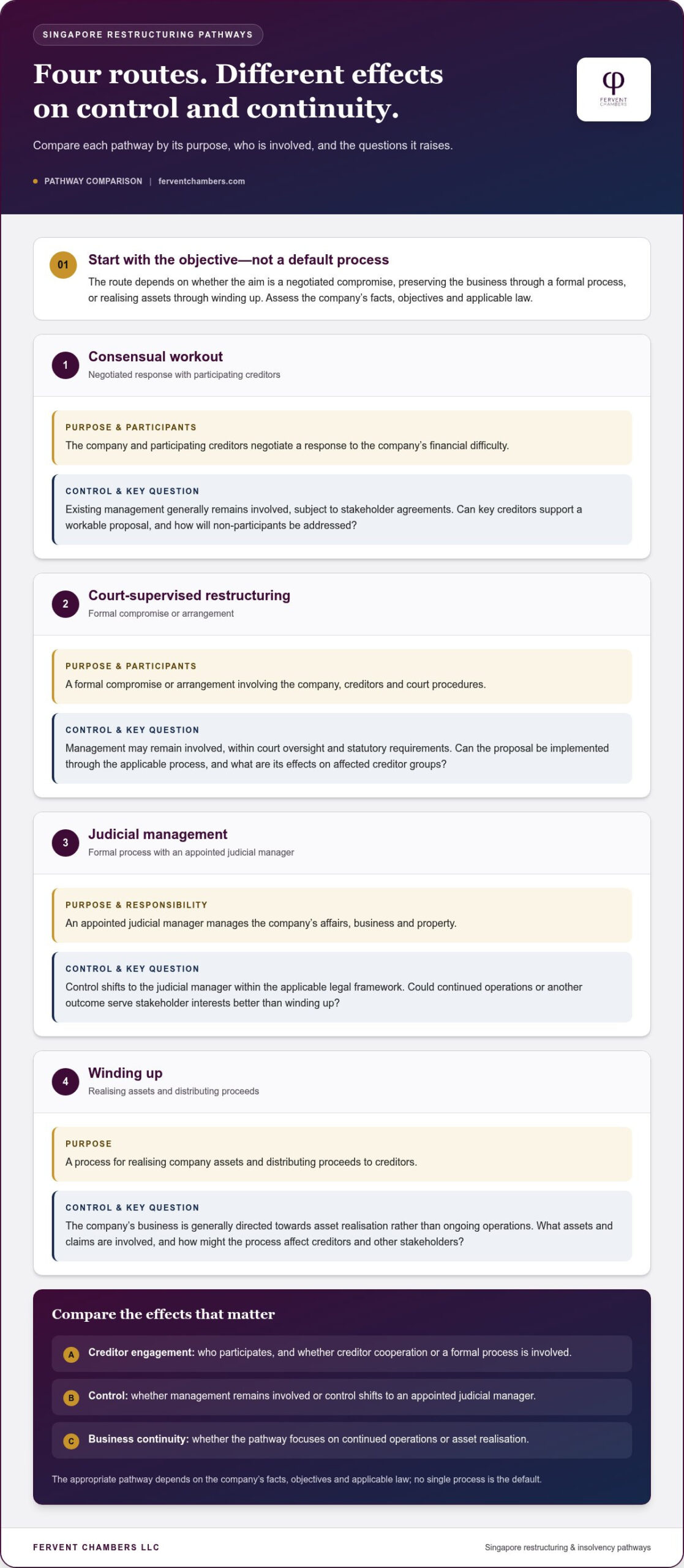
The route depends on whether the objective is to reach a negotiated compromise, preserve the business through a formal process or realise assets through winding up. Each option affects participation, control and business continuity. The appropriate pathway depends on the company’s facts, objectives and applicable law. Corporate restructuring insolvency lawyers Singapore businesses instruct can assess these factors together rather than treating any one process as the default.
| Pathway | Purpose and likely participants | Control considerations | Key questions |
|---|---|---|---|
| Consensual workout | A negotiated response involving the company and participating creditors. | Existing management generally remains involved, subject to stakeholder agreements. | Can key creditors support a workable proposal, and how will non-participants be addressed? |
| Court-supervised restructuring | A formal compromise or arrangement involving the company, creditors and court procedures. | Management may remain involved, but the process operates within court oversight and statutory requirements. | Can the proposal be implemented through the applicable process, and what are its effects on affected creditor groups? |
| Judicial management | A formal process in which an appointed judicial manager manages the company’s affairs, business and property. | Control shifts to the judicial manager within the applicable legal framework. | Could continued operations or another outcome serve stakeholder interests better than winding up? |
| Winding up | A process for realising company assets and distributing proceeds to creditors. | The company’s business is generally directed towards asset realisation rather than ongoing operations. | What assets and claims are involved, and how might the process affect creditors and other stakeholders? |
How do consensual workouts and court-supervised restructuring differ?
A consensual workout depends on creditor cooperation and a commercial proposal that participants consider viable. It can allow flexibility, but disagreement may stall progress. A court-supervised restructuring follows formal procedures and judicial oversight, providing a structured setting for a compromise while also imposing procedural requirements. Singapore’s framework continues to be considered for development, as described in the Ministry of Law’s recommendations on Singapore’s corporate restructuring and insolvency regime. Neither route is always faster, less costly or more effective. Feasibility depends on the company’s circumstances and the stakeholders involved.
When might insolvency proceedings or cross-border issues change the analysis?
When assets, creditors or contracts span jurisdictions, counsel may need to consider asset location, creditor composition, governing law and related proceedings. A Singapore process does not automatically determine how another jurisdiction will treat its effects, so recognition and coordination questions can shape strategy. If arbitration intersects with a restructuring dispute, the international arbitration business decision guide offers context on assessing that process alongside wider commercial objectives.
Companies and stakeholders weighing these routes can consider Fervent Chambers’ restructuring and insolvency advice in light of the matter’s commercial and procedural context.
How should you compare corporate restructuring and insolvency lawyers in Singapore?
Instructing counsel does not, by itself, commit a company to a formal insolvency process. Early advice can help decision-makers understand the available options, preserve room for negotiation and identify what information is needed before choosing a course. When comparing corporate restructuring insolvency lawyers Singapore, consider whether the adviser can connect legal procedure to the client’s role, commercial objectives and stakeholder exposure.
Broad claims of expertise are only a starting point. Look for experience relevant to the actual mandate, such as restructuring negotiations, insolvency proceedings or disputes over debts, guarantees and shareholder rights. If the matter involves arbitration, litigation, corporate advice or cross-border coordination, assess whether counsel can explain how those issues affect the restructuring analysis. Relevant examples should make the adviser’s role and the issues addressed clear without disclosing confidential client information.
What experience and strategic capabilities matter for this mandate?
Look for procedural knowledge paired with commercial analysis. Counsel should be able to explain available routes, material risks, dependencies and alternatives in terms decision-makers can use. A creditor seeking recovery may need a different analysis from a company seeking to preserve operations. A contested claim may require dispute experience alongside restructuring knowledge. If overseas assets or proceedings are involved, ask how recognition and coordination questions would be assessed.
Cross-border capability matters when a Singapore restructuring intersects with foreign insolvency proceedings. Harvard Law School’s analysis of Singaporean insolvencies illustrates why international dimensions can form part of the legal assessment. Recognition or effect in another jurisdiction depends on the relevant law and circumstances.
How can you assess communication, conflicts, and commercial alignment?
Effective communication is clear, appropriately qualified and directed to the people responsible for decisions. Consider whether advice distinguishes established facts from assumptions, flags decisions needing prompt attention and explains who must provide instructions. Clarify the proposed scope, reporting arrangements and division of responsibilities, particularly if the company’s board, management, lenders or investors are involved in the same matter.
Potential conflicts also deserve attention when counsel may be asked to advise parties with differing interests. Understand the relevant relationships, proposed client identity and boundaries of the mandate before work begins. Clear scope and reporting arrangements provide a practical basis for comparing advisers without relying on broad assurances or fee estimates.
A decision matrix can focus the comparison on the client’s priorities:
- Debtor company: assess restructuring options, creditor engagement, business continuity and related disputes.
- Creditor: assess recovery strategy, security considerations, information needs and coordinated action.
- Director: assess decision-making risks, procedural options and responsibilities as circumstances evolve.
- Investor or shareholder: assess potential effects on value, control, dilution and competing stakeholder interests.
The strongest fit is not necessarily the adviser with the broadest claims. It is counsel whose experience, analysis and communication match the mandate and the client’s position.
What information should you prepare before instructing restructuring counsel?
Start with urgency, not document volume. Identify immediate deadlines and operational pressures, then assemble the financial, creditor and corporate records that explain the company’s position. Complete, organised records help counsel assess options and dependencies more efficiently. They also make it easier to separate confirmed information from estimates, unresolved claims and matters requiring further investigation.
Use a short sequence to keep the initial briefing focused:
- List urgent events. Record payment dates, creditor demands, enforcement steps, covenant concerns, contractual deadlines and scheduled court, arbitration or negotiation milestones.
- Summarise current operations. Note pressures affecting trading, such as supply interruptions, staffing constraints, critical customer obligations or services that cannot readily be paused.
- Assemble core financial records. Gather recent management accounts, cash-flow forecasts, borrowing documents and current creditor schedules. Separate known figures from provisional estimates.
- Map the parties and connections. Identify directors, shareholders, lenders, major creditors, related entities and any assets, counterparties or proceedings connected with another jurisdiction.
Which documents and facts support an initial assessment?
Organise records by subject and date so counsel can trace the company’s position and identify gaps. Include available security documents, guarantees and key contracts, along with correspondence explaining disputed liabilities or creditor negotiations. A short index describing each item and its relevance can be more useful than an unlabelled collection of files.
- Financial records, forecasts, borrowing documents and creditor schedules, with overdue or disputed amounts clearly identified.
- Security information, guarantees and documents relating to assets pledged or otherwise relevant to creditor claims.
- Key customer, supplier, financing and other contracts, particularly provisions or dates that may affect continued operations.
- Notices, demands, enforcement communications, litigation documents and arbitration materials, including upcoming procedural or contractual milestones.
- Information on subsidiaries, related entities, overseas assets, foreign creditors and proceedings in other jurisdictions.
What should decision-makers clarify before giving instructions?
State the immediate commercial objective as clearly as possible. The priority may be continuity of operations, time to negotiate, recovery from a creditor’s perspective or an orderly exit. Identifying it helps counsel frame advice around the client’s role rather than assume a single preferred outcome. Clarify who can instruct counsel and who must approve consequential decisions, especially if directors, investors or lenders have differing interests.
Preserve relevant business records, including financial data, contracts and communications. Do not alter or selectively delete material. If records are incomplete, explain what is missing and why. Clear disclosure of uncertainties helps counsel assess dependencies and identify further information that may be needed. Businesses preparing to discuss a restructuring or insolvency matter can consult Fervent Chambers on their legal position with these priorities and records in view.
How Fervent Chambers supports restructuring and insolvency matters in Singapore
Restructuring decisions rarely involve only one legal process. They may affect financing arrangements, contractual performance, disputed claims and the interests of directors, creditors, shareholders or investors. Fervent Chambers LLC advises on restructuring and insolvency as part of a broader practice that includes corporate and commercial matters, dispute resolution and arbitration. This wider perspective can matter when a proposed course of action must account for commercial objectives and contentious issues involving stakeholders or counterparties.
The advice needed depends on the client’s position and the circumstances. A company seeking to preserve viable operations may have different priorities from a creditor considering recovery or an investor assessing the effects of restructuring on value and control. Advice can address the relevant stakeholder position, commercial objective and procedural context, focusing on the issues that may shape available choices. No process or result should be assumed in advance.
How does integrated disputes and restructuring experience support complex matters?
Contested claims, arbitration and commercial litigation can affect how a restructuring is assessed. A disputed liability, for example, may influence negotiations, while enforcement or a contractual disagreement may affect business continuity or creditor engagement. Considering these issues alongside corporate and insolvency questions helps decision-makers understand how the legal strands interact, rather than treating a dispute as separate from the company’s wider financial position. The approach depends on the matter.
Fervent Chambers’ cross-border experience may be relevant when a matter involves overseas counterparties, assets or proceedings. Its sector experience includes construction, oil and gas, shipping, technology, clean energy and hospitality. The firm acts for clients ranging from startups to listed multinational corporations. These contexts help frame the questions counsel may need to consider, but do not predetermine strategy or guarantee an outcome. For companies and stakeholders seeking corporate restructuring insolvency lawyers Singapore, relevant experience is most useful when applied to the facts, risks and objectives of the particular mandate.
What is a practical next step for a company or stakeholder?
Before a focused discussion, prepare a concise account of your role, immediate objectives, urgent events and principal stakeholder concerns. Identify the decisions requiring attention, the commercial outcome you want to preserve or achieve, and any claims, negotiations or proceedings that may affect your options. This framing makes the legal discussion more purposeful without requiring every issue to be resolved beforehand.
Fervent Chambers can discuss the strategic and legal dimensions of a restructuring or insolvency matter in light of its commercial and dispute context. Discuss your restructuring or insolvency matter with Fervent Chambers.
Take the next step with a clear strategic mandate
Before committing to a course of action, identify which decisions cannot be deferred, which remain open to negotiation and what consequences each may carry for the business and its stakeholders. This distinction helps leadership set a focused agenda for legal advice, preserve room to act and keep commercial priorities in view as the situation develops. The right corporate restructuring insolvency lawyers Singapore can help turn that mandate into a considered assessment of legal pathways and related risks.
Fervent Chambers brings restructuring and insolvency advice together with commercial and dispute-resolution perspectives, so the discussion can address the legal issues shaping the matter. A focused conversation can begin with your objectives and the decisions requiring attention, without presuming a particular outcome.
Discuss your restructuring or insolvency matter with Fervent Chambers and take a measured step towards informed decisions.
Frequently Asked Questions
When should a company speak to corporate restructuring and insolvency lawyers in Singapore?
A company should seek legal advice when financial pressure begins to affect its ability to meet commitments or respond to creditor action. Early guidance from corporate restructuring insolvency lawyers Singapore can help the board understand the company’s position before urgent decisions are made. Advice may be timely if a lender signals possible enforcement, a key supplier threatens to stop deliveries or management cannot reconcile competing claims against the company.
Can a company restructure its debts without entering insolvency proceedings?
Yes. A company may seek a consensual arrangement with some or all of its creditors without starting a formal insolvency process, provided the relevant parties agree to the terms. For example, a lender might agree to revised payment dates while the company negotiates separately with suppliers. Discussions do not bind creditors who have not agreed, so the company should understand which parties need to participate and what may happen if negotiations fail.
What is the difference between a scheme of arrangement and judicial management in Singapore?
A scheme of arrangement Singapore companies may pursue is a court-supervised process through which a company proposes a compromise or arrangement to creditors. In judicial management, an appointed judicial manager manages the company’s affairs, business and property. The key practical difference is control: under a scheme, the company generally develops the proposal within the applicable process; under judicial management, the appointed manager takes charge within the legal framework. Suitability depends on the circumstances and current law.
Can creditors apply to wind up a company in Singapore?
Yes. A creditor may apply to the court to wind up a company where the applicable legal grounds and procedural requirements are met. A creditor considering this step should assess the basis of the debt, supporting records, the company’s response and the likely effect of proceedings on recovery. A company receiving a winding-up demand or application should treat it as urgent, preserve relevant documents and obtain advice on its response and available options.
What documents should I prepare before meeting restructuring counsel?
Prepare current financial information, a schedule of creditors and amounts claimed, loan and security documents, guarantees, and contracts that materially affect operations. Include recent creditor correspondence, demands, court or arbitration papers, and enforcement notices. A short chronology can help explain how the position developed. If a document is missing or a figure is disputed, identify that clearly rather than presenting an estimate as settled fact.
Do Singapore restructuring lawyers advise both companies and creditors?
Restructuring and insolvency counsel may advise a company, creditor or other stakeholder, depending on the engagement and any applicable conflict considerations. Clarify the client’s identity and objectives from the outset: a company seeking continued operations and a lender assessing recovery may have different interests. Fervent Chambers advises on restructuring, insolvency and related commercial disputes, with the scope shaped by the particular mandate.
How do cross-border assets or creditors affect a Singapore restructuring?
Cross-border connections can raise questions about which laws govern particular obligations, where assets are located and how proceedings or restructuring measures may be treated in another jurisdiction. An overseas creditor, for example, may rely on a contract governed by foreign law, or company assets may be held outside Singapore. Recognition and coordination are not automatic, so the analysis should account for the relevant jurisdictions, documents and concurrent proceedings.
Does contacting restructuring counsel mean the company must enter insolvency?
No. Seeking advice gives decision-makers an opportunity to assess the company’s position and understand possible legal and commercial responses; it does not itself commence an insolvency process. Counsel may help examine negotiations, contractual exposure or other available routes before a course is chosen. The discussion can also identify urgent risks and information gaps, helping directors make informed decisions without assuming formal proceedings are inevitable.