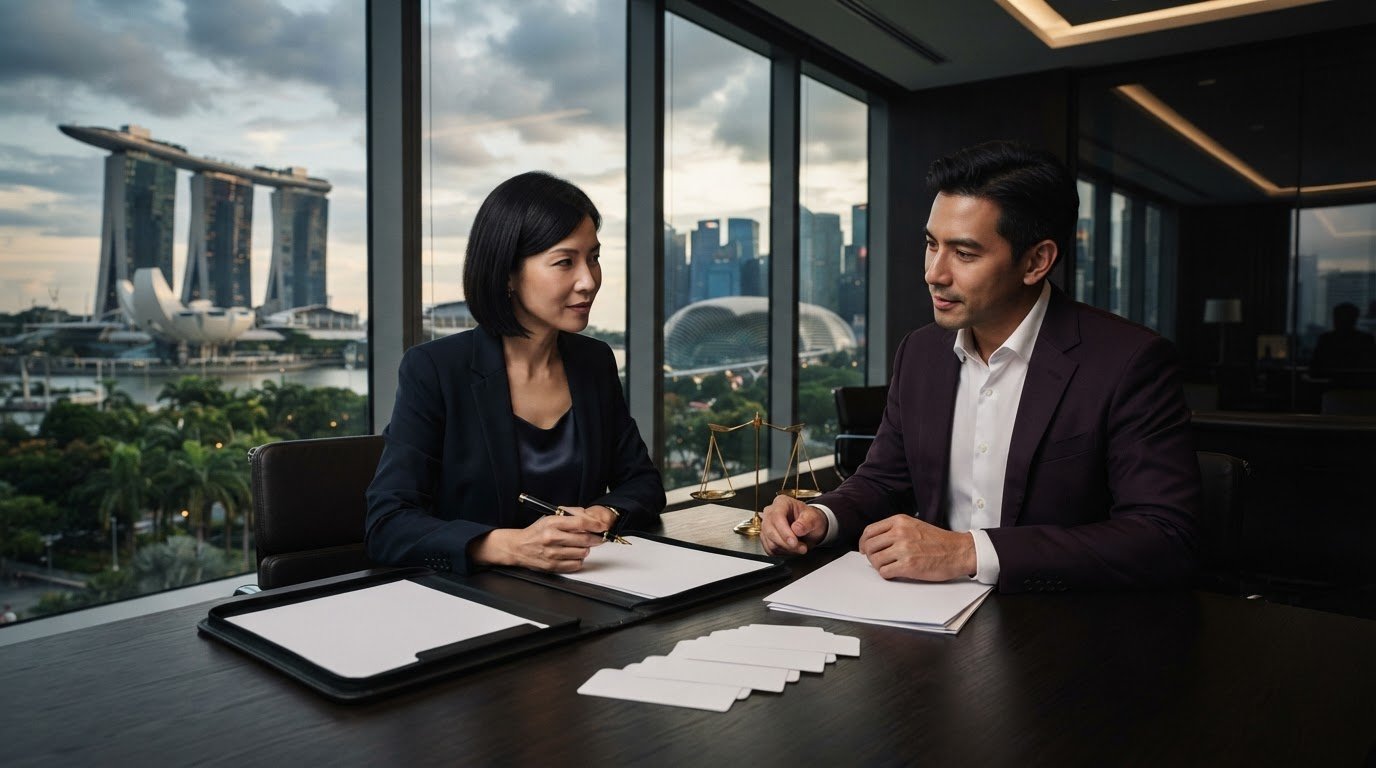
What if the best response to a commercial dispute is not to rush into court, but to protect your position while keeping practical options open? Businesses searching for a commercial litigation lawyer Singapore can rely on often face that decision when management time, commercial relationships and ongoing operations are at stake.
It is understandable to be unsure whether a disagreement calls for litigation, arbitration or another resolution route. In Singapore, parties are required to consider amicable resolution before commencing court action. The right course depends on the dispute, the available evidence, any relevant contract terms and the outcome your business needs.
This guide explains what a commercial litigation lawyer does, when to seek advice and how a commercial dispute may proceed in Singapore. It also covers how to assess counsel’s relevant experience, strategic approach and communication, and how to protect records and preserve options while limiting disruption to the business.
Key Takeaways
- Recognise when disputed contractual duties, shareholder tensions or contested commercial claims may call for legal advice, before decisions narrow your options.
- A commercial litigation lawyer Singapore businesses engage should connect procedural choices to evidence, available remedies and the commercial outcome sought.
- Understand the broad stages of a Singapore dispute, while accounting for how the claim, contract terms and court directions can affect the process.
- Compare counsel by relevant dispute and sector experience, strategic reasoning and the clarity of their advice on risks and alternatives.
- Prepare a concise chronology and core documents, and preserve relevant records so your business can make informed decisions with less disruption.
When a Commercial Litigation Lawyer in Singapore Can Help Your Business
A commercial litigation lawyer advises or represents parties in business disputes, helping them assess legal rights, evidence, remedies and next steps. The work is not limited to court proceedings. A commercial litigation lawyer Singapore businesses consult may also help evaluate whether negotiation, mediation or arbitration is more suitable, depending on the dispute, the contract and the parties’ objectives.
Disputed contractual obligations, shareholder conflicts and contested commercial claims can threaten more than a company’s legal position. A disagreement over delivery, payment or performance may interrupt operations. A shareholder dispute may affect decision-making, while a claim involving business assets or a key counterparty may put continuity or reputation at risk. Alongside the legal merits, consider what outcome is achievable, what resources the dispute may require and whether a successful claim could be recovered from the other party.
Which business disputes may require litigation advice?
Advice may be useful when a supplier disputes its obligations under an agreement, shareholders disagree over control or company decisions, or parties contest ownership or use of a commercial asset. A breakdown in a significant business relationship can also raise questions about contractual rights and available remedies. The underlying facts, agreement terms, counterparties and desired outcome all influence the appropriate route.
That route may involve negotiation, mediation, court litigation or arbitration. Arbitration may be relevant where an agreement provides for it. Court proceedings may be considered where the circumstances and remedies sought make that course appropriate. Singapore’s court structure includes the Supreme Court and State Courts; the Judicial system of Singapore provides a general overview. For more focused guidance, consult dedicated guides on shareholder disputes and commercial contract breaches.
When should a business seek legal advice?
Consider obtaining advice if you receive a formal demand, face a threat of proceedings or become aware of an urgent concern involving assets or records. Early assessment can help identify relevant documents, clarify strengths and uncertainties, and preserve options before communications or business decisions make them harder to manage. It can also help leadership weigh potential disruption to operations and commercial relationships against the remedies being pursued.
Early legal assessment helps you understand and preserve your options; it does not mean you must litigate. The right strategy may involve negotiation, mediation, arbitration or court action. The appropriate choice depends on the evidence, relevant agreements, commercial priorities and realistic prospects of obtaining the remedy sought.
How Commercial Litigation Proceeds Through Singapore’s Dispute Framework
Commercial litigation involves a sequence of decisions, not simply a hearing in court. For civil proceedings commenced on or after 1 April 2022, Singapore’s Rules of Court 2021 provide the procedural framework. The court manages cases in accordance with the rules and the circumstances of each matter. The precise steps depend on the claim, applicable rules, chosen court, dispute-resolution terms in the contract and directions made during the case.
What happens before and after proceedings begin?
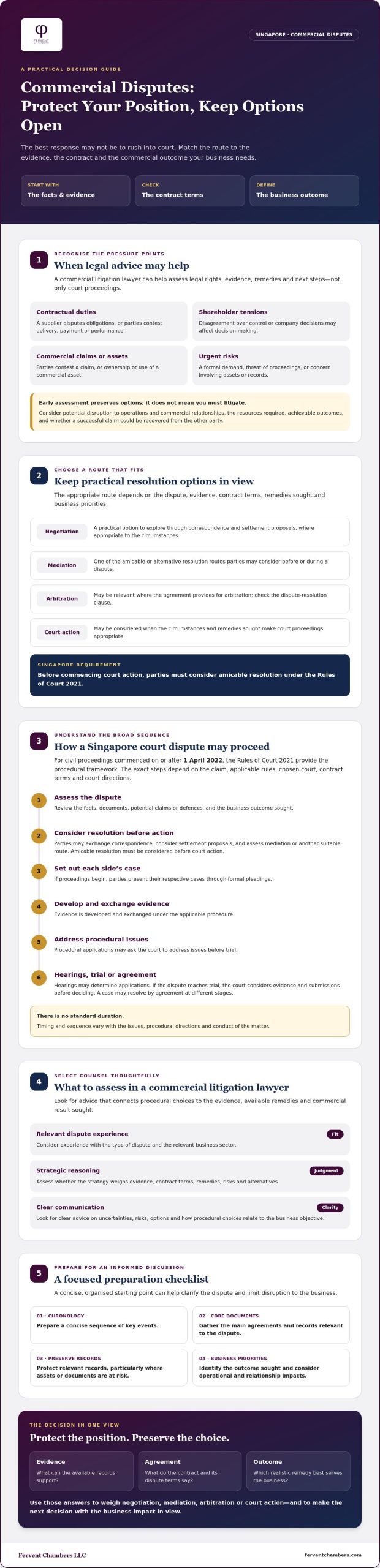
The process typically starts with an assessment of the facts, documents, potential claims or defences, and the business outcome sought. Parties may exchange correspondence, consider settlement proposals and assess whether mediation or another resolution route is appropriate. Before commencing court action, parties must consider amicable resolution under the Rules of Court 2021. The appropriate steps depend on the circumstances.
If proceedings begin, the parties set out their respective cases through formal pleadings. Evidence is then developed and exchanged under the applicable procedure. Procedural applications may address issues that need the court’s attention before trial. Hearings may determine specific applications or, if the dispute proceeds to trial, allow the court to consider evidence and submissions before reaching a decision. A case may resolve by agreement at different stages. There is no standard duration: timing and sequence vary with the issues, procedural directions and conduct of the matter.
How does the choice of forum affect strategy?
A contract’s dispute-resolution clause may direct the parties to arbitration rather than court proceedings, so review it before filing a claim. Court litigation takes place within Singapore’s court system, including the Supreme Court and State Courts. The appropriate forum depends on applicable jurisdictional rules and the case’s circumstances, not simply on a party’s preference.
International arbitration is a distinct process conducted before an arbitral tribunal. The agreement and applicable rules shape its procedure. For certain international commercial disputes, the Singapore International Commercial Court (SICC), a division of the High Court, may be relevant. Its jurisdiction and suitability require case-specific assessment. Forum selection can affect procedure, confidentiality considerations, enforceability and the demands placed on business personnel. Review the agreement and commercial priorities early.
A commercial litigation lawyer Singapore businesses consult can help assess the procedural route alongside the evidence, remedies and operational consequences. If your organisation is considering a dispute response, review Fervent Chambers’ dispute resolution services as part of that assessment.
How to Assess a Commercial Litigation Lawyer in Singapore
Selecting counsel for a significant dispute involves more than confirming that a lawyer handles litigation. Advice should address legal issues and business consequences together: the evidence available, remedies worth pursuing, management time, operational continuity and the effect on commercial relationships. Experience with similar disputes and familiarity with your sector can help counsel identify which facts and business constraints deserve close attention.
A commercial litigation lawyer Singapore businesses consider should explain the reasoning behind a proposed strategy, identify material uncertainties and address realistic alternatives. No lawyer can guarantee a particular result. A responsible assessment distinguishes what the evidence may support from what remains uncertain, and explains how that uncertainty affects decisions.
Which questions reveal whether counsel fits the dispute?
Use the initial discussion to test the substance and clarity of the proposed approach. Ask how the lawyer would assess the central issues, what evidence is needed, where the current record has gaps and which resolution routes may be available. Clarify who will manage the matter, how updates will be provided and how significant decisions or developments will be escalated to your leadership team.
Compare answers by their relevance to your dispute and their candour about risks, not by confidence alone. Useful advice connects legal analysis to the remedies sought and your organisation’s priorities. It should also make clear what further information could change the assessment.
How should businesses evaluate fees and proportionality?
Ask whether the proposed engagement uses hourly billing, a matter-based retainer or fees connected to defined stages of work. Clarify what the scope covers, how additional work or material changes in the dispute will be addressed, and how the firm will report work undertaken and monitor spending. Representation may involve hourly rates or matter-based retainers. Confirm the appropriate arrangement for your engagement in writing.
Assess legal fees against the agreed scope, the dispute’s complexity and developments that may change the work required. If factual or procedural demands expand, the work plan may need to change. Agree how that will be discussed before it affects the work. Proportionality also means considering whether proposed steps remain aligned with the practical value of the remedy and the business resources needed to pursue it.
Counsel should be able to explain how the case may be advanced and how key decisions will be made as it develops. Clear communication and candid analysis give decision-makers a sounder basis for weighing legal options against commercial objectives.
What to Prepare Before Instructing a Commercial Litigation Lawyer
A well-organised first briefing helps counsel identify the central issues, assess urgency and focus initial advice on your business objectives. Before meeting a commercial litigation lawyer, prepare a concise account of the dispute, a chronology of key events and the core documents. An unfiltered archive without an explanation of what matters is harder to assess.
Which documents and facts should be organised first?
Start with records that explain the parties’ obligations, decisions and communications. Depending on the dispute, these may include:
- Key contracts, amendments, purchase orders or other relevant agreements.
- Invoices, payment records, notices and formal demands.
- Relevant email, messaging records, meeting minutes and correspondence with the counterparty.
- A chronology identifying dates, participants, significant events and the documents that support each entry.
Separate confirmed facts from disputed accounts, assumptions and matters that still need verification. Flag inconsistencies rather than trying to resolve them without advice. Preserve potentially relevant paper and digital records, and avoid altering, deleting or selectively circulating material. Keep internal communications factual and appropriately controlled. Ask counsel how to handle specific records or communications in your circumstances.
What should the first consultation establish?
Use the discussion to identify immediate deadlines or procedural concerns, evidence already available and questions that require further investigation. Explain what the business needs to protect, such as continuing a key relationship, recovering an asset or limiting disruption to operations. Decision-makers should also identify practical constraints and acceptable outcomes, while recognising that legal advice can inform but cannot guarantee what may be achieved.
Before instruction, confirm whether any conflict prevents the lawyer from acting, what work the engagement covers, who will manage the matter, how updates and decisions will be handled, and whether fees are based on hourly billing, a retainer or defined stages. Clear arrangements support informed oversight as the matter develops.
Preparation need not be exhaustive. A concise summary, an organised set of key records and clearly stated business priorities give counsel a practical foundation for an initial assessment. To discuss your circumstances and possible dispute-resolution options, contact Fervent Chambers.
Working with Fervent Chambers on a Singapore Commercial Dispute
Commercial disputes can affect contracts, cash flow, governance and business relationships at the same time. Legal analysis should therefore be considered alongside the organisation’s wider priorities. Fervent Chambers LLC is a Singapore-headquartered disputes and corporate law firm serving clients ranging from startups to listed multinational corporations. Its work includes commercial disputes and arbitration, as well as restructuring and insolvency matters, each addressing distinct legal and business needs.
How can disputes advice account for wider business priorities?
A dispute strategy should reflect the facts and evidence, remedies sought, counterparty conduct and demands on the business, rather than procedure alone. For a company managing a key supplier relationship, continuity may be a central consideration. Where counterparties or relevant operations span borders, the legal and practical dimensions may require careful assessment across jurisdictions. The appropriate options remain matter-specific, and no route or remedy can be assessed responsibly without examining the circumstances.
Fervent Chambers’ work includes matters connected with construction, shipping, technology, clean energy and hospitality. Sector familiarity can provide useful context for understanding how a dispute intersects with operations, but it does not replace analysis of the particular agreement, evidence and commercial objectives. A commercial litigation lawyer Singapore businesses consider should explain how those factors inform the proposed approach, including whether litigation, arbitration or another dispute-resolution route warrants consideration.
What should a prospective client clarify before engagement?
Before instructing counsel, establish the proposed scope of work, who will be responsible for the matter, how progress and significant decisions will be communicated, and how the engagement will be billed. Representation may involve hourly rates or a matter-based retainer, depending on the engagement. Confirm the applicable basis and what work it covers directly with the firm. Discuss how changes in the dispute may affect scope, reporting and the work plan.
These practical arrangements help decision-makers understand how advice will be delivered and how the legal strategy can remain aligned with business priorities as the matter develops. They also create an opportunity to raise immediate concerns, identify information counsel needs and agree how important decisions will be handled, without assuming a particular outcome.
If your organisation is considering its options in a Singapore commercial dispute, discuss your commercial dispute with Fervent Chambers to consider the circumstances and potential next steps.
Make Your Next Dispute Decision with Clarity
A commercial dispute calls for a strategy that accounts for both legal position and business priorities. The appropriate route may be negotiation, mediation, litigation or arbitration, depending on the evidence, agreements and outcome your organisation seeks. Early preparation, clear communication and a realistic assessment of risks can help decision-makers protect their options without treating court action as inevitable.
When assessing a commercial litigation lawyer Singapore businesses should look for relevant experience, reasoned analysis of evidence and remedies, and advice that reflects operational realities. Fervent Chambers serves clients ranging from startups to listed multinational corporations and is an award-winning disputes and corporate law firm.
If your organisation is weighing its next steps, discuss your commercial dispute with Fervent Chambers to clarify the issues and consider potential next steps.
Frequently Asked Questions
What does a commercial litigation lawyer do in Singapore?
A commercial litigation lawyer Singapore businesses engage advises on and may represent parties in business-related disputes. This can include analysing contractual rights, assessing evidence and potential remedies, preparing or responding to legal claims, and advising on settlement options. Depending on the agreement and circumstances, a dispute may proceed through negotiation, mediation, arbitration or court proceedings. Counsel can also help decision-makers weigh the legal position against operational demands and wider commercial priorities.
When should a business contact a commercial litigation lawyer?
Contact a lawyer when a dispute threatens to escalate or could affect important assets, contracts or business relationships. Examples include receiving a formal demand, facing threatened proceedings or discovering that a counterparty may be disposing of property relevant to a claim. Early advice can help identify important records, assess urgency and clarify available options. It does not require a decision to litigate, and prompt advice cannot guarantee a particular outcome.
How do I choose a commercial litigation lawyer in Singapore?
Assess whether the lawyer has relevant experience with disputes like yours and understands the sector and commercial context involved. Ask how they would analyse the evidence, identify gaps, assess potential remedies and compare litigation with realistic alternatives. Clarify who will manage the matter, how updates will be given and how key decisions will be escalated. Compare the substance and clarity of the advice, rather than relying on confidence or promises of certainty.
How much does a commercial litigation lawyer in Singapore cost?
Legal fees depend on the engagement, the work required and how the dispute develops, so request a clear explanation of the proposed billing basis rather than relying on a general estimate. Representation may use hourly billing or a matter-based retainer. Confirm what work is covered, how additional work or changes in scope will be handled, and how fees and progress will be reported. Ask for the terms to be set out clearly before you instruct counsel.
Can a commercial dispute be resolved without going to court?
Yes. Depending on the dispute and relevant contract terms, parties may resolve it through direct negotiation, mediation or arbitration rather than court proceedings. Singapore’s Rules of Court 2021 require parties to consider amicable resolution before commencing court action. The suitable route depends on the facts, available evidence, remedies sought and business objectives. Legal advice can help assess the options, but no method ensures that the parties will reach agreement.
What documents should I bring to an initial consultation?
Bring a concise chronology, a short summary of the dispute and the key records that explain the parties’ obligations and dealings. These may include contracts and amendments, invoices, notices, relevant correspondence, meeting records and digital communications. Separate confirmed facts from disputed accounts or assumptions, and identify information that still needs checking. Preserve potentially relevant records; do not alter or delete them. An organised selection is generally more useful initially than an unsorted archive.
Does hiring a litigation lawyer guarantee a successful result?
No. A lawyer can advise on your position, develop a strategy, represent your interests and explain risks, but cannot guarantee how a dispute will be resolved. Outcomes may depend on the evidence, applicable agreements and law, the other party’s case, and decisions made by a court or tribunal. Ask counsel to distinguish established facts from uncertainties and explain possible outcomes and alternatives. Be cautious of assurances that promise a particular result.