
People searching for “Defamation and the cases Fervent successfully represented clients” need more than a headline or a result without context. A defamation dispute can turn on the exact words or images published, who encountered them, what they meant in context, the available evidence, and the response chosen. This guide explains the issues to assess and how to read case examples carefully, without treating another dispute’s outcome as a prediction.
When a statement may have harmed a reputation, start by preserving the material and separating what can be documented from what is inferred. The publication, its context, its audience, and the impact each raise different questions. A considered assessment can help identify the relevant evidence, potential legal issues, and practical objectives before deciding whether to seek a correction, negotiate, or consider proceedings.
Key Takeaways
- Assess publication, identification, and defamatory meaning together when considering a potential claim under Singapore law.
- Read case examples in context. A court judgment and a negotiated settlement establish different things, and neither predicts the outcome of another dispute.
- Preserve the original material, record where and when it appeared, and keep relevant correspondence and evidence of its reach.
- Consider whether a public reply or further sharing could increase attention, extend circulation, or create additional legal and reputational concerns.
- Compare possible responses against the evidence, the outcome sought, and the commercial or personal consequences before choosing a course of action.
What Fervent Chambers’ defamation cases can, and cannot, tell prospective clients
Case examples can help readers understand how legal issues and evidence shape a dispute, but they need to be read with care. A useful account identifies the central issue, explains the procedural context, and makes clear whether the matter ended in a judgment, settlement, withdrawal, or another resolution. It should also distinguish established events from commentary about why a particular decision or argument mattered.
Names are not the only details that may identify a person or business. Roles, relationships, dates, and unusual circumstances can also reveal identities or sensitive information. When reading an anonymised account, focus on the issue and the verified procedural outcome rather than filling gaps with assumptions. As general background, Defamation law in common law jurisdictions includes distinctions such as libel and slander, but a general overview cannot determine how Singapore law applies to an individual dispute.
How to read anonymised defamation case examples
First, identify what the account actually says happened. Was the dispute decided by a court, resolved by agreement, or concluded in another way? Next, separate the parties’ positions from any findings made by the court. A party’s allegation is not itself a finding, and an agreed settlement does not, by itself, establish that either side’s account was accepted by a court.
Then consider which facts are provided and which are not. An anonymised summary may omit information to protect a person or commercially sensitive circumstances. Do not treat an omitted detail as evidence for or against either party. A careful case summary gives enough context to understand the issue while avoiding claims that go beyond the record.
What past case outcomes do not establish
A past result does not establish that a new dispute will involve the same legal issues, evidence, or procedural choices. Similar wording can be understood differently in different contexts, and the audience, publication channel, available records, and parties’ objectives may all matter. Published examples are also selective, so they should not be treated as a complete account of a firm’s work or as a guide to what will happen in another matter.
Past outcomes do not guarantee future results. The value of an example is in the questions it prompts: what was published, how was it understood, what evidence supported each position, and what resolution was reached? The answers must be considered against the facts and legal issues in the dispute at hand.
The Singapore defamation issues that shape a case strategy
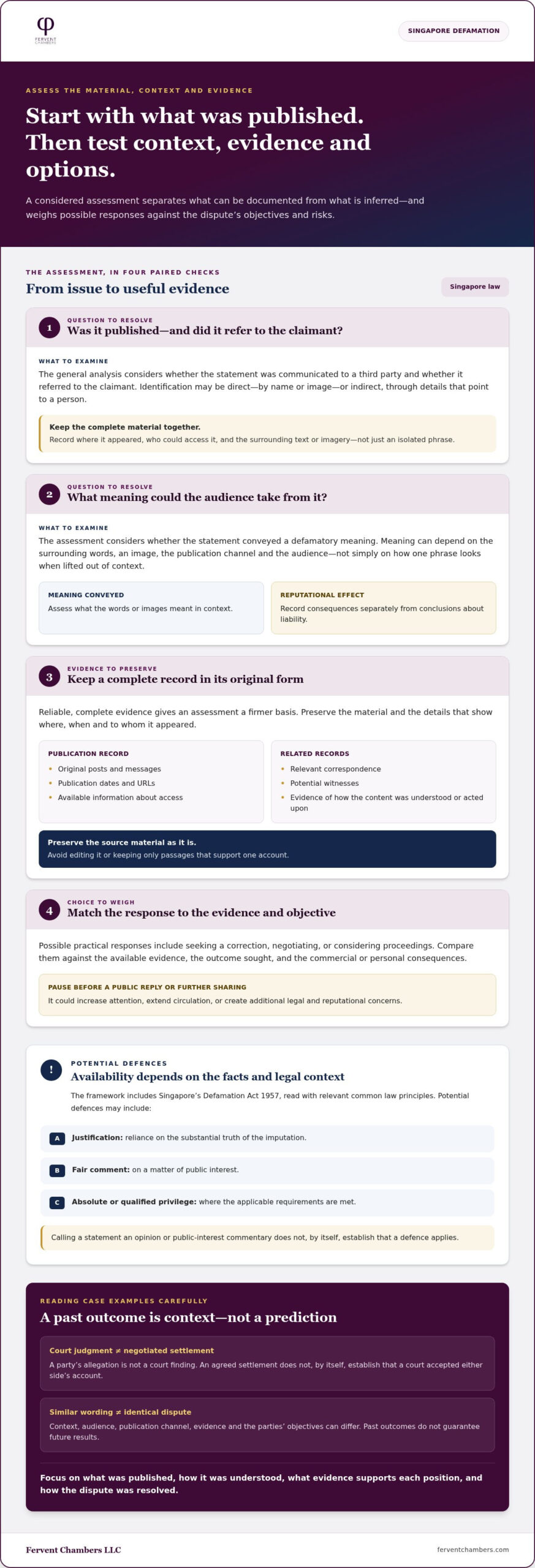
A defamation assessment starts with the specific words or images and the circumstances in which they were communicated. In Singapore, the analysis generally considers whether a statement was published to a third party, whether it referred to the claimant, and whether it conveyed a defamatory meaning. These questions work together. The same phrase may carry a different meaning when read with surrounding text, presented as an image, or encountered by a particular audience.
The statutory framework includes Singapore’s Defamation Act 1957, read with relevant common law principles. Potential defences may include justification, where the defendant relies on the substantial truth of the imputation, fair comment on a matter of public interest, and absolute or qualified privilege where the applicable requirements are met. Their availability depends on the facts and legal context. Calling a statement an opinion or describing it as public-interest commentary does not, by itself, establish that a defence applies.
Which facts may matter in a defamation dispute?
Consider the material as a whole rather than lifting one phrase out of context. What exactly was said or depicted? Where did it appear, who could access it, and what might the intended or reasonable audience understand? A person may be identified directly by name or image, or indirectly through details that point to them even when they are not named.
It is also important to distinguish the meaning conveyed from the effect on reputation. A person’s view that a statement was damaging is not a substitute for assessing what the words meant in context. Likewise, evidence of consequences should be recorded separately from conclusions about liability. Keeping those questions distinct makes it easier to identify what is established and what needs further assessment.
How evidence can affect available responses
Preserve the original posts, messages, publication dates, URLs, and available information about who could access the material. Keep relevant correspondence and note potential witnesses. Retain source material in its original form rather than editing it or saving only passages that support one account. A complete record can help show what was published, when and to whom, and how the content was understood or acted upon.
Reliable, complete evidence gives a legal assessment a firmer basis for comparing possible responses with the dispute’s objectives and risks. Legal tests and relevant authorities can develop, so Singapore-law propositions should be checked against current legislation and case law before publication or reliance. For an assessment focused on the specific material and circumstances, readers can explore Fervent Chambers’ dispute resolution work.
What the approved Fervent defamation case examples show about advocacy
To understand what a case example demonstrates, look for three things: the dispute’s central issue, the work described, and the verified resolution. These should be presented separately. A court’s findings are not the same as a party’s submissions, and neither should be confused with an explanation of the strategic considerations involved. Anonymisation can protect identities and sensitive information while leaving enough context to explain the point of the example.
Readers searching for “Defamation and the cases Fervent successfully represented clients” should apply the same care to any published example. Check whether it explains the procedural status and outcome, and distinguish a documented event from a general lesson about advocacy. A broad description of dispute-resolution work can provide context, but it is not a substitute for details that are specific to a case.
| Issue | Verified approach | Resolution | Practical insight |
|---|---|---|---|
| What was disputed, and in what context? | Identify the central issue and distinguish the parties’ positions from established facts. | State whether the matter ended by judgment, settlement, or another verified resolution. | Readers can see how the issue and evidence framed the dispute without assuming the same approach applies to another case. |
| What decision or evidential challenge mattered? | Separate documented legal work from the court’s findings or the parties’ agreed terms. | Describe the outcome and terms accurately, without extending beyond what the record establishes. | A precise account distinguishes procedural events from commentary about their significance. |
How to interpret representative matters
A judgment records a court’s determination. A settlement records terms agreed by the parties and does not, without more, establish that a court decided the underlying allegations. Case summaries should also avoid claiming that a particular legal argument or tactic caused an outcome unless the record supports that conclusion. These distinctions help readers understand what an example does and does not show about evidence-led advocacy.
A useful example adds a distinct, verifiable lesson rather than repeating the same point in different language. For wider context on how commercial disputes may intersect with business decisions, see the commercial litigation business guide. Any example remains illustrative, not predictive: the evidence, parties, publication, and objectives in a new dispute may call for a different assessment and response.
How to assess a defamation matter before choosing a response
A measured response starts with a reliable record, not a public exchange. Preserve the original material before requesting changes or replying. Then identify what was published, where it appeared, and who may have seen it. This gives you a clearer basis for considering whether a correction, removal request, negotiated resolution, or formal proceedings may be proportionate to the evidence and the impact.
What information should a reader organise?
Keep the exact words, images, or recording, along with the publication channel, date, URL, and any available evidence of its reach. Save relevant correspondence and create a chronology of what happened and when. Retain the source material in its original form rather than editing or selectively presenting it. Record business, personal, or operational consequences separately from conclusions about legal liability. This helps distinguish documented impact from interpretation.
- Preserve: original posts, messages, screenshots, links, and related correspondence.
- Identify: the publisher, platform, publication date, and available audience information.
- Assess: documented consequences, ongoing exposure, and the outcome you are seeking.
A public reply or repeated sharing may draw further attention to a statement, extend its circulation, or create additional legal and reputational considerations. Before responding publicly, consider whether your wording could be misunderstood, disclose sensitive information, or prolong the dispute.
Which response options may require legal assessment?
Depending on the circumstances, possible responses may include requesting a correction or removal, pursuing a negotiated resolution, or commencing proceedings. None is automatic. The appropriate course depends on the publication, available evidence, the parties’ positions, the impact, and the outcome sought. Urgency also varies. A continuing publication or imminent event may call for prompt assessment, but not every dispute requires immediate court proceedings.
Where urgent relief may be relevant, the Singapore injunction application process explains considerations associated with seeking an injunction. Whether relief is available depends on applicable law, evidence, and procedural requirements. For broader procedural context, see high-value litigation procedural tactics.
For readers considering how a disputes-focused legal practice can help assess a defamation matter, the practical first step is to organise the evidence and define the outcome sought. Discuss your defamation dispute with Fervent Chambers to seek an initial legal assessment of the publication, available evidence, objectives, and potential consequences.
Discuss a defamation dispute with Fervent Chambers
Case examples can show how evidence and legal issues inform dispute resolution, but they are illustrations rather than predictions. The phrase “Defamation and the cases Fervent successfully represented clients” points to a practical concern for prospective clients: what was published, what evidence remains available, what outcome is sought, and what commercial or reputational consequences may follow?
Early legal analysis can help organise these questions before a response is chosen. It can clarify the publication and its context, identify gaps in the available record, and assess how potential steps align with the client’s objectives. Fervent Chambers is a disputes and corporate law firm with a practice in complex dispute resolution. Its approach considers the facts, relevant legal framework, and practical consequences of a dispute. The appropriate strategy depends on the particular matter.
What to prepare for an initial legal discussion
A concise chronology can make an initial discussion more focused. Organise the publication itself, relevant dates, the identities or roles of the parties, and correspondence connected with the dispute. Note the outcome you are seeking, such as a correction, removal, or resolution, along with any time-sensitive business or reputational concerns. Keep original records intact and avoid circulating sensitive material more widely than necessary.
It is also helpful to separate documented events from your interpretation of them. For example, record when a statement appeared and any known response separately from your assessment of its effect. This gives counsel a clearer starting point for considering the evidence and identifying questions that require further analysis.
How Fervent’s dispute experience informs the next step
Experience in complex dispute resolution provides a practical framework for examining evidence, legal issues, and case objectives. A useful case example should accurately describe the matter’s status and outcome, while making clear which details are established and which are general commentary. No example can establish that a separate dispute will follow the same course. Each publication, evidential record, party, and applicable legal framework requires individual assessment.
If you are facing a defamation concern, prepare a short chronology and the relevant records, then discuss a defamation dispute with Fervent Chambers. An initial legal discussion can help frame the publication, available evidence, objectives, and potential consequences so that the next step is considered in context.
Take a considered next step in a defamation dispute
Defamation disputes call for more than a swift response. The words published, the audience, the available evidence, and the consequences all help shape a proportionate strategy. Case examples can provide context for how disputes are approached, but each matter turns on its own facts and no past outcome predicts another.
Preserve the original publication and related records, organise a concise chronology, and identify what you want to achieve before deciding whether to seek a correction, pursue a negotiated resolution, or consider proceedings. Early legal analysis can help assess those options alongside potential commercial and reputational consequences.
Fervent Chambers is a disputes and corporate law practice focused on complex dispute resolution across multiple sectors. If you are preparing to respond to a publication, discuss your defamation dispute with Fervent Chambers. A clear understanding of the facts can help you consider the next step in context.
Frequently Asked Questions
What types of defamation cases has Fervent Chambers represented?
Fervent Chambers’ practice includes complex dispute resolution. When reviewing a defamation case example, distinguish the issues and work described from the verified procedural status and outcome. Anonymised details can help protect identities and sensitive information, but a summary should still make clear what is established and what is commentary. The firm’s wider disputes experience provides context, while each defamation matter requires an assessment of its own facts and legal issues.
Can I expect the same outcome as a successful defamation case?
No. Another matter’s outcome cannot predict yours, even if the disputes appear similar. The words published, the evidence available, the parties involved, the procedural history, and the legal issues may differ in material ways. A case example may illustrate how particular facts shaped a response, but it is not a guarantee of success. An assessment based on your own circumstances and current Singapore law is more useful than relying on comparison alone.
What evidence should I preserve if I believe I have been defamed?
Preserve the original publication, its date and channel, relevant messages, and any available information about its audience. Keep source material intact and prepare a clear chronology of events. Retain related correspondence because context may affect how the words are understood. Avoid republishing the material publicly in an attempt to document it, as further circulation may raise additional concerns. The evidence needed depends on the particular dispute.
Is every damaging statement legally defamatory in Singapore?
No. Reputational harm alone does not establish that a statement is legally actionable. Assessment may involve the words and context, whether the claimant is identified, whether the statement was published to another person, and the applicable legal principles and any relevant defence. A definitive view requires consideration of the material facts. Have the current Singapore legal position assessed before taking action rather than assuming that every damaging statement gives rise to a claim.
Can a defamation dispute be resolved without going to court?
Sometimes. Depending on the facts and objectives, a dispute may be addressed through communications, a correction or removal request, negotiation, or settlement. These options are not suitable or available in every matter, and communications themselves may have legal consequences. A measured assessment considers the evidence, urgency, reputational impact, and resolution sought before selecting a response. Court proceedings are one possible route, but they are not automatically required in every dispute.
How quickly should I seek advice about a potentially defamatory publication?
Preserve the material promptly and consider obtaining advice if publication is ongoing, evidence may disappear, or the consequences are significant. Timing and available remedies depend on the circumstances, so do not assume a time limit without checking current law and the relevant facts. Timely assessment can help clarify options. It does not mean every matter requires immediate litigation or court proceedings.
Can Fervent Chambers keep my identity and case details confidential?
Confidentiality is fundamental to legal representation, but the handling of information depends on applicable professional duties, law, and the circumstances of the instruction. Published case examples should disclose only details approved for publication and should be anonymised where appropriate. Absolute confidentiality cannot be promised in every circumstance. An anonymised or public case example should not be taken to reveal the identity or information of a current or former client.