
People searching for “Committal proceedings and the cases Fervent successfully represented clients” need to understand both the legal process and how a particular case is assessed. Committal proceedings can expose a person to serious consequences, so they are not simply another way to enforce a debt. The court considers the wording of the order, the alleged conduct, the evidence and whether the required procedure has been followed.
This guide explains how committal proceedings generally work in Singapore, including the permission stage and the subsequent application for a committal order. It also sets out how to read reported judgments and assess case examples: distinguish the court’s findings from the parties’ arguments, and look at the evidence, the firm’s role and the result. Fervent Chambers LLC handles complex disputes and contentious proceedings, with advice shaped around the facts and procedural position of each matter.
Key Takeaways
- Start with the precise wording of the court order and the conduct alleged. Both determine whether committal may be relevant.
- Track each procedural requirement and deadline, since compliance affects how an application proceeds.
- Organise the documents and build a dated chronology to test what the evidence establishes about the alleged breach.
- When reviewing case examples, separate the court’s legal findings from party submissions and identify the firm’s role and the procedural result.
- Consider the commercial, organisational and reputational consequences when planning a response to committal proceedings.
Committal Proceedings in Singapore: What the Process Is Designed to Address
Ordinary enforcement steps seek to secure compliance with a court order. Committal proceedings address alleged contempt of court and may expose the person concerned to punishment. In Singapore, the Administration of Justice (Protection) Act 2016 addresses contempt, including intentional disobedience of a court order, while the Rules of Court 2021 govern court procedure. A committal application is therefore not simply another route to collect a debt or resolve disagreement about what an order means.
Committal proceedings are court proceedings in Singapore that examine alleged contempt arising from non-compliance with a court order, with the purpose of upholding the court’s authority and addressing intentional disobedience. An allegation is not a finding. The court must assess the applicable legal requirements and evidence before reaching a conclusion. The order’s wording, the conduct said to breach it and the procedural context all shape that assessment. The Judiciary of Singapore overview provides general context on the court system; the legal significance of a particular application depends on the relevant rules and order.
When can alleged breach of a court order become a committal issue?
Begin by reading the order itself. Its scope, clarity and the people to whom it applies help determine whether the conduct alleged could amount to non-compliance. An alleged act, such as doing something the order prohibits, may raise different questions from an alleged failure to do something it requires. Neither circumstance automatically establishes contempt. The court considers the evidence and legal framework rather than treating every breach as grounds for committal.
This distinction matters where the parties disagree about what compliance required, whether the order applied to particular conduct or what steps were taken. Compare the exact terms of the order with the conduct alleged and the records created at the time. That review helps separate the allegation from what the evidence can establish.
Who may be affected by committal proceedings?
The person or party potentially affected depends on the order and the applicable legal framework. A company may be involved in a dispute while the alleged conduct concerns decisions or actions taken by individuals. That does not, by itself, establish that an officer or employee is personally liable. The court considers the relevant circumstances and evidence before determining whether a person can properly be subject to proceedings.
For example, a commercial order might require a company to preserve specified records. If a later dispute concerns missing documents, their absence alone does not resolve the issue. The order’s terms, the alleged failure and the evidence about how the company handled the requirement all need careful examination. Such disputes can affect operations, governance and reputation, so a disciplined review is important. When considering “Committal proceedings and the cases Fervent successfully represented clients,” look for a clear account of the legal issue, the evidence considered, the firm’s role and the procedural result.
How Singapore Committal Proceedings Work: Applications, Evidence, and Judicial Review
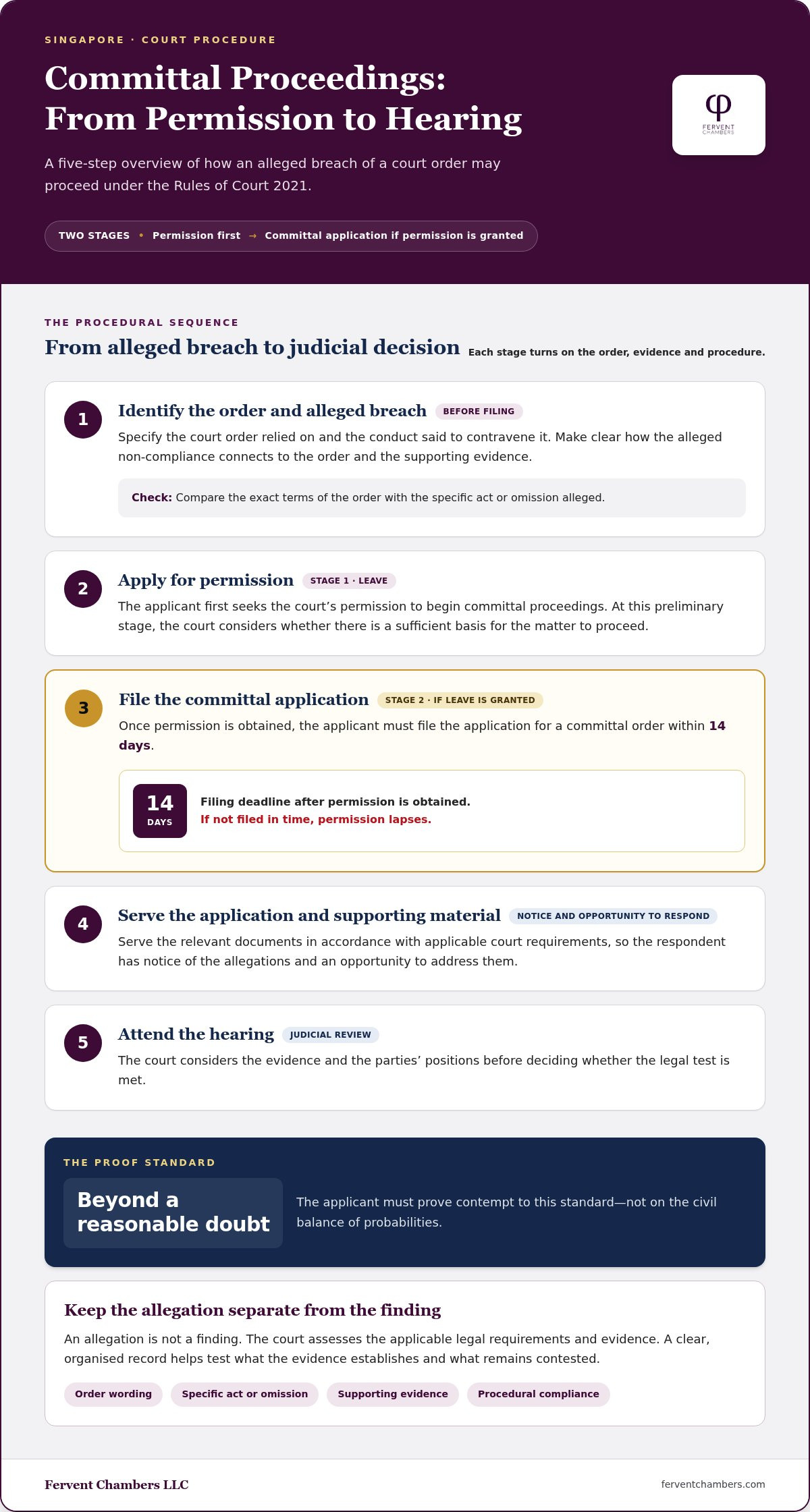
Singapore’s committal process is governed by the Rules of Court 2021 and is structured so an allegation is examined before a person may face a committal order. The Singapore’s committal proceedings process explains the current procedural framework. In broad terms, the process has two stages: permission to begin proceedings, followed, if permission is granted, by an application for a committal order.
- Identify the order and alleged breach. Specify the order relied on and the conduct said to contravene it. The connection between the order, the alleged non-compliance and the supporting evidence should be clear.
- Apply for permission. The applicant first seeks the court’s leave to start committal proceedings. At this preliminary stage, the court considers whether there is a sufficient basis for the matter to proceed.
- File the committal application if leave is granted. The applicant must file the application for a committal order within 14 days after permission is obtained. Otherwise, permission lapses.
- Serve the application and supporting material. Serve the relevant documents in accordance with applicable court requirements, giving the respondent notice of the allegations and an opportunity to address them.
- Attend the hearing. The court considers the evidence and the parties’ positions before deciding whether the legal test is met. The applicant must prove contempt beyond a reasonable doubt, rather than on the civil balance of probabilities.
Procedural compliance allows the court to assess the case fairly, while a clear evidential record makes each material allegation easier to test. The sequence is procedural; the practical task is to identify what the evidence can establish, where it is contested and whether the application accurately reflects the order.
What does the applicant need to establish and document?
The supporting material should identify the relevant order, the specific act or omission alleged and the facts connecting the two. Affidavits may set out the evidence. Contemporaneous records, correspondence and evidence of service may help establish relevant events and notice, where applicable. Broad assertions do not replace evidence addressing each material allegation. A well-organised record also distinguishes documented facts from inference.
How can the respondent address an alleged breach?
A respondent should examine the order’s wording and scope, what they knew about it, the conduct in question and the available records. A dated chronology can organise communications, decisions and compliance steps. Relevant documents may clarify disputed events or show what actions were taken and when. The appropriate response depends on the facts; no single explanation or document guarantees dismissal or a particular result.
Where the dispute has commercial or organisational consequences, procedural oversight and careful evidence analysis can support a measured response. Case examples should be read in context: identify the issue the court decided, the evidence relevant to it and the outcome, rather than assuming that another matter determines the result. Fervent’s dispute resolution practice addresses contentious matters through case-specific analysis.
What Reported Cases and Fervent’s Verified Matters Can Show About Committal Disputes
Case analysis is useful when the judgment, procedural posture and facts are distinguished accurately from allegations made by the parties. Reported judgments can show how a court approached a particular issue, while a case example can illustrate the demands of representing a client in a contentious matter. For readers searching “Committal proceedings and the cases Fervent successfully represented clients,” the useful details are the precise issue, the evidence considered, Fervent’s role and the procedural result. These details let readers understand the matter without treating one outcome as a prediction of another.
| Material | Issue and evidence | Fervent’s role | Procedural result |
|---|---|---|---|
| Singapore authority | Identify the issue the court decided and summarise the relevant facts and evidence from the full official judgment. | Distinguish the court’s account of the parties from any separately established role for the firm. | State the actual decision and separate the court’s reasoning from observations and party submissions. |
| Fervent matter | Explain the committal issue and material evidence in the context of the client’s dispute. | Describe the firm’s role in the matter and the work relevant to the issue. | Set out the procedural outcome accurately, without presenting it as a promise of future results. |
How to read a Singapore committal judgment accurately
Start with the full official judgment, not an excerpt or summary. Confirm what application the court was deciding, which material facts it accepted and what order it made. Then separate the court’s legal reasoning from case-specific observations and the parties’ submissions. An argument recorded in a judgment is not automatically a finding. Check the procedural stage as well: a decision about permission to proceed is not the same as a final determination of contempt.
What Fervent’s case examples should demonstrate
A useful case example connects the committal issue with the firm’s role, the relevant evidential work and the actual procedural result. Where a client’s identity or confidential information is involved, an anonymised account should protect identifying details and respect client confidentiality. A concise summary can explain the commercial context, distinguish established facts from legal principle and describe the outcome without implying that it guarantees a similar result in another matter.
Reported judgments clarify how courts approach particular issues. Case examples can show how representation responds to the facts and procedure of an individual dispute. Keeping the court’s findings, the parties’ positions and the firm’s work distinct gives readers a reliable basis for understanding both the law and the representation.
Evidence, Compliance, and Risk: Practical Questions Before a Committal Hearing
Preparation begins with a disciplined review of the order, the alleged non-compliance and the procedural record. The checklist below sets out general considerations; the applicable requirements depend on the order, the court process and the circumstances. A prompt, accurate assessment can help identify evidential gaps and procedural issues without assuming that an allegation will be established or predicting the outcome.
Which records and chronology should be organised?
- Locate the sealed order. Keep a complete copy and identify the precise terms said to apply, including relevant dates, conditions or limits.
- Assemble service and notice records. Organise available evidence showing when and how the order and subsequent applications were served or communicated, where relevant.
- Preserve potentially relevant material. Retain original documents, messages, emails and records of subsequent conduct. Avoid altering or selectively deleting material that may bear on the issues.
- Build a dated chronology. Record events alongside their supporting documents. Distinguish established facts from disputed allegations, recollections and inferences.
- Check procedural compliance. Review the applicable filing, service and hearing requirements against the current court rules and directions in the matter.
A chronology is not a substitute for evidence, but it can expose gaps, inconsistencies or points that need clarification. For each document, note its source and the event it records. If a point remains disputed, label it as disputed instead of presenting it as settled fact.
How does committal risk relate to wider litigation strategy?
Committal issues may arise alongside an injunction or broader commercial proceedings, so decisions about evidence, compliance and communications can have consequences beyond the immediate application. A connected injunction may define the conduct in issue, while the underlying dispute may continue to affect business operations, governance or commercial relationships. For context on injunction applications in Singapore courts, see the related guide. The Singapore commercial litigation guide addresses the wider dispute context.
Procedural oversight and evidence analysis also matter in high-value commercial litigation. When reviewing “Committal proceedings and the cases Fervent successfully represented clients,” assess the matter through its facts: the firm’s role, the evidence relevant to the issue and the recorded outcome. For case-specific dispute assessment, read about Fervent Chambers’ dispute resolution practice.
Fervent’s Committal Defense: Assessment to Resolution
Committal proceedings require close attention to the order, the alleged conduct and the evidence. The legal analysis should also account for the matter’s wider consequences. For a business, these may include operational constraints, governance responsibilities and reputational considerations. Fervent Chambers LLC handles complex dispute resolution matters and contentious proceedings, with representation shaped by the facts and procedural position of each case.
How does Fervent assess a committal matter?
An assessment can examine the order’s wording and scope, the conduct alleged, the available evidence and the procedural history. Counsel can identify which facts are established, which remain disputed and what further material may be relevant to the issues before the court. The review should also consider how the committal application relates to any underlying commercial dispute, so procedural decisions are considered alongside their organisational and reputational implications.
Advocacy is case-specific. It may involve analysing supporting material, identifying evidential or procedural issues and presenting the client’s position through the applicable court process. A case example should state the firm’s role, relevant evidence and procedural result accurately, while respecting client confidentiality. Past outcomes provide context for understanding a matter, not assurance of a future result.
What should a first legal discussion help clarify?
An initial discussion should establish the immediate questions: which order is involved, what conduct is alleged, what documents and communications exist, and which procedural steps or dates are relevant. It should also clarify the scope of the advice sought and how sensitive information will be handled. Reviewing these matters can help frame the available options without predicting the court’s decision or treating an allegation as a finding.
Where a dispute affects business operations, decision-making or public standing, legal strategy should account for those realities while remaining grounded in the evidence and applicable procedure. The appropriate approach may differ between matters, and past experience should be treated as context, not an assurance of a future result.
For a considered discussion of the facts, evidence and procedural priorities, Discuss your committal proceedings with Fervent Chambers.
Approach Committal Proceedings with Clarity and Care
Committal proceedings call for close attention to the order, the alleged conduct and the evidence, alongside careful observance of the applicable procedure. A disciplined chronology and review of the record can help clarify what is established, what remains contested and which issues require legal assessment. Reported judgments explain legal principles, while case examples help illustrate how representation responds to the facts and procedure of an individual dispute.
For readers assessing “Committal proceedings and the cases Fervent successfully represented clients,” accurate attribution matters: the firm’s role, the evidence and the procedural result should be clear. Fervent Chambers is a disputes and corporate law firm whose lawyers advise clients across commercial sectors. Its approach to contentious matters can be tailored to the legal issues and their commercial, organisational and reputational context.
If you are facing a committal application or need to assess a potential response, Discuss your committal proceedings with Fervent Chambers. A considered review can help identify the issues and clarify possible next steps.
Frequently Asked Questions
What are committal proceedings in Singapore?
Committal proceedings are court proceedings concerning alleged contempt, including intentional disobedience of a court order. Their purpose is not simply to enforce a debt; they address conduct said to undermine compliance with the court’s authority. Under Singapore’s framework, an allegation is considered through the applicable procedure and assessed against the evidence. It is not a finding of contempt unless the court determines that the legal requirements have been met.
When can a person face committal proceedings in Singapore?
A person may face an application where it is alleged that they intentionally disobeyed a court order, subject to the applicable legal and procedural requirements. The order’s wording, its application to that person, the alleged act or failure to act and the evidence are all relevant. Not every breach automatically results in committal. The applicant must first seek the court’s permission to begin proceedings, and the allegation remains unproven unless established in court.
What happens if someone breaches a court order in Singapore?
The consequences depend on the order, the circumstances and the applicable enforcement route. An alleged breach may lead to ordinary enforcement steps or, where the legal requirements are met, an application for committal. The court considers the evidence and procedure before deciding whether contempt is proved. Committal penalties may include a fine, imprisonment or both. An allegation of breach alone does not establish contempt or determine what consequence, if any, will follow.
What evidence is needed for committal proceedings?
The evidence should identify the order and support each material allegation of non-compliance. Relevant material may include the sealed order, evidence that it was served or brought to the respondent’s attention, contemporaneous communications, documents recording subsequent conduct and a reliable chronology. The applicant must prove contempt beyond a reasonable doubt. Broad assertions may not establish the necessary facts; the court assesses the evidence as a whole, including any response or explanation.
Do committal proceedings require leave of court in Singapore?
Generally, committal proceedings under the Rules of Court 2021 involve a two-stage process, beginning with an application for the court’s permission, or leave, to start proceedings. If leave is granted, the applicant may then apply for a committal order. The subsequent application must be filed within 14 days after permission is obtained, or the permission lapses. The current rules and requirements should be considered alongside the circumstances and court directions in the case.
How long do committal proceedings take in Singapore?
There is no single timeframe that applies to every committal matter. The overall duration may depend on the procedural steps, the evidence, service, the court’s directions and whether issues are contested. One important deadline is that, after leave is granted, the application for a committal order must be filed within 14 days or the permission lapses. That filing deadline does not indicate how long the entire proceedings or hearing will take.
Can committal proceedings be defended in Singapore?
Yes. A respondent may challenge whether the order clearly applied, whether the alleged conduct occurred, whether they knew of the relevant obligation or whether the evidence proves intentional disobedience. The procedural history and supporting material may also require examination. A coherent chronology and relevant records can assist the court in assessing disputed facts. No particular defence or document guarantees dismissal; the court determines the application on the evidence and applicable law.
How can a lawyer help with committal proceedings?
A lawyer can analyse the order, alleged conduct, evidence and procedural position, then advise on issues requiring attention and prepare advocacy tailored to the case. When reviewing “Committal proceedings and the cases Fervent successfully represented clients,” look for a clear explanation of Fervent’s role, the relevant evidence and the procedural outcome. Fervent Chambers LLC is a disputes and corporate law firm serving clients across commercial sectors.