
An arbitral award may establish that a party owes a debt, but it does not put assets within your reach or ensure payment. Cross-border arbitration and enforcement therefore requires a strategy that considers not only the arbitral seat, but also where the debtor’s assets are located and which courts may recognise the award.
This distinction matters when a losing party moves assets, operates through entities in several jurisdictions or holds little property where the arbitration took place. It is also important to distinguish a challenge to recognition or enforcement from an appeal on the merits. Courts may refuse enforcement on limited grounds, but the applicable rules and procedures depend on the jurisdiction.
This guide explains how the seat, enforcement forum and asset location interact, and what businesses should assess before pursuing recovery. It covers the New York Convention framework, Singapore’s approach to foreign arbitral awards, common grounds for challenge, and practical considerations for tracing and preserving assets. The aim is to help you make informed, evidence-led decisions and align enforcement steps with wider commercial objectives. Outcomes depend on the award, the relevant law and the facts in each jurisdiction.
Key Takeaways
- Map the award’s status, the debtor’s identity and the location of potentially reachable assets before selecting an enforcement forum.
- Cross-border arbitration and enforcement depends on the applicable treaty framework and local requirements in each jurisdiction where recognition or recovery is pursued.
- Distinguish procedural grounds for resisting enforcement from an appeal on the merits, then assess how the relevant court may apply those grounds.
- Investigate ownership structures, security interests and competing claims, as these may affect whether identified assets can support practical recovery.
- Coordinate legal analysis across jurisdictions and align enforcement steps with the business’s wider commercial priorities.
What cross-border arbitration and enforcement mean for a business
Cross-border arbitration is private dispute resolution involving parties, legal systems or contractual performance connected to more than one state. Cross-border enforcement is the process of seeking legal recognition of an arbitral award and, where necessary, using local procedures to pursue assets.
An award determines the dispute submitted to the tribunal, but it does not automatically transfer money or property to the successful party. Recognition gives the award legal effect in a jurisdiction, subject to that jurisdiction’s applicable rules. Enforcement is the further step of asking a court to support recovery against assets that are legally reachable. Depending on the forum, recognition and enforcement may be considered together or through separate procedures.
The Convention on the Recognition and Enforcement of Foreign Arbitral Awards, commonly known as the New York Convention, provides a central framework for recognition and enforcement among contracting states. Its application does not remove the need to examine local law, procedural requirements and the facts relevant to each application.
How the seat, governing law, and enforcement forum differ
The arbitral seat is the arbitration’s legal home. It identifies the procedural legal framework and the courts with supervisory functions over the arbitration. The law governing the contract is separate and generally addresses the parties’ substantive rights and obligations. The enforcement forum is the jurisdiction where recognition or enforcement is sought, often because relevant assets are located there. These choices may point to different countries, so they should not be treated as interchangeable.
Why an international award may require action in more than one country
A debtor may operate through entities in several jurisdictions, own property in one country and maintain financial or commercial operations in another. A single award may therefore lead to separate applications in jurisdictions where assets are identified. Each local court applies its own procedural requirements, and the availability and effectiveness of enforcement depend on the applicable law and circumstances.
For example, a hypothetical Singapore-seated arbitration might concern a contract governed by another country’s law, while the debtor’s potentially relevant assets are held through an entity in a third jurisdiction. The award creditor would need to assess where recognition or enforcement could be pursued, what local procedure applies and whether the assets belong to the debtor or another entity. Identifying property is only a starting point. Ownership, competing claims and legal protections may affect whether it can support recovery.
For a business, Cross-border arbitration and enforcement is not simply a continuation of the arbitration. It is a jurisdiction-sensitive process that connects the award, the parties’ legal relationships and the practical location of assets.
How cross-border award recognition and enforcement work under Singapore’s framework
The New York Convention is the principal treaty framework for facilitating recognition and enforcement of foreign arbitral awards between contracting states. Singapore gives effect to the Convention through its International Arbitration Act 1994 (IAA), which also incorporates the UNCITRAL Model Law for relevant international arbitration matters. The UNCITRAL Model Law on International Commercial Arbitration provides an important reference point, but the governing statute and procedural rules in the court where enforcement is sought remain decisive.
For businesses, this framework is a starting point, not a guarantee of uniform treatment. Treaty coverage, state reservations, the award’s status and local court requirements can all affect the route available. Cross-border arbitration and enforcement therefore calls for a jurisdiction-specific assessment, even where the Convention applies.
What the New York Convention does, and does not, establish
The Convention requires contracting states to recognise qualifying arbitration agreements and foreign arbitral awards, subject to grounds on which recognition or enforcement may be refused. It does not create one global court process or make every award enforceable in every country. Local implementation governs matters such as the application process, supporting documents and available execution measures. The position must therefore be assessed separately in each relevant forum.
What to prepare before seeking enforcement in Singapore or abroad
A disciplined application starts with the award and the record supporting it. Review the following documents and information:
- The award: Identify the tribunal, date, parties and relief granted. Establish its current status, including any relevant setting-aside or suspension proceedings.
- The arbitration agreement: Establish the basis on which the dispute was referred to arbitration and identify the applicable procedural framework.
- The parties and record: Confirm the parties’ correct legal identities and assemble relevant procedural documents, including evidence that may address anticipated objections.
- Local filing requirements: Determine whether certified copies, translations, authentication or other formalities are required in the selected forum.
In Singapore, the IAA and applicable court rules govern the relevant application route. Enforcement abroad is subject to the receiving jurisdiction’s own legislation and procedure. Verify the applicable statutory provisions, filing requirements and execution options against current law in each forum before commencing proceedings. Check treaty status and reservations for the relevant states as well.
A practical sequence is to assess the award and proposed forum, assemble the evidence, make the local application, address any objections and, if recognition or enforcement is granted, pursue execution against assets under the forum’s procedures. The order and scope of these steps may vary. For a broader commercial framework, see this international arbitration business decision guide. Fervent Chambers advises on international arbitration and dispute resolution, helping businesses align the legal route with the award, asset locations and wider commercial priorities.
Can a court refuse enforcement of a foreign arbitral award?
Yes, but resistance to enforcement is generally not a fresh appeal on the merits. A court asked to recognise or enforce an award does not ordinarily rehear the dispute because the losing party considers the tribunal’s conclusions mistaken. The question is whether a recognised ground for refusal applies under the law governing the application. The answer depends on the evidence and the forum.
For Convention awards, Article V of the New York Convention sets out grounds on which recognition or enforcement may be refused. Singapore’s International Arbitration Act gives effect to the Convention for relevant foreign awards, but the precise statutory provisions and their application should be assessed under current Singapore law. Other enforcement forums may implement the Convention differently or impose distinct procedural requirements.
Which objections may arise under the New York Convention
Potential objections include a party’s incapacity or an invalid arbitration agreement; lack of proper notice or inability to present a case; an award addressing matters beyond the submission to arbitration; irregularities in tribunal composition or procedure; and an award that is not yet binding, or has been set aside or suspended by a competent authority. A court may also consider whether the dispute is arbitrable under local law or whether enforcement would conflict with that forum’s public policy. These are illustrative categories, not a complete jurisdiction-specific checklist.
The resisting party’s arguments and supporting evidence matter. For example, an assertion that a party could not present its case requires examination of the procedural record and the circumstances of the alleged disadvantage. Dissatisfaction with the tribunal’s assessment of evidence is different from establishing a procedural ground for refusal. Questions about the tribunal’s authority likewise turn on the arbitration agreement, the claims submitted and the terms of the award.
Why public policy and procedural objections need careful analysis
Public policy is assessed within the governing legal framework, and its scope can vary between jurisdictions. It is not a general licence to revisit the tribunal’s reasoning or the substantive outcome. Procedural fairness objections also require close review of what occurred, what the party knew and whether the alleged defect falls within a ground recognised by the relevant law.
Arbitration enforcement proceedings are distinct from court litigation of the underlying commercial dispute, although court proceedings may arise when an award is challenged or enforcement is resisted. Singapore Ministry of Law material on Singapore’s framework for reciprocal enforcement concerns foreign judgments, not the Convention regime for arbitral awards. The two routes should not be conflated. For a separate discussion of the commercial court context, see this commercial litigation business guide.
In cross-border arbitration and enforcement, the practical assessment is forum-specific: identify the objection, test it against the evidence and applicable law, and distinguish a legally recognised challenge from an attempt to reopen the merits.
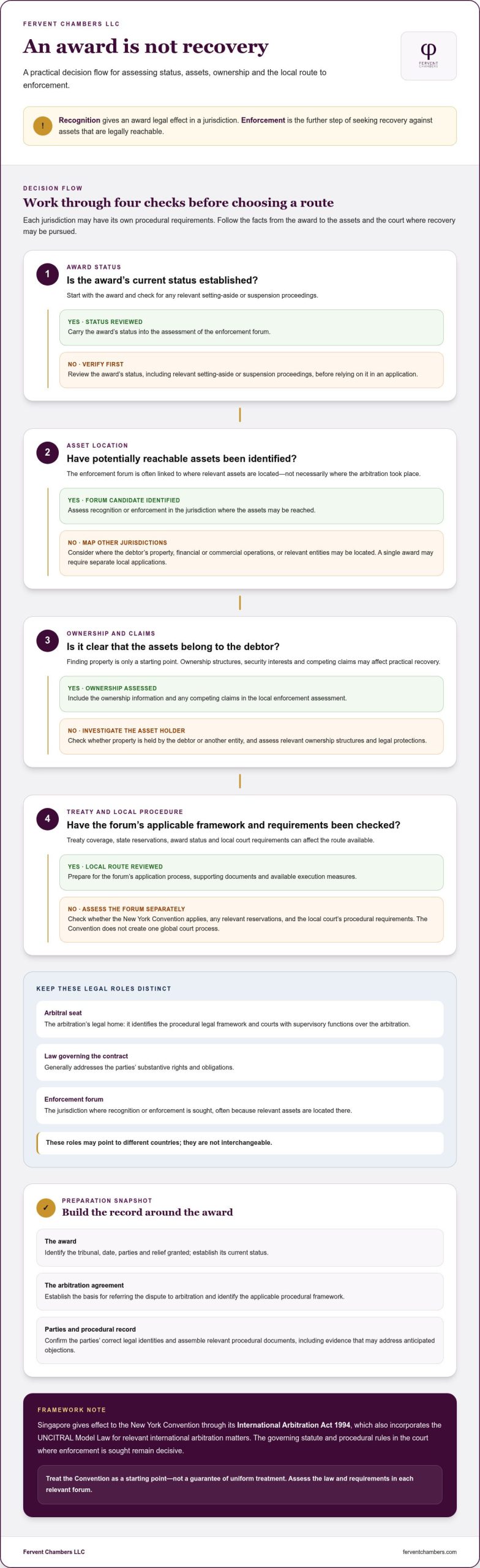
How to plan cross-border enforcement around assets and jurisdictions
An effective recovery plan begins with evidence, not assumptions about where enforcement should be commenced. Cross-border arbitration and enforcement is most coherent when the award, debtor, potential assets and local legal routes are assessed together, with each proposed step tied to a defined recovery objective.
Map assets before selecting enforcement forums
Use this sequence to structure the initial assessment:
- Step 1, confirm award status: Review the award, whether it is binding, any correction or interpretation process, and any challenge or suspension that could affect enforcement.
- Step 2, identify the debtor: Confirm the precise legal entity against which the award was made. A parent company, subsidiary or affiliate is not automatically responsible for another entity’s debt.
- Step 3, locate potential assets: Record the asset type, apparent owner, jurisdiction, source and date of the information. Separate verified records from indications, assumptions and outdated information.
- Step 4, assess enforceability: Consider whether the award can be recognised in the proposed forum and what local procedures may apply to the asset concerned.
Asset location alone does not establish that property is available to satisfy an award. Ownership structures, security interests, liens, competing claims and third-party rights may affect the prospect of recovery. Shares, receivables, bank accounts and physical property may also be subject to different local processes, so a forum suitable for one asset may not provide the same route for another.
Coordinate evidence, timing, and parallel steps
Organise the award, arbitration agreement, service record and supporting evidence so they can be adapted to each proposed forum. Local rules may prescribe filing formalities or translations, while limitation periods and procedural deadlines can differ. Verify these matters promptly for each jurisdiction.
Parallel applications may be appropriate where assets are genuinely distributed across jurisdictions, but duplication should not be the default. Compare the likely value and accessibility of each asset with the procedural burden, confidentiality considerations, costs and potential commercial leverage of pursuing it. A coordinated sequence can reduce inconsistent positions and direct effort toward the forums most closely connected to reachable assets.
Urgency also matters. Credible signs of asset dissipation may justify assessing interim relief, including whether a court in a relevant jurisdiction has power to grant it and what evidence and safeguards may be required. The availability, scope and timing of any relief depend on local law and the facts. It should not be assumed from the existence of an award alone.
Fervent Chambers LLC advises on international arbitration and complex commercial disputes, bringing the award, applicable legal framework, counterparty and asset locations into a coordinated analysis. Learn more about Fervent Chambers’ international arbitration and dispute resolution services.
When legal counsel can help turn an award into a recovery strategy
An award sets out the tribunal’s decision, but practical recovery may depend on questions beyond the arbitration itself: whether the award is enforceable in a chosen forum, which assets belong to the debtor, what objections may arise and how each step fits the business’s priorities. Counsel can assess these issues together, rather than treating recognition, asset analysis and execution as disconnected tasks. In cross-border arbitration and enforcement, that coordinated view helps businesses make informed decisions without assuming a particular recovery outcome.
What an initial enforcement assessment should clarify
A focused assessment should establish the award’s status and terms, the identity and known position of the debtor, and the commercial objective the claimant is seeking to achieve. It should then map potential enforcement jurisdictions against available information about assets, applicable law and procedural requirements, identifying material uncertainties in each forum.
Careful evidence review is central to that work. Counsel can distinguish verified ownership or asset records from outdated information and untested assumptions, assess the documents needed to support an application, and identify possible objections based on the award or arbitration record. Where timing is material, urgent risks and evidence gaps can be prioritised for jurisdiction-specific review, including whether interim measures may be available. None of these steps can guarantee recovery. Their purpose is to inform a proportionate strategy grounded in the facts.
How Fervent Chambers approaches complex dispute resolution
Fervent Chambers LLC advises on international arbitration and complex commercial disputes, considering enforcement questions in the context of the client’s wider commercial position. For a shipping dispute, for example, the analysis may need to account for the relevant contractual relationships and the location and ownership of potentially relevant assets. In construction or technology matters, corporate structures, contractual arrangements and business priorities may raise different considerations. The appropriate assessment depends on the dispute and applicable law.
Where proceedings may involve more than one legal system, coordination helps maintain consistent positions, organise evidence and align procedural decisions with the recovery objective. Counsel can also help weigh the merits and practical demands of potential steps, so that the strategy responds to the evidence and local requirements rather than assumptions.
For background on the firm’s work in this area, see Fervent Chambers’ arbitration and dispute resolution services.
Make the award the beginning of a considered recovery plan
An arbitral award is an important legal outcome, but its practical value may depend on where the debtor holds assets, which courts can recognise the award and what local procedures apply. Cross-border arbitration and enforcement therefore calls for joined-up planning: verify the award’s status, identify the correct debtor and assess asset locations before choosing enforcement steps.
Any challenge should be analysed under the relevant forum’s law and evidence, rather than treated as an opportunity to retry the merits. A clear strategy also weighs urgency, potential objections and commercial priorities, while recognising that enforcement outcomes depend on the facts and jurisdiction.
Fervent Chambers LLC is an award-winning disputes and corporate law firm that handles international arbitration and complex commercial disputes. It advises businesses across sectors including construction, shipping, technology and clean energy, bringing a commercially grounded perspective to disputes with cross-border dimensions.
Discuss a cross-border arbitration or enforcement matter with Fervent Chambers to assess the award, potential forums and recovery objectives in context. Careful assessment and coordinated decisions can help your business approach the next steps with greater clarity.
Frequently Asked Questions
What is cross-border arbitration enforcement?
Cross-border arbitration enforcement is the process of asking a court in a jurisdiction connected to the debtor or its assets to recognise an arbitral award and permit legally available measures to pursue recovery. Recognition gives the award legal effect in that forum; execution concerns steps against assets under local procedure. An award does not itself transfer property or ensure payment. The route depends on treaty coverage, the award and the forum’s requirements.
Can a foreign arbitral award be enforced in Singapore?
A foreign arbitral award may be eligible for recognition and enforcement in Singapore under the applicable framework, including the International Arbitration Act and relevant treaty obligations. Eligibility is not automatic for every award. The award’s status, the parties’ arguments, supporting documents and any statutory grounds for refusal must be assessed under current law. The correct procedure may also depend on the award’s origin and the circumstances of the application.
How does the New York Convention help enforce an arbitral award abroad?
The New York Convention provides a framework adopted by participating states for recognising and enforcing qualifying foreign arbitral awards. It can support an award creditor seeking recognition in a state other than the place of arbitration, but it does not remove local court procedures or guarantee recovery. Before applying, assess whether the relevant states are contracting parties, any applicable reservations, national implementation, documentary requirements and potential grounds for refusing enforcement.
Can a court refuse to enforce an international arbitral award?
Yes. Where applicable, a court may consider limited refusal grounds reflected in Article V of the New York Convention and implemented under local law. Examples may include an invalid arbitration agreement, procedural unfairness, an award exceeding the tribunal’s authority or conflict with public policy. The details depend on the forum and evidence. Disagreement with the tribunal’s reasoning or outcome alone is not ordinarily a merits appeal.
Where should a business enforce an arbitral award?
A business commonly assesses enforcement forums by identifying where the debtor has reachable assets, who owns them and whether the award can be recognised there. The arbitral seat does not necessarily determine where recovery should be pursued. Local procedure, competing claims, timing and available enforcement measures can alter the analysis. Cross-border arbitration and enforcement planning is therefore fact-specific, and asset information should be tested rather than assumed.
What documents are usually needed to enforce a foreign arbitral award?
Applicants commonly need the arbitral award and arbitration agreement, together with supporting material required by the forum. Depending on local law and court procedure, documents may need certification, authentication or translation. If enforcement is contested, records concerning notice, the tribunal’s jurisdiction, procedural history and the award’s status may also be relevant. Requirements vary by jurisdiction, so the precise filing set should be checked against current local rules.
Is enforcing an arbitral award the same as appealing it?
No. Enforcement asks a court to give effect to an award, while an appeal challenges a decision through a procedure available under applicable law. In many international arbitration frameworks, an enforcement court does not rehear the dispute merely because a party disagrees with the tribunal. Narrow objections to enforcement are distinct from any available application to set aside an award, which is generally made at the arbitral seat under its applicable law.