
What if a company’s financial or structural difficulties call for a negotiated compromise rather than an immediate change of control or liquidation? A scheme of arrangement Singapore companies may pursue can provide a court-supervised route to restructure obligations. Whether it is suitable depends on the business, the stakeholders involved and the terms proposed.
It is understandable to focus on the court process and the possibility that some creditors may disagree. A scheme requires careful attention to how stakeholders are grouped, how they vote and what court approval means for those who dissent. It also differs from judicial management, in which an independent judicial manager is appointed to manage the company.
This guide explains the scheme’s purpose and legal framework, its principal stages and the practical considerations that influence whether it may be appropriate. It covers creditor participation and court oversight, and the information that can help a company assess its options before acting. The aim is to clarify how restructuring decisions can support wider commercial objectives without assuming that one process will suit every situation.
Key Takeaways
- A scheme of arrangement Singapore companies consider is a court-supervised compromise that may address creditor obligations or member interests, depending on its purpose and the legal route.
- Assess whether a scheme fits the company’s objectives by weighing stakeholder support, business viability, urgency, management control and the consequences of alternative restructuring routes.
- The process may involve developing a proposal, making court applications, providing information to stakeholders, holding a vote where required, obtaining court sanction and implementing the arrangement.
- Before proceeding, organise current cash-flow and liability information, map affected stakeholder groups and clarify the commercial objectives of the proposed restructuring.
- Early, fact-specific legal advice can help directors assess procedural requirements, governance and disclosure considerations, and the risks of each available route.
What Is a Scheme of Arrangement in Singapore, and What Can It Address?
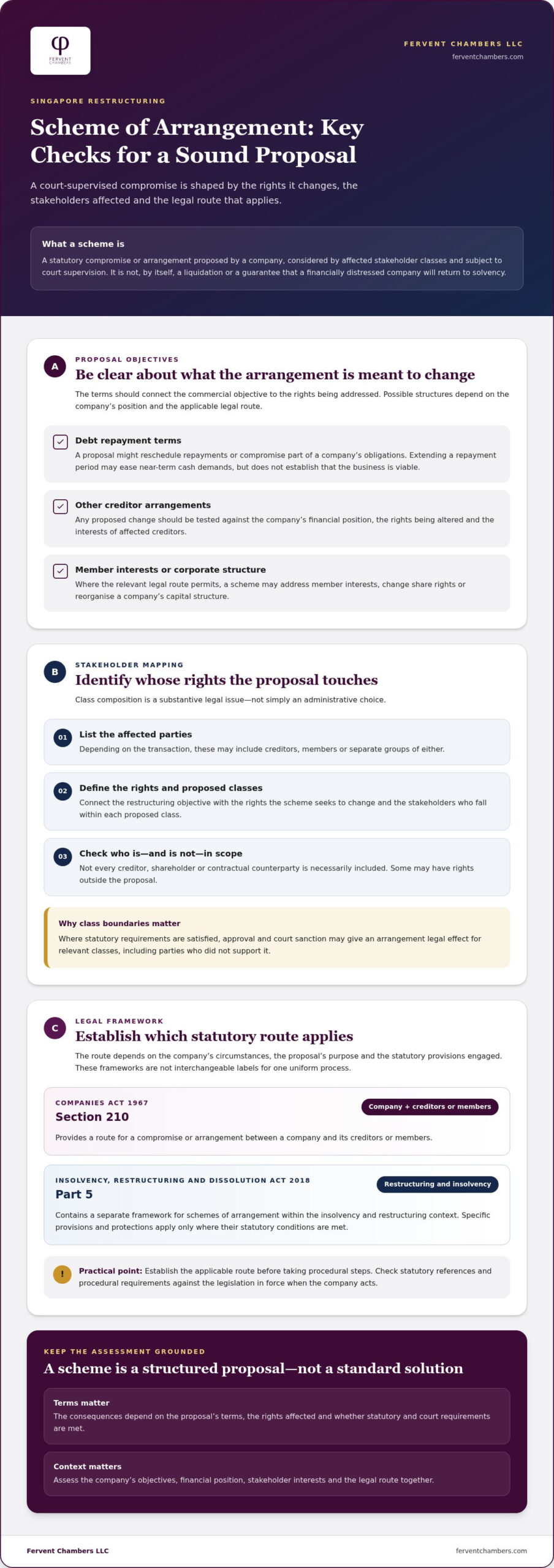
Definition: A scheme of arrangement is a statutory compromise or arrangement proposed by a company, considered by affected stakeholder classes and subject to court supervision. Depending on its purpose and the applicable legal route, it may alter creditor rights, member interests or both. Its legal effect depends on the relevant legislation, class composition, required approvals and court sanction.
A scheme of arrangement is a legal mechanism used in several jurisdictions, but its operation in Singapore is governed by Singapore legislation and court procedure. A scheme is not, by itself, a liquidation or a guarantee that a financially distressed company will return to solvency. It is a structured proposal whose consequences depend on its terms, the rights affected and whether the applicable statutory and court requirements are met.
The phrase scheme of arrangement Singapore describes a process, not a single standard solution. The proposal must be considered in its legal and commercial context, including the company’s objectives and the stakeholders whose rights it seeks to change.
What commercial problems can a scheme address?
A company might propose to reschedule debt repayments, compromise part of its obligations or revise other arrangements with creditors. These are possible structures, not assured outcomes. Each proposal must be tested against the company’s financial position, the rights being altered and the interests of affected creditors. For example, extending a repayment period may ease near-term cash demands and support continued operations, but it does not establish that the business is viable.
Schemes may also be used for corporate reorganisations or arrangements affecting members where the relevant legal route permits. A proposal could seek to change share rights or reorganise a company’s capital structure. The commercial objective must be considered alongside members’ legal rights and the proposed treatment of each affected group. A scheme is not a general means of changing any obligation or corporate arrangement without regard to those rights.
Who may be affected by a proposed scheme?
The proposing company develops the arrangement, which concerns the rights of the stakeholders it identifies. These may include creditors, members or separate groups of either, depending on the transaction. The company must identify the rights it proposes to address and the stakeholders who fall within the proposed classes. Class composition is a substantive legal issue, not simply an administrative choice.
Not every creditor, shareholder or contractual counterparty is necessarily included. Some may have rights outside the proposal, while others may be affected only if the scheme’s terms and applicable law bring them within its scope. This distinction matters because approval and court sanction may give an arrangement legal effect for relevant classes, including parties who did not support it, where statutory requirements are satisfied. Early legal analysis can connect the restructuring objective with the rights at stake, proposed class boundaries and the process required under Singapore law.
Which Singapore Legal Framework Governs a Scheme of Arrangement?
The legal route for a scheme of arrangement Singapore companies propose depends on the company’s circumstances, the purpose of the proposal and the statutory provisions engaged. The Companies Act 1967 and the Insolvency, Restructuring and Dissolution Act 2018 (IRDA) are relevant frameworks, but they are not interchangeable labels for one uniform process. Selecting the route requires attention to the company’s legal status and the rights the scheme is intended to affect.
How do the Companies Act and IRDA relate to schemes?
Section 210 of the Companies Act provides a route for a compromise or arrangement between a company and its creditors or members. For restructuring and insolvency matters, Part 5 of the IRDA contains a separate framework for schemes of arrangement. Which provisions apply depends on the proposal and the company’s circumstances. Establish the route before taking procedural steps, rather than assuming it from the fact that the proposal concerns debt.
| Framework | Relevant context | Practical point |
|---|---|---|
| Companies Act 1967, section 210 | A compromise or arrangement involving a company and its creditors or members. | Its application depends on the company and proposal; it is not a substitute label for the IRDA route. |
| IRDA 2018, Part 5 | Schemes within the insolvency and restructuring framework. | Specific restructuring provisions and protections apply only where their statutory conditions are met. |
This distinction matters because the governing provisions shape the application process, the court’s supervisory role and the legal consequences of an approved arrangement. Legislative amendments can also affect the available mechanisms. Check statutory references and procedural requirements against the legislation in force when the company acts, rather than relying on an older summary of Singapore law.
What protections or court powers may be relevant?
Under the IRDA, an eligible company may obtain an automatic 30-day moratorium upon filing a scheme application, subject to the statutory requirements. An extension requires court approval. This is not a general assurance that all enforcement will stop in every case. Its scope and availability must be assessed against the company’s circumstances and the applicable provisions.
The IRDA also provides for court-approved rescue financing that may receive priority over existing debt, and permits cross-class cram-down in qualifying circumstances. These are statutory mechanisms, not automatic entitlements. The proposed financing or scheme must satisfy the relevant legal tests, and the court retains a supervisory role. Their availability should be assessed against current legislation and the facts, including the rights and treatment of affected classes.
Because route selection can affect protections, timing and stakeholder rights, early restructuring and insolvency advice can help align the statutory analysis with the company’s commercial objectives. This overview is general information, not advice on a particular company’s position.
When Is a Scheme More Suitable Than Another Restructuring Route?
A scheme may be worth evaluating when a company needs a coordinated change to stakeholder rights and has a credible basis for continuing as a viable business. It is not automatically preferable, since it can involve court proceedings, extensive disclosure and negotiations across stakeholder classes. Compare whether its structure can address the company’s problem more effectively than consensual negotiations or a formal insolvency process. Consider likely support, urgency, management control and commercial consequences.
What factors indicate that a scheme may be worth evaluating?
Begin with the business fundamentals and whether the proposal makes practical and commercial sense. A restructuring plan should explain how changes to debt or other rights could support the company’s operations, rather than merely postpone an unresolved financial problem. Then identify who must participate. Creditors may have different priorities, while members may be affected by proposals concerning their interests. Interdependent claims or numerous stakeholders can make bilateral agreement difficult, although a scheme’s formal process can also be complex and demanding.
Consider whether the company can develop and present a proposal, provide stakeholders with the information needed to assess it and meet the relevant procedural requirements. If negotiations are progressing with essential counterparties, a consensual workout may be more direct. If a restructuring needs a court-supervised framework to address affected classes collectively, a scheme may merit closer consideration. Either way, test the commercial assumptions behind the proposal.
How does a scheme differ from other restructuring options?
A consensual workout is negotiated with the relevant parties and relies on their agreement. Parties outside that agreement are not bound simply because others accept the deal. A scheme involves court supervision and, if applicable statutory requirements are met and the court sanctions it, may bind dissenting parties within the relevant class. Dissent alone does not determine the outcome, but a scheme does not guarantee that a proposal will be approved or sanctioned.
Judicial management is a formal process in which an independent judicial manager is appointed to manage the company, rather than its existing management ordinarily retaining control as it may in a scheme. Its objectives and consequences differ, so the company’s need for independent management and prospects for restructuring are relevant to the comparison. Liquidation, by contrast, focuses on winding up the company and dealing with its assets and liabilities, rather than preserving operations through a compromise.
- Objective: Is the goal to adjust stakeholder rights, negotiate voluntary changes, place management under an independent office-holder, or wind up the company?
- Support and urgency: Can the necessary stakeholders engage with a proposal, and can the company manage the time and procedural demands involved?
- Control and consequences: What happens to management, business operations and stakeholder rights under each route?
Assess a scheme of arrangement Singapore companies consider against these factors together. Complexity, cost, timing and disruption depend on the proposal and the company’s circumstances. Early, fact-specific legal analysis can help directors compare the routes without assuming that one option is universally suitable. A debt restructuring lawyer in Singapore can also help assess viability, creditor support and the available restructuring options.
How Does the Scheme Process Move from Proposal to Implementation?
A scheme’s procedural path depends on the applicable statutory route and the court’s directions, so the steps below are a general guide, not a fixed sequence. In a scheme of arrangement Singapore process, preparation matters throughout: financial information must be reliable, the proposal must be workable and affected stakeholders need clear information to assess its implications.
- Develop the proposal. The company identifies the restructuring objective, the rights it proposes to change and the commercial basis for the arrangement. Cash-flow forecasts, liabilities, corporate records and supporting assumptions should be accurate enough to explain why the proposal is feasible.
- Confirm the legal route and stakeholder classes. The applicable legislation, proposed class composition and required procedure need legal analysis. These determine who may be included, how their interests are treated and what approvals or court directions are required.
- Apply to the court where required. Depending on the statutory route, the company may need to seek directions about meetings and the process for putting the proposal to affected stakeholders. The application and supporting evidence should reflect the proposed arrangement and applicable requirements.
- Provide explanatory information. Stakeholders should receive materials explaining the proposal, its likely effects on their rights and the relevant context for considering it. Incomplete or difficult-to-follow information can hinder informed consideration and undermine confidence in the process.
- Hold meetings and seek the required approvals. Where meetings are directed or required, voting arrangements follow the applicable legal framework and court directions. The necessary approvals depend on the route and proposal. A favourable vote does not, by itself, replace any required court sanction.
- Obtain sanction and implement the scheme. The court considers the application for sanction and may approve or refuse the arrangement. Where required, the sanction order must then be lodged with the Accounting and Corporate Regulatory Authority (ACRA). Under the relevant requirement, a copy is lodged within seven days. The scheme takes effect in accordance with the applicable law and order.
What preparation is needed before stakeholders vote?
Align the proposal, supporting evidence and stakeholder communications. Reconcile financial information with company records, explain material assumptions and describe how the proposed terms affect each relevant constituency. Class composition and voting arrangements require legal analysis. Similar-sounding claims do not necessarily mean stakeholders have identical legal rights, and court procedure and disclosure obligations can vary with the statutory route.
What happens after voting and court consideration?
After any required vote, the court considers whether to sanction the proposal under the applicable framework. Sanction and any required lodgement determine when the scheme takes effect. Implementation then requires the company to track performance against the approved terms and meet associated obligations. There is no standard timeline: negotiations, proposal complexity, court directions and stakeholder responses can all affect progress.
Early, fact-specific guidance can help identify procedural and disclosure issues before they disrupt the process. For tailored support with restructuring decisions, discuss your scheme process with Fervent Chambers LLC, or review this distressed company legal advice in Singapore checklist.
What Should Companies and Creditors Do Before Pursuing a Singapore Scheme?
Before pursuing a scheme, decision-makers should establish a reliable picture of the company’s financial position, identify whose rights may be affected and define the commercial purpose of the arrangement. A structured assessment helps reveal whether the proposal addresses the underlying problem, what information stakeholders will need and which legal questions require attention. A scheme of arrangement Singapore companies consider should be grounded in current records and realistic assumptions, not urgency alone.
What information should decision-makers organise?
Companies can start by assembling a decision brief that allows directors and advisers to assess the proposal from both a financial and legal perspective. Useful materials include:
- Financial position: Current financial statements, cash-flow information, debt schedules and details of liabilities, including contingent obligations where relevant.
- Contracts and security: Material contracts, security documents and records identifying assets or obligations connected to particular creditors.
- Stakeholder map: Creditor and member records, their respective rights and exposures, and any interdependencies that may affect negotiations or the proposed arrangement.
- Proposal assumptions: The commercial objective, proposed terms, implementation assumptions and principal risks, including the basis for expecting the company to meet its obligations under the proposal.
Records should be current and consistent enough to support clear explanations. If management forecasts, creditor schedules and corporate records do not align, the differences may affect confidence in the proposal and the quality of information available to stakeholders. Directors should also consider governance, record-keeping and disclosure issues, taking qualified legal advice on their responsibilities in the company’s specific circumstances.
How can legal advice support a considered decision?
Creditors should examine the proposal’s terms and supporting information, understand how their rights may be treated within any proposed class and compare the arrangement with relevant alternatives. They should identify assumptions that materially affect the company’s capacity to implement the proposal and consider how the outcome could affect their position. A creditor’s class position and rights depend on the applicable legal framework and the facts, not on labels used in negotiations.
Legal advice can help decision-makers assess the statutory route, proposed class composition, court procedure, disclosure requirements and stakeholder rights. Where relevant, the analysis may also need to account for potential litigation, enforcement activity or cross-border commercial relationships. Addressing these issues early can help the company evaluate procedural exposure alongside its operational and financial objectives. A broader overview of debt restructuring advice for Singapore businesses may assist readers considering the wider advisory issues involved.
This guide provides general information, not legal advice for a particular company or creditor. For a fact-specific assessment of restructuring options and stakeholder risks, discuss your circumstances with Fervent Chambers LLC.
Make the Next Restructuring Decision With Clarity
Turn a broad restructuring concern into a disciplined assessment of the company’s position, priorities and available choices. A scheme of arrangement Singapore businesses consider should be evaluated against the commercial objective and interests at stake, with advice tailored to the facts rather than assumptions about the likely outcome.
Disputes, corporate obligations or cross-border commercial and regulatory issues may also affect how a restructuring proposal is shaped and implemented. Fervent Chambers LLC advises on restructuring and insolvency, and handles complex commercial dispute resolution and corporate law matters, including challenges that span jurisdictions.
For guidance on the legal and commercial considerations relevant to your company’s circumstances, discuss a restructuring matter with Fervent Chambers LLC.
Frequently Asked Questions
Can a scheme of arrangement affect a company’s guarantors?
It may, but a scheme should not be assumed to release or vary a separate guarantee automatically. The position depends on the proposal’s wording, the guarantee and security documents, and applicable law. Identify who gave each guarantee, which obligations it covers and whether any connected claim is addressed by the proposed terms. Because the consequences are document-specific, obtain legal advice before treating a guarantee as changed or discharged.
Can a company continue trading while a scheme is being considered?
Possibly, but considering a scheme does not itself guarantee that ordinary trading can continue. The company’s ability to operate may depend on available cash, financing terms, key contractual obligations, court orders and any applicable protection. Directors should assess whether the business can meet near-term expenses, such as payroll and supplier payments, while the proposal is developed. They should monitor changes in the company’s position and take advice before making decisions that could affect creditors.
What happens to contracts during a scheme of arrangement?
A scheme does not automatically rewrite every contract connected with the company. The effect depends on the proposal’s terms, the contract wording and applicable law. To assess continuity, review provisions dealing with payment defaults, termination, consent or notice, particularly in contracts with essential suppliers, lenders, landlords or customers. A contract may raise separate issues even if related debt is addressed by the scheme, so assess each material agreement individually.
Can a foreign-incorporated company use a Singapore scheme of arrangement?
A foreign-incorporated company may be able to pursue a scheme in Singapore, but eligibility depends on the statutory requirements, its connection to Singapore, the court’s jurisdiction and the specific facts. The analysis should also consider whether creditors, assets or related proceedings are located overseas, since recognition or enforcement in another jurisdiction may affect practical implementation. Incorporation outside Singapore does not, by itself, resolve the question. Cross-border advice should address the company’s structure and relevant jurisdictions.
Do directors remain responsible for company decisions during a scheme?
Yes. Considering a scheme does not, by itself, remove directors’ responsibilities or automatically transfer management. The duties that apply depend on the company’s circumstances, governing law, court orders and any appointed officeholders. Directors should maintain reliable records of material decisions, document the information considered and keep governance arrangements under review as the company’s financial position develops. If distress may affect their decision-making obligations, they should obtain advice based on the company’s specific facts.
Can a scheme proposal be changed after it has been presented to creditors?
It may be possible to revise a proposal, but changes can affect stakeholder rights, disclosure materials, class analysis and voting arrangements. For example, a change to repayment terms may alter how a creditor assesses the proposal, making earlier explanatory information inadequate. The permitted steps depend on the stage reached, the applicable legislation and any court directions. Obtain legal advice before circulating revised terms or relying on approvals sought on the basis of an earlier proposal.