
The restructuring route that offers the fastest relief may not be the one that preserves a viable business. When cash flow tightens, directors need to weigh the company’s prospects against creditor interests, stakeholder support and the risk that negotiations could lead to formal proceedings. A debt restructuring lawyer Singapore businesses engage can help turn those issues into a clear legal and commercial strategy.
It can be difficult to know which creditors need to agree, what information they will expect and whether the business can continue operating while its liabilities are addressed. The right approach depends on the company’s financial position and the prospects of reaching an enforceable outcome, not just the amount of debt or urgency of creditor demands.
This guide explains how to assess viability, prepare for creditor discussions and compare Singapore’s restructuring options, including schemes of arrangement, judicial management and the Simplified Insolvency Programme. It also outlines how legal counsel can support negotiations, address disputes that intersect with restructuring and identify when formal proceedings or insolvency advice may be necessary.
Key Takeaways
- Treat tightening liquidity, missed obligations and creditor pressure as signals to assess options early, not proof that insolvency is unavoidable.
- Compare an informal workout, scheme of arrangement, judicial management and winding up by consent, court involvement, management control and intended outcome.
- Prepare for creditor engagement with a documented debt position, consistent forecasts and a clear map of stakeholders whose support may matter.
- A debt restructuring lawyer Singapore businesses work with can assess legal exposure and creditor positions alongside commercial objectives.
- Consider how disputes, arbitration and cross-border issues could affect the restructuring strategy and its implementation.
When does a Singapore business need a debt restructuring lawyer?
Tightening liquidity, missed obligations, creditor pressure and shrinking operational headroom are reasons to assess restructuring options before a payment crisis limits the company’s choices. These are warning signs, not proof that insolvency is unavoidable. A business may have a temporary cash-flow mismatch while its operations remain viable, or it may face deeper problems that call for a more fundamental response.
Early legal advice can help directors understand available routes, identify legal exposure and organise creditor discussions before positions harden. A debt restructuring lawyer Singapore businesses consult can assess the options alongside commercial realities, including whether reliable forecasts support a viable plan and whether key stakeholders may support it.
What signs suggest a company should assess restructuring options?
Start with a forward-looking cash-flow forecast. If it indicates the company may be unable to meet obligations as they fall due, investigate the cause and timing of the shortfall rather than relying on the current bank balance. Review near-term payments, expected receipts, available funding and assumptions that could materially change the forecast.
Other indicators include covenant concerns, overdue liabilities, refinancing pressure and material disputes with creditors. Their significance depends on context. A delayed payment caused by a temporary interruption differs from recurring operating losses or a debt burden the business cannot realistically service. An initial review should test both the source of the pressure and the time available to respond.
- Compare forecasts with actual cash movements, and update assumptions as trading conditions change.
- Record overdue debts, upcoming maturities, creditor demands and disputed amounts.
- Assess whether operational changes, refinancing or negotiated adjustments could restore liquidity, and identify the evidence for that assessment.
This analysis helps distinguish a short-term funding problem from a business that may not be viable in its current form. Where a company is already in financial distress, a distressed company triage checklist can help decision-makers organise the issues that need attention first.
Whose interests should the first legal assessment consider?
The assessment should map the company’s obligations and the people whose decisions or rights may affect its response. Directors need a clear view of the company’s position and the consequences of continuing to incur obligations. The company also needs a workable strategy that accounts for operational needs. Secured creditors may focus on their security and recovery prospects, while unsecured creditors may compare the proposed treatment of their claims with other possible outcomes.
Shareholders may prioritise preserving ownership value, but their interests can diverge from creditor priorities as financial distress deepens. The analysis should not assume that one group’s preferred outcome serves all stakeholders. Identify who needs to be engaged, what information they may need and where competing positions could block agreement.
Reliable financial information and candid stakeholder mapping make discussions more credible. If the business remains viable, early coordination may preserve more than one route. If it does not, prompt advice can help decision-makers consider an orderly response. The appropriate path depends on the company’s prospects, the evidence supporting them and the degree of stakeholder alignment, not creditor pressure alone.
How Singapore debt restructuring routes work under the legal framework
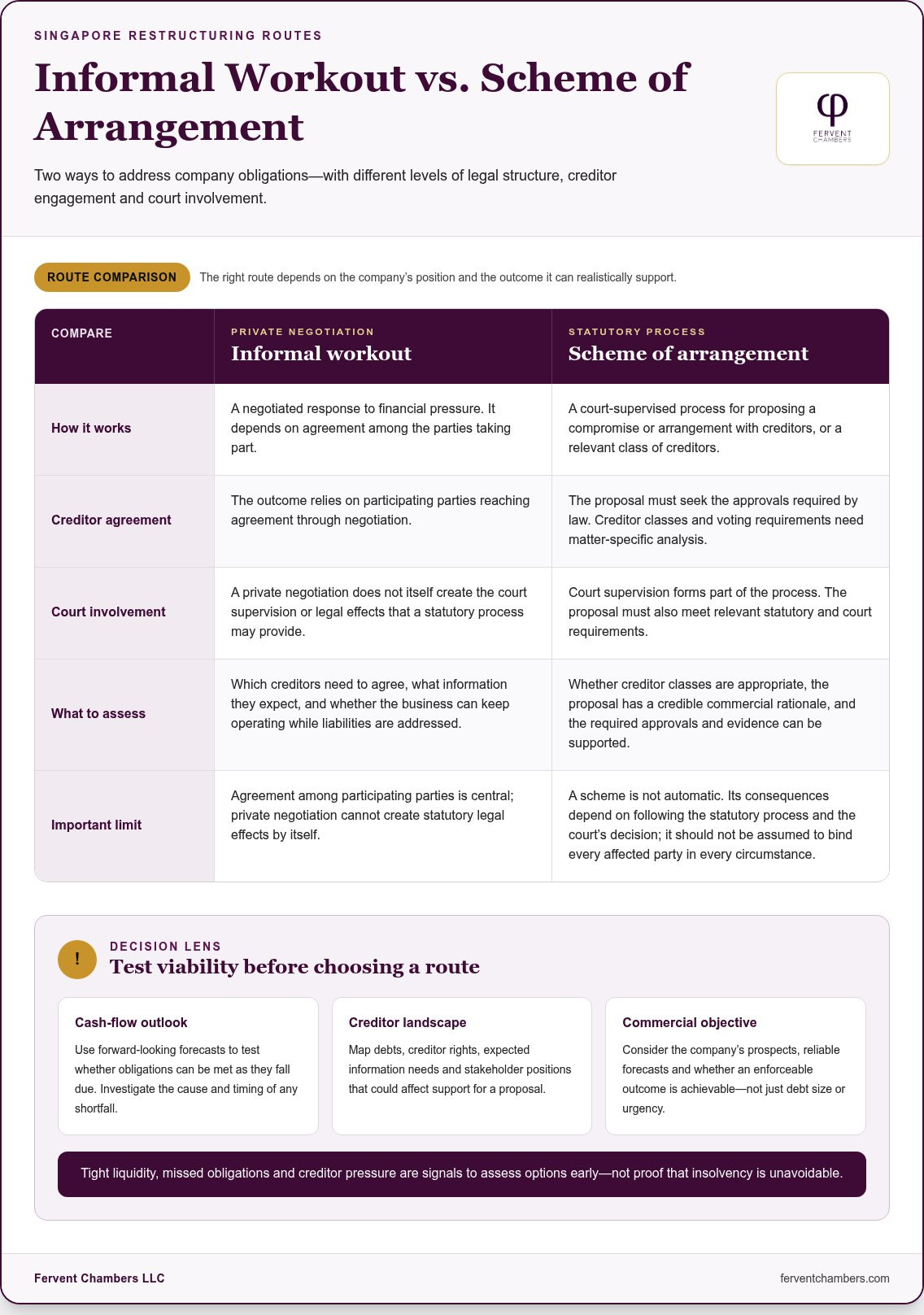
Debt restructuring is a negotiated or legally facilitated reorganisation of a company’s obligations. It aims to address financial pressure while giving the business and its creditors a framework for deciding what happens next. The route matters: an informal workout depends on agreement among participating parties, while a statutory process may provide court supervision and legal effects that a private negotiation cannot create by itself.
Singapore’s framework includes the Insolvency, Restructuring and Dissolution Act 2018 (IRDA) and the Companies Act 1967, alongside applicable regulations and procedural requirements. The rules relevant to a proposal depend on the mechanism and the company’s circumstances. A debt restructuring lawyer Singapore companies engage can assess how the framework interacts with creditor rights, existing agreements and the commercial objective.
What role can a scheme of arrangement play?
A scheme of arrangement is a court-supervised process through which a company may propose a compromise or arrangement with creditors, or a relevant class of them. It provides a formal structure for presenting revised obligations and seeking the approvals required by law, but it is not an automatic solution. The proposed classes, voting requirements, supporting evidence and court requirements need matter-specific analysis.
The company should consider whether creditors with materially different rights or interests need to be treated separately and whether the proposal has a credible commercial rationale. A scheme’s consequences depend on compliance with the statutory process and the court’s decision. It should not be assumed to bind every affected party in every circumstance. The Singapore scheme of arrangement guide provides further context on this mechanism.
When might judicial management or other formal steps arise?
Judicial management is a distinct formal mechanism under the IRDA. A judicial manager takes control of the company’s affairs, business and property under the statutory framework. The process is directed toward an outcome permitted by law, which may include rescuing the company or achieving a better result for creditors than winding up. Its effects, eligibility requirements and consequences for management and creditors must be assessed against the law and the company’s circumstances.
Urgent creditor enforcement, threatened proceedings or an imminent inability to meet obligations may narrow the practical choices. In some circumstances, a formal process may offer protections or coordination that an informal discussion cannot. In others, it may be unsuitable or disproportionate. Singapore also provides a Simplified Insolvency Programme for eligible companies, but the company’s eligibility and applicable process require legal assessment. No route should be selected on its label alone.
The decision should connect legal effect to commercial feasibility: who may be bound, what control changes, which obligations can be addressed and whether the proposal has a realistic prospect of support. Where these questions intersect with creditor disputes or business continuity, Fervent Chambers’ restructuring and insolvency counsel can help align the legal mechanism with the company’s wider strategy.
How to compare a workout, scheme or formal insolvency route
Each route affects how agreement is reached, who participates and who controls the company. An informal workout may preserve commercial flexibility, but it generally depends on the agreement of the creditors whose cooperation is needed. A statutory process provides a structured legal framework, although its protections, reach and requirements depend on the mechanism and circumstances.
The comparison below is a starting point, not a recommendation. Assess the company’s financial evidence, creditor composition, business viability and timing together. No route, including a formal rescue process, guarantees that the business will survive.
| Route | Consent | Court involvement | Management control | Stakeholder reach | Intended outcome |
|---|---|---|---|---|---|
| Informal workout | Agreement from participating creditors | Usually none | Typically remains with existing management | Usually limited to parties that agree | Negotiated changes to obligations or repayment |
| Scheme of arrangement | Statutory creditor approval and court sanction, subject to applicable requirements | Court-supervised | Usually remains with existing management | May extend to affected classes under the statutory process | Compromise or arrangement with creditors |
| Judicial management | Formal statutory route; the application and applicable requirements govern | Court-supervised | Control passes to a judicial manager | Operates within the statutory framework | Rescue or a better result for creditors than winding up, where achievable |
| Winding up | Depends on the applicable winding-up route | May involve the court, depending on the route | A liquidator administers the winding up | Claims are handled through the winding-up process | Realise assets and distribute proceeds according to applicable rules |
How does an informal workout compare with a formal process?
A workout can be tailored to the company’s operations and negotiated directly with creditors. That flexibility does not remove the need to secure sufficient participation or document agreements clearly. If a key creditor will not agree, or different creditor groups need coordinated treatment, a workout may not resolve the wider problem. Formal mechanisms provide statutory procedures and may have effects that private agreements cannot achieve, subject to the applicable requirements.
Which factors should determine the restructuring route?
Test whether continuing operations can support a credible repayment or compromise proposal, then consider how the proposed route fits the creditor structure. A debt restructuring lawyer Singapore companies retain can help evaluate the legal and commercial trade-offs without assuming that any particular mechanism is suitable.
- Viability: Can projected trading support the proposal, and are the assumptions evidence-based?
- Creditor structure: Which creditors are secured or unsecured, and do class or intercreditor issues affect coordination?
- Reach and control: Which parties need to agree, and would management retain control?
- Timing and connections: Could urgent enforcement change the available options? Could cross-border creditors, assets or contracts complicate implementation?
These considerations form a route-selection matrix, not a formula. For example, a business with support from its principal creditors may explore a negotiated workout. Fragmented creditor positions or a need for broader statutory effect may warrant analysis of a formal mechanism. If the evidence shows that the business cannot continue viably, winding up may also need to be considered. The decision should reflect enforceability and commercial consequences, not formality alone.
How to prepare for creditor negotiations and a restructuring plan
Creditor discussions are more productive when the company can explain its financial position, the cause of its difficulties and the basis for any proposed compromise. Preparation should produce a coherent account supported by records, not optimistic projections assembled to secure short-term agreement. As financial distress develops, directors should obtain tailored legal advice on their duties and the company’s exposure.
What information should be organised before creditor discussions?
Assemble a current financial picture and a forward view. Reconcile the figures across financial statements, management accounts and forecasts, and record the source of each material assumption, such as expected customer receipts, planned cost reductions or refinancing discussions. The debt schedule should distinguish amounts accepted as due from disputed claims, and identify security interests and contractual commitments that may affect the proposal.
How can a company structure creditor engagement?
Use an ordered preparation process so internal decisions precede external proposals. Adapt the steps to the company’s circumstances:
- Diagnose the finances. Prepare current and projected cash flows, assets, liabilities and upcoming payment obligations. Identify the timing and cause of any funding gap.
- Test the operating assumptions. Set out realistic forecasts, the evidence behind each assumption and the operational steps needed to achieve them. Explain material uncertainties rather than obscuring them.
- Reconcile the debt position. Map creditor identities, claim amounts, due dates, security, guarantees where relevant, and material contractual obligations. Separate disputed items from amounts the company accepts.
- Map stakeholders and dependencies. Identify creditors, counterparties or other stakeholders who may influence a proposal. Note differences in security, priority, commercial interests or enforcement positions, and consider cross-border connections involving creditors, assets or agreements.
- Set the engagement framework. Establish the company’s objectives, who has authority to negotiate, approved communication channels and a realistic timetable. Prepare a consistent explanation of the proposed treatment of obligations and the information supporting it.
Consistent forecasts let creditors examine the same assumptions and assess whether the proposal is commercially credible. A clear debt schedule can also reveal where claims, security or disputes need separate analysis before terms are discussed collectively.
Keep communications coordinated and accurate. Limit sensitive financial material to appropriate recipients, handle documents in accordance with legal advice, and do not assume that discussions are confidential or protected in every circumstance. Preserve relevant accounting records, contracts, creditor correspondence and board materials. Do not alter or discard records because negotiations are being considered.
A debt restructuring lawyer Singapore companies consult can help assess proposals, creditor positions and connected disputes, while supporting disciplined documentation of negotiations. Advice should also reflect the directors’ circumstances as financial distress evolves.
For help organising creditor discussions and evaluating restructuring options, Fervent Chambers advises on restructuring and insolvency matters.
What a debt restructuring lawyer in Singapore can contribute
Restructuring advice is most useful when legal mechanisms are assessed alongside the company’s commercial objectives, creditor positions and operational constraints. A debt restructuring lawyer Singapore businesses engage can help identify available options, the risks of each route and how a proposed course of action may affect the business beyond its immediate financing needs. The assessment should be grounded in the company’s records and circumstances, not an assumed outcome.
How does counsel support a restructuring from assessment to implementation?
Counsel can analyse the company’s obligations, creditor rights, contractual terms and potential legal exposure, then compare those findings with its financial and operational objectives. This includes identifying which parties may need to participate, where creditor interests differ and whether disputes could obstruct a proposed compromise. The analysis can inform the structure of negotiations and the documentation needed to progress the chosen approach.
Implementation also requires attention to the wider business. A proposal affecting supply arrangements, financing or key contracts may affect continuity, so those consequences should be considered alongside creditor recovery. Counsel can help address these connected issues and record the company’s position accurately, without assuming creditors will accept a proposal or that a particular route will produce a specific result.
When should a business seek restructuring and insolvency advice?
Consider advice when material liquidity constraints threaten the company’s ability to meet obligations, creditors are taking or preparing enforcement steps, or stakeholders disagree over a restructuring proposal. Early analysis can clarify legal and commercial choices, identify matters requiring directors’ attention and help prevent a dispute or delayed decision from unnecessarily narrowing the available options.
Fervent Chambers LLC advises on restructuring, insolvency and complex commercial matters, including disputes and arbitration that may intersect with creditor negotiations. For businesses with overseas creditors, assets or contractual relationships, cross-border considerations may affect how a proposed strategy can be implemented. A broader corporate restructuring and insolvency guide can help frame the issues, while advice on a particular matter should be tailored to its facts and applicable law.
The appropriate next step depends on the company’s financial position, stakeholder landscape and immediate risks. If your business is facing creditor pressure or evaluating a restructuring plan, discuss your circumstances with Fervent Chambers to consider the legal and commercial issues that may shape the way forward.
Set the Next Step on a Clear Commercial Footing
Before committing to a proposal, ensure decision-makers understand its assumptions, consequences and practical demands. A restructuring strategy should stand up to creditor scrutiny while reflecting the company’s operating realities. Where uncertainty remains, advice can clarify the choices before positions become harder to shift.
A debt restructuring lawyer Singapore businesses engage should consider legal exposure alongside commercial objectives and stakeholder relationships. Fervent Chambers is an award-winning disputes and corporate law firm advising clients from startups to listed multinational corporations. Its restructuring and insolvency work sits alongside commercial dispute resolution and arbitration, which can be relevant when creditor negotiations intersect with contested claims or wider business issues.
A considered discussion can help leadership identify the questions requiring attention and determine how to address them. Discuss your restructuring options with Fervent Chambers to take the next step with a clearer basis for decision-making.
Frequently Asked Questions
Can a company restructure debt without going to court?
Yes. A company can restructure debt without court involvement through a consensual workout. For example, a lender might agree to revised instalments directly, while a supplier remains outside that agreement and retains its existing rights. A court-supervised mechanism is different: it follows statutory procedures and may have legal effects beyond a private agreement. Whether an out-of-court solution is workable depends on the creditors whose participation is needed, their rights and the company’s circumstances.
How does a scheme of arrangement affect creditors in Singapore?
A scheme provides a court-supervised framework for a company to propose a compromise or arrangement with creditors. Its effect depends on how affected creditors are classified, whether applicable approval requirements are met and whether the court sanctions the proposal. A creditor’s treatment may depend on the rights attached to its claim and the scheme’s terms. A debt restructuring lawyer Singapore businesses engage can assess these issues against the company’s circumstances and applicable law.
What happens if creditors reject a debt restructuring proposal?
Rejection does not automatically determine the company’s next step or mean it must immediately be wound up. The consequences depend on the proposal’s terms, the rejecting creditors’ rights and whether enforcement or court proceedings are already underway. The company may need to revise its offer, pursue discussions with different creditor groups or assess a formal route. Before responding, it should obtain advice on how rejection affects its legal position and alternatives.
Can directors continue operating a company during debt restructuring?
Often, but the answer depends on the process and the company’s circumstances. Directors may continue managing day-to-day operations under some arrangements, while a formal process can change who controls the company. For example, a proposed change to supplier payments or new borrowing may have legal and commercial consequences that need careful review. Directors should obtain tailored advice as financial distress develops, particularly before taking decisions that could increase the company’s obligations.
How long does debt restructuring take in Singapore?
There is no fixed duration for every restructuring. A focused negotiation with a small number of creditors may progress differently from a complex matter involving disputed claims, multiple creditor groups or cross-border interests. A formal process can also involve steps that affect timing, including court procedures and creditor engagement. Keeping financial information current and addressing questions promptly can support more informed planning.
Is judicial management the same as a scheme of arrangement?
No. Judicial management and a scheme of arrangement are distinct formal mechanisms with different structures and purposes. Judicial management involves a judicial manager taking control of the company’s affairs under the applicable framework. A scheme allows the company to propose a compromise or arrangement with creditors through a court-supervised process. Which mechanism, if either, fits depends on the company’s position, objectives, creditor interests and applicable legal requirements.