


Investment readiness depends on more than a compelling business plan. The company’s structure, ownership terms and financing documents need to work together. Startup legal counsel in Singapore can help founders prepare for investment, raise equity, arrange venture debt or convertible financing, and document shareholder rights and employee incentives. A clear legal framework helps define rights and obligations before they become points of friction in a transaction or within the company.
Founders often focus on how much to raise and which investors to approach. Yet terms governing control, conversion, dilution and future decisions can have lasting consequences. Give these details careful attention, particularly when financing arrangements and employee incentives need to support the company’s plans.
This article explains how legal counsel can help with investment structuring, equity and debt financing, convertible instruments, shareholder agreements and employee incentive plans. It also outlines how to assess the support your startup needs and how corporate and commercial advice can help make the funding process more coherent.
Key Takeaways
- Align employee incentives and shareholders’ loans with ownership, repayment expectations and the startup’s plans for future financing.
- Compare equity fundraising, venture debt and convertible financing by considering how each affects control, repayment obligations and later ownership.
- Use shareholders’ agreements and related documents to set clear expectations for decision-making, transfers and dispute resolution.
- Choose a business structure that supports the company’s operations and anticipated investment arrangements.
- Review convertible note terms alongside the intended equity round so the transition from financing to share ownership is clearly addressed.
Employee incentive plans and shareholders’ loans
Employee incentives and shareholders’ loans can affect ownership, cash flow and future financing. Define each arrangement before offering shares or options, or agreeing on repayment terms. An option plan, for example, can set eligibility, vesting conditions and what happens when employment ends. A loan agreement can identify the lender, repayment expectations, interest terms and any conversion rights. Clear documents help founders explain obligations as the company grows, enters new markets or considers an acquisition.
Employee share awards transfer or promise shares under specified conditions, while options give employees the right to acquire shares under the plan’s terms. Vesting can depend on continued service or agreed milestones, so the timing and consequences of an employee’s departure matter. Founders should also determine how awards affect ownership records and future equity rounds. Clear plan rules help employees understand what they may receive and what could affect their interests.
Company size should shape how an incentive plan is administered, not replace careful drafting. A founder-led startup with a small team may need straightforward eligibility and approval processes. A growing company hiring across markets may need consistent documents and decision records. The number of employees affects how awards are communicated, tracked and approved. State who administers the plan and how changes are recorded, so team growth does not create uncertainty.
Employment documents should reflect the role, compensation, responsibilities and applicable workplace policies. Startup legal support can include employment contracts, hiring policies and advice on compliance with Singapore Ministry of Manpower rules. Startups handling customer information should also consider the Personal Data Protection Act. According to the Attorney-General’s Chambers of Singapore, an organisation remains responsible for personal data processed on its behalf by a data intermediary.
When comparing law firms in Singapore, assess whether each can explain the scope of work, drafting process and commercial consequences of employee plans and shareholders’ loans. Compare the proposed work with your needs, including hiring documents, ownership records and funding plans, rather than relying on a generic service description.
Founders should prepare employment contracts, hiring policies and any applicable employee share option plan documents. They should also document loan terms and keep records of approvals, awards and ownership changes. Make sure the documents work together: employment terms should not contradict incentive rules, and loan provisions should make repayment or conversion expectations clear.
For an employee share option plan, define who qualifies, how options vest, how employees exercise them and how departures are treated. Set an approval and recordkeeping process that can continue as hiring expands. For a shareholders’ loan, document whether repayment is expected before distributions or future financing, and how amendments will be handled. These steps give founders a clearer basis for discussions with employees and investors.
Review the arrangements when hiring patterns, financing plans or ownership expectations change. A plan designed for a small founding team may need revision before broader recruitment or an acquisition. Aligning employment contracts, incentive documents and loan terms helps maintain a coherent framework as the startup develops.
Equity fundraising, venture debt and convertible financing
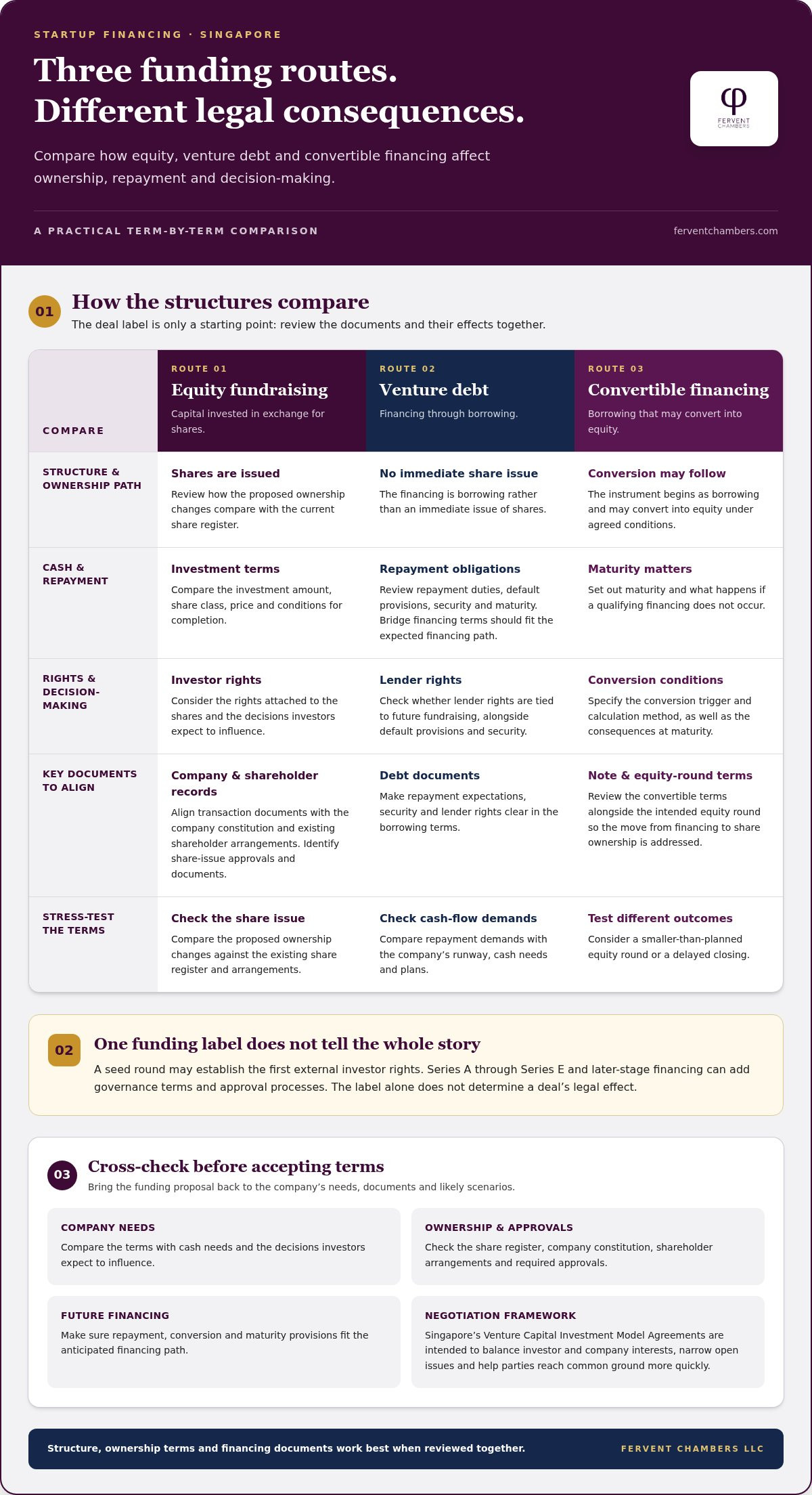
Each funding route has different consequences for ownership, repayment and control. A seed round may establish the first external investor rights, while Series A through Series E and later-stage financing can add governance terms and approval processes. The label alone does not determine a deal’s legal effect. Before accepting an offer, compare its terms with the company’s cash needs and the decisions investors expect to influence.
For an equity round, review the investment amount, share class, price, investor rights and conditions for completion. The transaction documents should align with the company’s constitution and existing shareholder arrangements. Start by comparing the proposed ownership changes with the current share register, then identify the approvals and documents needed to issue the shares. This helps founders understand how a new investor may affect equity and decision-making.
Venture debt provides financing through borrowing rather than an immediate share issue. Review repayment duties, default provisions, security and any lender rights tied to future fundraising. Bridge financing may support operations before a larger equity round, but its maturity and repayment terms should fit the expected financing path. Compare the cash-flow demands with the company’s runway and plans instead of treating debt as a substitute for a completed equity transaction.
Convertible financing begins as borrowing and may convert into equity under agreed conditions. The documents should address the conversion trigger, calculation method, maturity and what happens if a qualifying financing does not occur. Test the terms against different scenarios, including a smaller-than-planned round or a delayed closing. Clear drafting reduces uncertainty when the instrument converts or reaches maturity.
Singapore’s Venture Capital Investment Model Agreements are intended to balance investor and company interests and help parties reach common ground more quickly by narrowing open issues and negotiation. They can serve as a starting point for financing discussions, but each provision still needs to fit the transaction. For startups in financial services, regulatory considerations and business-specific obligations may also affect the financing structure and documents.
Before signing, founders can organise the process around several steps:
- Prepare current ownership and company records.
- Compare equity, debt and convertible terms against cash-flow needs.
- Identify approvals, completion conditions and document changes.
- Model how conversion or repayment affects the next financing stage.
Singapore’s funding market includes companies using different financing structures. Singapore-based AI-driven data processing company bluesheets raised a Series A round, while Singapore-based synthetic data company Betterdata raised a seed round. These examples illustrate why stage labels alone are not enough: founders need to assess instrument terms, investor rights and the business plan behind each transaction.
When negotiations involve competing investor rights, repayment exposure or conversion mechanics, founders can consider corporate financing considerations as part of their legal review, keeping the proposed documents aligned with the company’s commercial objectives.
Shareholders’ agreements and ancillary agreements
For Singapore startups, agreements should connect founder expectations, investor terms and day-to-day operations. Review them together to ensure one document does not undermine another.
Founders’ and Shareholders’ Agreements
A founders’ agreement can record each founder’s role, contribution, decision-making responsibilities and arrangements if someone leaves. A shareholders’ agreement can cover voting, share transfers, reserved decisions and processes for resolving disagreements. Compare these provisions with the company’s constitution and current ownership records. Clear documents give investors a defined framework to review before investing.
Term Sheets and Investment Agreements
A term sheet sets out proposed investment terms, while definitive agreements document the transaction and its obligations. Review valuation, share rights, governance provisions, conditions to completion and investor protections as a connected set. The Venture Capital Investment Model Agreements are intended to balance investor and company interests and narrow open issues and negotiation. Treat model documents as a starting point, then assess each term against the proposed transaction.
Technology and SaaS businesses should document how their software, data and services may be used. A SaaS agreement can specify service scope, payment arrangements, access rights, support responsibilities and termination procedures. Data-processing terms should identify the parties’ roles and explain how customer information is handled. According to the Attorney-General’s Chambers of Singapore, an organisation remains responsible for personal data processed on its behalf by a data intermediary. Singapore startups handling customer information should consider the Personal Data Protection Act.
Intellectual property arrangements also need attention. Record who owns software, designs, written materials and other work created by founders, employees or contractors, and define permitted use in relevant contracts. Startup legal services may include preparing vendor contracts and partnership agreements tailored to the business. A vendor agreement, for example, should describe deliverables, payment, confidentiality and termination. A partnership agreement should clarify responsibilities and decision-making.
Key considerations for Singapore startups include employment contracts and hiring policies that account for Ministry of Manpower rules, customer-data practices that consider the Personal Data Protection Act, and clear contractual arrangements for intellectual property ownership. The documents should reflect the company’s workforce, technology and commercial relationships.
Before signing, founders can map each agreement to a business relationship:
- Match founder and shareholder terms to the ownership records.
- Align investment documents with governance arrangements.
- Document software use, data handling and intellectual property ownership.
- Set out vendor and partner responsibilities in commercial agreements.
Startup business structuring for future investment
For incorporation, founders first select a suitable structure, such as a private limited company, VCC or partnership. They then document ownership, establish governance arrangements and align company records with the financing plan.
Investment due diligence examines whether the entity, ownership and business records support the proposed transaction. Addressing gaps before approaching capital partners gives founders a clearer basis for discussions with investors and institutions.
Venture Capital Investment Terms
Venture capital terms determine the capital invested, the equity issued and the rights attached to that investment. Review valuation alongside voting rights, board participation, information access, transfer restrictions and conditions for completion. Each provision can shape founders’ decisions after funding. A fintech startup, for example, should consider how its business development plans fit with investor oversight.
Term sheets record proposed terms for negotiation; investment agreements set out the transaction’s operative provisions. Compare both documents, identify provisions requiring further negotiation and ensure the final terms match the company’s ownership records. Singapore’s Venture Capital Investment Model Agreements are intended to balance investor and company interests and narrow open issues and negotiation.
Risks for Startup Founders
A lawyer can help founders identify risks such as inconsistent ownership records, unclear decision rights and investment terms that conflict with existing arrangements. These issues can complicate due diligence or lead to disputes after funding. Review the constitution, shareholder arrangements and proposed investment documents together, then record approvals and agreed changes in the company’s records.
The company’s structure also affects how it prepares for growth, new markets or a change in financing. When selecting an entity, founders should weigh the company’s activities, investors’ expectations and future governance needs. A structure chosen without considering these factors may need adjustment as the business develops. A lawyer can help assess these issues and coordinate incorporation documents.
A practical incorporation process starts with the proposed business activities and ownership plan. Founders can then compare private limited companies, VCCs and partnerships against their operations and investment objectives. Next, prepare formation and governance documents, record ownership and establish company records that reflect the agreed structure. This gives prospective investors a coherent basis for review.
For due diligence, assemble current ownership information, governing documents, material commercial agreements and records of company decisions. Compare each record with the proposed investment terms and identify inconsistencies to resolve. This review helps founders explain how capital will enter the business, what rights investors receive and which decisions remain subject to agreed governance.
Founders seeking venture capital representation should consider how legal advice addresses both negotiation and the company’s position. Review the proposed term sheet against the intended financing, assess each investor protection and identify its operational effect. Then carry agreed terms into definitive documents while keeping the company’s governance and commercial plans in view. This discipline helps keep the structure aligned as the venture grows.
Convertible notes and equity rounds
A convertible note begins as financing with repayment terms and may convert into shares under specified conditions. For a Singapore startup, the note should explain when conversion occurs, how the conversion price is calculated and what happens if the planned equity round does not proceed. Before signing, founders and investors should understand maturity, repayment obligations and any conversion rights. These provisions determine how borrowing may later affect the company’s ownership.
Conversion terms deserve close attention before a priced equity round. The documents should explain which financing qualifies, how the share price is determined and whether the note converts automatically or gives the parties a choice. Founders can model the agreed calculation against possible round terms, then compare the resulting ownership with existing company records. This makes the effect on the founders and incoming investors easier to assess.
A note also needs a clear outcome if financing is delayed or never takes place. Review the maturity date, repayment terms, default provisions and any process for extending or amending the instrument. A software company, for example, may need to consider how the note’s repayment date relates to expected customer revenue and fundraising discussions. The agreement should state how the parties will handle these circumstances, rather than leaving essential outcomes to assumption.
Historical transactions illustrate why dates matter. Convertible notes issued by mm2 Asia Ltd to Phillip Asia Pacific Opportunity Fund were due on 30 June 2017. That example is not a current financing template; it shows that a note’s stated due date has a practical role. Founders should record the maturity date and keep it visible alongside financing milestones and obligations.
Before an equity round involving outstanding notes, founders and their lawyers can follow a focused review:
- List each note, its maturity date and its conversion conditions.
- Confirm the qualifying financing trigger and calculation method.
- Compare the expected conversion with the proposed share issuance.
- Identify required approvals, amendments and updated ownership records.
This sequence helps investors understand how existing instruments interact with the new round. It also gives the startup a structured way to explain the proposed equity issuance, conversion mechanics and resulting ownership. If note terms differ, identify each difference and determine its effect before finalising documents. A consistent record supports negotiations with new funding partners.
Convertible financing and equity rounds should be reviewed as connected transactions, not isolated documents. Founders preparing for a round can review convertible financing documents with legal support, focusing on conversion, maturity and the company’s updated ownership position.
Fervent Chambers LLC: Dispute Resolution
Fervent Chambers LLC assists startups when financing arrangements, shareholder rights or commercial relationships give rise to legal issues. Its Dispute Resolution and Arbitration offerings address commercial disputes, while Corporate and Commercial support helps founders assess related business matters. If financial pressure affects the company’s obligations, Restructuring and Insolvency may also be relevant.
Consider seeking legal assistance when investor negotiations become contentious, a shareholder disagreement affects decision-making, or a contractual dispute threatens business operations. The right course depends on the documents, parties and issues involved. Early review can help founders understand their options and the commercial implications.
Contact Fervent Chambers LLC to discuss your startup’s corporate, commercial or dispute resolution needs.
Make the Next Funding Decision with Clarity
Before pursuing a new funding opportunity, establish a clear process for evaluating its legal and commercial consequences. Identify who can approve proposed terms, which records need updating and how decisions will be communicated to founders, employees and investors. This governance discipline helps maintain alignment as the business develops and new opportunities arise.
Startup legal counsel in Singapore can help founders assess how a proposed transaction affects the company’s wider obligations and relationships. When disagreements or financial pressure arise, Fervent Chambers LLC offers Dispute Resolution, Arbitration, and Restructuring and Insolvency support. The appropriate focus depends on the issue.
For a considered discussion about your company’s next steps, contact Fervent Chambers LLC to discuss your startup. With a clear decision process and appropriate legal support, founders can approach future opportunities with greater confidence.
Frequently Asked Questions
What does a startup lawyer in Singapore help with?
A startup lawyer can help founders address legal issues affecting formation, commercial operations and investor relationships. Counsel may, for example, review a proposed customer contract, assess data-handling terms for a software provider or help resolve a disagreement between business partners. The work depends on the decision facing the company. A clear written scope helps founders distinguish immediate transaction support from ongoing corporate advice.
How much do startup legal counsel services cost in Singapore?
Fees depend on the matter, with a quote provided after a request. Cost factors include complexity, document volume, urgency and whether support covers a defined transaction or ongoing work. Fervent Chambers LLC’s corporate advisory uses fixed and matter-based fees, while legal representation and dispute resolution may use hourly rates or retainers. Compare the proposed scope and billing basis, rather than relying on a rate alone.
What should startups look for when choosing a Singapore startup lawyer?
Choose a lawyer who can explain the scope of work, key decisions, documents and likely stages in clear commercial terms. Ask how the advice will address your specific issue, such as a contract negotiation or shareholder dispute, and what the engagement covers. Startup legal counsel in Singapore should also understand how legal decisions affect the company’s operations, funding plans and stakeholder relationships.
What should Singapore startups know about fundraising and investment agreements?
Ensure information given to investors is consistent across company records, contracts and transaction documents. For example, confirm that statements about ownership, existing obligations and commercial arrangements match the underlying records before signing. Identify who can approve final terms and keep a record of agreed changes. These steps help prevent avoidable inconsistencies during investor review and after completion.
Can Singapore startups use a fractional general counsel or fixed-fee legal services?
Startups can arrange legal support for ongoing needs or a defined matter, depending on the work required. Fixed-fee or matter-based arrangements can suit clearly scoped corporate tasks, while ongoing external advice can help a business manage recurring decisions. Fervent Chambers LLC provides fixed and matter-based corporate advisory fees. Clarify the engagement’s scope, deliverables and billing basis before work begins.
