
The first response to financial distress can shape the choices available to a company. If cash is tightening and obligations are overdue, establish what the company can pay, what falls due next, and which legal or commercial risks need immediate attention. Distressed company legal advice Singapore can help directors assess those facts before uncertainty develops into a more serious solvency concern.
It is understandable to hope that a temporary liquidity gap will resolve itself, particularly while the business is still operating. But delay can narrow the scope for a considered response, while acting without a clear picture of the company’s position can add risk. Start with evidence-led triage, not the assumption that one restructuring route will suit every company.
This checklist sets out the information to assemble, warning signs to prioritise, and broad restructuring or insolvency pathways that may be relevant under Singapore’s framework. It also explains how to prepare for a focused discussion with counsel. Fervent Chambers LLC advises businesses on restructuring, insolvency, and related commercial issues, bringing legal obligations and business realities into the same assessment.
Key Takeaways
- Treat cash-flow pressure, disputed debts, and interrupted trading as prompts to investigate, not as proof of insolvency on their own.
- Build a dependable position statement by separating confirmed figures from estimates and disputes, then organising forecasts, liabilities, receivables, security documents, and financing terms.
- Assess negotiated workouts, formal restructuring, and insolvency outcomes against the company’s viability, stakeholder support, available funding, and deadlines.
- Use distressed company legal advice Singapore to clarify immediate exposure, support informed decision-making, and evaluate options against the company’s evidence and commercial objectives.
- Prepare for a focused legal assessment by recording key decisions and deadlines, preserving relevant records, and identifying cross-border, contractual, or dispute-related concerns.
Distressed company legal advice in Singapore: recognise the need for early triage
Financial pressure may first show up as a working-cash shortfall, a disputed invoice delaying collections, or disrupted trading that weakens expected revenue. These developments need attention, but none alone establishes that a company is insolvent. Early triage means assembling reliable facts, identifying time-sensitive exposure, and assessing which responses remain commercially and legally available.
Financial distress is a commercial warning that calls for evidence-led assessment, not an automatic finding of insolvency. A missed payment may reflect a temporary timing mismatch. A pattern of unpaid obligations alongside shrinking cash reserves may call for closer examination. Assess the company’s position in context rather than inferring it from one indicator.
Begin with a concise working file covering:
- Cash on hand, expected inflows, and near-term forecasts.
- Obligations due, overdue amounts, and disputed liabilities.
- Creditor or other stakeholder communications, including formal demands.
- Trading interruptions, key contracts, and unresolved disputes.
- Supporting records, decision-makers, and urgent response dates.
Which warning signs should prompt an immediate review?
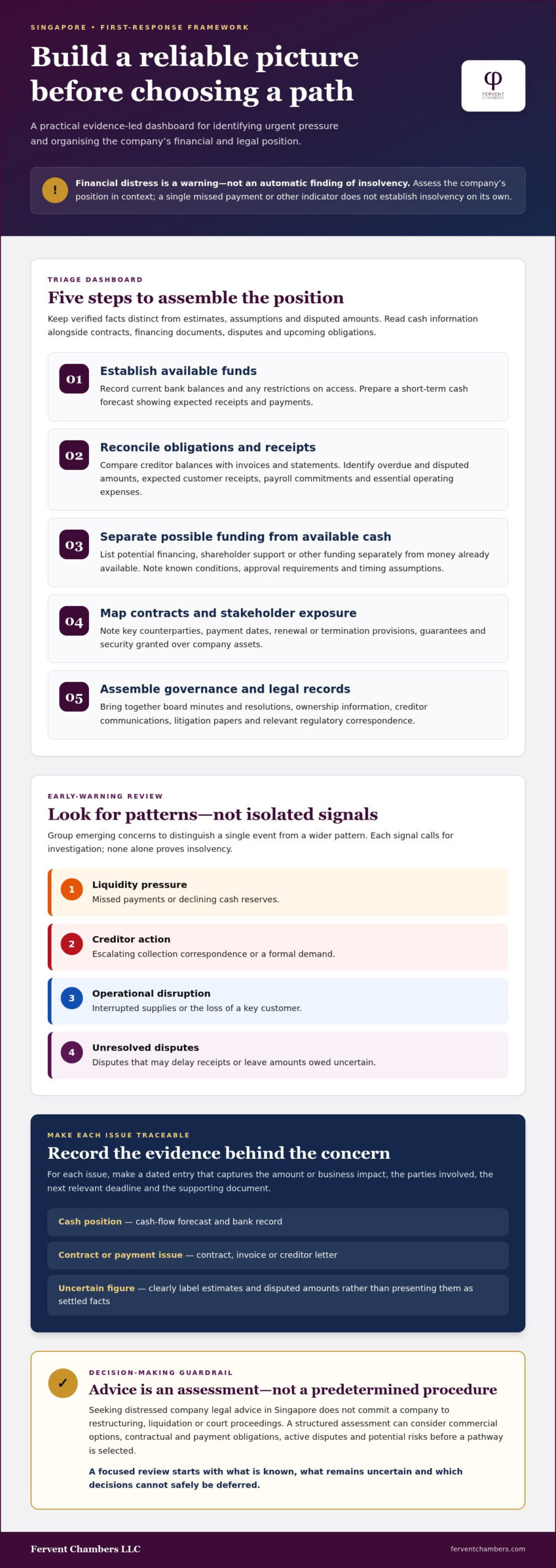
Group emerging concerns to distinguish an isolated event from a wider pattern. Liquidity pressure may include missed payments or declining reserves. Creditor action may involve escalating collection correspondence or a formal demand. Operational disruption can include interrupted supplies or the loss of a key customer, while unresolved disputes may delay receipts or create uncertainty over what is owed.
For each issue, make a dated entry stating the amount or business impact, the parties involved, the next relevant deadline, and the supporting document. A cash-flow forecast, bank record, contract, invoice, or creditor letter may help establish the position. Clearly label estimates and disputed figures rather than presenting them as settled facts.
Why early legal advice does not automatically mean insolvency proceedings
Seeking distressed company legal advice Singapore does not commit a company to restructuring, liquidation, or court proceedings. It can provide a structured assessment of commercial options, contractual and payment obligations, active disputes, and potential risks before the company selects a pathway. That assessment is more useful when leaders can explain what is known, what remains uncertain, and which decisions cannot safely be deferred.
Consider advice alongside the company’s trading realities and the interests of relevant stakeholders, not as a predetermined procedural step. Fervent Chambers advises businesses on restructuring, insolvency, and related commercial disputes, including matters with cross-border dimensions. For broader context, the corporate restructuring and insolvency business guide outlines the wider advisory landscape.
Build a reliable picture of the company’s financial and legal position
Once concerns are identified, create a dependable record of the company’s position. Separate verified information from estimates, assumptions, and disputed amounts. Combining them without explanation can obscure the scale of immediate pressure and the reliability of any proposed response.
A useful distress assessment combines current cash data, contractual commitments, and credible forecasts. No single spreadsheet provides the whole picture. Read financial information alongside financing documents, key contracts, active disputes, and obligations that may fall due before expected receipts arrive.
Assemble the material in sequence:
- Establish available funds. Record current bank balances and any restrictions on access. Prepare a short-term cash forecast showing expected receipts and payments.
- Reconcile obligations and receipts. Compare creditor balances with invoices and statements. Identify overdue and disputed amounts, expected customer receipts, payroll commitments, and essential operating expenses.
- Separate funding possibilities. List potential financing, shareholder support, or other funding sources separately from money already available. Record known conditions, approval requirements, and timing assumptions.
- Map contractual and stakeholder exposure. Note key counterparties, payment dates, renewal or termination provisions, guarantees, and security granted over company assets.
- Assemble governance and legal records. Include board minutes and resolutions, ownership information, creditor communications, litigation papers, and relevant regulatory correspondence.
What financial information should leaders assemble first?
Start with a dated cash position and a forecast that makes its assumptions visible. Identify uncertain collection dates, disputed customer payments, and outflows that may change. Reconcile creditor balances against available records, distinguishing overdue liabilities from amounts not yet due. This helps decision-makers see which figures are confirmed and which need verification.
Present payroll and essential operating costs separately so their timing and business significance are clear. Do not treat a proposed facility or anticipated shareholder contribution as cash on hand. State whether it is under discussion, subject to conditions, or available for use.
Which legal records can materially change the assessment?
Review financing agreements, security documents, guarantees, leases, material supply contracts, and relevant shareholder arrangements. Their terms may affect payment obligations, available assets, or the consequences of a proposed action. Separately schedule active claims, threatened proceedings, adjudication matters, and response or hearing dates, linking each entry to its supporting document.
Preserve source records in a secure, complete, and traceable form. Keep versions and relevant correspondence together. Do not alter or selectively discard documents, even if a record appears incomplete or unfavourable. A clear index can help counsel assess the position efficiently. Where the records reveal intersecting restructuring, insolvency, or commercial disputes, Fervent Chambers’ restructuring and insolvency advice can help place the evidence in its legal and commercial context.
Compare Singapore restructuring and dispute pathways against business realities
Once the company’s financial and legal position is clearer, assess which response fits the evidence and the business’s immediate constraints. A negotiated workout, formal debt restructuring options in Singapore, and an insolvency outcome differ in purpose and implications. Cash pressure alone does not make any one route appropriate. Consider whether the business can operate viably, whether key stakeholders may support a proposal, what funding is realistically accessible, and which obligations or deadlines cannot wait.
A practical comparison asks:
- Viability: Can the underlying business generate sufficient value if liabilities or operations are addressed?
- Stakeholder position: Which creditors, secured parties, shareholders, or counterparties are likely to influence the available options?
- Funding and timing: Is credible funding available for continued operations and implementation? Can action be taken before urgent obligations or legal steps limit choices?
- Dispute exposure: Could claims, enforcement action, or contractual rights materially affect cash, assets, or the ability to trade?
Evaluate these considerations together. A business may remain commercially viable while a dispute threatens a critical contract. Conversely, creditor support alone may not make a proposal workable if the operating plan lacks credible funding. Tailored distressed company legal advice Singapore can help test proposed routes against legal obligations and commercial realities, without treating any outcome as assured.
When might a negotiated workout merit assessment?
Consensual discussions may merit consideration where the company has a credible operating plan and constructive engagement with relevant creditors appears possible. Before approaching stakeholders, identify their positions, the nature of any security, intercreditor arrangements, and contractual restrictions that could shape discussions. Assess a proposal for feasibility, not simply its appeal to one creditor. Negotiations do not by themselves suspend legal rights, enforcement steps, or response deadlines.
When should formal restructuring or insolvency processes be examined?
Singapore’s Insolvency, Restructuring and Dissolution Act 2018 (IRDA) provides a statutory framework relevant to company restructuring and insolvency. At a high level, a scheme of arrangement Singapore companies may pursue may provide a route to propose a compromise with creditors, while judicial management and winding up serve different purposes and involve distinct processes. Their availability, requirements, and consequences depend on the circumstances and current law, so they are not interchangeable solutions.
Formal processes merit examination where informal engagement cannot address the company’s obligations, stakeholder positions are difficult to reconcile, or the business requires a structured legal process. An insolvency outcome may also need consideration if continued trading or restructuring is not viable. Assess implementation time, funding needs, effects on stakeholders, and immediate procedural or contractual risks. Verify current statutory details before making decisions.
Disputes may require a parallel strategy rather than being postponed until a restructuring route is chosen. A claim, threatened enforcement action, or termination right may affect cash flow, operations, or negotiations. A restructuring proposal may also influence how a dispute is approached. Where litigation intersects with financial distress, the commercial litigation business guide provides context on the dispute issues to consider alongside restructuring options.
Use this first-response checklist to protect decision-making and preserve records
During financial pressure, disciplined first steps can help prevent uncertainty from becoming avoidable exposure. The immediate objective is not to make every strategic decision at once. It is to secure accurate information, identify deadlines, preserve relevant records, and obtain advice before taking steps with potentially lasting consequences.
A distressed-company response should prioritise accurate records, deadline control, and informed decisions. Use this sequence as a starting point:
- Assign responsibility for maintaining a current cash and obligations schedule, clearly identifying assumptions and uncertainties.
- List imminent payment dates, court or contractual deadlines, and creditor response dates requiring prompt attention.
- Identify essential suppliers and business-critical operations that missed payments or disrupted services could affect.
- Preserve relevant emails, agreements, accounting records, board materials, and creditor communications in their original, complete form.
- Seek tailored legal advice before committing to an irreversible transaction or action whose consequences are not yet understood.
What should the company prioritise in the first review?
Start with time-sensitive obligations and operational dependencies. For each payment or deadline, record its due date, amount or consequence, responsible person, and supporting document. An essential supplier may require a different assessment from a non-critical expense, but document that distinction rather than assuming it. Keep the cash and obligations schedule current so decision-makers use a consistent record.
Preserve records at the same time. Retain relevant correspondence, executed and draft agreements, accounting material, board papers, and creditor communications. Keep a clear record of where documents are held and who has access. Do not alter or selectively discard records because they appear incomplete or unfavourable.
How should leaders manage communications and decisions?
Coordinate communications through appropriate decision-makers. Ensure statements to employees, creditors, suppliers, and counterparties are accurate and consistent with the information available. Avoid unsupported assurances about payment or business continuity. A promise made to preserve a relationship can create further difficulty if the company cannot fulfil it.
Before transferring assets, making a selective payment, or entering an arrangement that could affect creditors or stakeholders, assess its legal and commercial implications. Directors’ duties and possible personal exposure are fact-sensitive. They require analysis against the company’s circumstances and current Singapore law, not a general assumption about what a distressed company must do.
For each material decision, record who participated, what information was available at the time, the assumptions relied on, the alternatives considered, and the reasons for the decision. Keep records of advice received and subsequent actions, while observing confidentiality and applicable document-retention obligations. A contemporaneous account can help show whether a decision was considered and informed.
Where immediate obligations, potential creditor exposure, or director concerns require a tailored assessment, Fervent Chambers’ restructuring and insolvency advice can help put the issues in context.
Prepare for tailored distressed company legal advice in Singapore
A useful initial legal assessment should clarify four things: what the company is seeking to achieve, which risks need immediate attention, what evidence supports its current position, and when key decisions must be made. For leaders seeking distressed company legal advice Singapore, a concise, organised briefing helps counsel focus on the issues affecting the company’s choices instead of using initial discussions to reconstruct basic facts.
Preparation need not resolve every uncertainty. It should show what is established, what remains disputed or estimated, and which decision cannot reasonably wait. Assemble the following information where available:
- The latest cash forecast, creditor schedule, expected receipts, and material obligations.
- Key contracts, financing documents, security or guarantee records, and relevant shareholder arrangements.
- Active dispute materials, including claims, threatened proceedings, creditor correspondence, and response dates.
- A short account of the company’s ownership, operations, principal jurisdictions, and immediate commercial priorities.
- Decisions already taken, assumptions relied on, upcoming deadlines, and questions requiring urgent resolution.
If a document or figure is unavailable, identify the gap and explain its significance instead of treating an estimate as confirmed. This helps distinguish urgent legal exposure from matters that can be investigated further, while keeping the company’s objectives and operational realities in view.
What information makes an initial legal assessment more useful?
Organise the material by issue and date, then prepare a brief chronology of significant events, such as missed or deferred payments, creditor communications, contract disruptions, and management or board decisions. Identify who holds the relevant records and whether figures have been reconciled. State which deadlines are fixed, which are under discussion, and what consequences may follow if they are missed.
Explain what the business needs to preserve, such as continued supply, a particular customer relationship, or time to evaluate a restructuring proposal. These priorities help frame advice around practical outcomes without assuming that a particular legal process is already preferred.
How can Fervent Chambers support a considered response?
Fervent Chambers is a Singapore disputes and corporate law firm advising on restructuring, insolvency, commercial disputes, and cross-border matters. Its work can bring connected issues into one assessment: how a proposed restructuring relates to creditor positions, whether a dispute or contractual right affects trading, and how relevant jurisdictions may shape the company’s choices. This allows the advice to be considered alongside operational continuity and the company’s wider commercial objectives.
A focused discussion should give the company a clearer view of immediate risks, evidential gaps, pathways for further assessment, and decisions needing prompt attention. Discuss a distressed company matter with Fervent Chambers to consider the company’s position and the advice it requires.
Make the next decision with a clear line of sight
Turn the company’s current position into a decision timetable: identify who must decide, what information is still needed, and which developments would require the assessment to be revisited. This helps leadership respond deliberately as circumstances change, rather than allowing urgent events to dictate the sequence of decisions.
Where restructuring, insolvency concerns, and complex commercial disputes intersect, advice should reflect both legal exposure and the realities of continued operations. Fervent Chambers advises businesses across sectors and cross-border contexts on these matters, bringing relevant commercial and legal considerations into a considered assessment. Seeking distressed company legal advice Singapore can help decision-makers establish a sound basis for their next steps without presuming a particular outcome.
Discuss your company’s restructuring or insolvency concerns with Fervent Chambers to consider the company’s position and next steps.
Frequently Asked Questions
What should a company do first when it is in financial distress?
First, establish how much cash is accessible and which payments or legal dates are approaching. Compare bank balances with accounting records, and identify funds that are restricted or expected but not yet received. Preserve relevant records and mark figures as confirmed, estimated, or disputed. A missed payment alone does not determine the company’s legal position. A Singapore-qualified lawyer can assess the facts and help prioritise urgent decisions.
When should a distressed company seek legal advice in Singapore?
Consider distressed company legal advice Singapore when liquidity pressure persists, creditors threaten enforcement, a liability is disputed, or a material decision could affect creditors or operations. A proposed asset sale or response to formal creditor correspondence, for example, may have consequences requiring prompt, fact-specific review. Seeking advice does not commit the company to formal proceedings. It can clarify deadlines, risks, and potential options before circumstances narrow the available choices.
Can a distressed company continue trading in Singapore?
Whether continued trading is appropriate depends on the company’s financial position, obligations, governance decisions, and current legal duties. A cash-flow concern or creditor demand alone cannot provide a universal answer. Before approving new commitments, directors should consider whether the company can meet them and what reliable information supports that assessment. If the ability to pay obligations is uncertain or formal action is threatened, obtain current Singapore-law advice before making material decisions.
What documents should directors prepare for a restructuring lawyer?
Prepare recent financial statements, forecasts, creditor and debtor schedules, financing and security documents, major contracts, guarantees, board records, and material creditor communications. Include court papers, threatened claims, and relevant regulatory correspondence, organised by date and issue. A concise chronology can show how the company’s position developed and which decisions followed. Clearly mark estimates and disputed amounts, and identify missing documents so assumptions are not mistaken for established facts.
Does financial distress automatically mean a company must be wound up?
No. Financial difficulty alone does not make winding up inevitable or establish that a particular process is suitable. The assessment may depend on whether the business is viable, whether credible funding exists, how stakeholders are positioned, and which legal requirements apply. A negotiated solution or formal restructuring may merit consideration in some circumstances, while other facts may point elsewhere. Singapore processes are technical, so assess current requirements against the company’s situation.
Can creditors take action while a company explores restructuring?
Yes. Creditor action may remain possible depending on the relevant agreements, claims, proceedings, and any legal protection that applies. Informal discussions do not automatically pause contractual rights, court deadlines, or enforcement steps. If a creditor signals intended action, preserve the communication, note any response date, and obtain advice on its implications. Do not assume negotiations create a moratorium or defer a deadline unless the applicable protection has been established.
Are directors personally liable when a Singapore company becomes distressed?
Personal exposure is not automatic merely because a company experiences financial difficulty. It depends on the facts, the directors’ conduct, applicable duties, and relevant statutory rules. Directors should ensure decisions are supported by the information available, record the reasoning, and preserve relevant governance materials. If the company may be unable to meet obligations or creditor interests may be engaged, obtain current advice on the specific circumstances rather than relying on a general assumption.