
A dispute can be governed by one country’s law, heard in another, and depend on evidence or assets held elsewhere. For a cross-border commercial dispute Singapore businesses face, choosing a forum before understanding those connections can limit options or complicate enforcement.
Jurisdiction, governing law and dispute forum are related, but they do not operate in isolation. Evidence, counterparties and assets may also be spread across several legal systems. Before filing in a familiar court or commencing arbitration, assess how the contract, parties, claim and enforcement prospects fit together.
This 2026 guide explains how Singapore’s courts, arbitration and mediation may feature in that assessment, and how governing law, evidence, procedure and enforcement shape the available choices. Fervent Chambers LLC’s disputes and international arbitration practice considers these issues in their commercial context, helping businesses preserve a coherent position and identify a disciplined next step before committing to a forum.
Key Takeaways
- A cross-border commercial dispute can involve multiple jurisdictions through the parties, contract, performance, evidence or assets. Map those connections early.
- For a cross-border commercial dispute Singapore is involved in, assess court jurisdiction separately from governing law, then examine how forum-selection or arbitration clauses may shape the route.
- Compare litigation and arbitration by decision-maker, procedure, contract terms and cross-border implications. The right forum depends on the specific dispute.
- Secure agreements, preserve relevant records and identify connected parties and jurisdictions while observing applicable legal and retention obligations.
- Coordinate commercial objectives, forum choices, evidence and procedural decisions across jurisdictions to maintain a coherent resolution strategy.
What makes a commercial dispute cross-border when Singapore is involved?
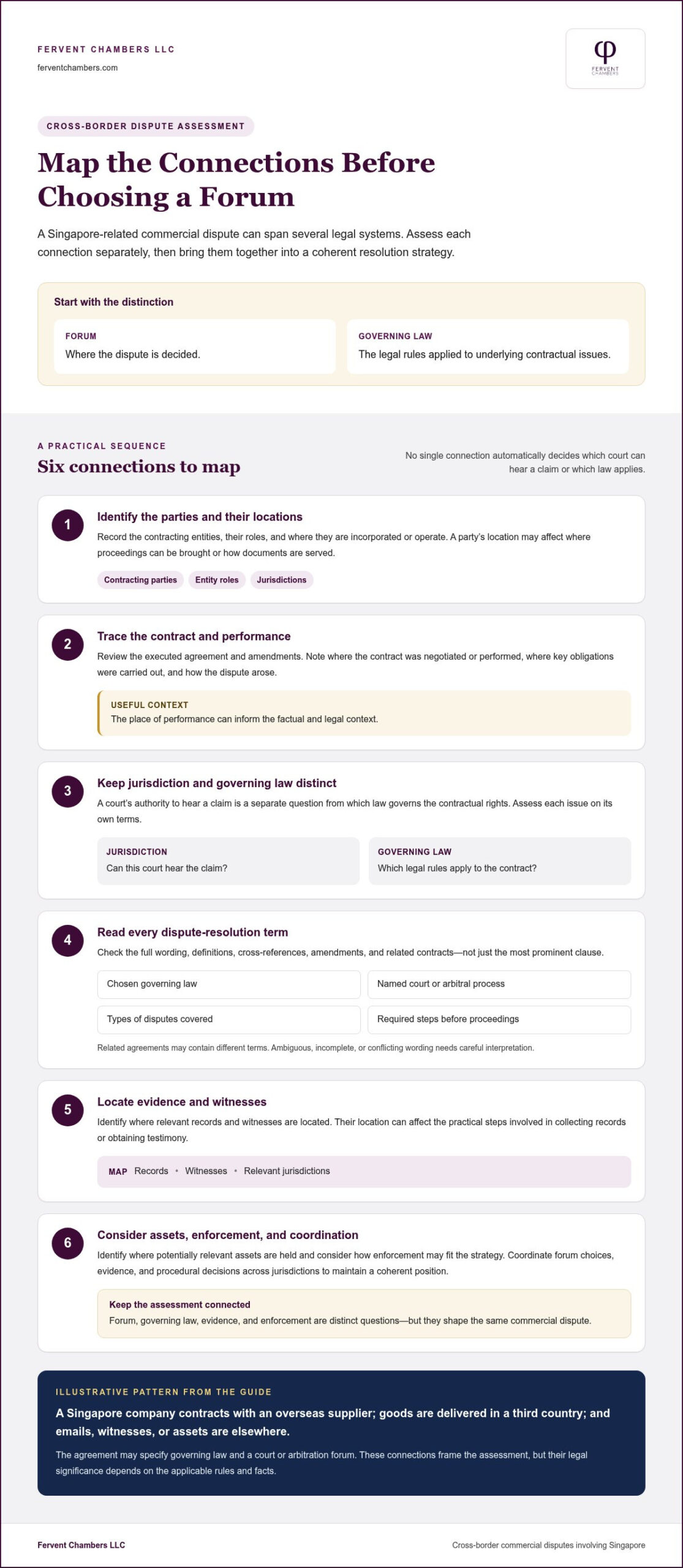
A commercial dispute is cross-border when the business conflict has material connections to more than one jurisdiction. In practical terms, a cross-border commercial dispute is a business conflict whose parties, contract, performance, evidence or potential enforcement reach across national borders. No single connection automatically decides which court can hear the claim or which law applies. Each must be assessed in context.
For example, a Singapore company might contract with an overseas supplier, arrange for goods to be delivered in a third country, and later dispute whether the supplier met its obligations. The agreement may specify a governing law and a court or arbitration forum, while relevant emails, witnesses and assets are located elsewhere. This can make the matter a cross-border commercial dispute involving Singapore without making every legal question a Singapore question.
Singapore may be relevant because a party is incorporated or operates here, a contract was negotiated or performed here, the transaction has a substantial local connection, or the agreement selects a Singapore court or arbitral seat. Assets in Singapore may also matter to a possible enforcement strategy. These connections frame the analysis, but their legal significance depends on the applicable rules and the facts.
Which cross-border connections matter in a Singapore-related dispute?
Map each connection separately because they raise different questions. A party’s location may affect where proceedings can be brought or how documents are served. The place of performance may inform the factual and legal context. A governing-law term concerns the rules used to interpret contractual rights, while a court-selection or arbitration clause addresses the chosen route for resolving the dispute, subject to applicable law.
Evidence, witnesses and potentially relevant assets may also be in different jurisdictions. Their location can affect the practical steps involved in collecting records, obtaining testimony or pursuing a remedy. Identifying these details early helps separate the dispute’s legal connections from its operational demands, rather than treating “cross-border” as a conclusion about jurisdiction.
Why can one commercial conflict raise several legal questions?
A court’s authority to hear a claim is distinct from the law governing the underlying contract. A Singapore business and an overseas counterparty might disagree over payment under an agreement governed by foreign law that contains a Singapore forum clause. The clause may be relevant to where proceedings should take place, while the governing-law term may direct how contractual obligations are interpreted. Neither answer, by itself, resolves every procedural or enforcement issue.
Further questions may arise about coordinating steps across jurisdictions, maintaining a consistent position, and whether a judgment or award can be acted upon where relevant assets are located. The Singapore International Commercial Court (SICC) is part of Singapore’s court framework for international commercial disputes. Whether a particular claim belongs there depends on the applicable requirements and circumstances. An initial assessment should consider forum, governing law, evidence and enforcement together while keeping their distinct legal tests clear.
How do jurisdiction, governing law and contract terms shape the dispute?
Contract terms can influence where a dispute is heard and how the parties’ rights are assessed, but these questions require separate analysis. The forum determines where a dispute is decided; the governing law identifies the legal rules applied to the underlying contractual issues. A Singapore court may therefore be asked to consider a contract governed by another country’s law, subject to the relevant legal framework.
In a cross-border commercial dispute Singapore is connected to, start with the executed agreement and any amendments, not just the clause that appears most prominent. Identify the contracting parties, their roles and the relevant performance obligations, then compare the dispute-resolution wording across related documents. A supply agreement, guarantee or services schedule may contain different terms, creating questions about scope and coordination without automatically deciding the outcome.
What should businesses examine in governing-law and forum clauses?
Read each clause in full, including its definitions and cross-references. Record the chosen governing law, the named court or arbitral process, the types of disputes covered, and any stated steps that must come before proceedings, such as negotiation or mediation. Check whether amendments changed the wording and whether connected contracts use consistent terms. If clauses are ambiguous, incomplete or conflicting, interpret them carefully rather than assuming one term controls every claim.
Review the facts alongside the text. Establish which entity signed, whether another party is bound by the clause, where key obligations were performed and how the dispute arose. These details can affect how the contractual provisions operate and which issues need further legal analysis.
How can Singapore courts and arbitration fit into the analysis?
Litigation before a court and arbitration are distinct routes. A court clause may identify a court, while an arbitration clause may provide for a private tribunal and name an administering institution, such as the Singapore International Arbitration Centre (SIAC). Read the exact wording carefully: the institution, seat, scope and any procedural requirements need to be considered together, with applicable law governing the analysis.
Where the contract points towards Singapore court proceedings, the Singapore International Commercial Court official site explains the SICC’s role in international commercial dispute resolution. Whether that court can hear a particular claim depends on its jurisdictional requirements and the case’s circumstances; a Singapore connection alone does not settle the question. For arbitration, businesses can review this Singapore international arbitration business decision guide when assessing the contractual route.
A careful clause review can preserve options before procedural steps are taken. If a live dispute turns on competing contract terms, Singapore disputes counsel can assess the wording alongside the commercial objectives and cross-border facts.
How should a business compare litigation, arbitration and parallel proceedings?
The appropriate route depends on the contract, the parties and the claims, not on a general preference for courts or arbitration. For a cross-border commercial dispute Singapore businesses are assessing, first identify what the agreement requires and whether connected claims or parties fall under the same clause. Then compare the practical features of each route, separating general considerations from conclusions that depend on the facts and applicable law.
| Consideration | Court litigation | Arbitration | Requires case-specific analysis |
|---|---|---|---|
| Basis for the route | May be shaped by a court-selection clause and applicable jurisdictional rules. | Generally depends on an arbitration agreement and its scope. | Whether the clause applies to each claim and party. |
| Decision-maker | A judge or, where relevant, a designated court. | An arbitral tribunal constituted under the agreement or applicable rules. | Whether the chosen decision-maker can determine the dispute. |
| Procedure | Governed by the relevant court’s procedures and directions. | May be shaped by agreed institutional or procedural rules. | Timetable, evidence process and available procedural measures. |
| Cross-border implications | May involve questions about jurisdiction and the later use of a judgment abroad. | May raise questions about the seat, applicable rules and recognition or enforcement. | Practical consequences in each relevant jurisdiction. |
When might arbitration or court litigation warrant closer consideration?
Examine the parties’ agreement, the claims and the procedural route each clause establishes. An arbitration clause may identify an institution, such as the Singapore International Arbitration Centre, or refer to procedural rules. Its wording and scope remain important. Court litigation may be relevant where the contract points to a court or where the claim’s structure calls for court proceedings, subject to applicable requirements. Businesses comparing the routes can also consult this guide to choosing arbitration versus litigation in Singapore.
What should businesses understand about parallel proceedings?
Related disputes can involve different contracts, parties or forums. For example, a claim under a supply contract may proceed separately from a claim under a guarantee, even when both arise from the same commercial relationship. This raises questions about sequencing, document handling, shared witnesses and consistency of position. Conflicting decisions are not inevitable, but poorly coordinated steps can complicate the overall strategy.
Before commencing or responding to proceedings, map the claims, parties, contracts and clauses together. Consider whether a proposed step could affect a related case and identify which procedural rules govern each process. The answer may depend on facts and law in more than one jurisdiction, so verify procedural assumptions before they shape a filing or other consequential decision.
What practical steps can protect a business’s position across borders?
Once a dispute emerges, disciplined early steps can preserve evidence and support a coherent position across jurisdictions. For a cross-border commercial dispute Singapore businesses are managing, treat document preservation, contract review and communications as connected tasks. Each can affect how the matter is understood and addressed in different proceedings.
Start by organising the signed agreements and amendments, notices, invoices, delivery or performance records, and relevant correspondence before forming a definitive account of events. Then work through this sequence:
- Secure the agreements. Gather executed contracts, amendments, schedules, guarantees and related documents. Note the parties and any dispute-resolution terms.
- Preserve relevant records. Restrict alteration or deletion of potentially relevant emails, messages, files and business records, subject to applicable legal, regulatory and retention obligations. Record where the information is held and who controls it.
- Build a chronology. Record key decisions, performance events, notices and communications, using dates and sources where available. Distinguish contemporaneous records from later recollections.
- Map the connections. Identify parties, witnesses, documents and potentially relevant assets by jurisdiction. This helps put the factual record alongside the legal and procedural questions.
Which records and facts should be organised first?
Start with the documents that show what was agreed, what each party did and how the disagreement developed. Keep originals and versions together where possible, and note gaps rather than filling them with assumptions. A clear chronology helps compare internal records with external correspondence. A jurisdiction map can also show where further evidence or coordination may be needed.
How can a business avoid weakening its position?
Before a coordinated review, avoid informal admissions, speculative explanations and inconsistent statements to counterparties, employees or other external parties. Keep communications accurate and measured, and do not alter or selectively remove records to create a preferred narrative. Preservation measures must also account for applicable retention duties and legal obligations, which may differ across jurisdictions.
Limitation periods and the availability or timing of urgent applications depend on the claim, governing law, forum and relevant facts. Identify potential deadlines promptly and obtain advice on the rules that may apply rather than assuming one jurisdiction’s timetable controls every related claim. If an arbitration award becomes relevant, assess the award, the jurisdictions involved and the applicable enforcement framework. The Singapore guide to enforcing arbitration awards addresses that stage.
Preserving a reliable record is not simply an administrative exercise. It helps decision-makers assess the commercial history without allowing inconsistent accounts to undermine the wider strategy. For support organising a live dispute across jurisdictions, discuss your cross-border dispute with Singapore disputes counsel.
How can Singapore disputes counsel coordinate a cross-border resolution strategy?
In a cross-border commercial dispute involving Singapore businesses, legal choices can affect commercial operations beyond the immediate claim. Counsel can assess the matter as a whole by considering the parties, contract terms, forum options, jurisdictional connections and business priorities together, rather than treating each legal issue in isolation. This helps identify decisions that need immediate attention and areas where advice across jurisdictions must be aligned.
What should an initial strategic assessment address?
An initial assessment should establish the matter’s procedural and commercial position before recommending a route. Key questions include who the parties are, which contracts govern their relationship, what claims or counterclaims may arise, whether proceedings have started, and what the business needs to protect or achieve. The analysis can then distinguish urgent preservation steps from longer-term decisions about resolution.
- Contract and claim structure: Identify the agreements, parties, obligations in dispute and any related claims.
- Forum and applicable law: Review governing-law terms, court-selection clauses or arbitration agreements alongside the jurisdictions connected to the dispute.
- Evidence and coordination: Consider where key documents and witnesses are located and how advice across jurisdictions can align evidence-gathering and procedural decisions.
- Commercial objectives: Clarify business continuity needs, important relationships, management capacity and the practical significance of potential outcomes.
- Enforcement considerations: Consider where a judgment or award may need to be recognised or enforced, without assuming that the chosen forum resolves that separate question.
Consider these questions together, but they do not all need to be answered at once. Separating immediate deadlines and preservation needs from decisions about the ultimate forum can help the business maintain control while the legal position is assessed.
How can legal strategy remain aligned with commercial priorities?
A legally available route is not the only relevant consideration. Proceedings can require management attention, affect ongoing relationships and influence business continuity, while the merits and potential exposure remain central to the assessment. Counsel can set out viable procedural options, explain the decision points and identify what further information is needed, without promising a particular result or prematurely committing the business to a forum.
Where overseas counsel is involved, coordination can align the analysis of local law, documents, evidence and procedural steps. Clear responsibility for communications and a shared understanding of the factual record can reduce the risk of disconnected advice while preserving each jurisdiction’s distinct legal requirements. Fervent Chambers LLC’s Singapore disputes and arbitration practice advises businesses on complex commercial disputes across sectors including construction, shipping, technology, oil and gas, clean energy and hospitality.
For arbitration-specific considerations, the cross-border arbitration and enforcement guide provides further context. A measured next step is to discuss the dispute’s facts, key documents and business priorities with counsel, so the available options can be assessed against the matter’s commercial and legal realities.
Set a Clear Direction for the Dispute
The next step in a cross-border commercial dispute connected to Singapore should be guided by the business decision you need to make, not by procedural momentum alone. Before committing to a route, clarify what must be protected, what outcome is commercially workable and which decisions cannot safely wait. This gives legal analysis a practical purpose and helps keep the dispute aligned with the organisation’s wider priorities.
Fervent Chambers LLC is a Singapore-headquartered disputes and corporate law firm advising businesses on commercial dispute resolution and international arbitration. Its work across sectors including construction, shipping, technology, oil and gas, clean energy and hospitality supports an assessment grounded in each matter’s commercial context as well as its legal dimensions.
Bring the key agreements, relevant communications and a clear account of your business priorities to the discussion. Discuss a cross-border commercial dispute with Fervent Chambers to assess a path forward. An early, coherent review can help your business approach its next decision with greater clarity.
Frequently Asked Questions
Can a foreign company bring a commercial dispute in Singapore?
Yes. A foreign company may bring a claim in Singapore if the court has jurisdiction and the relevant procedural requirements are met. Foreign incorporation alone does not determine whether a claim can proceed. For a cross-border commercial dispute involving Singapore, the analysis may consider the contract, parties, claim and any forum clause. If a defendant is overseas, service and other procedural steps require careful attention to the applicable rules.
Does Singapore law automatically govern a contract involving a Singapore business?
No. A Singapore connection does not, by itself, make Singapore law govern the contract. Check whether the agreement expressly selects a governing law and whether related documents contain separate terms. If there is no effective choice, the court may need to determine the applicable law under the relevant conflict-of-laws principles. For example, a Singapore company’s contract with an overseas supplier requires analysis of the agreement’s terms and connections, not just the company’s location.
Can a Singapore court judgment be enforced in another country?
Potentially, but enforcement depends on the law and procedures of the country where it is sought. That country may apply a treaty or statutory regime, or other rules governing recognition of foreign judgments. The type of judgment, whether it is final and the circumstances of the case may also matter. Before relying on a Singapore judgment to recover against overseas assets, assess the relevant enforcement route where those assets are located.
What happens if a cross-border contract has no dispute-resolution clause?
The absence of a clause does not automatically prevent a claim, but it can leave the parties without a pre-agreed forum or process. The appropriate court and applicable procedure must be assessed under relevant jurisdictional rules, while governing law remains a separate question. Parties may later agree on a process, but neither side should assume the other will consent. Review related contracts too, since a connected agreement may contain relevant terms.
Is international commercial arbitration confidential?
Not automatically in every respect. Privacy, which concerns who may attend a hearing, is distinct from confidentiality, which concerns restrictions on disclosing information about the arbitration. The arbitration agreement, chosen institutional rules and applicable law may affect these issues, and exceptions may apply. Businesses handling commercially sensitive material should examine the protections that govern the proceeding, including how documents, hearing information and any resulting decision may be used or disclosed.
How long does a cross-border commercial dispute in Singapore take to resolve?
There is no standard timeline for every matter. Duration can depend on the forum, the number and complexity of issues, evidence requirements, procedural challenges and whether related proceedings take place elsewhere. Settlement may resolve a dispute before a final hearing, while contested claims can require substantial preparation. For a realistic assessment, establish the current procedural stage, identify upcoming deadlines and consider which factual or legal issues are likely to require determination.