

An apparently faster, more private forum may still leave a business with the wrong remedy or a difficult enforcement path. Privacy, cost and speed matter, but their value depends on the dispute, the parties and the relief required. Choosing arbitration vs litigation Singapore businesses face is therefore not simply a choice between private proceedings and a public courtroom.
This guide compares the legal, procedural and commercial consequences of arbitration and Singapore court proceedings. It explains how to assess available remedies, procedural control, privacy, timing and cost, and considers cross-border enforcement and the effect of an existing dispute resolution clause. Use the framework to evaluate the contract, the parties and your business objectives, then identify where focused legal advice is needed.
Key Takeaways
- Choosing arbitration vs litigation Singapore requires weighing the dispute, the parties and the commercial objectives, rather than assuming one forum is always preferable.
- Identify the governing dispute clause early, as its wording may shape the available forum and next steps.
- Compare privacy, procedural control, review options and enforcement needs against the remedies your business may require.
- Assess the location of relevant parties, evidence and assets, particularly where the dispute has cross-border elements.
- Separate contract planning from responding to a live dispute, then obtain focused advice on the clause, procedural position and strategic consequences.
Choosing Arbitration vs Litigation in Singapore Starts with the Dispute
Arbitration is a private adjudicative process based on the parties’ agreement. Litigation places a dispute before a court exercising jurisdiction under Singapore law. Both provide formal routes to resolve a commercial claim, but neither is universally superior. The practical question is which process can provide the remedies, degree of control and enforcement prospects this dispute requires. A general overview of Arbitration can help explain the process, but the decision depends on the contract and circumstances.
Forum selection is a commercial decision shaped by the dispute clause, the outcome the business needs and the route most likely to make that outcome effective. Consider not only how the decision will be reached, but also what must happen afterwards. For example, will the result need to be recognised or enforced where a counterparty or its assets are located?
What does choosing a forum mean for a Singapore business?
A dispute-resolution clause may specify arbitration, a court, or procedural steps that must happen before a claim proceeds. Its wording can determine where a dispute is heard and how the parties are expected to pursue it. Before a conflict arises, assess whether your standard contract clause fits the likely counterparties and transactions. Once a dispute exists, examine the signed agreement, the nature of the claim and any procedural steps already taken. The clause and applicable law require matter-specific legal analysis.
The distinction can be consequential. A clause drafted for a domestic supply arrangement may not address the demands of a later cross-border disagreement. In a live dispute, there may be less room to change the agreed forum. Start with the actual contract and procedural position, rather than a general preference for arbitration or court proceedings.
Which commercial priorities should guide the initial assessment?
Start with the outcome sought and the process required to secure it. A business may need urgent relief, want to limit public exposure, value procedural flexibility, or consider a public determination more suitable. The answer depends on the relief legally available and the facts supporting it, not simply on the forum’s label.
- Parties and cooperation: Identify where counterparties are based and whether they are likely to participate in the process.
- Assets and enforcement: Map where relevant assets are located and consider where a decision may need to be recognised or enforced.
- Evidence and urgency: Assess where key documents and witnesses are, and whether timing or interim measures are commercially important.
- Privacy and public determination: Clarify how sensitive public proceedings would be for the business. Do not assume arbitration guarantees confidentiality.
Treat claims about speed and cost as questions to test, not built-in advantages. Complex evidence, procedural applications or limited cooperation can affect either route. When choosing arbitration vs litigation Singapore businesses should compare realistic scenarios for the dispute, then align the forum decision with operational priorities, risk exposure and the value of an enforceable outcome.
How Singapore Arbitration and Court Litigation Work
Singapore has separate legal frameworks for arbitration and court proceedings. The International Arbitration Act (IAA) generally governs international arbitration seated in Singapore, while the Arbitration Act applies to domestic arbitration, subject to each statute’s scope and the circumstances of the case. An arbitration agreement is foundational: it records the parties’ consent to submit defined disputes to arbitration. The agreement, applicable legislation and any selected procedural rules together shape how the tribunal is constituted and how proceedings unfold.
Arbitration proceeds under a framework agreed by the parties, while litigation is administered by the courts under applicable procedural rules and judicial directions. That does not mean parties control every arbitral step or that court procedure is identical in every case. Singapore’s established role in international dispute resolution is reflected in the Ministry of Law’s discussion of Singapore’s role in international arbitration. The applicable framework still depends on the arbitration agreement and dispute.
How arbitration proceeds under an agreement
Typically, a claimant gives notice of arbitration in accordance with the agreement or applicable rules. The tribunal is then constituted. The parties set out their claims and responses, exchange or present evidence, and hold a hearing if required. The tribunal issues an award resolving the matters submitted to it. If the parties selected institutional rules, such as those of the Singapore International Arbitration Centre (SIAC), those rules guide key steps. The agreement and rules determine matters such as appointments, submissions and hearing procedure.
How Singapore court proceedings proceed
Court litigation generally begins through prescribed originating processes, followed by pleadings that define each party’s case. The court manages the matter, gives directions on procedural steps and timing, and oversees the presentation of evidence before a hearing or trial. A judgment follows the court’s determination. Civil proceedings are governed by applicable court rules, including the Rules of Court 2021, and case-specific judicial directions. The complexity of the issues, evidence and applications may affect the course and duration of a case, so do not assume a fixed timetable.
These procedural differences matter when choosing arbitration vs litigation Singapore businesses must consider not only who decides the dispute, but also how the case will proceed under the governing framework. For a dispute clause or proceeding already under way, focused advice can clarify the applicable rules and immediate procedural choices. Singapore dispute-resolution counsel can assist with that assessment.
Arbitration vs Litigation in Singapore: Compare the Commercial Trade-Offs
The practical differences between arbitration and litigation do not guarantee a better result in either forum. Arbitration can give parties more input into tribunal appointment and aspects of procedure, while court proceedings follow judicially managed processes. Privacy, review and enforcement each need separate consideration. The right choice depends on the dispute, the agreement and what the decision must achieve.
| Decision factor | Arbitration | Court litigation |
|---|---|---|
| Decision-maker and control | Parties may have a role in tribunal selection, subject to the agreement and applicable rules. | A judge is assigned through the court system; parties do not select the decision-maker. |
| Procedure | Procedure may be shaped by agreement and selected rules, within applicable legal limits. | Procedure follows court rules and judicial directions. |
| Privacy | Hearings are generally private, but privacy does not guarantee absolute confidentiality. | Proceedings and judgments are generally more publicly accessible, subject to applicable restrictions. |
| Review | An award may be challenged only on limited grounds under applicable law; it is not ordinarily reconsidered as a merits appeal. | Appeal rights and routes depend on applicable law and procedural requirements. |
| Enforcement | Cross-border enforcement may be available under applicable conventions and local law, subject to relevant requirements and defences. | Recognition or enforcement abroad depends on the destination jurisdiction’s law and applicable arrangements. |
Control, privacy and procedural flexibility
Arbitration may suit parties who value input into tribunal composition or want to tailor procedural steps to a technical dispute. That flexibility is not unlimited: the arbitration agreement, chosen rules and governing law constrain the process. Court proceedings are managed by judges under established rules, providing structured oversight. A private arbitral hearing should not be equated with complete secrecy. Confidentiality obligations and exceptions depend on applicable law, rules and circumstances. A public judgment may be valuable where a business seeks authoritative clarification or a precedent relevant to wider commercial conduct.
Cost, review and cross-border enforcement
Total dispute cost depends on complexity, procedure, evidence and duration, not on the forum label alone. Arbitration may involve tribunal and institutional fees as well as legal and evidential work. Litigation has its own legal, court-process and evidence demands. Extensive document production, expert evidence, interlocutory applications or a contested hearing can affect either route. Neither arbitration nor litigation is automatically faster or less expensive.
Review mechanisms differ. An arbitral award may be set aside or resisted on recognised legal grounds, but this is distinct from an appeal that re-examines a court decision. Appeal rights and permission requirements may apply to court decisions. For disputes involving overseas counterparties or assets, analyse the location of the assets and the applicable enforcement regime early. The cross-border arbitration and enforcement guide provides further context. When choosing arbitration vs litigation Singapore businesses should weigh these trade-offs against the specific award or judgment they need and the jurisdictions where it must have effect.
A Singapore Forum-Selection Framework for Contracts and Live Disputes
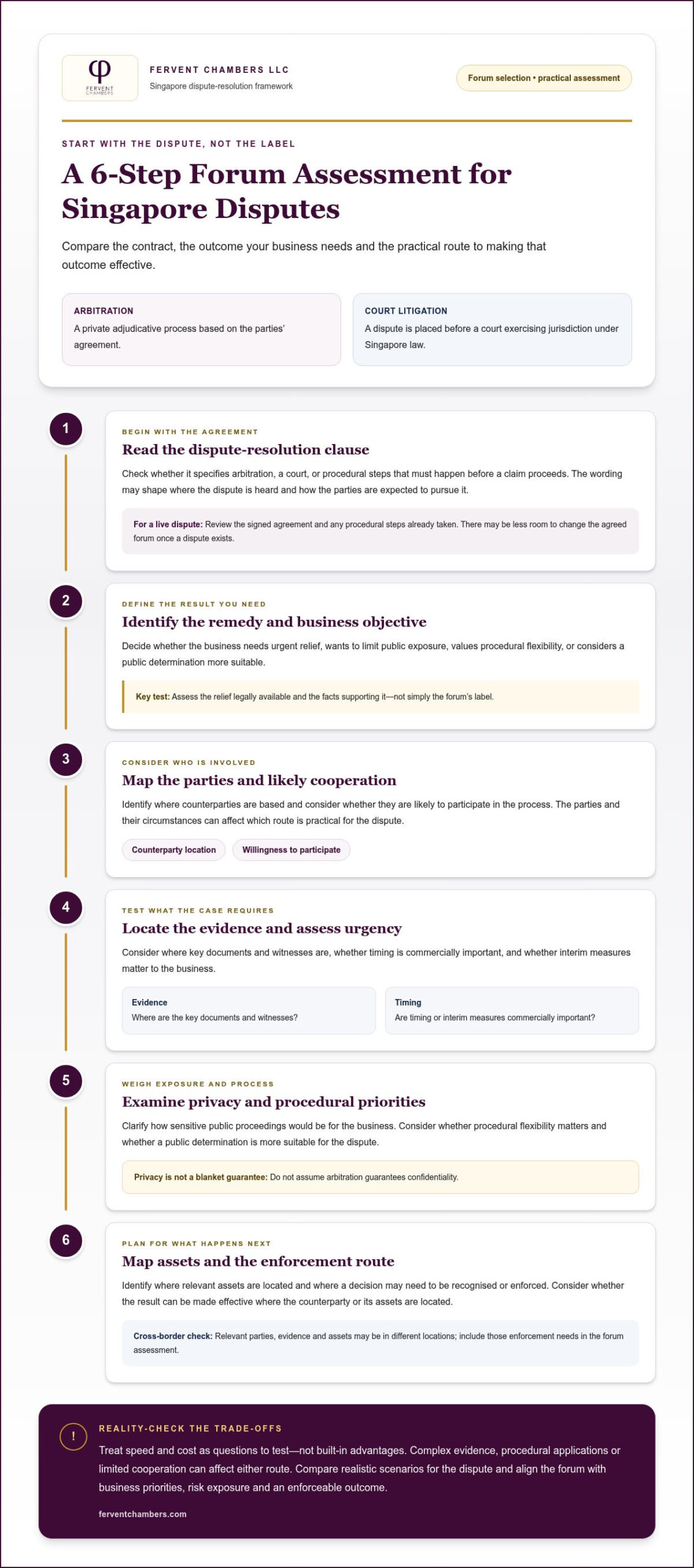
A sound forum decision takes more than a general preference for arbitration or court proceedings. Consent, jurisdiction, contractual language and steps already taken may constrain the available choices. Use this framework to organise the analysis, then distinguish between drafting for a future disagreement and responding to one that has arisen.
Assess the clause, parties and remedy sought
Start with the executed contract. Identify its dispute-resolution clause, governing law, any arbitration seat or court jurisdiction wording, and required escalation steps such as negotiation or mediation. Check whether each relevant party is bound by the agreement. A related company or other participant may not automatically be included. Define the practical relief sought, including whether urgent court assistance could be important. These points shape the options before procedural preference is considered.
- Read the clause in context. Review the complete wording, related contract provisions and incorporated rules, rather than relying on a clause heading or template label.
- Map the parties. Identify contracting entities, guarantors and other potentially relevant participants. Assess whether the clause binds each party you may need to proceed against.
- Specify the remedy. Clarify whether the objective is payment, performance, a declaration or urgent protective relief. Consider which forum can address that need under applicable law.
- Locate evidence. Record where key documents, witnesses and technical material are held, including whether access or preservation may become contentious.
- Trace assets and enforcement needs. Identify where a counterparty’s relevant assets may be situated. Location can inform strategy, but it does not make recognition or enforcement automatic.
- Account for procedural posture. Note any notice, negotiation or mediation requirements, deadlines, filings or proceedings already commenced, since these may affect the next steps.
Map evidence, assets and procedural constraints
Related claims may involve multiple contracts, entities or jurisdictions. Consider whether the claims can proceed together, whether separate proceedings risk inconsistent findings, and whether the relevant parties have consented to the same forum. A dispute involving a Singapore company, an overseas counterparty and assets in another jurisdiction calls for coordinated analysis of the clause, likely decision-maker and enforcement route. The international arbitration business decision guide offers further context for cross-border considerations.
For future contracts, assess forum wording against the transaction, likely counterparties and remedies the business may require. For a live dispute, focus first on the signed agreement, applicable procedural requirements and actions already taken. A preferred forum cannot simply replace the agreed one where consent or jurisdiction does not support it. Businesses reviewing court options can also consult this commercial litigation lawyer Singapore business guide.
A clause can have consequences beyond the immediate claim. Obtain a matter-specific review before taking a step that may affect forum rights or procedural position. Discuss your dispute clause and forum strategy with counsel.
Plan the Next Step with Singapore Dispute-Resolution Counsel
A forum decision brings together the wording of the dispute clause, the business outcome sought, the process the dispute is likely to require and the jurisdictions where an award or judgment may need to be enforced. For businesses choosing arbitration vs litigation Singapore, a matter-specific review can distinguish what the contract permits from what may seem commercially preferable. Fervent Chambers LLC advises on commercial disputes, arbitration and complex cross-border matters, bringing legal and commercial considerations into one strategic assessment.
What to assemble before seeking advice
A focused review is more productive when counsel can consider the relevant documents alongside the business’s immediate position. Gather the contract and dispute clause, amendments, related agreements and material correspondence. Prepare a concise chronology, identify each party and summarise the outcome the business needs. This helps the analysis address both the legal basis of the claim and its practical objectives.
- Documents: Assemble signed agreements, amendments, notices and correspondence relevant to the dispute.
- Timeline: Record key events, communications and decisions in sequence, distinguishing confirmed dates from estimates.
- Parties and outcome: Identify the entities and individuals involved, and state the remedy or commercial result the business is seeking.
- Urgent matters: Flag active deadlines, proceedings, preservation concerns or risks that may require prompt attention.
- Cross-border factors: Note where counterparties, key evidence and potentially relevant assets are located, together with anticipated enforcement concerns.
This material helps counsel assess the procedural position, the contract’s forum language and the evidence supporting the proposed course. It also separates urgent issues from longer-term strategy, particularly if a claim has already been filed or a contractual notice has been issued.
How a tailored forum assessment supports business decisions
Forum strategy has consequences beyond the conduct of the case. The process may affect management time, business continuity, sensitive information and the future of a commercial relationship. Advice should test the facts and applicable law, rather than rely on assumptions that arbitration is invariably private or court proceedings invariably slower. It should also identify relevant uncertainties, including how procedural choices could affect the ability to pursue the remedy sought.
Fervent Chambers LLC’s disputes and arbitration work addresses commercial matters involving complex evidence, multiple parties or cross-border considerations. A focused assessment can help decision-makers understand the implications of the clause, the current stage of the dispute and the strategic alternatives before committing to a course of action. It can also clarify which documents, decisions or procedural steps need immediate attention.
To discuss a Singapore dispute-resolution strategy with Fervent Chambers LLC, contact the firm about the clause, the dispute’s current position and the commercial outcome your business is seeking.
Turn Forum Strategy into a Confident Business Decision
A forum decision can shape more than the conduct of one dispute. It can influence how the business prepares for contractual risk, protects important relationships and allocates management attention. Before signing a new agreement or allowing an existing disagreement to escalate, include the forum in a broader risk review. The process should reflect the organisation’s commercial priorities, not simply a default clause or a general perception of either forum.
For businesses choosing arbitration vs litigation Singapore, focused legal advice can test the proposed strategy against the contract, procedural position and desired outcome. Fervent Chambers LLC is an award-winning disputes and corporate law firm with counsel experienced in commercial litigation, arbitration and complex cross-border disputes. Its assessment can help decision-makers approach the next step with greater clarity.
Discuss your dispute-resolution strategy with Fervent Chambers LLC, whether you are reviewing a clause for a future transaction or considering how to respond to a live commercial dispute.
Frequently Asked Questions
Is arbitration better than litigation in Singapore?
Neither is inherently better. The appropriate forum depends on the parties’ agreement, the relief sought and the circumstances of the dispute. For example, a business seeking a decision it can pursue against overseas assets may assess arbitration differently from a party seeking a public court ruling on a recurring contractual issue. When choosing arbitration vs litigation Singapore, assess the specific claim and enforcement context rather than relying on a general preference.
Is arbitration confidential in Singapore?
Arbitration hearings are generally private, but that does not mean every aspect of the dispute is absolutely secret. Confidentiality may be affected by the arbitration agreement, applicable rules, governing law and circumstances such as court applications or legal disclosure obligations. A company concerned about sensitive technical or financial material should identify what information may become public and consider appropriate protections before sharing it in the proceedings.
Can a Singapore court grant interim relief during arbitration?
Yes. Singapore courts may grant interim relief in support of arbitration in appropriate circumstances, including measures to preserve assets or evidence. The court’s role is supportive, not a substitute for the tribunal deciding the underlying dispute. Whether relief is available depends on the applicable legal framework, the evidence and the urgency of the situation. A party considering an application should promptly assess the arbitration agreement, the tribunal’s powers and the procedural position with counsel.
Is arbitration always faster or less expensive than litigation?
No. The timetable and overall expense depend on the dispute’s complexity and how the process unfolds. A technically demanding arbitration may require extensive expert evidence, tribunal hearings and institutional administration. A court case may involve substantial procedural applications or a lengthy trial. A narrowly framed claim may proceed more efficiently in either forum. Compare the likely procedural steps and resource demands for the specific matter, not broad claims about cost or speed.
Can a business change an arbitration clause after a dispute begins?
The parties can usually amend their dispute-resolution arrangement only if they agree, subject to the contract, applicable law and procedural steps already taken. One party generally cannot replace an agreed arbitration process with court litigation simply because its commercial preference has changed. If both sides are willing, they may consider a written variation or settlement process. Assess its effect before signing, especially if a notice or proceeding is already under way.
Can parties who did not sign an arbitration agreement be joined to arbitration?
Not automatically. Arbitration ordinarily depends on consent, so a tribunal’s power to hear a claim against a non-signatory requires a recognised legal basis and careful analysis of the relevant contracts and facts. Institutional rules may address multi-party appointments or joinder procedures, but procedural rules alone do not necessarily bind an outsider to arbitrate. An affiliated company’s relationship with a signatory, for example, does not by itself establish that it agreed to the arbitration clause.
Can a Singapore court judgment or arbitral award be enforced overseas?
Potentially, but recognition and enforcement depend on the destination jurisdiction’s law and relevant treaty arrangements. Arbitral awards may benefit from international conventions, subject to local requirements and grounds for refusal. Court judgments follow different recognition routes, which vary between countries. Identify where the counterparty’s assets are located and obtain jurisdiction-specific advice before relying on recovery. A favourable decision does not, on its own, guarantee enforcement abroad.

