


Will the next procedural step protect your commercial position, or simply add cost and complexity? A search for “SIAC arbitration lawyer Singapore” often starts with that concern: businesses need counsel who can explain the choices ahead and connect legal strategy to operational and commercial priorities.
Arbitration counsel should do more than manage filings and deadlines. Decisions about how to frame the dispute, prepare evidence and approach settlement can affect both the proceedings and the business’s wider position. This article explains how counsel can support those decisions, what information helps shape a focused assessment, and how to align the approach with your priorities.
Fervent Chambers LLC advises on complex commercial disputes and arbitration, including matters with cross-border and sector-specific considerations. The following guidance outlines key stages of SIAC arbitration and explains how legal advice can keep procedural choices connected to the commercial issues at stake.
Key Takeaways
- Bring counsel in early to assess the arbitration clause and understand your commercial options.
- Effective representation connects case strategy, written submissions, evidence and hearing preparation to the dispute’s business priorities.
- When assessing an SIAC arbitration lawyer Singapore, consider strategic oversight, cross-border complexity and how legal advice will support your decisions.
- Prepare the contract, arbitration clause, dispute chronology, key correspondence and available evidence for a focused initial assessment.
- Fervent Chambers advises on complex commercial disputes across sectors, including arbitration matters involving business context and cross-border considerations.
When does a business need an SIAC arbitration lawyer in Singapore?
Arbitration decisions can affect more than the legal outcome. They may have implications for contractual relationships, project delivery, cash flow and the company’s position in other jurisdictions. SIAC arbitration is a private dispute-resolution process administered by the Singapore International Arbitration Centre under the parties’ arbitration agreement, in which an independent tribunal decides the dispute. The Singapore International Arbitration Centre (SIAC) administers proceedings, while the tribunal determines the parties’ claims and defences.
A SIAC arbitration lawyer Singapore businesses engage can assess the contract and dispute, advise on procedural and strategic choices, and represent a party through the proceedings. The value of that advice is not in predicting an award. It is in identifying options, risks and information gaps early enough for decision-makers to act deliberately.
What does a SIAC arbitration lawyer advise on?
Counsel’s review starts with the arbitration agreement and commercial facts: which entities signed, what disputes the wording covers, and how the alleged breach relates to the contract and transaction history. This helps define the dispute’s scope and clarify the client’s priorities, such as the business relationship, potential exposure and practical objectives. Advice should be based on the actual clause and evidence, not assumptions about how a dispute will proceed.
As the matter develops, counsel can help formulate claims or defences, prepare pleadings, organise relevant evidence and assess procedural choices. Counsel may also support settlement discussions, where an assessment of the merits and risks can inform the authority and terms a business is prepared to consider. The right strategy depends on the contract, facts, applicable law and commercial objectives. No procedural step guarantees a particular result.
When should a business seek advice on a SIAC clause?
During contract negotiation, advice can help the business understand how the proposed clause may shape dispute planning, including the agreed arbitration framework and how related contracts interact. For a cross-border transaction, review the clause alongside the governing law, counterparties and practical consequences of resolving a dispute through arbitration. Clause wording can affect the options available later, so assess it before a disagreement limits the parties’ room to plan.
When a claim is threatened, counsel can review the contract and communications, clarify the allegations and help preserve a coherent record while management considers its response. After an arbitration notice arrives, prompt analysis can identify the issues requiring attention, relevant documents and decisions that should not be delayed. Early advice does not predetermine whether to defend, settle or pursue a claim. It helps the business weigh those options on an informed basis. The cross-border commercial dispute Singapore guide considers how arbitration choices fit wider commercial and cross-border considerations.
How SIAC arbitration counsel supports a dispute from clause review to hearing
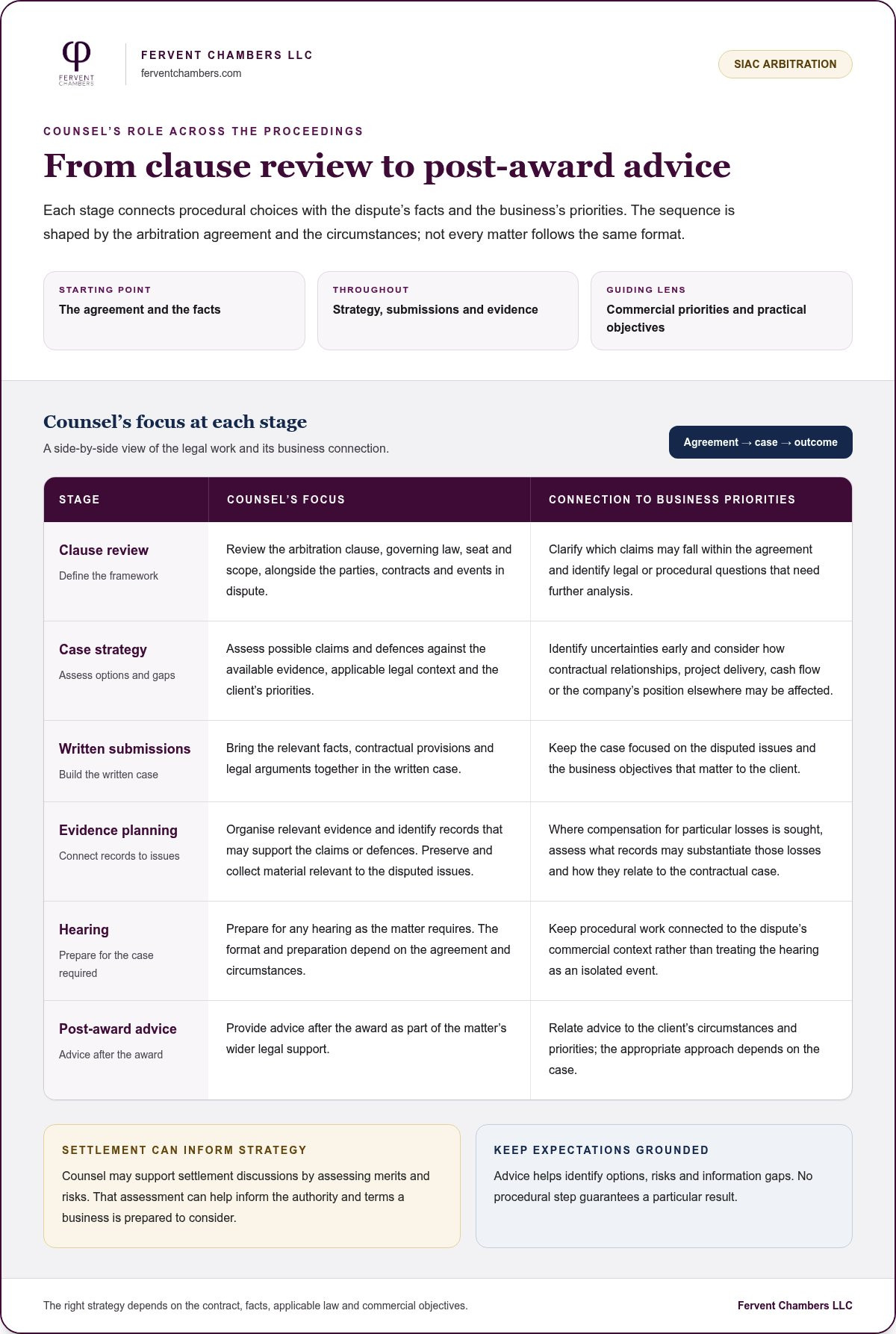
Arbitration involves a sequence of connected decisions, not just a hearing. Choices made early can shape which issues, evidence and remedies receive attention later. A SIAC arbitration lawyer Singapore businesses engage can guide the process while keeping procedural work connected to the dispute’s commercial context.
A SIAC arbitration moves from interpreting the arbitration clause and assessing the facts through case strategy, written submissions, evidence, any hearing, and post-award advice, with the sequence shaped by the agreement and circumstances. Not every matter follows the same format. Counsel’s role is to identify what the case requires and prepare accordingly.
From arbitration clause review to case strategy
The initial review considers the arbitration clause, governing law, seat and scope, as well as the parties, contracts and events in dispute. These details help identify which claims may fall within the agreement and which legal or procedural questions need further analysis. Singapore’s statutory framework is also relevant to arbitration seated here. The Ministry of Law’s material on Singapore’s International Arbitration Act provides context on the legislation and its review.
With the framework understood, counsel assesses possible claims and defences against the available evidence and the client’s priorities. For example, a company facing a claim over delayed project delivery may need to distinguish contractual responsibility from operational causes, assess contemporaneous records and consider the commercial implications of different remedies. The contract and circumstances determine the legal and procedural implications. Early strategy should identify uncertainties rather than treat assumptions as established facts.
Remedies and evidence planning are closely linked. If a party seeks compensation for particular losses, counsel needs to assess what records may substantiate those losses and how they relate to the contractual case. Identifying those records early can guide document preservation and collection. It can also help the business avoid an unfocused review of material that does not address the disputed issues.
Managing written submissions, evidence and the hearing
As the matter progresses, counsel develops the written case by bringing the relevant facts, contractual provisions and legal arguments together. Counsel reviews and presents documentary evidence in support of the issues. Witness statements or expert material may also be considered where the dispute calls for them. Preparation should be proportionate to the questions the tribunal must decide.
Before a hearing, counsel helps refine the issues, prepare witnesses and address the evidence relied on by the other party. Some proceedings may be determined substantially through written materials, while others may include an oral hearing. The format depends on the agreement, applicable procedure and circumstances of the case. A focused presentation helps show how the evidence supports each material contention.
After an award, advice may address its implications, available next steps and how to enforce an arbitration award in Singapore. The analysis should account for the award, the parties’ commercial objectives and the applicable legal framework. No single course suits every case. Fervent Chambers’ arbitration and dispute resolution counsel can help businesses assess these connected decisions in complex commercial matters.
How to assess SIAC arbitration representation against your commercial needs
Assess representation by how well legal analysis, procedural choices and communication fit the dispute your business faces. A SIAC arbitration lawyer Singapore businesses consider should explain both the legal issues and how proposed steps relate to commercial priorities, cross-border considerations and available evidence. Relevant experience matters when it informs that analysis, rather than standing in for it.
Which counsel capabilities matter in a complex SIAC dispute?
Consider whether counsel can analyse the arbitration agreement, identify the main legal and factual issues, test the evidence and explain potential remedies without overstating the prospects. In cross-border disputes, parties, records and assets may involve different jurisdictions. Clear identification of coordination needs and jurisdiction-specific questions is important. Singapore’s legal framework is part of this context. The Ministry of Law’s role in Singapore’s legal industry includes developing the country’s legal sector.
| Assessment area | What to consider |
|---|---|
| Strategic oversight | Can counsel explain the available choices, their risks and trade-offs, and how each relates to the outcome the business seeks? |
| Dispute complexity | Does the proposed approach account for the number of parties, contractual relationships, technical issues and evidence involved? |
| Cross-border issues | Can counsel identify coordination needs where counterparties, documents, governing laws or assets span jurisdictions? |
| Communication | Will decision-makers receive clear explanations of developments, choices requiring approval and the reasoning behind recommendations? |
Sector familiarity can help counsel understand how a dispute affects operations, but it does not determine the legal merits. For example, experience across construction, shipping, oil and gas, technology, clean energy or hospitality may provide useful context for contracts, project records and business pressures. Sector knowledge should inform the questions asked and the strategy developed, not be treated as a promise of a particular result.
How should the business measure strategic alignment?
Start by identifying what the business needs to protect or achieve. Priorities may include continuity of a project or supply relationship, reputational considerations, recovery of losses, or a resolution that lets management focus on operations. Counsel should explain how the proposed case strategy responds to those priorities and where legal objectives may need to be balanced against commercial trade-offs.
Cost assessment should reflect the dispute’s scope and complexity, the evidence involved and the work required at each stage. Seek a clear explanation of the anticipated work and the factors that could affect it, rather than relying on promotional comparisons or unverified outcome claims. If the question is whether arbitration suits the business at all, the arbitration versus litigation decision guide can help frame the forum choice. Fervent Chambers advises on complex commercial disputes with attention to their wider business context. Businesses considering representation can explore its arbitration and dispute resolution practice.
What to prepare before engaging a SIAC arbitration lawyer
A focused initial assessment depends on more than the contract alone. Organising key documents, the sequence of events and business objectives helps a SIAC arbitration lawyer Singapore assess the dispute in light of both its legal framework and commercial context. Your materials need not be exhaustive. A clear distinction between what is known, disputed and uncertain is more useful than presenting assumptions as established facts.
Documents and facts to organise
Gather the core records so the transaction and disagreement are easy to follow. If documents are held by different teams or entities, note where they are and who may have relevant knowledge.
- Contract documents: Collect the signed agreement, amendments, schedules, related transaction documents and the arbitration clause. Include versions that may show how the parties’ obligations changed.
- Chronology: Prepare a dated sequence of important events, decisions and communications. Identify the source for each date where possible, and flag gaps or uncertain timings.
- Correspondence: Organise key emails, letters, meeting records and formal notices by issue or date. Preserve the context of exchanges instead of extracting isolated statements.
- Claims and responses: Summarise what each party says happened, the contractual basis relied on and the response received. Separate agreed events from disputed allegations.
- Supporting evidence: Identify project records, payment or delivery records, internal decisions, witness knowledge and other material that may bear on the issues. Note evidence that is missing or difficult to locate.
Label each point as an established fact, a disputed fact or an unanswered question. For example, a delivery date recorded in a signed document may be established, while responsibility for the delay may be contested. An undocumented conversation may remain uncertain until further evidence is found. This distinction helps counsel test the case without treating an allegation as proven.
Questions that clarify the business objectives
Legal analysis is more useful when counsel understands what the business needs to protect, not just what it wishes to argue. Before a discussion, consider the desired resolution and the operational constraints that may affect the available options.
- Commercial objective: Is the priority to resolve a payment claim, preserve a continuing relationship, limit disruption or obtain another practical remedy?
- Operational context: Are project delivery, customer commitments, financing or internal resources affected by the dispute?
- Cross-border details: Identify the parties and relevant jurisdictions, the contract’s governing law, and any assets or records connected to the dispute.
- Urgent developments: Record approaching deadlines, recent notices, threatened action or decisions requiring prompt legal assessment.
These details help counsel separate immediate decisions from matters that can be investigated further, and frame advice around the business’s actual priorities. If you’re preparing to assess a commercial dispute, discuss your matter with Fervent Chambers.
How Fervent Chambers approaches SIAC arbitration and complex disputes
Arbitration strategy is more useful when it accounts for the commercial environment in which a dispute arose, rather than treating legal issues as separate from business operations. Fervent Chambers LLC is a Singapore-based disputes and corporate law firm advising on complex commercial dispute resolution and arbitration. It serves clients ranging from startups to listed multinational corporations, with advice shaped by each matter’s facts, contractual framework and objectives. For a business seeking a SIAC arbitration lawyer Singapore, that wider context helps connect legal analysis to decisions affecting the enterprise.
Commercial context across sectors and jurisdictions
Fervent Chambers’ client experience spans construction, oil and gas, shipping, technology, clean energy and hospitality. Familiarity with these sectors can inform how counsel examines contractual arrangements, operational records and the practical consequences of a dispute. A disagreement involving project delivery, for example, may require close attention to how contractual obligations relate to records created during performance. A shipping matter may raise different commercial considerations. Sector context helps shape relevant questions, but does not determine the legal merits or outcome.
Cross-border dimensions matter when parties, contracts, documents or assets connect with more than one jurisdiction. Counsel can consider these features within the dispute’s commercial context and identify legal issues that need particular attention. The analysis depends on the agreements, evidence and jurisdictions involved. This is especially important where a dispute may affect ongoing operations, business relationships or decisions beyond the arbitration itself.
Fervent Chambers approaches arbitration as part of a wider dispute-resolution practice, with strategy directed to the commercial and legal issues in play. The focus is on understanding the client’s position, assessing material facts and developing advice that reflects the dispute’s complexity, without implying a particular SIAC result or relying on general claims about success.
Discussing a potential or active SIAC matter
A first discussion is more focused when the business provides the relevant contract and arbitration clause, a concise overview of the disagreement, key correspondence or notices, and any immediate concerns. It is also useful to identify the outcome the business seeks, operational pressures and developments requiring prompt attention. These details help frame the issues for assessment without requiring the business to resolve every factual uncertainty in advance.
Fervent Chambers can discuss a matter by reference to its facts, strategic priorities and legal issues, whether the business is considering a potential claim or responding to an active proceeding. Discuss your arbitration matter with Fervent Chambers to consider how the legal strategy can align with your commercial objectives.
Put the next decision in commercial context
Start by deciding what the business needs from the dispute process and what information will help counsel assess the available options. A SIAC arbitration lawyer Singapore businesses engage should understand that procedural choices can affect the organisation, its relationships and its wider commercial position. Clarity about those priorities makes the legal assessment more focused.
Fervent Chambers is an award-winning disputes and corporate law firm whose lawyers advise clients ranging from startups to listed multinational corporations. Its sector experience across construction, shipping, technology, clean energy and hospitality informs its understanding of the commercial context, while each matter’s facts and objectives remain central to the advice.
If you are considering a claim or responding to an active dispute, prepare a clear account of your concerns and priorities. Discuss your arbitration matter with Fervent Chambers to consider a measured legal strategy aligned with your business objectives.
Frequently Asked Questions
Is SIAC arbitration suitable for every commercial dispute?
No. Arbitration depends on an applicable agreement and whether the dispute falls within its scope, so it may not suit every claim or party. Consider the clause, the remedy sought, the number of parties and the practical implications of resolving the dispute privately. For example, related contracts with different dispute clauses may complicate how connected claims are managed. Assessing these issues early helps clarify whether arbitration fits the commercial objective.
Can a foreign company bring a claim through SIAC arbitration?
Yes, a foreign company can generally bring a claim if it is entitled to do so under an applicable arbitration agreement and the dispute falls within that agreement’s scope. The parties’ nationality alone does not determine whether SIAC can administer the case. The contract, identity of the signatories, governing law and seat may all be relevant. If companies in a corporate group signed different agreements, counsel should examine which entity holds the claim and which clause applies.
How long does a SIAC arbitration take in Singapore?
There is no single duration for every SIAC case. Complexity, procedural choices, evidence, the tribunal’s constitution and the parties’ conduct can affect the timetable. Under the SIAC Rules 2025, an eligible dispute valued up to S$1 million may fall under the Streamlined Procedure unless the parties opt out, with a final award to be rendered within three months of the tribunal’s constitution. The Expedited Procedure targets an award within six months of constitution, subject to its applicable requirements.
What documents should I provide to an SIAC arbitration lawyer?
Provide the complete contract record, including schedules and amendments, alongside the arbitration clause and any formal notices. Include documents directly connected to the disputed obligation, such as relevant approvals, delivery records or payment entries, and identify who created or holds them. Preserve original electronic files where possible, since context and version history may matter. Flag material in another language, missing records or uncertainty about whether a document is complete.
Can parties challenge an arbitral award made in Singapore?
A party may apply to set aside an award on limited legal grounds, but this is not an ordinary appeal to reconsider the tribunal’s decision on the merits. Where the seat is Singapore, the applicable statutory framework governs the court’s supervisory role and the grounds available. The analysis is fact-specific, and procedural requirements may apply. A party concerned about an award should obtain prompt advice on the applicable grounds and any relevant time limits.
Are SIAC arbitration proceedings confidential?
Confidentiality should not be assumed to be absolute. Its scope may depend on the applicable SIAC Rules, the parties’ agreement and the circumstances of any related court process or disclosure obligation. Singapore’s International Arbitration Act provides powers relating to enforcement of confidentiality obligations, but that does not mean every document or detail is necessarily protected in every situation. Parties should assess confidentiality provisions before sharing sensitive commercial, technical or personal information in the proceedings.
When should a business appoint an SIAC arbitration lawyer?
Seek advice when negotiating an arbitration clause, when a claim appears likely, or as soon as an arbitration notice or formal demand arrives. Earlier input can be particularly useful if management must preserve records, respond to a contractual notice or make decisions affecting an ongoing project. A SIAC arbitration lawyer Singapore businesses instruct can assess those immediate issues against the contract and commercial priorities. Waiting until positions have hardened may leave fewer practical options to consider.

