
A poor commercial outcome does not, by itself, establish director misconduct. The central question is what constitutes a breach of director’s duties: whether the director acted in good faith, for a proper purpose and in the company’s interests, and complied with applicable statutory and fiduciary obligations. Directors must make difficult decisions amid uncertainty, but may face personal consequences when their conduct crosses the legal line.
An allegation can be concerning, particularly when the boundary between an unsuccessful judgment and a breach is unclear. This article explains the principal duties directors owe in Singapore, the conduct that may attract scrutiny, and the legal and practical considerations that follow an allegation.
It considers how the Companies Act 1967 and common-law fiduciary duties operate together, including duties concerning conflicts, disclosure and reasonable diligence. It also explains how company records, decision-making processes and the company’s financial position may inform an assessment, and how a director-duty issue can develop into a company or shareholder dispute.
Key Takeaways
- Understand what constitutes a breach of director’s duties under Singapore law, and why an unsuccessful business decision alone does not prove misconduct.
- Recognise how conflicts of interest, misuse of company assets or information, and personal advantage may attract scrutiny.
- Assess an allegation systematically by examining the duty, decision, purpose, process, and any resulting benefit or harm.
- Preserve relevant records, establish the facts, and obtain independent legal analysis before taking steps that could affect the company’s position.
- Learn which civil remedies may be available and why governance or reputational consequences depend on the circumstances rather than following automatically.
What constitutes a breach of directors’ duties under Singapore law?
A breach occurs when a director’s conduct falls short of a legal duty owed to the company. The question is not simply whether a decision proved profitable. A carefully considered commercial choice may fail, while a decision that benefits the director personally or disregards the company’s interests may raise a different concern. What constitutes a breach of director’s duties depends on whether the director met the applicable legal standard in the circumstances.
Singapore law draws on statute, common law and equity. Directors’ duties are generally owed to the company, not individually to each shareholder. A shareholder’s dissatisfaction with a board decision does not, by itself, establish a personal claim for breach. The nature of the duty and the company’s interests must also be considered.
What does section 157 of the Companies Act require?
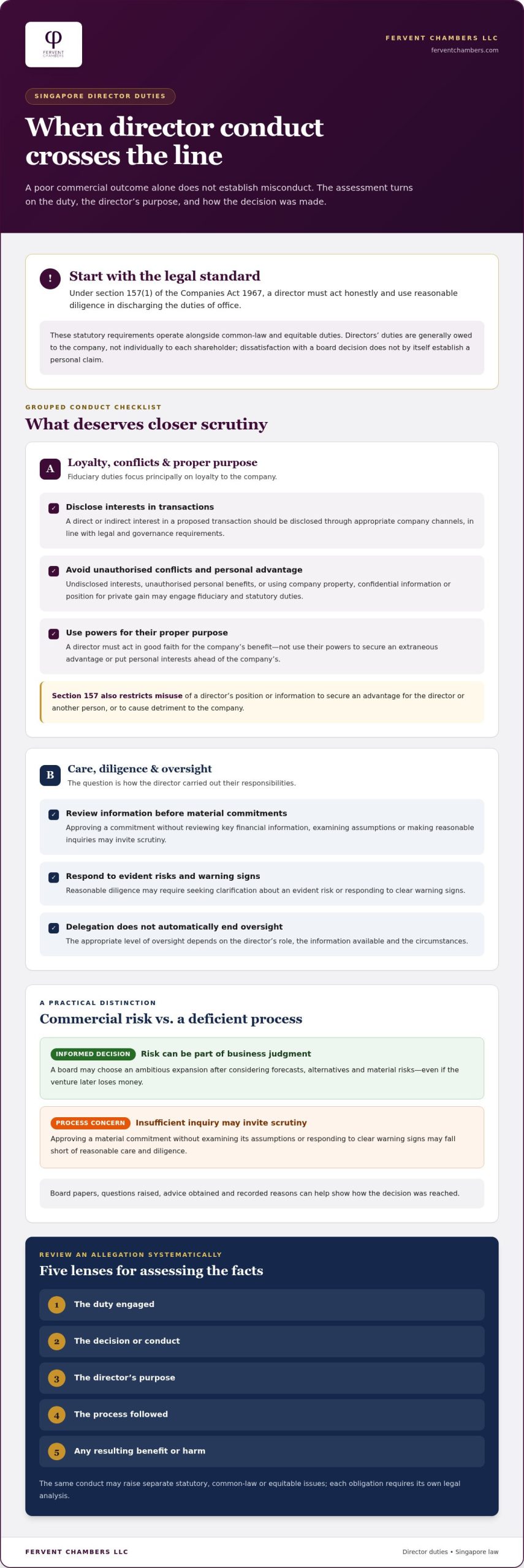
Section 157(1) of the Companies Act 1967 requires a director to act honestly and use reasonable diligence in discharging the duties of office. Section 157 also restricts the improper use of a director’s position or information to secure an advantage for the director or another person, or to cause detriment to the company. A contravention may have statutory consequences, separate from any civil claim arising on the facts.
These statutory requirements operate alongside duties developed by courts through case law. The same conduct may involve a statutory breach and a breach of a common-law or equitable duty, but each is a separate legal analysis. The relevant elements and consequences depend on the obligation relied upon.
How do fiduciary duties differ from duties of care?
Fiduciary duties are principally concerned with loyalty. They require directors to act in good faith for the company’s benefit, avoid unauthorised conflicts of interest, and exercise their powers for proper purposes rather than personal advantage. The broader common law duties of directors provide useful background, although Singapore courts apply Singapore law and authorities.
The duty of care, skill and diligence concerns how a director performs their responsibilities, including the attention and oversight brought to a decision. It does not ask only whether the director acted loyally. Inadequate inquiry or supervision may matter even where there is no personal conflict. The same facts can engage both categories. In Singapore, Ho Kang Peng v Scintronix Corp Ltd [2014] SGCA 22 is relevant to directors’ fiduciary obligations, while Lim Weng Kee v Public Prosecutor [2002] 2 SLR(R) 848 is among the authorities to consider on diligence.
Which director decisions and conduct may amount to a breach?
Whether conduct amounts to a breach depends on the duty engaged, the director’s purpose and the circumstances of the decision. Not every disagreement or commercial failure shows misconduct. Scrutiny is more likely where a director puts personal interests ahead of the company’s, uses company resources for private advantage, or makes decisions without appropriate care.
Conflicts of interest, secret profits, and proper purpose
A director with a direct or indirect interest in a proposed transaction should disclose it through the appropriate company channels and comply with applicable legal and governance requirements. Failure to disclose, an unauthorised personal benefit, or use of company property, confidential information or position for private gain may engage fiduciary and statutory duties. Directors must also exercise their powers for the purposes for which those powers were conferred, not to secure an extraneous advantage.
Hypothetical example: A director supports a contract with a supplier owned by a close relative but does not disclose the relationship and influences the board’s selection process. The relationship alone does not determine liability. Relevant questions include what the director disclosed, whether the board used a proper process to consider the transaction, and whether the director used their position to obtain an unauthorised benefit or disadvantage the company.
Care, diligence, and oversight failures
A director may also face scrutiny for approving a material commitment without reviewing key financial information, seeking clarification about an evident risk, or making reasonable inquiries. Delegating operational work does not automatically remove the director’s responsibility to exercise appropriate oversight. The extent of that responsibility depends on the director’s role, the information available and the circumstances.
The distinction is between a properly informed decision involving commercial risk and a process that falls short of reasonable care and diligence. A board may choose an ambitious expansion after considering forecasts, alternatives and material risks, even if the venture later loses money. By contrast, approving the commitment without examining its assumptions or responding to clear warning signs may invite scrutiny. Board papers, questions raised, advice obtained and recorded reasons can help show how the decision was reached.
If a potential conflict or oversight failure emerges, preserving the decision record and obtaining independent legal analysis can help the company assess its position before the issue develops into a wider corporate dispute. Corporate dispute resolution advice can support that assessment.
How do Singapore courts assess whether a director breached a duty?
Courts assess the alleged conduct against the particular duty said to have been breached. A disappointing result is not, on its own, proof of wrongdoing. A practical analysis identifies the duty, the decision or omission, the director’s purpose, the process followed and any resulting benefit or harm. The relevant legal standard depends on the duty and the circumstances.
Singapore authorities illustrate why these questions must be considered together. In Ho Kang Peng v Scintronix Corp Ltd [2014] SGCA 22, the Court of Appeal considered directors’ fiduciary obligations. Lim Weng Kee v Public Prosecutor [2002] 2 SLR(R) 848 is relevant to the statutory requirement of reasonable diligence. These cases address specific legal issues; neither supplies a single test for every allegation. What constitutes a breach of director’s duties turns on the duty engaged and the evidence of how the director acted.
Does a failed business decision prove a breach?
No. Commercial ventures can fail even when a decision was made in good faith and after reasonable consideration. The court’s assessment focuses on what the director knew or ought to have considered at the time, what inquiries were made, and whether the process met the applicable standard. A loss may be relevant to the consequences of conduct, but it does not, by itself, establish a breach. The analysis should apply Singapore law rather than assume that a foreign business-judgment rule provides a defence.
| Situation | What the court may examine |
|---|---|
| Poor outcome | Whether the decision was properly considered despite the eventual loss. |
| Possible negligence | Whether the director reviewed material information, made reasonable inquiries and exercised appropriate oversight. |
| Conflict of interest | Whether a personal interest was disclosed and whether the director obtained an unauthorised benefit. |
| Improper purpose | Whether the power was exercised for the purpose for which it was conferred, rather than to secure an extraneous advantage. |
What evidence can help establish or answer an allegation?
Relevant material may include board minutes, written approvals, disclosure records, professional advice, contemporaneous communications and transaction documents. These records can show what information reached the board, what questions were raised, how a conflict was handled and who stood to benefit. Their significance depends on context. No document should be treated as conclusive without considering the full decision-making record.
Preserve original records and obtain legal advice before drawing conclusions from incomplete evidence. A structured review can clarify whether the issue concerns a poor outcome, deficient process, undisclosed interest or improper purpose, and help the company determine its next steps.
What should a company or director do after a suspected breach?
An allegation calls for a measured response, not an immediate conclusion about liability. The company should preserve relevant material, establish the factual sequence, identify actual or potential conflicts, and obtain independent legal analysis before deciding how to proceed. These steps help distinguish a governance concern from a legally actionable breach and protect the integrity of any subsequent investigation.
What records should be preserved?
Preserve relevant board papers, minutes, written approvals, correspondence, transaction documents and accounting records. Keep electronic communications in their original form, with available context such as dates, recipients and attachments. Preserve the full decision-making timeline, not only material that appears favourable to one account.
Do not delete records, rewrite minutes or create retrospective documents that could be mistaken for contemporaneous records. Avoid unsupported admissions before the facts and applicable duties have been assessed. If information is incomplete or disputed, record that accurately and seek legal advice on the next steps.
How should a board manage conflicts during an investigation?
The company and an individual director may have different interests, particularly where the allegation concerns that director’s own conduct. Identify who may be affected, consider whether a conflict could influence the investigation or board decisions, and assess appropriate governance safeguards with legal advice. The process will depend on the company and circumstances, so document decisions and safeguards accurately.
A disciplined response can proceed in sequence:
- Preserve: Secure relevant paper and electronic records without altering their original form.
- Establish: Build a factual timeline from available documents, approvals and communications.
- Identify: Determine which directors or other participants may have interests that differ from the company’s.
- Assess: Obtain independent legal analysis of the duties engaged, the evidence and the company’s options.
If the issue develops into a company or shareholder dispute, possible pathways depend on the facts, the parties’ positions and the relief being considered. The Commercial Litigation Lawyer Singapore: Business Guide explains considerations relevant to commercial disputes. Fervent Chambers LLC advises on corporate disputes and can help assess a director-duty allegation and its implications.
What consequences can follow a breach of directors’ duties?
The consequences depend on the duty involved, the evidence, any loss to the company or benefit to the director, and the legal basis of a claim. An allegation does not automatically result in compensation, removal from office, disqualification or reputational harm. Each potential remedy or sanction has its own requirements. The analysis should distinguish a claim brought for the company from statutory or insolvency consequences that may arise separately.
What remedies may be available to the company?
Where a breach is established, the company may seek a remedy suited to the obligation and proven circumstances. Depending on the legal basis, this may include compensation for loss, restoration of company property or an account of profits obtained through the breach. These remedies are not interchangeable or automatic. The court will consider matters such as causation, the benefit received, available defences and supporting evidence.
Statutory consequences are distinct from civil remedies. Under the current provisions described for section 157 of the Companies Act 1967, breach of the duty of reasonable diligence may attract a fine of up to S$20,000, imprisonment of up to 12 months, or both. A failure to disclose an interest under section 156 may attract a fine of up to S$5,000, imprisonment of up to 12 months, or both. The applicable elements must be established; an allegation alone does not establish an offence or determine the outcome.
Separate insolvency rules may also become relevant if the company is insolvent or nearing insolvency. For example, wrongful or fraudulent trading concerns involve distinct statutory questions and are not automatic consequences of every directors’ duties claim.
When can a director-duty issue become a wider dispute?
A director-duty allegation may arise alongside a shareholder dispute, a contested transaction, contractual claims or questions about the company’s financial position. These related issues may affect evidence, strategy and available relief, but each requires its own legal analysis. Governance and reputational consequences may follow if the dispute affects confidence in the board or becomes public, although neither is inevitable.
For a company or director, a proportionate next step is to clarify the alleged duty, preserve relevant evidence and assess potential remedies and related claims under Singapore law. Explore Fervent Chambers LLC’s legal services for support with a consequential corporate dispute.
Assess the facts and protect the company’s position
The central question is not whether a business decision succeeded, but whether the director complied with the applicable duty, acted for a proper purpose and followed a defensible process. Understanding what constitutes a breach of director’s duties requires close attention to the company’s circumstances, the director’s interests and the contemporaneous evidence.
When concerns arise, preserve relevant records, establish the decision-making timeline and identify any conflicts before drawing conclusions or making admissions. A director-duty allegation may also intersect with shareholder, contractual or insolvency issues, so each potential claim and consequence warrants separate legal analysis.
Fervent Chambers LLC is an award-winning disputes and corporate law firm advising clients from startups to listed multinational corporations. Its lawyers help businesses assess consequential corporate disputes and determine considered next steps. Contact Fervent Chambers LLC for legal advice on a director-duty matter.
Frequently Asked Questions
What is the most common breach of directors’ duties in Singapore?
There is no reliable basis to identify one breach as universally the most common in Singapore. Concerns often involve undisclosed conflicts, misuse of company assets or information, improper purpose, or inadequate diligence, but the conduct must be assessed against the duty involved and the company’s circumstances. The decision-making process and evidence also matter. A disputed decision or poor outcome alone does not establish that a director breached a duty.
Can a director be personally liable for a breach of duty?
Yes, a director may face personal liability if the legal requirements for a civil claim or statutory consequence are established. The remedy depends on the duty, conduct, causation, any loss to the company or benefit received by the director, and applicable defences. Liability does not follow automatically because the company suffered a loss. The allegation must be assessed against the evidence and relevant Singapore law.
Does a bad business decision constitute a breach of directors’ duties?
Not necessarily. A decision that later proves unsuccessful does not, by itself, show that a director acted improperly or failed to meet the applicable standard. The assessment may consider the information available at the time, inquiries made, whether a conflict existed, and whether the decision was taken for a proper purpose. No particular decision-making process guarantees protection; its adequacy depends on the circumstances and evidence.
What does section 157 of the Companies Act 1967 require directors to do?
Section 157 requires directors to act honestly and exercise reasonable diligence in carrying out their duties. In practice, directors must approach their responsibilities with integrity and take appropriate care in overseeing company affairs. These statutory obligations are distinct from fiduciary duties developed through common law and equity, including duties of loyalty and proper purpose. The provision’s current wording and application should be considered against Singapore law and the facts at issue.
Can a director be sued for an undisclosed conflict of interest?
Yes, an undisclosed conflict may support a claim where a director’s personal interest conflicts with the company’s interests or the director obtains an unauthorised benefit. A potential conflict does not automatically establish liability. The analysis may turn on the nature of the interest, disclosure, approvals, the company’s governing documents and applicable law. Contemporaneous disclosures, minutes and transaction records can help show how the conflict was handled.
What evidence is relevant to a claim for breach of directors’ duties?
Relevant evidence may include board minutes, papers considered by directors, conflict disclosures, transaction documents, accounting records and contemporaneous communications. Together, these may clarify what information was available, the purpose of a decision and whether an interest was disclosed. Preserve records in their original form and context, including relevant electronic communications. Selective preservation can distort the timeline, so assess the complete evidential picture with legal advice.
Can a director be disqualified for breaching directors’ duties in Singapore?
Disqualification is not an automatic consequence of every alleged or established breach. It is distinct from civil liability and depends on applicable statutory grounds and the circumstances. For example, separate statutory rules provide for automatic disqualification in specified cases involving repeated company strike-offs, while courts may disqualify directors for certain repeated filing-related offences. Whether a ground applies requires analysis of the relevant findings, current provisions and procedure.