
If you’re considering what to do in shareholder dispute Singapore, start by protecting your position, not by choosing a forum. Avoid hurried decisions about company records, assets or operations until you understand the risks, your authority and the rights set out in the company’s governing documents.
A dispute can leave you unsure how to respond while important company decisions continue to be made. The constitution and any shareholders’ agreement may affect what you can do, and the quickest route is not always proportionate. Negotiation, mediation, arbitration and court proceedings can carry different legal and commercial consequences.
This checklist explains how to preserve relevant evidence, identify the documents that affect your options and assess immediate risks. It also compares common resolution routes so you can make informed decisions that account for both your interests and the company’s operations.
Begin by securing relevant records and reviewing the governing documents. Then identify the nature of the dispute, the outcome you want and whether a negotiated or formal process fits the circumstances. A careful assessment can help you act decisively without overlooking the company’s wider commercial needs.
Key Takeaways
- Prepare a dated chronology and an indexed record of key communications and company decisions. This gives you a reliable account to assess against the available evidence.
- Review the company constitution and any shareholders’ agreement for relevant rights, procedures and dispute-resolution clauses.
- Work out whether the complaint concerns your personal rights as a shareholder or an alleged wrong to the company. The distinction may affect who can bring a claim and how.
- Compare negotiation, mediation, arbitration and court action against your priorities, including urgency, confidentiality and the effect on business relationships.
- To decide what to do in shareholder dispute Singapore, define the outcome you seek and weigh legal exposure alongside operational and commercial consequences.
First Steps in a Singapore Shareholder Dispute
A shareholder dispute can affect company control, finances and day-to-day operations. Start by identifying the disagreement, checking what could change urgently, preserving relevant records and confirming your authority before taking action. These steps protect your options. They do not mean that litigation is inevitable.
- Write down the central disagreement, the people involved, the decisions in question and the key dates.
- Check for immediate risks to company records, assets, decision-making or access to information.
- Preserve relevant documents and communications in their original form where possible.
- Before changing access, moving company funds or altering records, establish who has authority to act.
The right response depends on the facts, the company’s governing documents and whether the complaint concerns your personal rights as a shareholder or a possible wrong to the company. General corporate law principles provide background on the relationship between companies, directors and shareholders, but they cannot determine your rights in a particular Singapore dispute.
Identify the dispute and the immediate business risks
Describe the disagreement in neutral, specific terms. For example, distinguish a challenge to a board decision from a concern that records may be altered or company assets transferred. Separate risks that could disrupt operations or cause immediate loss from issues that may be addressed through ordinary governance, discussion or a formal resolution process. This helps keep any urgent response proportionate to the risk.
Record who made each relevant decision, when it happened and what information supports your account. If a decision affects payments, system access or the company’s ability to trade, note the practical consequences. Do not assume that one party is entitled to reverse the decision. Authority may depend on the constitution, any shareholders’ agreement and the person’s role.
Preserve records and avoid actions that may worsen the position
Keep relevant emails, messages, meeting minutes, financial records and versions of key documents. Preserve originals where possible, and note how and when each item was obtained. Avoid editing files or relying only on screenshots when the underlying record is available. If company information is stored across different accounts or systems, note where it is held and who controls access.
Do not delete material, make threats or circulate confidential allegations more widely than necessary. Avoid restricting another person’s access, moving company funds or altering records until you have checked your authority and the possible consequences. If you’re considering what to do in shareholder dispute Singapore, a concise chronology and organised evidence can help counsel assess your position alongside the company’s operational and commercial needs.
Which Singapore Company Documents and Legal Rights Should You Check?
Your position depends on more than the number of shares you hold. The company constitution and any shareholders’ agreement may set out voting rights, board appointment rights, share transfer restrictions, reserved matters and procedures for resolving deadlock. Read the documents together. A shareholders’ agreement may operate alongside the constitution, and the effect of a particular provision depends on its wording and the circumstances.
Review the constitution, shareholders’ agreement, and company records
Check provisions on meeting notices, voting thresholds, consent requirements and any steps that must be taken before a dispute proceeds to negotiation, mediation or arbitration. Compare the relevant terms with company records, such as meeting notices and minutes, registers and financial information. A discrepancy may point to an issue that needs further investigation, but it does not by itself establish that a legal right has been breached.
Note any sequence of steps or deadlines stated in the governing documents. If the appropriate forum or process is unclear, Singapore’s legal and dispute resolution bodies provides an authoritative starting point for locating relevant institutions and court information.
Understand possible claims and remedies under Singapore law
First distinguish a complaint about harm to you as a shareholder from an alleged wrong to the company. For example, exclusion from a decision-making arrangement may raise a personal shareholder issue, while diversion of a company opportunity may involve harm to the company. The distinction matters because the proper claimant and procedure may differ.
Under section 216 of Singapore’s Companies Act 1967, a shareholder may seek relief where the company’s affairs are conducted oppressively, disregard the shareholder’s interests, or are unfairly prejudicial. Section 216A provides a separate route for a shareholder to seek the court’s permission to bring an action on the company’s behalf, typically where the company does not act over an alleged wrong to it. These routes have different purposes and requirements. Neither follows automatically from dissatisfaction with a decision or a particular ownership percentage.
A winding-up application is a distinct and consequential remedy, not simply another form of personal compensation. Interim relief, such as an injunction, may also be considered where the legal grounds, evidence and urgency support it — understanding the injunction application Singapore court process, evidence requirements and key risks can help you assess whether this form of relief fits your circumstances. The court assesses whether that relief is appropriate. The remedy sought should match both the nature of the alleged harm and the practical outcome required.
To assess what to do in shareholder dispute Singapore, organise the governing documents and records around the specific decision or conduct in question. If the relevant rights, potential claims or procedures are unclear, consider obtaining advice on the company documents and dispute-resolution options from Singapore dispute resolution counsel.
How to Compare Negotiation, Mediation, Arbitration, and Court Action
The appropriate route depends on the dispute, the outcome sought and the procedures in the constitution or shareholders’ agreement. Review those documents before proposing a process or starting proceedings, particularly if they contain an arbitration clause or require negotiation or mediation first. A route that seems attractive in principle may not be available or may not address the company’s immediate needs.
The comparison below is a starting point, not a prediction of timing or outcome. Confidentiality, urgency and enforceability depend on the applicable agreement, rules, law and circumstances.
| Route | Control and outcome | Confidentiality | Urgency and enforceability | Business relationships |
|---|---|---|---|---|
| Negotiation | Parties control discussions and any agreed solution. | Can be handled privately, but privacy should not be assumed. | May be arranged directly; an agreed settlement should be properly recorded. | Can preserve working relationships if communication remains constructive. |
| Mediation | A neutral mediator facilitates discussion; parties decide whether to settle. | Often conducted privately, subject to applicable terms and law. | May be organised by agreement; mediation does not itself impose a binding outcome. | Can support dialogue, but settlement is not guaranteed. |
| Arbitration | An arbitrator or tribunal determines the dispute under the applicable procedure. | May offer greater privacy, subject to the arbitration agreement, rules and law. | Procedure and any urgent relief depend on the clause and applicable rules; an award is generally binding. | Formal determination can strain commercial relationships. |
| Court action | The court determines issues and may grant remedies available under law. | Proceedings are generally public, subject to applicable exceptions or orders. | Urgent applications may be available where justified; court orders can be enforced through court processes. | Formal proceedings may affect ongoing business dealings and management attention. |
When a negotiated or mediated resolution may be worth exploring
If the parties can still communicate and the company can continue operating, structured negotiation may help identify practical outcomes, such as governance changes or a mutually agreed exit. Before discussions, define your priorities, confirm who has authority to settle and identify matters that are not negotiable. Mediation adds a facilitator who can help the parties test proposals, but it does not compel agreement. Record any settlement clearly.
When arbitration or court proceedings may require consideration
If discussions fail, an applicable clause may direct the parties to arbitration. Review its scope and procedural terms before assuming that court is the correct forum. If the evidence points to an immediate risk to assets, records or business operations, obtain advice about whether urgent relief may be available. Arbitration and court action follow different procedures; either can require substantial preparation and draw management attention away from the business. Litigation may also involve costs, disclosure obligations and consequences for continuing commercial relationships. Working with an experienced commercial litigation lawyer Singapore businesses rely on can help you assess whether court proceedings are proportionate and how to protect your position while keeping practical options open.
Deciding what to do in shareholder dispute Singapore means weighing urgency and enforceability against control, confidentiality and the company’s ability to function. Choose a proportionate route based on the governing documents and the outcome needed, rather than assuming one process is always faster or preferable.
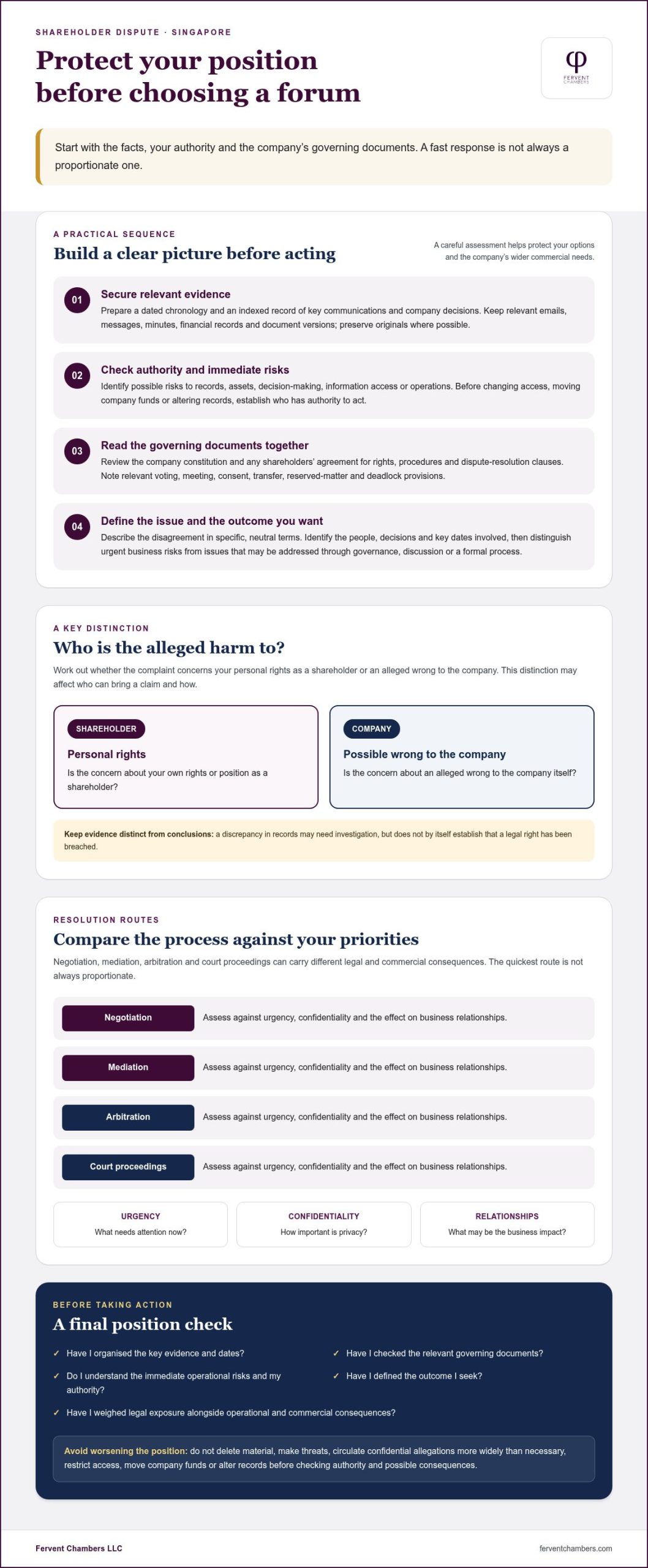
A Practical Checklist for Protecting Your Position Before Taking Action
Before sending a formal demand or proposing governance changes, assemble a clear account of the dispute and decide what you want to achieve. Start by preserving relevant records, documenting events, identifying immediate risks and confirming your authority to act.
Prepare a reliable chronology and evidence file
Use a dated chronology to separate what happened from what you believe it means. Keep firsthand evidence distinct from recollection or inference, and record uncertainties rather than filling gaps with assumptions. An indexed file helps advisers locate documents and assess the dispute against a reliable factual record.
- List key events: Record participants, decisions, communications and dates in chronological order. Identify the source for each entry, such as meeting minutes or an email.
- Preserve relevant material: Retain records lawfully and in their original form where possible, including relevant messages, financial records and document versions. Do not access another person’s account or restricted company material without authority.
- Index the documents: Create a contents list with dates, document descriptions and storage locations. Mark missing records and note who may hold them, without trying to obtain them improperly.
Define objectives and obtain advice before escalating
A clear objective helps keep your response proportionate. Decide whether you seek a change in decision-making, access to information, a negotiated arrangement, an exit or another outcome. Then identify acceptable compromises and practical constraints, including the company’s ability to continue operating.
- Check authority and conflicts: Before speaking for the company, changing access or proposing a settlement, confirm your authority under the relevant company documents and your role. Identify any personal interests that may differ from the company’s interests. The appropriate process depends on the circumstances and governing documents.
- Protect confidentiality: Limit circulation of sensitive records and allegations to people who need them for a proper purpose. Consider confidentiality obligations and whether unnecessary disclosure could affect the company or the dispute.
- Prepare focused questions: Ask an adviser to assess your rights, procedural clauses, evidence gaps, urgency and possible next steps before you make a formal demand or propose a governance change.
Avoid public statements, threats or communications that could intensify the conflict or expose confidential information. If you’re deciding what to do in shareholder dispute Singapore, first organise the facts and objectives, then seek advice on the legal and commercial consequences of each proposed step.
Review your shareholder dispute options with counsel before taking a step that could affect your position or the company’s operations.
How Singapore Disputes Counsel Can Help You Choose the Next Step
Once you have assembled the key facts and documents, disputes counsel can assess how the constitution, shareholders’ agreement and available evidence affect your position. That assessment can help clarify whether a potential claim concerns your rights as a shareholder or an alleged wrong to the company, whether a procedural clause applies and which options merit further consideration.
Advice should account for more than legal exposure. A proposed step may affect decision-making, access to information, business continuity and commercial relationships. If shareholders, assets or transactions involve more than one jurisdiction, counsel can also consider the cross-border elements relevant to the dispute. Fervent Chambers LLC advises clients from startups to listed multinational corporations and handles commercial dispute resolution and arbitration, alongside corporate and commercial advisory.
What to bring to an initial legal consultation
A focused set of materials can make an initial discussion more useful. Bring the company constitution, any shareholders’ agreement, relevant resolutions and available company records, along with a concise chronology and key correspondence. Be ready to explain your preferred outcome, possible compromises and practical constraints affecting the business.
Flag time-sensitive matters clearly, including scheduled meetings, possible transactions, approaching deadlines or operational concerns. If a document is missing, note what it is and who may hold it instead of trying to obtain restricted information without authority.
How to assess a suitable shareholder-dispute strategy
Ask counsel to explain the potential legal basis for your position, the available routes, material uncertainties and immediate priorities. Consider how negotiation, mediation, arbitration or court action may affect confidentiality, decision-making, management attention and the company’s ongoing relationships. The aim is to assess options against your circumstances, not to assume a particular remedy is available or appropriate.
For a cross-border dispute, clarify which agreements, parties and business activities may be relevant in each jurisdiction and how that context could affect the practical strategy. A considered assessment can align legal steps with the company’s operational needs without treating continuity as a reason to overlook a legitimate concern.
If you are considering what to do in shareholder dispute Singapore, an initial discussion can help identify the documents and facts that matter, any urgent issues and whether further advice is appropriate. Review your shareholder dispute options with Fervent Chambers LLC to consider the circumstances and possible next steps, without assuming a particular outcome.
Take Your Next Step with a Clearer Strategy
A shareholder dispute can put pressure on individual rights and the company’s ability to operate. Before choosing a remedy, preserve relevant evidence, review the constitution and shareholders’ agreement, and clarify whether the concern is personal or involves harm to the company. Then compare the available routes against your desired outcome, the procedures that apply and the practical effects on the business.
If you’re weighing what to do in shareholder dispute Singapore, a careful assessment can help you move forward without treating court action as the only option. Fervent Chambers LLC advises on complex commercial dispute resolution and arbitration, serving clients from startups to listed multinational corporations. Its counsel can assess legal exposure alongside operational and commercial considerations, with the strategy grounded in the circumstances of your dispute.
To discuss your position and possible next steps, contact Fervent Chambers LLC with the relevant documents, a concise account of events and a clear sense of your objectives.
Frequently Asked Questions
What should I do first in a shareholder dispute in Singapore?
If you’re searching for what to do in shareholder dispute Singapore, start by preserving relevant records, preparing a dated chronology and identifying immediate risks to company assets, records or operations. Review the constitution and any shareholders’ agreement. Do not destroy documents, make public allegations or take unilateral action involving company assets before obtaining advice. The right next step depends on the facts, governing documents and urgency. This checklist is general information, not an assessment of an individual claim.
Can a minority shareholder take legal action in Singapore?
A minority shareholder may have legal options in appropriate circumstances, but eligibility depends on the facts, company documents and legal basis. Section 216 of Singapore’s Companies Act 1967 may provide a route to seek relief for oppressive or unfairly prejudicial conduct, but the requirements and potential outcomes are case-specific. Shareholding percentage alone does not determine whether a claim is available. Obtain current legal advice before deciding whether to commence proceedings or pursue a particular remedy.
What happens if a shareholders’ agreement has a dispute-resolution clause?
A dispute-resolution clause may set out steps such as negotiation, mediation or arbitration before the parties pursue another process. Its wording, the nature of the dispute and related company documents all matter. Do not assume the clause automatically excludes court involvement or answers every procedural question. Before sending a formal notice or starting proceedings, have the agreement and constitution reviewed to understand the process they may require and any relevant conditions.
Can I force another shareholder to sell their shares in Singapore?
Do not assume you can compel another shareholder to sell simply because the relationship has broken down. Transfer provisions in the constitution or shareholders’ agreement, applicable law and the facts may affect the available options. A forced sale is not automatic, and the existence of a dispute alone does not establish an entitlement to require a transfer. Obtain advice on the relevant documents and circumstances before making a demand or agreeing to sale terms.
Should I use mediation or go to court in a shareholder dispute?
The suitable route depends on the governing documents, urgency, evidence, desired outcome and whether the parties can negotiate. Mediation can facilitate discussion and a negotiated solution, but it does not guarantee settlement. Court proceedings provide a formal process and may affect costs, disclosure, management attention and business relationships. Arbitration may also be relevant if an applicable agreement provides for it. Review the available routes with Singapore counsel before deciding how to proceed.
How do I protect company records during a shareholder dispute?
Preserve relevant correspondence, meeting materials, financial records and document versions in their original form where possible. Note where records came from, and do not delete, alter or access information without proper authority. If a record is missing, note who may hold it rather than trying to obtain restricted material improperly. If there is an immediate risk to records or business operations, seek advice promptly about lawful, proportionate steps that fit the company’s circumstances and applicable obligations.
Do I need a lawyer for a shareholder dispute in Singapore?
Whether to instruct a lawyer is an individual decision, but legal advice can help clarify rights under company documents, identify potential claims, assess procedural clauses and compare resolution routes. Advice may be particularly important where control, company assets, urgent transactions or cross-border issues are involved. Fervent Chambers LLC advises on complex commercial dispute resolution and arbitration, serving clients from startups to listed multinational corporations. This general checklist cannot determine your rights or replace advice based on your facts.