The fastest injunction application Singapore court process is not necessarily the strongest one. Urgency cannot make up for an unclear legal basis or incomplete evidence. When threatened harm could disrupt a business, expose assets or compromise confidential information, the pressure to act quickly is understandable. But the form of relief and the evidence supporting it need to fit the risk.
An injunction may prohibit conduct, require a party to take specified action or, in appropriate circumstances, restrain dealings with assets. The evidence required depends on the relief sought. An urgent application without notice carries a strict duty to disclose material facts, including those that may weaken the applicant’s case. An undertaking as to damages can also expose the applicant to consequences if the order is later found to have been wrongly granted.
This article explains the main types of injunctions available in Singapore, the principles courts apply and the documents and evidence that may need prompt attention. It also covers procedural choices, cross-border issues and the commercial risks of seeking urgent relief, helping you identify questions that warrant case-specific advice before taking action.
Key Takeaways
- Match the injunction sought to the threatened conduct, and distinguish interim protection from a final determination of the dispute.
- The court’s assessment of an injunction application depends on the claim, the relief requested and the evidence relevant to the legal principles.
- Organise records to show what happened, why action is urgent, what harm may follow and how the proposed order would address it.
- Confirm the appropriate forum and process by reference to the claim and current court requirements.
- Weigh the protective value of an order against the undertaking, potential costs and commercial effects. Consider whether negotiation or another dispute-resolution step is appropriate.
What Singapore Court Injunctions Can and Cannot Do
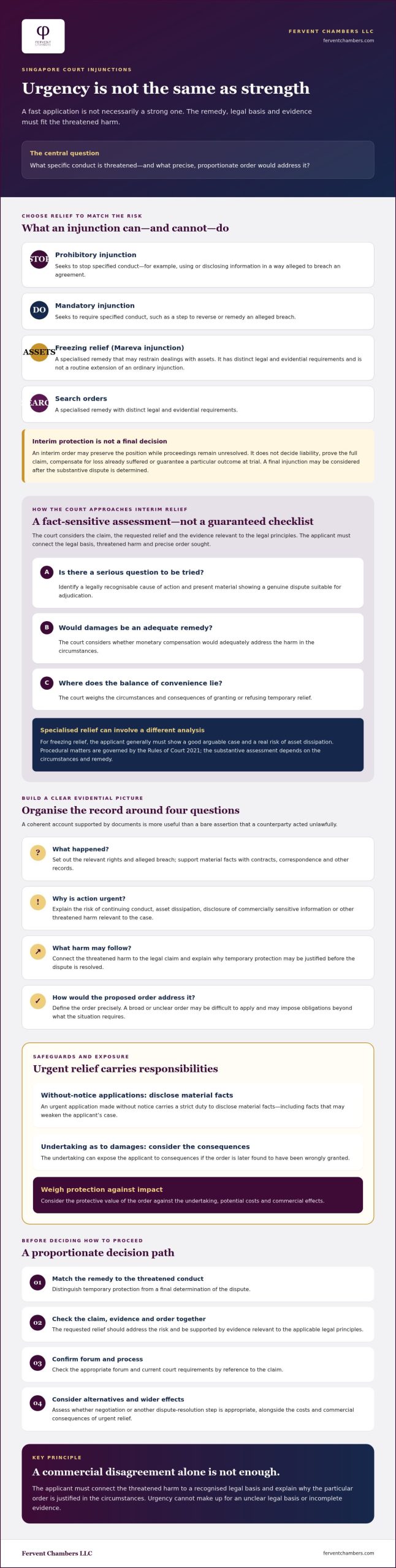
An injunction is a court order that, depending on its terms and legal context, restrains a person from specified conduct or requires that person to take specified action. It is intended to prevent or control conduct. It does not replace proof of the full claim or provide compensation for loss already suffered.
In Singapore litigation, interim injunctive relief is a temporary court order that restrains or requires specified conduct while the underlying proceedings remain unresolved.
An interim order may preserve the position so that a later judgment remains effective, but it does not decide liability or guarantee a particular outcome at trial. A final injunction, by contrast, may be considered as part of the relief after the court determines the substantive dispute. The general purpose of an interlocutory injunction is to maintain the position pending a final decision, although the order’s precise scope depends on the case and the court’s assessment.
Which injunction type may address the threatened harm?
A prohibitory injunction seeks to stop conduct, such as using or disclosing information in a way alleged to breach an agreement. A mandatory injunction seeks to require conduct, such as taking a specified step to reverse or remedy an alleged breach. Freezing relief, commonly described as a Mareva injunction, and search orders are specialised remedies with distinct legal and evidential requirements. They are not routine extensions of an ordinary injunction request.
The appropriate order depends on the legal basis, the evidence and the particular risk the applicant seeks to address. Its terms should be precise. A broad or unclear order may be difficult to apply and could impose obligations beyond what the situation requires.
When might a Singapore court application become relevant?
An injunction application Singapore court may become relevant where evidence points to a risk that assets will be dissipated, commercially sensitive information may be disclosed, or allegedly wrongful conduct may continue before the dispute is resolved. These examples may warrant assessment, but they do not automatically satisfy the legal test or entitle a party to relief.
A commercial disagreement alone is not enough. The applicant must connect the threatened harm to a recognised legal basis and explain why the particular order is justified in the circumstances. The court considers the case presented, including the evidence and the consequences of granting or refusing relief. Case-specific advice can help assess whether an application is proportionate.
How Singapore courts assess an application for interim injunctive relief
The court considers not only whether the applicant has an arguable legal claim, but also whether temporary relief is justified before that claim is finally determined. For a conventional interlocutory injunction, the general approach considers whether there is a serious question to be tried, whether damages would be an adequate remedy and where the balance of convenience lies. These considerations guide the court’s discretion. They are not a mechanical checklist or a guarantee of an order.
In a fact-sensitive injunction application, Singapore court proceedings require the applicant to connect the legal claim, the threatened harm and the precise order sought. The applicable analysis may differ for specialised remedies. For freezing relief, for example, the applicant generally must show a good arguable case and a real risk of asset dissipation. The Rules of Court 2021 govern procedural matters, but the substantive assessment depends on the circumstances and remedy in question.
What must the applicant establish about the underlying claim?
The applicant must identify a legally recognisable cause of action and support it with material showing that the dispute is genuine and suitable for adjudication. Pleadings should explain the relevant rights and alleged breach. Contracts, correspondence and other records should support the material facts. A bare assertion that a counterparty acted unlawfully is less persuasive than a coherent account backed by documents and evidence.
At the interim stage, the court does not have to decide the entire case. The applicant must still present the claim clearly enough for the court to assess whether interim protection is warranted. An injunction should not be used simply to gain leverage in a commercial disagreement. Businesses that are uncertain whether litigation is the right route may benefit from reviewing what a commercial litigation lawyer Singapore businesses rely on can offer before committing to court proceedings.
How urgency, harm, and the balance of convenience matter
Timing helps the court assess whether relief is needed before a final decision. Evidence of a concrete, impending risk may explain why delay could make later relief ineffective. Unexplained delay may count against the claimed urgency. The applicant should identify the anticipated harm and explain why damages or another eventual remedy may not adequately address it.
The court also considers the practical prejudice to each party. It may weigh the consequences of allowing the challenged conduct to continue against the burden an order would impose, including whether a narrower measure could preserve the position with less disruption. The balance depends on the evidence and context, not on a formula applied without regard to the remedy sought.
Where a claim crosses contractual, sectoral or national boundaries, disputes counsel can help assess the legal basis, supporting material and commercial consequences before an application is pursued. Fervent Chambers LLC advises on complex commercial dispute resolution and arbitration. Further information is available at commercial dispute resolution advice.
What evidence and safeguards matter in an injunction application?
A persuasive application depends on a reliable evidential record, not simply the seriousness of the allegation. For an injunction application, Singapore court materials should connect each material assertion to an identifiable source. This helps the court assess the alleged right, the threatened harm and the order requested. Contracts, amendments, contemporaneous emails, notices, transaction records and witness accounts may each support different parts of the case.
Keep the evidential issues distinct. Documents supporting an alleged breach do not, by themselves, establish that harm is imminent or that the proposed order is necessary. Explain what conduct is said to be wrongful, why waiting for a final decision may cause prejudice, and how the requested terms would address that risk without going further than needed.
Building a clear and credible evidential record
Arrange the materials chronologically and identify the source for each important fact. An evidence matrix can link each proposed order to its factual support and legal basis, while highlighting gaps that need clarification before filing. For example, a contract may establish an asserted restriction, while correspondence and records of later conduct may help show what happened and when.
Address inconsistencies directly. If documents are missing, dates conflict or a fact may support the other party’s position, explain the uncertainty rather than presenting an incomplete account as settled. A balanced record helps the court assess the application and reduces the risk that later disclosure will undermine its credibility.
Understanding undertakings and disclosure duties
The court may require an undertaking as to damages. Under it, the applicant undertakes to compensate the other party for loss caused by an injunction if the order is later found to have been wrongly granted. The court’s requirements and the undertaking’s scope depend on the application. Assess potential exposure before seeking relief rather than treating the undertaking as a formality.
Where an application proceeds without notice to the other party, the applicant must give full and frank disclosure of material matters. This includes facts adverse to the application, relevant contrary documents and material uncertainty, so the court can assess the request fairly without submissions from the other side. Material non-disclosure may lead the court to reconsider or discharge an order and may have costs consequences. An unsupported application also risks refusal and adverse consequences.
Procedure varies by forum. The Family Justice Courts Practice Directions concern proceedings in that court. Commercial litigants should check the directions applicable to their actual forum. Reviewing the evidence, disclosure position and proposed undertaking can help identify weaknesses before an urgent application is filed.
How to prepare and proceed with an injunction application in Singapore
Start with the threatened conduct, not a court form. Identify what may happen, when it may happen, the legal right said to be at risk and the specific order that could address it. Then obtain a prompt legal assessment of the evidence, urgency, appropriate forum and possible consequences of seeking relief. The procedure for an injunction application in Singapore court depends on the underlying claim and remedy, so confirm the correct route before filing.
A practical preparation sequence is to establish the factual timeline, assemble relevant documents and witness evidence, define the proposed order’s scope, and assess whether notice can be given without undermining the purpose of the application. If the dispute has a cross-border element, jurisdiction and the practical reach of any order also require careful consideration. A high value commercial litigation Singapore procedural framework may provide useful context, but the route must be assessed against the particular claim.
Preparing the application materials and proposed order
Depending on the proceedings and applicable procedure, the application may require pleadings or an originating process, affidavit evidence with exhibits, and a draft order setting out the relief requested. The draft should state clearly what the respondent must stop or do, and for what period or until what event. Terms tied narrowly to the evidenced risk are generally more workable than broad restrictions unsupported by the material.
Singapore civil proceedings are governed by the Rules of Court 2021, and court applications are filed electronically through eLitigation. The originating process, supporting documents, filing steps, hearing arrangements and service requirements depend on the claim and current rules. Confirm the requirements for the relevant court before submission instead of relying on a generic checklist.
A without-notice application may be considered where notifying the respondent could frustrate the purpose of the relief, but it is not simply a faster route. The applicant must meet the applicable procedural requirements and make full and frank disclosure. The court may give directions on service and a further hearing. Do not assume that notice can be withheld without judicial authority or that a particular timetable will apply.
What may happen after the court hears the application?
The court may grant the order sought, impose narrower terms, refuse relief or adjourn the matter for further evidence or submissions. Read and comply with any order as made. A party who believes its terms are unworkable should seek appropriate directions rather than disregard them. Depending on the circumstances and applicable procedure, the order may also be varied or discharged. For more on the consequences of alleged non-compliance with a court order, see committal proceedings in Singapore and how courts assess alleged breaches.
Because an injunction can affect operations, counterparties and ongoing proceedings, legal assessment should address both the application and what compliance would require in practice. For advice on the procedural and commercial dimensions of a dispute, contact Fervent Chambers LLC about commercial dispute resolution.
Choosing a proportionate next step for an injunction dispute
An injunction can protect a legal or commercial position, but seeking one also creates obligations and exposure. Before proceeding, weigh its likely protective value against the evidence required, any undertaking the court may require, legal costs and the effect an order could have on counterparties, staff, suppliers or customers. An order broader than the immediate risk may disrupt operations or intensify a dispute without providing proportionate protection.
Urgent court relief is not the only possible response. Depending on the facts, a negotiated undertaking, targeted notice or another dispute-resolution step may address the risk while preserving a commercial relationship. These options are not interchangeable. Negotiation may be unsuitable if it could prompt the conduct the applicant seeks to prevent, while litigation may be disproportionate if a narrower measure can contain the risk. The decision should reflect the evidence, timing and practical consequences. Understanding what a commercial litigation lawyer Singapore businesses engage can offer in terms of strategic assessment may help clarify which route is most appropriate before committing resources.
Assessing the commercial and procedural risks before filing
Map the effect of the dispute on the business as well as the legal claim. Consider operational continuity, contractual commitments, reputation and any cross-border assets, parties or proceedings. Where corporate control is at stake, the facts may also call for analysis of the wider shareholder dispute, including how interim relief could affect governance and business decisions.
Assess the consequences of refusal or delay alongside the obligations an order would impose if granted. If relief is later varied or discharged, the parties may face further procedural steps, changed commercial positions and possible costs consequences. These possibilities are reasons to define the objective and proposed terms carefully, not to assume that an application will fail or succeed. Understanding how procedural tactics in high value commercial litigation Singapore can shape outcomes may help parties sequence their decisions more effectively.
When to seek advice from disputes counsel
Prompt legal assessment is prudent where assets may be moved, confidential information may be disclosed, business operations face immediate interference, or key evidence could become unavailable. Counsel can help test the legal basis, identify evidential gaps, assess the forum and procedural route, and compare the proposed order with less disruptive options. This is particularly important where the dispute crosses borders, since the location of parties or assets may affect strategy and the practical reach of relief.
Fervent Chambers LLC advises on complex commercial dispute resolution, arbitration and cross-border matters. An injunction application Singapore court decision should be based on the circumstances of the dispute, rather than treated as a necessary step in every commercial conflict. To discuss the issues and available options, Discuss an injunction concern with Fervent Chambers.
Make the Next Step Deliberate
An injunction can help protect a commercial position, but the decision to seek one should rest on a clear legal basis, evidence supporting the risk and an order framed to address that risk proportionately. The court considers the underlying claim and the practical consequences of granting or refusing relief. Procedural choices and safeguards can also carry significant commercial implications.
Before pursuing an injunction application in Singapore court proceedings, assess what harm is threatened, what evidence is available, whether less disruptive steps may be appropriate and what obligations an order could impose. These questions become more complex when parties, assets or proceedings cross borders, or when the dispute affects ongoing business operations.
Fervent Chambers LLC advises on commercial dispute resolution and arbitration, including matters across construction, shipping, technology and clean energy, and has experience in cross-border disputes. Discuss an injunction concern with Fervent Chambers to explore the issues specific to your circumstances. A measured assessment can help you choose a course that protects your position while keeping wider commercial priorities in view.
Frequently Asked Questions
Can I apply for an injunction in a Singapore court without notice to the other party?
Yes. A Singapore court may consider a without-notice application in appropriate circumstances, but it is not a routine alternative to notifying the other party. The applicant may have to give full and frank disclosure of material facts, including matters adverse to the application, and address safeguards such as an undertaking as to damages. Requirements depend on the case, so check current Singapore rules and authorities before applying.
What evidence is needed for an injunction application in Singapore?
Evidence should support the underlying claim, threatened harm, asserted urgency and precise order requested. Relevant material may include contracts, contemporaneous communications, business records and witness evidence, but no single checklist applies to every case. Organise the evidence so each material assertion can be traced to a source, address inconsistencies and present adverse facts fairly. The evidence required depends on the circumstances and relief sought.
How quickly can a Singapore court hear an injunction application?
There is no fixed hearing period for every application. Timing depends on the urgency shown, the court’s directions, the applicable procedure and whether the application materials are complete. People searching “injunction application Singapore court” should not assume that a hearing will take place within a particular number of days. If a genuine risk is documented, obtain prompt legal assessment and verify current procedural requirements before filing.
What is an undertaking as to damages in an injunction application?
An undertaking as to damages is an assurance to the court that may require the applicant to compensate the respondent for loss caused by an injunction, if the court later determines that compensation is appropriate. It is a potential safeguard for the party restrained by the order, not a standard term with identical effects in every case. Its form, scope and application depend on the court’s requirements and the circumstances.
Can a Singapore court grant an injunction against someone outside Singapore?
A cross-border injunction question cannot be answered categorically without examining the case. Jurisdiction, service, the order’s territorial reach and its enforceability may depend on the parties, the location of assets, the relief sought and applicable law. Do not assume that an order made in Singapore will operate effectively abroad. Before seeking or relying on such relief, verify the relevant Singapore authorities and any foreign-law issues with advice specific to the dispute.
What happens if an injunction application is refused?
Refusal does not necessarily determine the underlying dispute, although it may affect the parties’ positions and next steps. The court may provide reasons or make directions, while any available procedural option depends on the order and circumstances. Do not assume that the same application can simply be filed again. Review the decision promptly with a lawyer, and confirm any applicable deadlines and requirements before taking further action.
Can an injunction order be changed or discharged after it is granted?
A party may be able to apply to vary or discharge an injunction, subject to the order’s terms, the evidence and current court procedure. A material change in circumstances may be relevant, but does not automatically justify changing the order. Until the court varies or discharges it, parties must comply with its terms. Obtain case-specific advice before seeking a change or taking any step that may conflict with the order.
For advice on an injunction concern or related commercial dispute, contact Fervent Chambers LLC to discuss the issues and options relevant to your circumstances.