
In high value commercial litigation Singapore, the first procedural decision may not be when to file. It may be what to preserve before the dispute advances. Delay can make important evidence harder to secure and commercial leverage more difficult to maintain. An unnecessarily broad approach, however, can increase operational and reputational consequences.
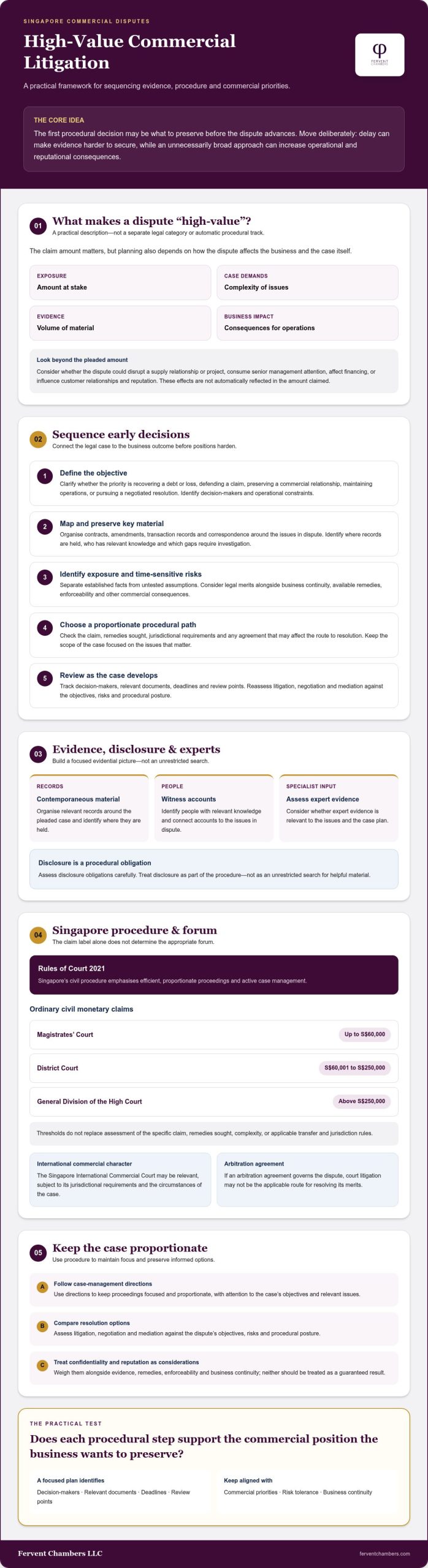
In a high-value dispute, procedural choices can shape how a case is presented, as well as the time, resources and business disruption it demands. Singapore’s Rules of Court 2021 emphasise efficient, proportionate proceedings and active case management. This makes early decisions about evidence, disclosure and the scope of a case especially consequential.
This article offers a practical framework for sequencing those decisions. It covers preserving relevant records, assessing disclosure obligations, considering expert evidence, responding to case-management directions and evaluating resolution options. It also explains how to align litigation objectives with commercial priorities and risk tolerance, so each procedural step supports a considered position rather than creating avoidable exposure.
Key Takeaways
- “High-value” describes the practical demands of a dispute, not necessarily a separate legal category. Exposure, complexity and business continuity should shape procedural strategy.
- In high value commercial litigation Singapore, sequence early decisions by defining commercial objectives, assessing key documents and identifying risks before choosing the next procedural step.
- Organise contemporaneous records and witness accounts around the pleaded case. Treat disclosure as a procedural obligation, not an unrestricted search for helpful material.
- Assess litigation, negotiation and mediation against the dispute’s objectives, risks and procedural posture. Use case-management directions to keep the case focused and proportionate.
- Build a litigation plan that identifies decision-makers, relevant documents, deadlines and review points, so procedural choices remain aligned with commercial priorities.
What Makes High-Value Commercial Litigation in Singapore Procedurally Different?
“High-value commercial litigation” is a practical description, not a distinct legal category with a single procedural track. In Singapore, it generally describes a commercial dispute where the amount at stake, complexity of the issues, volume of evidence or consequences for business operations call for careful case planning. The claim’s value matters, but it does not determine the procedure on its own.
In high value commercial litigation Singapore, procedural priorities depend on how legal merits interact with commercial objectives. A party may have a well-supported claim and still need to consider whether the remedy sought is enforceable, whether business operations can continue, and how proceedings may affect customer relationships, financing or reputation. These consequences require a client-specific assessment and are not automatically reflected in the amount claimed.
How Singapore court procedure shapes commercial dispute strategy
Singapore’s civil proceedings are governed by the Rules of Court 2021, which provide for active case management and proportionate procedure. The appropriate forum depends on the claim, remedies sought, monetary jurisdiction and complexity, rather than the label “high-value” alone. For ordinary civil monetary claims, the Magistrates’ Court hears claims up to S$60,000, the District Court hears claims from S$60,001 to S$250,000, and the General Division of the High Court has jurisdiction over claims above S$250,000. These thresholds do not replace an assessment of the specific claim or any applicable transfer and jurisdiction rules.
Where a dispute has an international commercial character, the Singapore International Commercial Court may also be relevant, subject to its jurisdictional requirements and the circumstances of the case. The broader Judicial system of Singapore offers useful structural context, but forum selection should be checked against current rules and the remedies sought. If an arbitration agreement governs the dispute, court litigation may not be the applicable route for resolving its merits.
Why commercial stakes extend beyond the claim
The quantified claim is only one part of the exposure. A dispute may disrupt a supply relationship, delay a project, consume senior management attention or affect a company’s ability to secure financing, even where those consequences are not pleaded as recoverable loss. Separating the amount claimed from these operational effects helps decision-makers identify what outcome would actually protect the business.
Confidentiality and reputation may also affect the choice and conduct of proceedings, but neither should be treated as a guaranteed result. Weigh those concerns alongside the evidence, available remedies, enforceability and need to maintain business continuity. The aim is to align procedural decisions with the commercial position the client seeks to preserve.
How to Sequence Early Decisions in Singapore Commercial Litigation
Early decisions are most useful when they connect the legal basis of the case to the outcome the business needs. In high value commercial litigation Singapore, taking a procedural step before clarifying objectives can create avoidable cost, distract from key evidence or limit later options. An initial review gives decision-makers a chance to establish priorities before positions harden.
Use this sequence as a starting framework, then check each step against the facts, applicable agreements and current procedural requirements:
- Define the objective. Identify whether the priority is recovering a debt or loss, defending a claim, preserving a commercial relationship, maintaining operations or pursuing a negotiated resolution. Record who can approve material decisions and any operational constraints that may affect the strategy.
- Assess the available documents. Map contracts, amendments, transaction records and correspondence to the issues in dispute. Note where records are held, who has relevant knowledge and which gaps need investigation. Keep untested assumptions separate from established facts.
- Identify exposure and time-sensitive risks. Consider likely legal and commercial consequences, including disruption to a project or supply arrangement. Limitation periods and court or arbitration deadlines depend on the specific claim and procedural posture. Check them promptly with counsel rather than assuming a general timetable applies.
- Evaluate the available route. Compare the merits, evidence and desired outcome before deciding whether to commence or defend proceedings, explore resolution or pursue another applicable process. For a qualifying international commercial dispute, the Singapore International Commercial Court may warrant consideration, subject to its jurisdiction and the circumstances of the case.
Set objectives before choosing procedural steps
Separate what the business wants legally from what it needs commercially. Recovery may be central in one matter. In another, a defensible resolution that allows a key relationship to continue may better serve the company. Establish decision authority, acceptable settlement parameters and operational limits early. Also assess whether urgent protective action may be needed to prevent an immediate risk from worsening.
Preserve evidence and control communications
Identify relevant custodians, email and messaging systems, contract files, accounting records and transaction data. Include material held across business units or jurisdictions. Put a documented preservation process in place and have it reviewed against applicable legal obligations. Staff should not alter or delete potentially relevant records, or circulate selective commentary that could later be misunderstood.
Preserving evidence early supports litigation readiness by reducing the risk that relevant records become unavailable before the issues are properly assessed.
Early legal review can test whether the proposed claim or defence is supported by available evidence and remains aligned with the intended commercial result. Businesses considering their next steps may discuss a commercial dispute with Fervent Chambers as part of that assessment.
Evidence, Disclosure and Experts: Where High-Value Cases Gain or Lose Ground
In high value commercial litigation Singapore, a pleaded position depends not only on the legal case, but on whether the available evidence supports it consistently. Contemporaneous contracts, emails, meeting records and transaction data may corroborate a party’s account, expose gaps or show that events unfolded differently than first understood. Witness recollections can add context, but should be tested against records and other accounts rather than treated as conclusive on their own.
Factual evidence records what a person observed, said or did. Expert opinion evidence assists the court on specialised matters such as technical causation or valuation. Each proposed witness or expert should have a defined role tied to a material issue. Under the Rules of Court 2021, court approval is required for expert evidence, and the framework encourages a single joint expert where appropriate. The specific approach remains subject to the court’s directions.
Build a proportionate documentary evidence plan
A focused evidence plan starts by identifying the factual questions that matter, then mapping likely custodians, repositories, relevant date ranges and record types. In a construction dispute, for example, the review may need to connect contract variations, project correspondence and progress records to the disputed events. Keep the scope proportionate to the issues rather than collecting every potentially related file without a clear purpose.
A working chronology can reveal missing records, conflicting dates and inconsistencies between documents and witness accounts. Disclosure is a procedural obligation governed by applicable rules and court directions, not an unrestricted search for helpful material. Privilege, confidentiality, personal data and records held across borders may affect how material is identified, reviewed, protected or handled. These issues require case-specific legal analysis before material is circulated or produced.
Use witnesses and experts with a defined purpose
For each proposed witness, identify the material facts within that person’s knowledge and compare their account with the documentary record. Repetitive statements can obscure rather than clarify the issues. An unexplained difference between testimony and contemporaneous documents may also undermine a pleaded position. Witnesses should not be encouraged to adopt a uniform narrative that the evidence does not support.
Expert evidence may be relevant where a disputed issue requires specialised analysis, but it should address a defined question rather than duplicate factual evidence or advocate for a party. Before instructing an expert, assess the issue, the expertise required and the likely value of the evidence to the case. Confirm applicable procedural requirements and court directions early, since approval, scope and timing can affect how expert evidence is prepared and used.
Case Management, Settlement and Proportionality in Singapore Disputes
In high value commercial litigation Singapore, the procedural plan must remain proportionate to the issues and business objective. The Rules of Court 2021 emphasise efficient, proportionate proceedings and active case management. Directions and timetables can help parties focus on material questions, organise the steps needed to resolve them and prevent peripheral issues from consuming disproportionate attention.
No single path suits every dispute. Continued litigation may be appropriate where a binding court determination or formal remedy is central, but it involves procedural obligations, management time and the work of preparing the case. Negotiated resolution gives parties scope to shape agreed terms, although it depends on their willingness and authority to reach agreement. Mediation offers a structured opportunity to explore resolution with a mediator, but does not guarantee settlement or determine the dispute unless the parties reach agreement.
Keep litigation proportionate to the commercial objective
Assess each proposed procedural step by asking whether it advances a material issue, protects a position or assists resolution. An application, extensive evidence exercise or additional expert work may be justified if it addresses a decisive question. If its relevance is marginal, it may add burden without advancing the outcome the business needs. Consider management time, disclosure volume, specialist input and operational disruption, not only the legal merits.
Case-management directions and timetables provide structure, while a clear definition of the issues can keep preparation focused. Under Singapore’s current civil procedure, the court manages proceedings with an emphasis on efficiency and proportionality. As evidence develops, directions are made or settlement positions change, decision-makers should review whether the strategy remains aligned with the commercial objective. Consider cost exposure qualitatively and in context, without assuming a particular result or recovery.
Evaluate settlement without surrendering litigation readiness
Resolution can be considered at different stages: after an initial assessment of claims and defences, when key evidence clarifies the parties’ positions, or as procedural steps narrow the issues. The Rules of Court 2021 require parties to consider amicable dispute resolution before commencing proceedings. The appropriate approach depends on the dispute, applicable procedure and circumstances. Mediation is one option, not a universal requirement or assurance of agreement. Assess any confidentiality expectations against the applicable process and terms.
Remain ready to progress the case while assessing proposals against the evidence, available remedies and business priorities. For broader guidance on commercial disputes and counsel selection, discuss your commercial litigation options with Fervent Chambers LLC.
Build a Singapore Litigation Plan Around Commercial Priorities
A litigation plan should give decision-makers a clear basis for acting, not simply list procedural steps. In high value commercial litigation Singapore, connect the intended legal outcome with the available evidence, business constraints and people authorised to make consequential decisions. Revisit the plan as the case develops, since new evidence, deadlines or settlement proposals may change the balance of risks.
Prepare for an initial litigation strategy discussion
You do not need to assemble every record before seeking legal input. A concise, organised briefing can help counsel identify urgent issues, test the preliminary position and determine what further information is needed. Consider preparing:
- Core records: relevant agreements and amendments, key correspondence, procedural notices, transaction documents and a concise chronology of significant events.
- Commercial priorities: the outcome sought, immediate operational constraints, material customer or financing concerns and unresolved questions.
- Dispute context: the entities involved, relevant jurisdictions, applicable agreements and any related court, arbitration or other proceedings for counsel to assess.
- Timing and authority: known deadlines or limitation concerns, internal decision-makers and any approval limits affecting litigation or settlement decisions.
Keep the chronology factual and distinguish documented events from recollection or inference. Flag any notice or deadline promptly for matter-specific legal review rather than assuming a general timetable applies.
Align counsel, procedure and business decision-making
Effective oversight depends on clear reporting lines. Decide who receives updates, who can approve material steps and how often the strategy should be reviewed. Regular review points allow the business and counsel to assess whether procedure remains proportionate, new evidence affects the case theory or commercial priorities have shifted. This structure can also help prevent operational teams from making inconsistent decisions or communications while the dispute is active.
Fervent Chambers LLC states that it handles complex commercial disputes and arbitration, with clients ranging from startups to listed multinational corporations across sectors including construction, oil and gas, shipping, technology, clean energy and hospitality. This cross-sector experience provides context for its disputes practice, but the appropriate strategy and forum depend on the facts, governing agreements and applicable procedure. Counsel can help decision-makers evaluate those choices and their potential commercial implications without presuming an outcome.
An initial discussion is most useful when the key documents, objectives, deadlines and decision authority are clear. To discuss a commercial dispute and its procedural considerations, contact Fervent Chambers.
Protect Your Position with a Deliberate Litigation Strategy
In high value commercial litigation Singapore, procedural discipline can help preserve evidence, keep the case focused and protect commercial leverage. Start by defining the business outcome sought, checking time-sensitive obligations and organising records that support or challenge the position. As proceedings develop, assess disclosure, witnesses, expert evidence and case-management steps against the issues that matter.
Litigation strategy should account for demands beyond the pleaded claim, including operational continuity, management attention and the prospects of a negotiated resolution. Regular review helps decision-makers adapt as evidence and commercial circumstances change, while keeping procedural choices aligned with the organisation’s priorities.
Fervent Chambers describes itself as an award-winning disputes and corporate law firm, with stated experience handling complex commercial disputes across sectors including construction, shipping and technology. For a matter-specific discussion of procedural choices and commercial exposure, discuss your commercial dispute with Fervent Chambers.
With clear objectives, considered evidence management and informed decisions, businesses can approach a high-stakes dispute with greater structure and confidence.
Frequently Asked Questions
What is considered high-value commercial litigation in Singapore?
High-value commercial litigation is a practical description, not necessarily a separate legal category in Singapore. It commonly describes a business dispute where the claim, complexity, volume of evidence or operational consequences call for careful procedural planning. Claim value alone does not determine the appropriate court or strategy. Remedies, agreements, evidence and business objectives also matter when assessing the forum and how the dispute should proceed.
How does commercial litigation proceed in Singapore?
Commercial litigation generally involves court filings, case management, exchange or disclosure of relevant material, evidence preparation and, if unresolved, a hearing or trial. The applicable steps depend on the claim and court directions. Singapore civil proceedings are governed by the Rules of Court 2021, which emphasise active case management and proportionality. Parties must also consider amicable dispute resolution before commencing proceedings, while the suitability of resolution options depends on the circumstances.
When should a business consult a commercial litigation lawyer?
A business should seek legal advice promptly when a dispute becomes likely, a formal demand or court document arrives, evidence may be lost, or a limitation period or procedural deadline may apply. Early review can help assess the claim or defence, preserve relevant material and align procedural decisions with commercial priorities. In high value commercial litigation Singapore, timely advice can be particularly useful where several entities, jurisdictions or ongoing business relationships are involved.
What evidence is important in a high-value commercial dispute?
Relevant evidence may include contracts and amendments, correspondence, transaction and accounting records, project documents, meeting notes and data held in business systems. Witness accounts can explain events, while expert opinion may assist with specialised technical or valuation questions. Organise material around the disputed issues and preserve its context. Disclosure is governed by applicable procedural requirements and court directions, so it is not an unrestricted search only for documents that support one party’s position.
Can a Singapore commercial dispute be settled before trial?
Yes. Parties may negotiate directly or consider mediation before trial, including as evidence clarifies the strengths and uncertainties of their positions. Singapore’s Rules of Court 2021 require parties to consider amicable dispute resolution before commencing proceedings, but this does not mean every dispute must settle or that mediation guarantees agreement. Assess any proposed resolution against the remedies sought, enforceability, commercial priorities and procedural posture of the case.
How long does high-value commercial litigation take in Singapore?
There is no reliable duration that applies to every case. Timing depends on factors such as the number and complexity of issues, volume of evidence, interlocutory applications, expert evidence, court timetables and whether settlement is reached. Cross-border records or related proceedings may also require additional coordination. A lawyer can assess likely procedural stages after reviewing the matter, but any estimate should be case-specific and may change as the case develops.
What should a company prepare before speaking with litigation counsel?
Prepare core agreements, key correspondence, relevant transaction or project records, formal notices and a concise chronology of events. Summarise the outcome the company seeks, immediate operational constraints, known deadlines and unresolved factual questions. Identify the entities and jurisdictions involved, any related proceedings, and who has authority to approve litigation or settlement decisions. The material need not be exhaustive. An organised overview helps counsel identify urgent issues and information gaps. Where the dispute involves company ownership or control, reviewing a practical checklist for what to do in a shareholder dispute in Singapore can help clarify the governing documents, rights and immediate steps before engaging counsel.