


A broad practice label is a poor measure of whether a firm can handle your business mandate. When assessing a commercial law firm Singapore companies may engage, focus on the legal capability your matter requires, not simply the breadth of the firm’s service descriptions.
It is understandable to look for a firm with wide-ranging experience, especially when an issue touches disputes, contracts, regulation or operations across jurisdictions. But broad descriptions alone do not show whether counsel has handled matters relevant to your sector, can coordinate advice across business units or will shape its strategy around your commercial objectives.
This guide offers a practical framework for assessing fit. You will learn how to map a business issue to the right legal capability, evaluate relevant experience and strategy, and clarify the proposed scope of an engagement. It also explains how to prepare for an initial discussion so your objectives, key risks and operational context are clear from the outset. Whether your organisation is a startup or a listed multinational, the aim is to identify counsel whose capabilities fit the mandate, rather than choosing on a practice label alone.
Key Takeaways
- Classify the mandate as corporate advice, a dispute, arbitration, restructuring or data protection work before comparing firms.
- Assess a commercial law firm Singapore businesses may engage by relevant experience and proposed strategy, not broad practice labels alone.
- Compare communication and engagement scope alongside mandate fit, so responsibilities and expectations are clear.
- Prepare a concise chronology, key agreements and a clear statement of objectives to make the initial discussion more productive.
- Consider how a firm’s capabilities align with your organisation’s operations, stakeholders and commercial priorities.
What a Commercial Law Firm in Singapore Does for a Business
A commercial law firm advises businesses on legal issues arising from their operations and decisions, including contracts, transactions, governance, regulatory matters and disputes. A commercial law firm Singapore businesses engage may support a specific transaction, provide continuing corporate advice or address a dispute when a commercial disagreement escalates. The right role depends on the company’s objectives, operations and exposure to risk.
The Commercial law field covers legal principles affecting business relationships and activity, but a practice label alone does not show how counsel’s work will fit a particular mandate. Ongoing corporate advice may help a company assess contract terms, structure an arrangement or consider governance implications before acting. Contentious work, by contrast, may involve a claim, arbitration or another dispute-resolution process. The two can overlap: advice on a contract dispute may need to address both the immediate disagreement and the company’s continuing operations.
Legal needs also vary with the business. A startup negotiating its first significant supplier arrangement may need a different level of support from an established company restructuring a group relationship. Sector matters too: a shipping contract, construction project or technology arrangement can raise distinct operational and contractual issues. The counterparties, affected business units and any cross-border elements can also affect the analysis and coordination required.
Which business issues call for commercial legal advice?
Questions can arise in routine operations as well as during major business changes. A company reviewing a customer agreement may need clarity on performance obligations and remedies. A business entering a new commercial arrangement may need advice on its structure and allocation of risk. Governance decisions, regulatory concerns, data-handling questions and threatened claims can also call for legal input. A delayed payment, for example, may first require a review of the contract and available commercial options, rather than immediate litigation.
The key question is how the legal issue affects the business decision. Counsel can help identify relevant obligations, assess the available paths and consider the consequences for counterparties, internal teams and ongoing operations. A formal dispute-resolution process becomes relevant if the matter cannot be resolved through other means.
When should a business engage commercial counsel?
Early advice can clarify obligations and options before a decision becomes difficult to reverse, a deadline passes or a disagreement hardens. A contract review or defined transaction may suit a one-off engagement. Recurring commercial decisions, continuing regulatory concerns or a sustained flow of disputes may call for an ongoing advisory relationship. The right arrangement depends on the work required and how the business expects its needs to develop.
Assess urgency, complexity and potential commercial impact together. A time-sensitive contractual notice, a transaction involving several counterparties or an issue affecting multiple business units may need prompt, coordinated attention. Set out the decision to be made, relevant dates and likely operational consequences so counsel can focus on the business mandate, not treat the legal issue in isolation.
Match a Singapore Commercial Law Firm’s Capabilities to Your Mandate
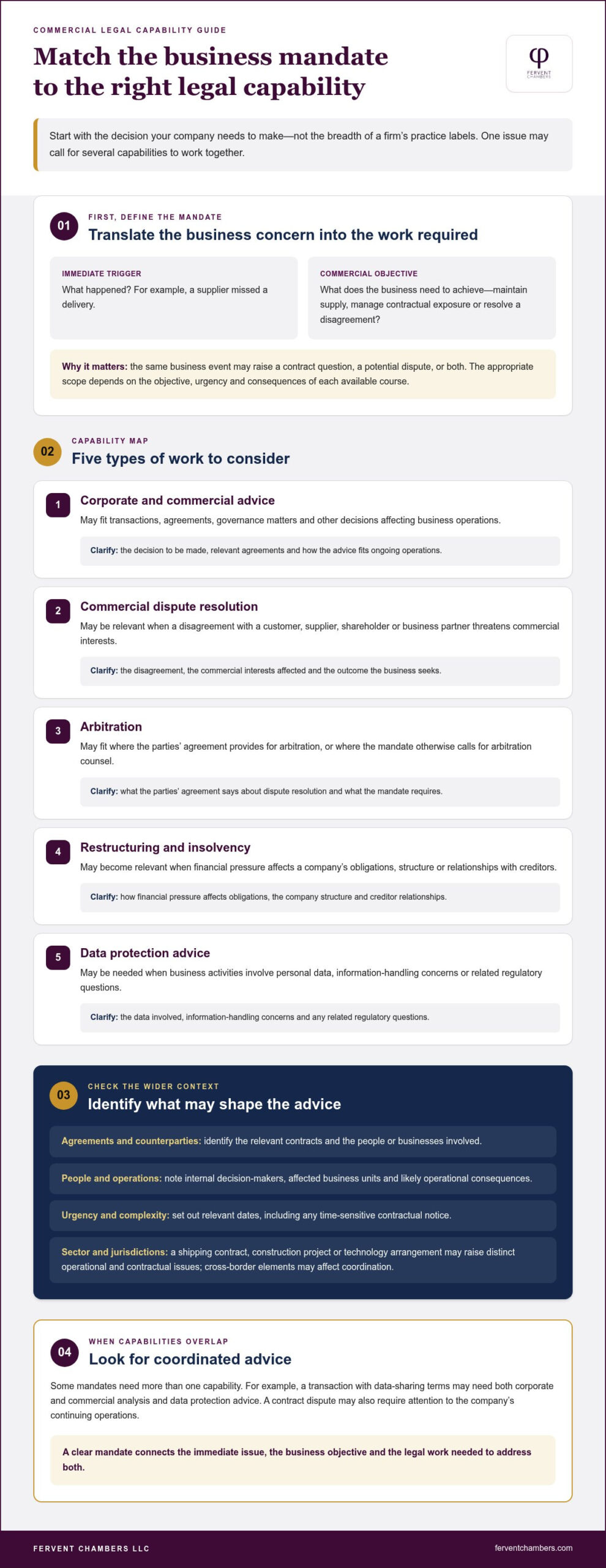
Start by translating the business concern into the decision the company needs to make. A delayed project, for example, may raise a contract question, a potential dispute or both. The appropriate scope depends on the company’s objective, urgency and the consequences of each available course. For a business assessing a commercial law firm Singapore has to offer, this mandate-first approach is more informative than choosing by practice label alone.
As a starting point, connect the issue to the work it may require:
- Corporate and commercial advice may be relevant to transactions, agreements, governance matters and other decisions affecting business operations.
- Commercial dispute resolution may help when a disagreement with a customer, supplier, shareholder or business partner threatens commercial interests.
- Arbitration may be relevant where the parties’ agreement provides for this form of dispute resolution, or where the mandate otherwise calls for arbitration counsel.
- Restructuring and insolvency may become relevant when financial pressure affects a company’s obligations, structure or relationships with creditors.
- Data protection advice may be needed when business activities involve personal data, information-handling concerns or related regulatory questions.
Identify the legal work behind the business problem
Separate the immediate trigger from the underlying commercial objective. A supplier’s missed delivery is the immediate problem; maintaining supply, managing contractual exposure or resolving a disagreement may be the company’s objective. Identify the relevant agreements, counterparties, internal decision-makers, affected business units and jurisdictions. Then consider which capabilities need to work together. A transaction that includes data-sharing terms, for example, may need both corporate and commercial analysis and data protection advice.
Consider sector and cross-border complexity
Sector context helps counsel understand the facts, but it does not establish fit on its own. A construction mandate may centre on project obligations, while a shipping matter may involve different counterparties and commercial arrangements. Technology and energy businesses can also face distinct contractual, operational or information-related questions. Identify the sector-specific facts that bear directly on your objective instead of treating industry familiarity as a substitute for relevant experience.
Cross-border elements can add another layer. Relevant parties, contracts, operations or regulatory considerations may involve more than one jurisdiction, affecting how advice is coordinated and which questions need attention. Consider Singapore’s legal framework in context. The Ministry of Law’s overview of Singapore’s Legal System provides background on its foundations and sources of law. Specify which jurisdictions are implicated without assuming that one legal analysis resolves every issue.
Once you have mapped the issue, objective, urgency and affected stakeholders, you can define a clearer scope of advice. Businesses dealing with connected corporate and commercial issues can review Fervent Chambers’ corporate and commercial advice as part of that assessment.
How to Compare Commercial Law Firms in Singapore
Selecting counsel involves more than finding a firm that lists the relevant practice area. Ask whether its proposed legal strategy can support your commercial objective while addressing the matter’s complexity, constraints and risks. Apply the same criteria to each firm and test broad claims against the needs of your mandate.
The framework below provides a consistent basis for comparison:
| Criterion | What to assess |
|---|---|
| Mandate fit | Does the firm understand the legal work involved and the business decision you need to make? |
| Relevant experience | Are its examples comparable in issue, complexity, sector or cross-border features, rather than merely carrying the same practice label? |
| Proposed approach | Does the strategy identify options, material risks, decision points and commercial constraints? |
| Communication | Are the lead lawyer, reporting channels, response expectations and client responsibilities clear? |
| Engagement scope | Are the deliverables, assumptions, exclusions and fee arrangement explained in a way that allows informed comparison? |
Assess relevant experience and strategic approach
Experience is most useful when it shows how counsel may handle your actual mandate. Look for relevant familiarity with the type of matter and its material complexity, such as multiple counterparties, operational dependencies or cross-border dimensions. An example need not duplicate your circumstances, but it should demonstrate judgment that applies to them. Ask how the proposed strategy accounts for your desired outcome, business continuity, timing and tolerance for risk.
A useful discussion should make the decision landscape clearer. Counsel should explain viable alternatives, the principal risks of each and the points at which management input may be needed. This matters when a legal position could affect a commercial relationship or limit operational choices. A broad assurance of expertise is less informative than a considered explanation of how the advice will serve the company’s priorities.
Compare communication, team and engagement scope
Clarify who will lead the matter, who else will contribute and how work across legal disciplines or business units will be coordinated. Agree on practical communication arrangements, including how progress is reported, who receives updates and how decisions are escalated. Clear responsibility and timely communication help ensure that legal analysis reaches the people making the relevant business decisions.
Review the proposed scope alongside the fee arrangement. Representation may be structured on an hourly or retainer basis, while specified corporate advisory work may use fixed or matter-based fees. Compare the basis of the engagement, not just a headline figure. Confirm which deliverables are covered, what assumptions shape the work and how a material change in scope would be addressed.
Rankings and professional recognition can provide context, but they cannot establish whether a firm fits your mandate. When comparing a commercial law firm Singapore businesses may engage, focus on the matter-specific discussion: does counsel understand the objective, outline a coherent approach and establish a clear working scope?
Prepare for an Effective Commercial Counsel Engagement
A focused first discussion starts with a clear account of the business decision, the relevant facts and the support you need. Before engaging a commercial law firm Singapore businesses can prepare the mandate in four practical steps. This helps counsel identify the central issues and define a workable scope.
- Define the objective and decision authority. State the commercial outcome the company seeks, such as completing a transaction, preserving an important relationship or resolving a disagreement. Record the principal concerns, relevant deadlines, internal approval requirements and people authorised to make decisions. Distinguish established facts from unresolved questions, disputed assumptions or information that still needs to be gathered. This gives counsel a clearer basis for identifying the decisions that require legal analysis.
- Organise the key documents. Assemble the agreements most directly connected to the issue, together with relevant correspondence, corporate records and any prior legal advice available. A concise chronology can make the material easier to understand. Note significant events, dates, communications and decisions, and identify which documents support each point. Avoid sending a large, unstructured collection when a short index can explain what is included and why it matters.
- Identify constraints and stakeholders. Note operational limits, commercial sensitivities, dependencies on counterparties, affected teams and any relevant cross-border elements. Identify who needs to provide information and who will approve a course of action. If the matter is urgent, explain why and state the date by which a decision is required. Clear constraints help counsel shape advice around the company’s circumstances rather than assess the legal question in isolation.
- Agree the scope and working arrangements. Define the immediate deliverables, responsibilities, communication channels and decision points. A defined corporate advisory project may be scoped around specified work, while representation may use an hourly or retainer arrangement. Fixed or matter-based fees may apply to specified corporate advisory work. The right basis depends on the engagement. Clarify what the proposed scope covers, how updates will be handled and how material changes to the mandate will be addressed.
You do not need to complete a legal analysis before the first meeting. The purpose of preparation is to present the matter accurately, surface gaps and help counsel focus on the options and next decisions. For a commercial law firm Singapore company leaders are considering, an organised brief also helps establish whether the proposed engagement fits the business objective and the work required.
Prepare your chronology and key documents, then discuss your commercial legal matter with Fervent Chambers.
Why Consider Fervent Chambers for Commercial Legal Work in Singapore
Once the mandate and selection criteria are clear, consider whether a firm’s capabilities match the work your business needs. Fervent Chambers LLC is a Singapore disputes and corporate law firm serving organisations from startups to listed multinational corporations. Its work spans commercial disputes, arbitration, restructuring and insolvency, corporate and commercial advice, and data protection matters, including cross-border and regulatory challenges.
A disputes and corporate practice for complex mandates
Commercial issues rarely fit neatly into one category. A disagreement over a business arrangement may require dispute-resolution advice while the company continues to manage its commercial obligations. Financial pressure may bring restructuring considerations alongside corporate decision-making. Fervent Chambers handles commercial litigation and international arbitration, as well as restructuring, insolvency and corporate advisory matters. Its data protection work is also relevant when information-handling concerns intersect with contractual or regulatory considerations.
The firm advises clients across construction, oil and gas, shipping, technology, clean energy and hospitality. This sector experience offers context for different operating environments, counterparties and commercial relationships. The legal analysis remains specific to each company’s objectives and circumstances. Where parties, contracts or regulatory considerations span jurisdictions, a cross-border perspective can help frame the issues and coordinate advice without assuming that one jurisdiction’s analysis resolves every question.
For readers assessing a commercial law firm Singapore businesses may instruct on complex mandates, the practical question is how the firm’s capabilities apply to the matter at hand. Fit depends on the legal issue, the business objective and the coordination the engagement requires, not on a broad practice description alone.
Discuss your business mandate with Fervent Chambers
Fervent Chambers’ clients range from startups to listed multinational corporations, across different organisational stages and commercial contexts. Its sector experience and disputes and corporate capabilities may be relevant where a mandate involves more than one legal concern or legal advice must account for operational and cross-border dimensions.
For a focused initial discussion, outline the commercial objective, central legal issue, relevant parties and jurisdictions, and any important timeline. Identifying the decisions your business needs to make can help define the scope of advice required. For disputes that may involve formal proceedings, the commercial litigation guide and international arbitration decision guide provide further context on those specialist considerations.
If your organisation is evaluating a transaction, managing a commercial dispute or addressing a restructuring or data protection concern, set out the business objective, legal issue and relevant timeline to discuss the support your mandate requires.
Move Forward With a Clear Commercial Mandate
The value of choosing counsel lies in what the engagement enables your business to do next. Before authorising work, make sure the intended outcome, decision authority and boundaries of the mandate are understood. Legal advice can then inform business action rather than sit apart from it. A considered choice of commercial law firm Singapore businesses can rely on starts a working relationship grounded in clarity and shared priorities.
Keep the commercial objective visible as the matter develops. If circumstances change, reassess whether the original scope still addresses the issue, the stakeholders affected and the decisions ahead. This helps maintain alignment between legal work and business needs, whether the engagement concerns a single transaction or a more involved commercial challenge.
To discuss your organisation’s commercial legal requirements, contact Fervent Chambers with a clear outline of the mandate.
Frequently Asked Questions
How much does it cost to engage a commercial law firm in Singapore?
There is no single fee for commercial legal work. The amount depends on the matter’s scope, complexity and agreed billing basis. Representation may be billed hourly or under a retainer, while defined corporate advisory work may use fixed or matter-based fees. Before proceeding, clarify the work included, expected deliverables, assumptions and how a change in instructions could affect scope. This makes it easier to compare proposals on more than the initial figure.
Can a commercial law firm advise a company with operations in several countries?
Yes. A Singapore firm can advise on Singapore-law issues and help coordinate matters involving other jurisdictions, depending on the mandate and countries involved. Prepare a simple map of the relevant entities, counterparties, governing-law clauses and locations of key operations. For example, a Singapore company contracting through an overseas subsidiary may need advice that distinguishes Singapore-law questions from issues requiring input from legal teams in another jurisdiction.
Can one law firm handle both corporate advice and commercial disputes?
Yes, some firms handle both advisory and contentious work, although the appropriate arrangement depends on the matter and capabilities required. If a contract negotiation becomes disputed, explain both the business objective and the nature of the disagreement, then clarify how advice and dispute work will be coordinated. The engagement may be integrated or divided into distinct workstreams, with responsibilities and decision-making channels defined for each.
What should a company prepare before speaking with commercial counsel?
Prepare a brief account of the issue, the outcome sought, key dates and the people responsible for decisions. Include the agreements and correspondence that show how the matter developed, rather than sending every company record. A short note identifying what is confirmed, what remains uncertain and which facts are disputed can help counsel focus the first discussion. You do not need to reach a legal conclusion before seeking advice.
How can a business assess whether its legal matter is urgent?
Assess urgency by identifying approaching dates, contractual notice provisions, threatened proceedings, operational disruption and decisions that may be difficult to reverse. For example, a proposed termination or a supplier’s stated deadline may call for prompt review of the relevant agreement and communications. Record the dates and source documents, and describe the practical consequences of delay. These factors help counsel assess the circumstances without assuming that one event determines the legal response.
Can a startup and a large company use the same commercial law firm?
Yes, both may engage the same firm, but fit depends on the mandate rather than company size alone. A startup planning a venture capital funding round in Singapore may need focused corporate advice, while a listed multinational may have several entities, internal approval processes and cross-border stakeholders to coordinate. Fervent Chambers serves clients from startups to listed multinational corporations, so a useful discussion should explain the organisation’s stage, sector and decision process.

