What if the strongest arbitration strategy is not the one with the highest profile, but the one that best protects your commercial position? Choosing an international arbitration law firm Singapore businesses can rely on means looking beyond reputation alone. Counsel should help align the forum, governing law, seat and procedural choices with the dispute’s cross-border dimensions and the realities of your operations.
Uncertainty over those decisions is understandable: an early procedural choice can affect the time, complexity and business disruption involved in resolving a claim. This guide sets out practical criteria for assessing arbitration counsel, including relevant industry experience, cross-border coordination and the ability to connect legal strategy with commercial exposure.
It also explains how Singapore’s framework, including the International Arbitration Act and the SIAC Rules 2025, may fit into a cross-border dispute, while distinguishing the arbitration seat from the law governing the contract. Fervent Chambers LLC advises on complex commercial disputes and international arbitration across sectors including construction, shipping, technology, clean energy and oil and gas. Use the considerations that follow to prepare for a focused discussion about strategy, risks and next steps.
Key Takeaways
- Assess whether arbitration fits the contract, the parties and your commercial objectives rather than assuming it is the preferred route.
- Distinguish the arbitral seat, hearing venue, governing law and institutional rules. Each serves a different purpose in a cross-border dispute.
- When evaluating an international arbitration law firm Singapore businesses may engage, compare counsel’s relevant sector experience, cross-border coordination and strategic communication against the issues in your matter.
- Map the key procedural stages early, while recognising that available remedies, timing and requirements depend on the arbitration agreement and applicable rules.
- Consider how arbitration advice fits within the broader commercial dispute strategy, including the operational and sector-specific interests at stake.
When an International Arbitration Law Firm in Singapore Is the Right Counsel
International commercial arbitration is a private dispute-resolution process in which parties ask an independent tribunal to decide a dispute arising under their agreement. The agreement, applicable arbitration rules and governing law help define how the proceeding is conducted. Arbitration counsel represents a party in the process and develops its legal case, while accounting for the business interests affected by the dispute.
Arbitration counsel connects the legal case to the commercial decisions a business must make while the dispute is underway. That matters when a claim involves several jurisdictions, substantial evidence or operations that cannot simply pause. Arbitration is not automatically preferable to court proceedings: its suitability depends on the contract, the parties’ priorities, the relief sought and practical considerations such as enforceability and business continuity.
Which disputes commonly lead to international arbitration?
Cross-border supply and services contracts, joint ventures and shareholder arrangements can generate disputes over performance, payment, control or termination. Construction and infrastructure projects may involve delays, defects or responsibility distributed among parties in several countries. Shipping disputes may concern charterparties, cargo or vessel-related obligations.
Where parties operate under different national legal systems, they may value an agreed process that does not place the dispute exclusively before either party’s domestic courts. That does not remove jurisdictional complexity. The arbitration clause and applicable law influence whether a dispute falls within the tribunal’s authority and which procedures govern it, so reviewing the agreement is a critical first step.
What does arbitration counsel do for a business?
Counsel assesses potential claims and defences, the tribunal’s jurisdiction, procedural options and the evidence needed to support the case. As the matter progresses, counsel can prepare pleadings, coordinate witness and expert evidence, represent the business at hearings and evaluate settlement options. The approach should reflect the commercial stakes, including the need to preserve key relationships, manage demands on staff and limit disruption to ongoing projects.
Cross-border disputes may also require coordination of documents, witnesses and legal advice across jurisdictions. The choice of an international arbitration law firm Singapore businesses engage should therefore reflect the actual dispute: its sector, contractual structure and operational consequences, rather than a broad claim of international experience alone.
Representation and administration are distinct roles. Counsel advises and advocates for a party; an arbitral institution administers proceedings when the parties’ agreement provides for institutional arbitration. For example, where an agreement refers disputes to the Singapore International Arbitration Centre (SIAC), the institution’s rules and administrative role are separate from the tribunal’s task of deciding the dispute. Fervent Chambers advises on international arbitration and complex commercial disputes, connecting legal strategy with clients’ sector and business priorities.
How Singapore’s Arbitration Framework Shapes a Cross-Border Dispute
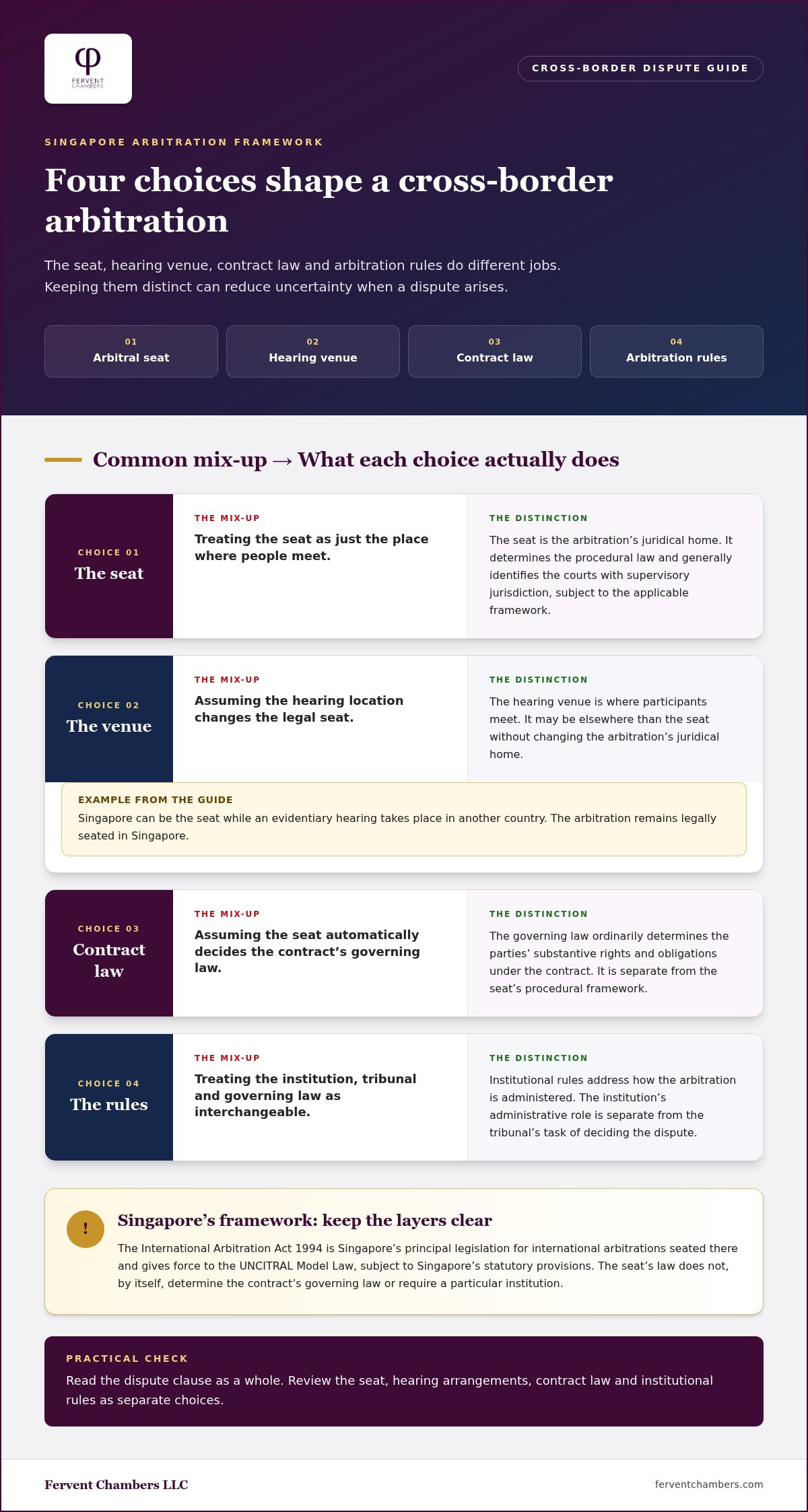
For a cross-border dispute, four choices must be kept distinct: the arbitral seat, the hearing venue, the law governing the contract and the rules governing the arbitration. They can point to different places or legal systems, and each affects a different part of the process. Treating them as interchangeable can create avoidable uncertainty when a dispute arises.
What is the difference between the seat and the hearing venue?
The seat is the arbitration’s juridical home. It determines the procedural law of the arbitration and generally identifies the courts with supervisory jurisdiction, subject to the applicable legal framework. The hearing venue is where participants meet, either physically or by arrangement, and can be elsewhere without changing the seat.
For example, parties might agree that Singapore is the seat while holding an evidentiary hearing in another country for practical reasons. The arbitration remains legally seated in Singapore. The seat is a legal choice that shapes the arbitration’s procedural framework, not merely a location for hearings.
The governing law is separate: it ordinarily determines the substantive rights and obligations under the contract, while institutional rules address how the arbitration is administered. Examine the dispute clause as a whole rather than relying on a reference to a place or institution in isolation.
How do SIAC rules and Singapore law relate?
Singapore’s International Arbitration Act 1994 is the principal legislation for international arbitrations seated in Singapore and gives force to the UNCITRAL Model Law, subject to Singapore’s statutory provisions. The seat’s law supplies the procedural legal framework; it does not, by itself, determine the contract’s governing law or require parties to use a particular institution.
Where parties choose the Singapore International Arbitration Centre (SIAC), SIAC administers the proceedings under the applicable SIAC Rules. The parties’ arbitration agreement establishes their chosen framework, the institutional rules govern administrative and procedural matters within their scope, and the law of the seat provides the legal foundation and court supervision. A Singapore-seated arbitration need not be administered by SIAC, and different rules may produce different procedural arrangements.
The New York Convention supports recognition and enforcement of arbitral awards across its contracting states, subject to the Convention’s requirements, applicable local law and limited grounds on which recognition or enforcement may be refused. It can strengthen the practical value of an arbitration award, but enforcement is not automatic in every jurisdiction.
These distinctions help an international arbitration law firm Singapore businesses engage assess how the clause, seat and enforcement jurisdictions interact with commercial priorities. For guidance on the legal and business implications of an arbitration clause, read about discussing your cross-border dispute strategy with Fervent Chambers.
How to Evaluate an International Arbitration Law Firm in Singapore
Choosing counsel for a cross-border dispute is a matter of fit, not profile alone. A prominent name or directory ranking may offer context, but it cannot establish whether a team understands the contract, industry pressures and procedural demands of your case. Assess how the proposed counsel will address the issues that could materially affect your position.
Which experience matters for a complex arbitration?
Compare the dispute’s subject matter and transaction context with the lawyers’ relevant experience. A construction claim involving delay analysis and expert evidence calls for different familiarity from a shareholder dispute centred on governance or a shipping claim involving contractual performance. Look for a clear explanation of how the proposed team would approach the actual issues, evidence and cross-border coordination required, not just a broad claim of arbitration experience.
Use the following criteria to structure an initial assessment:
| Criterion | What to assess |
|---|---|
| Dispute type | Experience with the relevant contractual, shareholder or project-related issues. |
| Sector familiarity | Understanding of the commercial and operational context, such as construction, shipping, technology or energy. |
| Cross-border coordination | Capacity to manage documents, witnesses, expert evidence and legal coordination across jurisdictions. |
| Strategic communication | Ability to explain procedural choices, risks and trade-offs in terms decision-makers can use. |
How should businesses assess counsel beyond rankings?
Consider how clearly the proposed lawyers identify the central issues, explain the initial strategy and connect legal steps to business priorities. Establish who will lead the matter, how partner involvement and team continuity will work, and how the firm will manage potential conflicts of interest. A commercially clear explanation is especially valuable when procedural choices may affect operations, internal resources or settlement options.
Discuss the proposed scope and fee structure before engagement, including what work is covered and how additional work would be addressed. The objective is transparency, not a promise of a particular cost or result. Singapore’s arbitration framework is also subject to public consultation and review; the Ministry of Law’s consultation reflects a continual review to ensure Singapore remains attractive as an arbitration jurisdiction.
Finally, consider whether arbitration is the appropriate route at all. If court proceedings may better serve the dispute’s objectives, compare the relevant considerations in this commercial litigation business guide. The right international arbitration law firm Singapore businesses appoint should explain how its proposed approach fits the specific dispute, rather than relying on broad credentials alone.
Key Strategic Decisions Through the Arbitration Process
Arbitration strategy develops in stages, but choices made at the outset can shape the entire proceeding. The process commonly moves from reviewing the arbitration clause and assessing the dispute to defining claims and defences, preparing pleadings, gathering evidence and presenting the case at a hearing. The exact steps, timing, available remedies and procedural requirements depend on the agreement and applicable rules.
What should counsel assess at the outset?
Initial advice should examine the arbitration agreement, the parties, governing law, seat, applicable rules and any steps required before arbitration begins. Counsel can then map potential claims and defences against the available records, business objectives and immediate procedural risks. Questions about jurisdiction or limitation periods may require prompt legal assessment.
Preserve relevant documents early, including contracts, project records, correspondence and internal decision-making materials. A preliminary evidence review can identify gaps, inform the case theory and help determine whether witness or expert evidence may be needed. It also supports practical planning, such as managing staff time and protecting sensitive business information.
How do evidence and settlement strategy affect the case?
Once the issues are clearer, counsel can organise the evidence around what must be established, assess the likely significance of witness accounts and expert input, and prepare for procedural steps such as pleadings and hearings. Keep that analysis connected to the business’s priorities, including operational continuity, commercial relationships and the consequences of different possible outcomes.
Settlement can remain a strategic option at different points, from early discussions through later stages of the arbitration. Evaluating it requires a reasoned view of evidential strengths and weaknesses, procedural risks, potential remedies and commercial alternatives, without treating any outcome as assured.
Arbitration’s procedure and cost depend on the clause, the case’s complexity and the parties’ conduct. It is unsafe to assume arbitration will necessarily be faster, simpler or less expensive than litigation. The selected rules, volume of evidence, procedural applications and parties’ cooperation can all affect the course of a case. An international arbitration law firm Singapore businesses engage should help decision-makers understand these trade-offs as the matter develops, rather than advance procedural steps in isolation.
Fervent Chambers advises on arbitration and complex commercial disputes, with strategy informed by the client’s business context and cross-border considerations. Explore Fervent Chambers’ arbitration services in relation to the issues, evidence and next steps relevant to your matter.
Engaging Fervent Chambers for an International Arbitration Matter
Appointing arbitration counsel is an important business decision, particularly where a dispute crosses jurisdictions or affects ongoing operations. Fervent Chambers LLC is a Singapore-headquartered disputes and corporate law firm advising clients from startups to listed multinational corporations. Its work includes international arbitration and complex commercial disputes, with sector experience spanning construction, oil and gas, shipping, technology, clean energy and hospitality.
That combination matters because legal strategy should reflect the transaction and the business behind it. Counsel’s assessment can connect the contractual position and procedural choices with the evidence, commercial exposure and operational priorities at stake. Businesses seeking an international arbitration law firm Singapore can engage should be ready to explain both the dispute and what the business needs to protect or achieve.
What information should a business prepare before seeking counsel?
A concise, organised briefing helps make an initial discussion more focused. Gather the contract and arbitration clause, relevant correspondence, notices and key transaction or project documents. Prepare a short chronology identifying major events, the entities involved and any steps already taken in the dispute, including procedural milestones or communications with the other party.
It is also useful to identify immediate commercial concerns: operational disruption, important relationships, business priorities and settlement considerations. You do not need a complete legal analysis before speaking with counsel. The aim is to make the factual and commercial picture clear enough for an informed preliminary assessment.
How can counsel align dispute strategy with the business?
Fervent Chambers’ experience across sectors such as shipping, construction and technology provides context for considering how a dispute may affect contracts, projects and day-to-day operations. The firm advises businesses at different stages of development, from startups to listed multinational corporations. Its arbitration and complex commercial dispute work can be considered alongside the broader business position, rather than as a procedural exercise in isolation.
A focused discussion can address the arbitration clause, the current procedural position, key evidence, the parties involved and the outcomes the business considers important. It can also identify issues that may need prompt attention and clarify next steps for assessing the matter. Any strategy will depend on the specific facts, agreement and applicable rules; no particular result can be assumed.
To discuss your dispute’s procedural position and commercial context, read more about Fervent Chambers’ international arbitration services.
Choose Counsel With Your Commercial Priorities in View
The right arbitration strategy begins with a clear view of the agreement, the dispute’s procedural framework and the business interests at stake. The seat, governing law and arbitration rules serve distinct functions, while counsel’s relevant sector experience and ability to coordinate evidence across jurisdictions can shape how effectively those considerations are addressed.
When assessing an international arbitration law firm Singapore businesses may appoint, look beyond broad credentials to matter-specific fit, clear communication and a strategy that accounts for operational impact. Preparing the arbitration clause, a concise chronology, key documents and your commercial priorities can make the first discussion more focused.
Fervent Chambers is an award-winning Singapore-headquartered disputes and corporate law firm advising clients from startups to listed multinational corporations, with stated sector experience across construction, oil and gas, shipping, technology, clean energy and hospitality. To discuss your dispute’s procedural position and commercial context, contact Fervent Chambers about your international arbitration matter.
Frequently Asked Questions
What does an international arbitration law firm in Singapore do?
An international arbitration law firm represents a party in a dispute governed by an arbitration agreement, advising on claims, jurisdiction, procedure, evidence, hearings and settlement options. Counsel also considers how legal decisions affect the business, including ongoing projects and cross-border operations. An international arbitration law firm Singapore businesses engage may coordinate with lawyers or evidence sources in other jurisdictions as the dispute requires, while representing the client before the arbitral tribunal.
Is Singapore a suitable seat for international arbitration?
Singapore may be a suitable seat where its legal framework, court supervision and practical arrangements align with the parties’ needs. The International Arbitration Act 1994 gives force to the UNCITRAL Model Law in Singapore for international arbitrations, subject to the Act’s provisions. The seat is a legal choice, not simply the hearing location. Suitability depends on the contract, parties, procedural preferences, likely enforcement jurisdictions and commercial objectives.
What is the difference between SIAC arbitration and Singapore-seated arbitration?
SIAC arbitration means the Singapore International Arbitration Centre administers a proceeding under its applicable rules. Singapore-seated arbitration means Singapore is the arbitration’s juridical home, which generally determines its procedural law and supervisory courts. The concepts are distinct: parties can choose SIAC administration and choose Singapore as the seat, but a Singapore-seated arbitration is not automatically administered by SIAC. The arbitration agreement determines the parties’ choices, subject to applicable law.
How do I choose an international arbitration lawyer in Singapore?
Assess counsel against the dispute’s actual legal and commercial demands, rather than relying on broad claims or rankings alone. Consider experience relevant to the contract and industry, ability to coordinate cross-border evidence, clarity of strategic communication, partner involvement, team continuity and conflicts management. Discuss the proposed scope and fee arrangement, too. The right fit is counsel who can explain procedural options and their implications for your business in clear, decision-ready terms.
Can an arbitral award made in Singapore be enforced in another country?
An award may be recognised and enforced in another country under the New York Convention, where that country is a contracting state, subject to the Convention’s requirements and local law. Enforcement is not automatic: a court may consider specified grounds for refusing recognition or enforcement. Practical guidance on cross-border arbitration and enforcement should account for where the opposing party’s assets are located, the relevant local procedures and any potential challenges to the award.
Is arbitration always faster or less expensive than court litigation?
No. Arbitration is not necessarily faster, simpler or less expensive than litigation. The timetable and overall demands depend on the arbitration agreement, applicable rules, case complexity, volume of evidence, procedural decisions and how the parties conduct the proceeding. A focused assessment compares these factors with the dispute’s objectives and available alternatives. Counsel can help identify likely decision points, but should not treat any particular duration, cost or outcome as assured.
What should I prepare before speaking with arbitration counsel?
Gather the relevant contract and arbitration clause, key correspondence, notices and transaction or project documents. Prepare a concise chronology, identify the entities involved and note any steps already taken, such as a notice of dispute or procedural directions. Also outline business priorities, operational pressures and settlement considerations. This material helps counsel understand the contractual position and commercial context, identify issues requiring prompt attention and structure a focused initial discussion.