
A letter of demand is a decision point, not a court judgment. If one has arrived, it is understandable to be unsure what it means, which deadline applies, or whether a reply could weaken your position. Knowing how to respond to a letter of demand starts with identifying the document: an ordinary private demand is different from court papers or a statutory demand, which may carry formal consequences and strict time limits.
An ordinary letter of demand is not itself a court document, but ignoring it can allow a dispute to escalate. A response period of 7 to 14 days is common, but the date stated in the letter and the type of document both matter. Start by checking the allegations, gathering relevant records, and assessing potential exposure. Then decide whether to dispute the claim, negotiate, or seek legal advice.
This guide explains how to assess a demand in Singapore, organise the facts and supporting evidence, and prepare a proportionate response that protects your position while keeping commercial resolution in view. It also explains when disputed liability, significant exposure, or formal proceedings may call for dispute counsel.
Key Takeaways
- To understand how to respond to a letter of demand, preserve the letter and compare each allegation with the relevant contracts, correspondence, invoices, and performance records.
- Choose a response that fits the facts: dispute the claim, request particulars, explore negotiation, or acknowledge receipt without admitting liability.
- Draft a measured reply that addresses the key issues accurately, professionally, and consistently with the documentary record.
- Consider how your response may affect the commercial relationship, potential exposure, and any future proceedings.
- Further correspondence, negotiation, or legal proceedings may follow. Seek dispute counsel when liability, deadlines, or strategy are contested.
What a Letter of Demand Means, and What It Does Not Mean
A letter of demand is correspondence in which a person or organisation asserts a claim and asks the recipient to take a specified step, such as paying an alleged debt, performing an obligation, or addressing a claimed loss. It sets out the sender’s position and may identify a proposed remedy or response date. For a general overview of what a letter of demand is, see the linked background material. The legal effect of a particular document depends on its contents and the circumstances in Singapore.
An ordinary demand letter is not, by itself, a court judgment. It does not establish that the claim is valid, and it does not mean a court has ordered you to pay or act. It may signal that the sender is considering proceedings, relying on contractual rights, or expecting a prompt answer. Treat it as a consequential communication, not as a ruling and not as something to disregard.
The distinction matters because a document’s consequences depend on what it is, not merely on what its sender calls it. Court papers may indicate that proceedings have begun and may set procedural deadlines. A statutory demand is a separate formal step in insolvency matters, with potentially serious consequences and specific time limits. The applicable procedure and legal effect can depend on the recipient and how the document was served, so obtain advice promptly if you are unsure which category applies.
How to identify the document you received
Read the document and everything attached before deciding how to respond. Check who sent it and who it addresses, the date, the legal basis asserted, the remedy requested, and any stated response deadline. Look for a court name, case number, filing information, or prescribed statutory wording. Note whether the documents appear to come from a court or another formal process. A heading alone is not decisive; assess the substance and accompanying papers together.
If the sender alleges a breach of contract, identify the agreement and the specific obligation said to have been breached. Keep the original document and attachments, including the email or envelope through which they arrived. These details can help establish whether the communication is a private demand or a formal document requiring a different procedural response.
Why the stated deadline deserves attention
A deadline in an ordinary demand letter is generally the date requested by its sender, not automatically a universal statutory deadline. That does not make it safe to ignore. A contract may contain relevant notice or response provisions, while court papers or a statutory demand may trigger separate, time-sensitive obligations. In Singapore, a statutory demand may carry different response periods depending on the type of debtor and where service occurred, so do not assume that the deadline in an ordinary demand applies.
Record the date you received the document, the date stated in the letter, and any dates appearing in accompanying papers. If you are uncertain about the document’s status or the consequences of missing a deadline, obtain legal advice promptly. Understanding these distinctions is an essential first step in deciding how to respond to a letter of demand without confusing an asserted claim with a formal order.
How to Assess the Claim Before You Respond
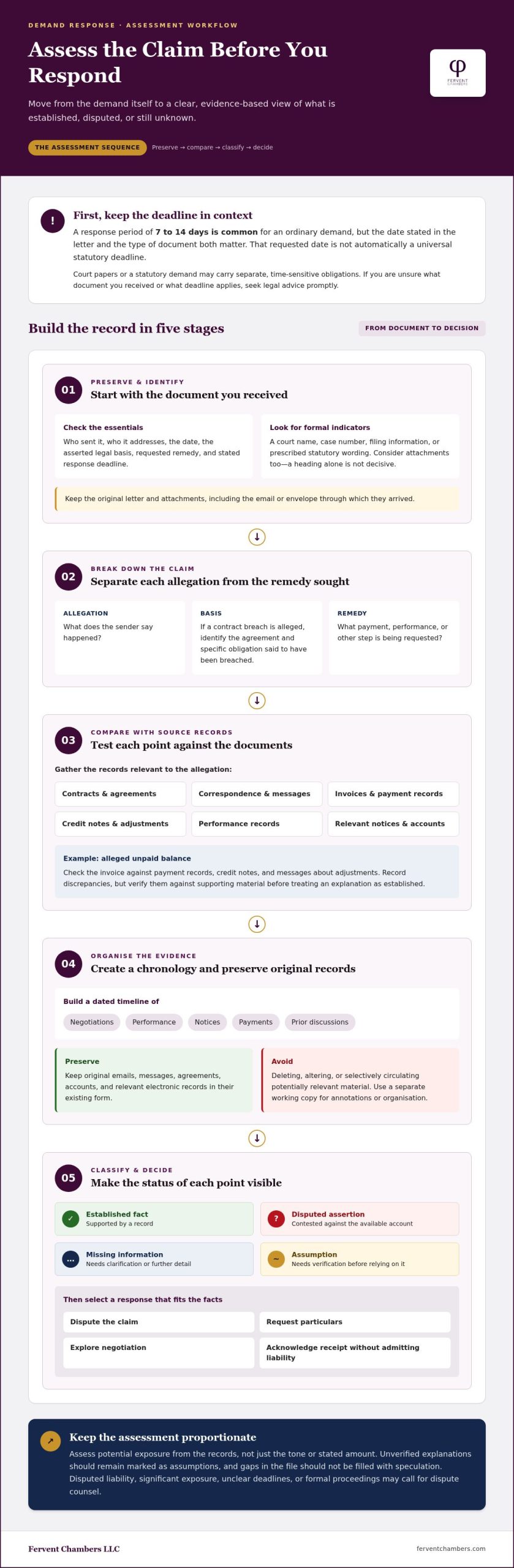
Before deciding how to respond to a letter of demand, build a reliable picture of the claim instead of reacting to its tone or stated amount. Preserve the letter and attachments, identify each allegation and requested remedy, review the relevant records, and assess possible exposure. Then select a response. This sequence helps separate what the documents establish from what the sender asserts, what remains unclear, and what may be an assumption.
For each allegation, compare the claim with the underlying contract, correspondence, invoices, payment records, and documents showing what work or services were performed. If the sender alleges an unpaid balance, for example, check the invoice against payment records, credit notes, and messages about adjustments. Record discrepancies, but do not treat an explanation as proven until you have reviewed the supporting material. A Singapore-focused overview of demand letters and their use is available in Responding to a Letter of Demand.
Build a reliable chronology and evidence file
Create a dated timeline of negotiations, performance, notices, payments, and prior discussions. Keep original emails, messages, agreements, accounts, and relevant electronic records in their existing form. If you need to annotate or organise them, make a separate working copy. Avoid deleting, altering, or selectively circulating potentially relevant material. Incomplete records can obscure context and complicate later assessment.
For clarity, label each point as an established fact supported by a record, a disputed assertion, missing information, or an assumption that needs verification. This helps prevent gaps in the file from being filled with speculation and makes it easier to identify which evidence could materially affect your assessment.
Measure the demand against the underlying documents
Identify the legal and factual basis the claimant relies on, then test each part against the source records. Check whether the requested amount is itemised and whether its calculation accounts for payments, adjustments, or other relevant entries. If the requested remedy is not payment, identify the contractual term or factual basis said to support it. Note unanswered questions and any possible counterclaim separately. Neither should be treated as established without evidence.
Also flag the contract’s governing law, jurisdiction provisions, and any dispute-resolution clause, as these may affect where or how a disagreement is addressed. Set aside court papers or other procedural documents for prompt legal review, since they may require a different response from ordinary correspondence. Where liability, exposure, or the appropriate next step is contested, dispute-resolution counsel can help assess the evidence and strategy before a reply is sent.
Which Response Should You Choose: Dispute, Clarify, Negotiate, or Acknowledge?
The appropriate response depends on what the documents support, what remains uncertain, and what outcome best protects your position. A blanket denial may be unhelpful if only part of the claim is disputed. An offer to resolve the matter should not be drafted as an unintended admission. Before choosing a course, assess the strength of the evidence alongside the commercial relationship, potential exposure, enforceability, and risk of escalation.
| Response | When it may fit | Point to manage |
|---|---|---|
| Reasoned dispute | The evidence contradicts specific allegations or calculations. | Identify the disputed points and supporting records instead of issuing an unsupported blanket denial. |
| Request for particulars | The claim lacks details or documents needed for a meaningful assessment. | Specify what information is missing and why it matters. |
| Negotiation | A practical resolution may serve commercial objectives, even where some issues remain contested. | Define the proposal and its intended effect carefully. A settlement label alone does not determine legal protection. |
| Limited acknowledgment | You need to confirm receipt or ask for time to review the claim. | Keep the reply limited to receipt or process. Avoid language that could be read as accepting liability or promising payment. |
When a disputed or unclear claim may call for a measured reply
If you dispute the claim, address the particular allegation, amount, or calculation in issue and briefly identify the records that support your position. If an invoice or contractual obligation is unclear, request the relevant particulars or documents rather than speculating about the claimant’s case. Avoid asserting counterclaims, facts, or legal conclusions that the available evidence does not support. A measured reply can leave room for further assessment without conceding the disputed points.
When negotiation or early resolution may serve the objective
Negotiation may be appropriate where resolving the dispute has commercial value, such as preserving an ongoing business relationship or avoiding the cost and disruption of escalation. Any proposal should distinguish a genuine settlement discussion from an unconditional admission or promise to pay. In Singapore, whether a communication attracts settlement-related protection depends on its context and applicable rules. Wording such as “without prejudice” should not be treated as automatically decisive. Obtain legal review where the proposed terms, reservations, or consequences are material.
There is no single formula for how to respond to a letter of demand. Choose a response that aligns with the evidence and your objectives, and ensure its wording does not create commitments beyond those intended.
How to Draft and Send a Careful Response
A response should be deliberate, not reflexive. Once you have selected a position, draft it in a sequence that makes the purpose and limits of your reply clear: identify the demand, state your position, address the material points, and specify the next step. Communicate accurately and professionally while avoiding unnecessary admissions, threats, emotional language, speculation, or unauthorised promises.
A practical structure for the reply
Refer precisely to the date and subject of the letter, and make clear that your response addresses that correspondence. Then deal with the material allegations individually. Distinguish matters you can admit, matters you dispute, and matters you cannot yet verify. Explain any request for supporting information where needed. Close by stating what you propose to do next, what you need from the sender, or when you expect to provide a further response. Do not commit beyond what you can reliably meet.
Before sending, check each factual statement against the underlying records and confirm that any attachments are complete, relevant, and appropriate to disclose. A reply that conflicts with an earlier email, payment record, or contractual notice may complicate later discussions. Keep the language measured and focused on resolving the issues rather than making accusations or setting out arguments that do not assist your position.
Before sending, review the legal and commercial risks
Consider whether the proposed wording could affect negotiations, potential proceedings, insurance notifications, or a contractual notice requirement. A simple acknowledgment of receipt should remain limited to receipt; it should not accidentally accept liability or promise payment. If the response contains a substantive admission, settlement proposal, or reservation of rights, review its wording and context carefully, particularly where the claim is material or contested.
Once approved, retain the final signed or sent version, all attachments, evidence of delivery, and the relevant internal approval record. Keep these with the original demand and supporting file so the organisation can establish exactly what was communicated and when.
When to involve dispute counsel
Prompt legal advice may be appropriate where the claim is substantial, factually complex, cross-border, or accompanied by formal process papers. Counsel can also assess whether a contractual arbitration or dispute-resolution clause affects the strategy or form of response. For broader context on court proceedings, see this Singapore commercial litigation guide.
If you are weighing a substantive reply, discuss your demand-letter response with Fervent Chambers. Careful review can help align the wording with the evidence, commercial objectives, and potential procedural consequences before it is sent.
What Happens After You Respond, and When to Seek Legal Advice
Sending a considered reply is an important step, but it does not conclude the dispute or compel the claimant to settle. The next stage may involve further correspondence, an exchange of supporting information, negotiation, or commencement of proceedings. The claimant may reject your position or make a counterproposal. Track every new communication, document request, commitment, and date so the response process remains controlled rather than reactive.
If the claimant accepts, rejects, or does not answer
If the claimant agrees to resolve the matter, record the terms clearly in writing before treating the dispute as settled. Confirm what each party must do, the timing, and how the agreed outcome will be implemented. Where the terms are material or complex, have them reviewed before relying on them. If negotiations continue, keep communications consistent with your stated position and preserve new evidence and correspondence.
A rejection does not establish that the claim is correct, just as the claimant’s silence does not mean the demand has been withdrawn or the claim extinguished. If no response arrives, retain the record of your reply and assess what follow-up, if any, is appropriate in light of the documents and commercial objectives. Do not assume the matter has ended without clear confirmation.
Prepare for escalation without assuming it is inevitable
Continue monitoring correspondence and promptly review any formal court papers or statutory documents that arrive, since they may carry procedural requirements distinct from the earlier demand. Record the date and method of receipt, preserve all accompanying materials, and obtain advice on the applicable steps and time limits. Review the contract’s governing law, jurisdiction, and dispute-resolution provisions with counsel, particularly if the parties or performance span more than one country.
Tailored dispute advice can help assess the strength of the evidence, potential exposure, procedural position, and prospects for a commercial resolution. It may be especially valuable where liability is contested, the claim is material, or a contractual arbitration clause could shape the next steps. Knowing how to respond to a letter of demand includes planning for these possible outcomes while recognising that neither settlement nor litigation is inevitable.
For a contested commercial claim, discuss a dispute-resolution strategy with Fervent Chambers.
Respond with Clarity and Protect Your Position
A letter of demand is a point for careful assessment, not an automatic finding against you. Identify whether you have received private correspondence or formal documents, compare the allegations with the evidence, and choose a reply that reflects both your legal position and commercial objectives. Keep your response measured, retain a complete record, and monitor what follows. A reply does not guarantee settlement or prevent further steps.
Understanding how to respond to a letter of demand means weighing the facts, deadlines, potential exposure, and available paths to resolution before making commitments. Where liability, procedure, or strategy is contested, dispute counsel can help assess the position and consider proportionate next steps.
Fervent Chambers advises on commercial disputes, litigation, and arbitration, serving clients from startups to listed multinational corporations. The firm is an award-winning disputes and corporate law firm. For support assessing your position and preparing a considered reply, discuss a measured response to your demand with Fervent Chambers.
Frequently Asked Questions
Is a letter of demand the same as a court order?
No. An ordinary letter of demand is correspondence asserting a claim and requesting a response or remedy; it is not, by itself, a court judgment or order. It may precede legal proceedings, but documents with similar wording can carry separate statutory or procedural consequences. Review the contents and attachments rather than relying on the title alone, and seek prompt legal advice if the document refers to court action or a formal process.
Can I ignore a letter of demand in Singapore?
Ignoring a letter may leave allegations unanswered and allow a dispute to escalate, although the consequences depend on the claim, any relevant contract, and applicable procedures. First establish whether you received ordinary demand correspondence or formal process papers, identify the stated deadline, and preserve relevant records. If the claim is material or the document’s status is uncertain, obtain legal advice before deciding not to respond, since different documents may require different steps.
How long do I have to respond to a letter of demand?
There is no single response period that can safely be assumed for every letter of demand. The sender may request a reply by a particular date, while a contract, court document, or statutory process may create separate requirements. Record all dates, review the document and underlying agreement, and seek advice promptly if the deadline or legal effect is unclear. Do not rely on a general online timeframe to determine the applicable deadline in your circumstances.
What should I include in a response to a letter of demand?
A careful response should identify the demand, address its material allegations accurately, distinguish disputed from admitted matters, and state any reasonable request for particulars or proposed next step. Check each factual statement against the records, and avoid unsupported assertions, unnecessary admissions, or threats. The appropriate wording depends on the claim and procedural context, so a substantive reply to a significant or contested demand should receive legal review before it is sent.
Should I admit the debt or make a part payment after receiving a demand?
Do not admit liability, promise payment, or make a part payment solely because the demand requests it. First assess the claim’s basis and potential consequences. Review the contract, account records, correspondence, and any disputed calculations. Acknowledging receipt is not necessarily an admission, but the wording and conduct surrounding a payment can matter. If the claim is significant, seek legal advice before acknowledging liability, proposing payment terms, or entering into a settlement.
What happens if I dispute the claim in my response?
The claimant may provide further particulars, continue negotiations, reject your position, or commence proceedings. Disputing a claim does not determine the matter or prevent further action. Identify the specific factual or legal points you contest and support them with available records, rather than relying on a blanket denial. Preserve relevant evidence and monitor later correspondence carefully, as formal documents may carry different deadlines and requirements from the original demand.
Should I consult a lawyer before replying to a letter of demand?
Legal advice is particularly valuable if the claim is substantial, complex, cross-border, disputed, or accompanied by court or statutory documents. Counsel can assess the evidence, contractual terms, procedural position, potential exposure, and commercial objectives before a reply is issued. To discuss a demand-letter response and your dispute-resolution options, contact Fervent Chambers.