


What if the remedy that appears to protect your position could also deepen a deadlock and diminish the value you’re trying to preserve? For shareholders facing exclusion, unequal treatment or decisions that undermine their interests, the question is not simply which minority shareholder oppression remedies Singapore permits; it is which response fits the facts and the company’s commercial future.
It’s understandable to be uncertain about whether conduct crosses the legal threshold, particularly when taking action may affect relationships, operations and the company itself. Section 216 of the Companies Act 1967 gives a member a route to seek relief from the court, but the outcome depends on the circumstances and the evidence. No single order is appropriate for every dispute.
This guide explains when the statutory remedy may apply, how it differs from a derivative action, and what orders the court may consider, including a share buy-out or measures regulating the company’s future conduct. It also examines how to weigh those options against your commercial objectives and which records, communications and corporate decisions may matter before proceeding. The aim is a disciplined assessment of both legal position and business continuity.
Key Takeaways
- Assess the substance and context of the conduct under section 216 of the Companies Act 1967; a commercial disagreement or poor outcome alone may not establish oppression.
- Understand how minority shareholder oppression remedies Singapore courts may consider depend on the proven facts, statutory powers and justice of the case.
- Compare potential orders, including a share purchase, governance measures, restraint or required-action orders, and winding up, against your ownership and business-continuity objectives.
- Bringing an oppression claim does not automatically require you to sell your shares; the court determines appropriate relief based on the circumstances.
- Prepare for advice by preserving records, building a chronology, identifying relevant rights and separating documented facts from assumptions that need investigation.
What counts as minority shareholder oppression in Singapore?
A shareholder can retain their shares yet lose meaningful participation in the company or see the value of their interest undermined by decisions they cannot influence. Section 216 of Singapore’s Companies Act 1967 provides a statutory route for a member to seek relief where the company’s affairs or the exercise of directors’ powers are oppressive, disregard members’ interests, or involve conduct that is unfairly discriminatory or otherwise prejudicial. It is a fact-sensitive remedy, not an automatic response to every dispute.
The concept reflects a broader oppression remedy found in Commonwealth company law, but whether section 216 applies depends on Singapore law and the particular evidence. The court considers the substance and context of the conduct, including the parties’ relationship and what they could reasonably expect as members.
Which conduct may support an oppression application?
Exclusion from management may be relevant where participation was part of the parties’ understanding, particularly in a closely held company formed on a basis of mutual trust. Other allegations might include company opportunities or assets being diverted for the benefit of those in control, or company value being shifted away from a member. Persistent withholding of material information may also contribute to the overall picture, especially when it prevents a shareholder from understanding or protecting their interests.
These circumstances do not establish oppression by themselves. Their significance depends on the evidence, the company’s arrangements and how the conduct affects members in their capacity as members.
Who may apply, and what must be established?
Section 216 provides a route for a member to apply to the court, subject to the statutory standing requirements. An applicant must do more than describe conduct as unfair: the case must connect the alleged unfairness to the company’s affairs, the exercise of directors’ powers, or relevant company conduct within the statutory framework.
Governing documents, such as the constitution and any shareholders’ agreement, may help establish the parties’ formal rights, while the history of the relationship and their course of conduct may inform the context. A practical assessment therefore separates what can be shown through records or direct knowledge from assumptions that require investigation.
A commercial disagreement, an adverse business decision or disappointment with company performance does not, without more, amount to oppression. The central question is whether the conduct, viewed in context, departs from standards of fair dealing or disregards interests protected by the statute. That distinction is essential when assessing which minority shareholder oppression remedies Singapore law may make available, a question addressed in the next sections.
How Singapore courts assess an oppression claim
Calling a decision “oppressive” does not establish that it is legally actionable. The court examines what happened, how it affected the member’s interests, and the company and relationship context in which the conduct occurred. The statutory framework in Section 216 of the Companies Act 1967 addresses company affairs conducted, or directors’ powers exercised, oppressively or in disregard of members’ interests, as well as company acts or resolutions that unfairly discriminate against or otherwise prejudice members.
In concise terms, the question is whether the proven conduct falls within one of these statutory grounds, assessed in its full context. A disputed decision, an unsuccessful strategy or a disadvantage shared by members does not, without more, establish oppression. The analysis turns on the nature of the conduct and its impact on the member’s interests, rather than the label attached to it.
Why the company’s governance history matters
The constitution and any shareholders’ agreement help identify formal rights, including voting powers, appointment arrangements and decision-making procedures. But the documents may not tell the whole story. In a closely held company, the parties’ established approach to management or participation may help explain the expectations against which later conduct is assessed.
Board resolutions, meeting minutes and consistent past practice can provide that context. An informal understanding does not automatically create an enforceable right, however; its relevance depends on the evidence and the surrounding arrangements. The court’s task is to evaluate the relationship as it operated, not to treat every past practice as a binding promise.
How evidence can strengthen or weaken the claim
A disciplined evidence review connects each alleged act to what occurred, who was involved, when it happened and how it affected the company or the member. Relevant material may include:
- Contemporaneous emails, messages and shareholder communications that record decisions or explain the parties’ understanding.
- Board minutes and resolutions showing how a decision was made, recorded and communicated.
- Financial and company records that may help trace the commercial effect of the conduct.
Records should be considered alongside their surrounding context. An email may appear decisive when read alone but be qualified by later correspondence; minutes may omit discussion that other evidence helps clarify. Gaps, inconsistencies or assumptions presented as established facts can complicate the assessment, so a reliable chronology is often more useful than a collection of documents without explanation.
Because the available minority shareholder oppression remedies Singapore courts may consider depend on the legal basis and evidence established, early analysis should connect the alleged unfairness to specific records and governance decisions. For a considered assessment of complex commercial disputes, Fervent Chambers LLC’s dispute resolution advice can help align the legal analysis with ownership and business-continuity objectives.
Which minority shareholder oppression remedies may fit the dispute?
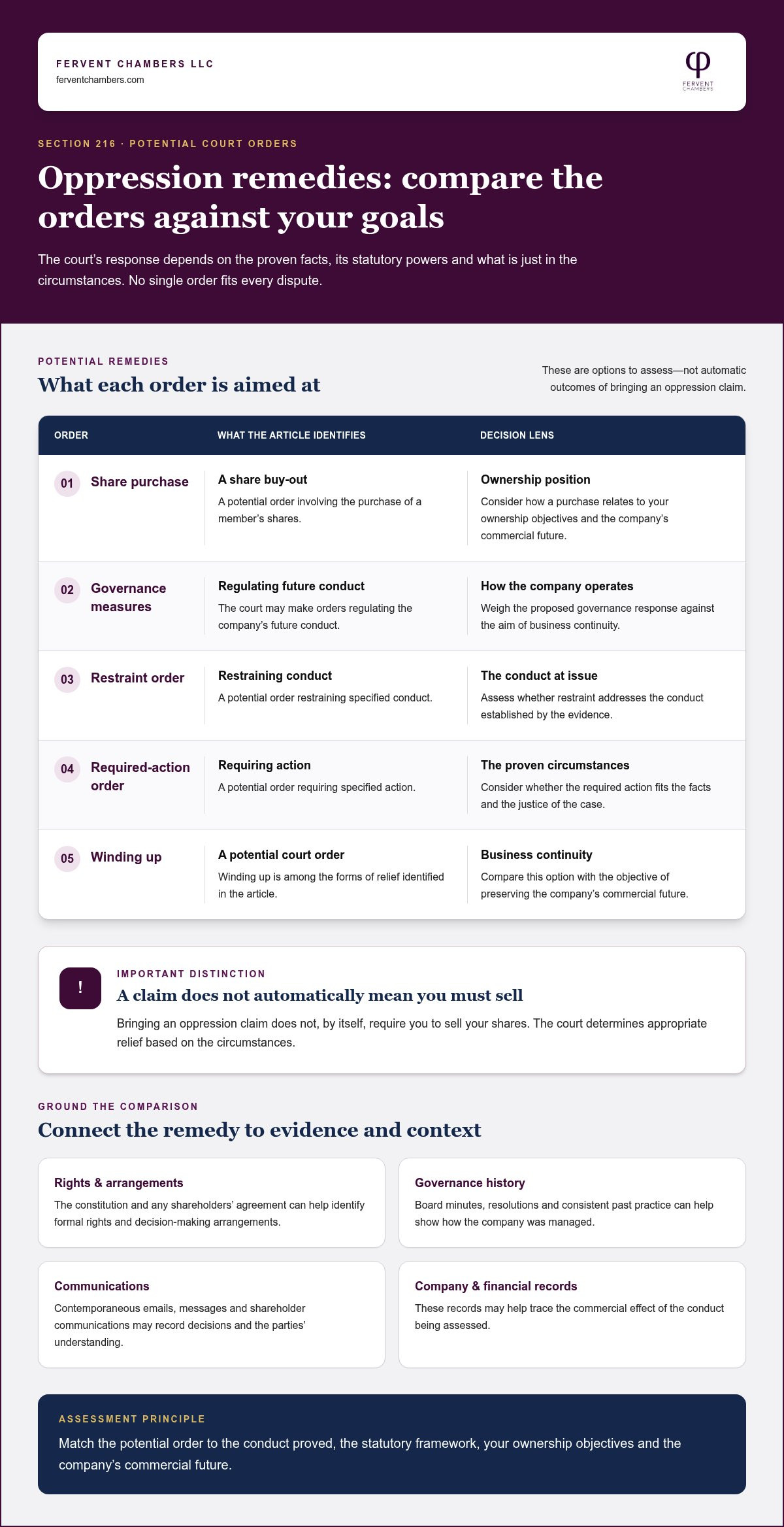
Section 216 gives the court broad discretion to make an order it considers appropriate to bring the complained-of matters to an end or remedy them. The available relief is not automatic: the court’s choice depends on the conduct proved, the statutory powers engaged and what justice requires in the circumstances. The practical objective is to match the order sought to the unfairness while accounting for the company’s prospects and the parties’ commercial relationship.
Depending on the case, orders may include a purchase of shares, regulation of the company’s future affairs, restraint of particular conduct, a requirement that a specified act be done, or winding up. A share purchase can provide a route for the parties to separate; governance-focused relief may be more suitable if the business remains viable and future participation can work. The right remedy is not necessarily the most disruptive one.
A share purchase order or a change in company conduct
A buyout may be considered where continued joint ownership is no longer practical, but the valuation must be supported by evidence and assessed in light of the company’s circumstances. Relevant issues can include the valuation date, the information available about the business and the basis used to calculate the shares’ value. Singapore courts generally do not apply a minority discount in oppression-related buy-outs, although valuation remains dependent on the facts and the court’s approach in the particular case.
Where the parties can continue to operate the business, an order regulating future conduct may address the problem more directly. Depending on the established facts and statutory powers, relief might restrain a particular course of conduct or require a specified action. Such an order can preserve the company’s operations, but its practical value depends on whether the parties can comply and work within the resulting arrangements.
When winding up or other relief enters the analysis
Winding up may be considered where the company cannot practically continue, but it is consequential: ending the company’s operations may destroy value as well as resolve the dispute. It should not be treated as the inevitable result of shareholder conflict. The court may consider whether a less disruptive order can adequately address the proven unfairness.
An oppression application is generally a personal remedy for a member’s interests. By contrast, a statutory derivative action seeks to pursue a cause of action belonging to the company, typically where the alleged wrong is to the company itself. Academic discussion of the statutory derivative action in Singapore helps place these routes in context. The distinction matters: remedy selection should reflect whose interests were harmed and what outcome would address that harm. Accordingly, minority shareholder oppression remedies Singapore courts may grant should be assessed against both the legal case and the company’s commercial future.
Does bringing an oppression claim mean you must sell your shares?
No. Filing an oppression application does not, by itself, require you to sell your shares. A share purchase order is one possible form of relief, but the court has discretion to select an order appropriate to the facts and statutory framework. A claim may instead seek measures addressing company conduct or governance, depending on the unfairness alleged and the applicant’s objectives.
That distinction matters commercially. A shareholder seeking continued participation may have different priorities from one seeking a fair exit. Before proceedings begin, consider not only the legal basis for the claim but also valuation uncertainty, the disclosure of sensitive company information, potential delay and expense, and the effect of a dispute on working relationships. Litigation may also affect operations, financing discussions, counterparties and employees, even where preserving the business remains a priority.
Assess the commercial consequences before choosing a course
Set out what a useful outcome would mean in practical terms. Is the priority to restore participation in decision-making, obtain information, protect the value of the shareholding or achieve an orderly separation? These aims may point towards different forms of relief, and they may not all be achievable through the same order.
Consider whether negotiation or another dispute-resolution process could address some issues without a court determination. Those options may be worth evaluating, but their suitability depends on the parties’ positions, the urgency of the alleged conduct and whether a workable agreement can be reached. They should not be treated as substitutes for assessing the evidence and protecting the company’s position.
Prepare a focused case assessment
A dated chronology can clarify how the dispute developed and help distinguish isolated events from a continuing pattern. Record key decisions, communications and changes in your position, then connect each alleged act of unfairness to the evidence and to the relief sought. For example, if the concern is exclusion from governance, identify the relevant decision, the rights or understanding relied on, and the order that could address the exclusion.
Keep the objective in view: a remedy should respond to the established conduct while accounting for ownership and business continuity. For wider procedural context, see this commercial litigation guide. A focused assessment of the evidence, procedural options and commercial consequences can help clarify the next step; discuss a shareholder dispute with Fervent Chambers LLC before committing to a course that may affect both your interests and the company’s future.
How to prepare for minority shareholder oppression advice in Singapore
A clear record of events and objectives helps counsel assess the dispute against the relevant legal framework and the company’s commercial realities. Preserve relevant material, build a dated chronology, identify the rights you rely on and define what you want to achieve. Keep direct observations, documentary evidence and assumptions separate, so the issues requiring further investigation remain visible.
Documents and questions to organise
Gather the company constitution, any shareholders’ agreement, share records, board minutes and relevant financial information. Then record each act complained of, when it occurred, who was involved and its practical effect. This provides a starting point for connecting the facts to the rights and interests at issue.
- Preserve relevant emails, messages and shareholder communications in their original context.
- Mark information you know directly, material supported by documents, and matters that remain uncertain.
- Identify urgent concerns, such as a threatened asset transfer, exclusion from participation or an imminent decision that may require prompt assessment.
Choosing a proportionate path forward
Clarify whether your priority is restored participation, a change in governance, separation from the other shareholders or protection of value. A proposed remedy should respond to the conduct alleged and be assessed against the evidence available, the company’s ability to continue operating and the practical consequences of pursuing the dispute.
- Set out the relief you may seek and explain how it addresses each alleged act.
- Identify evidential strengths, gaps and records that may need to be obtained or examined.
- Consider procedural requirements and timing in light of the facts and applicable court rules.
- Weigh litigation alongside negotiation or other dispute-resolution options, without assuming any route will be suitable in every case.
These steps support a focused assessment of the minority shareholder oppression remedies Singapore law may permit, while keeping ownership, governance and business continuity in view. The appropriate procedural course and timing depend on the specific circumstances, the evidence and the rules that apply. Fervent Chambers LLC advises on complex commercial disputes and related corporate matters, with analysis directed to both legal position and commercial priorities. Discuss a shareholder dispute with Fervent Chambers LLC.
Choose a path that protects your position and the business
A section 216 claim turns on the conduct, the evidence and the circumstances of the company and its members. A disagreement or adverse business decision is not automatically oppression, and bringing an application does not itself require you to sell your shares. The court may consider different forms of relief, so the appropriate objective might be continued participation, changes to company governance, protection of value or an orderly separation.
Before deciding how to proceed, organise the key records, establish a chronology and distinguish documented facts from assumptions requiring investigation. Then assess the relief you want against its likely commercial consequences, including the company’s ability to maintain operations and relationships.
Fervent Chambers LLC handles complex commercial dispute resolution and advises clients ranging from startups to listed multinational corporations. A disciplined review can help align minority shareholder oppression remedies Singapore may permit with your ownership, governance and business-continuity priorities. Discuss your shareholder dispute with Fervent Chambers LLC and take a considered next step with greater clarity.
Frequently Asked Questions
What is the minority oppression remedy in Singapore?
It is a statutory remedy under section 216 of the Companies Act 1967 that allows a member to apply to court when the company’s affairs or directors’ powers are exercised oppressively, disregard members’ interests, or involve unfairly discriminatory or prejudicial conduct. The court has discretion to grant relief suited to the circumstances. The available minority shareholder oppression remedies Singapore may include orders affecting share ownership or the company’s future conduct, but no particular outcome is automatic.
What conduct can amount to minority shareholder oppression in Singapore?
Conduct may support an oppression claim if, viewed in context, it unfairly prejudices a member or disregards their interests as a member. Examples may include excluding a shareholder from management where participation formed part of the parties’ understanding, diverting company opportunities or value, or persistently withholding important company information. These examples do not establish a claim on their own. The court considers the company’s arrangements, the parties’ relationship, the conduct’s effects and the supporting evidence.
Can a minority shareholder force the majority to buy their shares?
Not simply by filing an application. Under section 216, the court may order a share purchase as one possible form of relief if the facts and justice of the case support it, but a buyout is not guaranteed. The court may consider other orders, including measures regulating the company’s affairs. Valuation evidence and the commercial circumstances may affect the terms of any purchase order, so a shareholder should assess the desired outcome before proceeding.
Does a minority oppression claim automatically lead to a winding-up order?
No. Winding up is one order the court may consider under section 216, but a shareholder dispute does not automatically result in the company being closed. The court assesses the proven conduct and whether another form of relief could address it. Depending on the circumstances, an order regulating company affairs, restraining conduct or requiring an act may be more appropriate. Because winding up can end the business, its consequences for company value and stakeholders require careful consideration.
What evidence is needed for a shareholder oppression claim?
Useful evidence may include the company constitution, any shareholders’ agreement, share records, board minutes, financial documents, emails and shareholder communications. Organise the material by date and connect each alleged act to the decision-maker, its practical effect and the records supporting it. Separate what you witnessed directly from what documents establish and what remains an assumption. Missing context or inconsistent records can complicate the assessment, so preserve relevant material in its original form where possible.
How is a minority oppression claim different from a derivative action?
An oppression claim under section 216 is generally brought by a member to address unfair treatment or disregard of their interests as a member. A statutory derivative action under section 216A is brought on behalf of the company to pursue a wrong done to the company, with statutory requirements applying to the process. The distinction concerns whose interests were harmed and who would benefit from the claim. Identifying this correctly helps clarify the appropriate legal route and relief sought.
Can a shareholder seek an injunction in an oppression dispute?
Yes, an applicant may ask the court for an order restraining specified conduct, and section 216 gives the court broad remedial powers. Whether an injunction is granted depends on the circumstances, evidence and applicable legal and procedural requirements. For example, a shareholder may seek to prevent a disputed step from proceeding while the claim is considered. The request should identify the conduct to be restrained and explain why the proposed order is connected to the alleged oppression.