



Insolvency alone does not make every director personally liable, but continuing to incur debts when the company has no reasonable prospect of paying them can carry serious consequences. The wrongful trading consequences in Singapore may include personal responsibility, without limit, for some or all company debts or liabilities: under section 239(1), a court may impose this liability on a person party to wrongful trading. Wrongful trading can also lead to criminal penalties, while fraudulent trading involves a distinct requirement of actual dishonesty.
These terms are easy to confuse, but the distinction matters when a company is in financial distress and directors must decide whether to keep trading. This article explains how Singapore law distinguishes wrongful, fraudulent and insolvent trading, the civil and criminal risks directors may face, and how D&O insurance may respond. It also outlines the legal framework and practical considerations that shape liability, helping directors and businesses understand their position before making consequential decisions.
Key Takeaways
- Assess whether continued trading could expose directors to personal liability, focusing on the company’s ability to meet debts as they arise.
- Distinguish wrongful trading from fraudulent trading by examining the conduct and mental element each regime addresses.
- Understand how the IRDA provides separate routes for civil responsibility and criminal penalties, and how its provisions fit within Singapore’s insolvency framework.
- Consider how financial distress, potential claims and D&O insurance interact before deciding how to respond to a developing insolvency risk.
What Constitutes Wrongful Trading in Singapore?
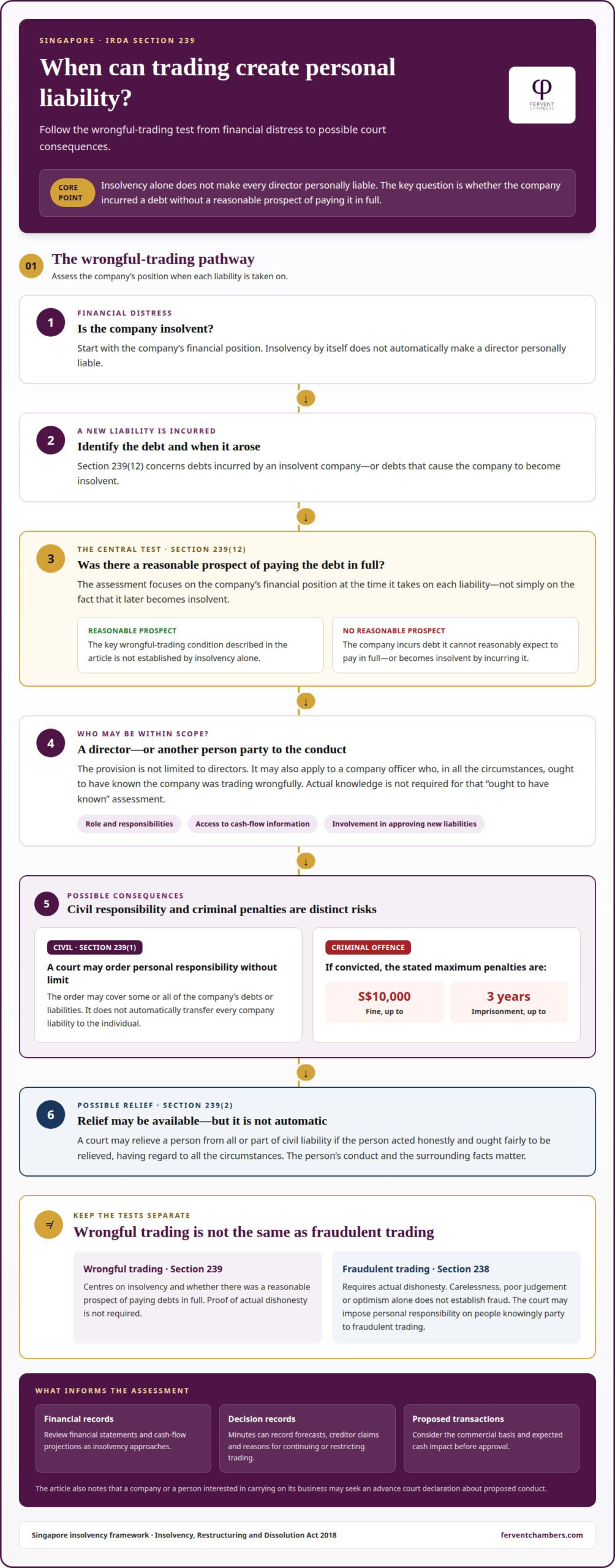
Section 239(12) of Singapore’s Insolvency, Restructuring and Dissolution Act 2018 defines when a company trades wrongfully. This occurs when an insolvent company incurs debts without a reasonable prospect of paying them in full, or becomes insolvent by incurring them. The assessment focuses on the company’s financial position when it takes on each liability.
According to Singapore Statutes Online, under section 239(1), a court may make a person party to wrongful trading personally responsible, without limit, for all or some of the company’s debts or liabilities. This civil exposure can therefore extend beyond a director’s existing personal guarantees. Applications concerning wrongful trading may be brought by eligible parties through the applicable legal process.
Directors are not the only people who may fall within the provision. It may also apply to a company officer who, in all the circumstances, ought to have known that the company was trading wrongfully. Actual knowledge is not required. A senior officer’s role, access to cash-flow information and involvement in approving new liabilities may all be relevant to what they ought to have known.
The wrongful trading consequences in Singapore include civil personal liability and criminal penalties. A person convicted of the wrongful-trading offence may face a fine of up to S$10,000 or imprisonment for up to 3 years. A civil order may cover some or all relevant company debts, rather than automatically transferring every company liability to the individual.
Section 239(2) provides a statutory route to relief from all or part of civil liability. The court may grant relief where the person acted honestly and ought fairly to be relieved, considering all the circumstances. This is not automatic immunity: the person’s conduct and the surrounding facts matter to the court’s assessment.
Island Logistic Pte Ltd illustrates related director-liability proceedings under the former Companies Act, not a decision applying section 239. After a creditor’s judgment debt proved irrecoverable, it sought a declaration concerning directors’ personal liability under section 340(1). The court held that the application could proceed by originating process, including without joining the company. That distinction matters when comparing historical fraudulent-trading proceedings with today’s wrongful-trading regime.
How is fraudulent trading different from insolvent trading?
Singapore’s Insolvency, Restructuring and Dissolution Act 2018 distinguishes wrongful trading from fraudulent trading. Under section 239(12), wrongful trading occurs when an insolvent company incurs debts without a reasonable prospect of paying them in full. It also applies when incurring those debts causes insolvency. The test centres on the company’s financial position and the liabilities it takes on. Fraudulent trading, by contrast, requires actual dishonesty. Carelessness, poor judgement or optimism alone does not establish fraud.
According to Singapore Statutes Online, fraudulent trading in Singapore corporate insolvency is governed by Section 238 of the Insolvency, Restructuring and Dissolution Act 2018. Under section 238(1), a court may hold people knowingly party to fraudulent trading personally responsible, without limit, for some or all company debts or liabilities. This civil exposure is distinct from wrongful trading’s insolvency-focused test. Fraudulent trading can also carry criminal consequences, while a wrongful trading claim does not require proof of actual dishonesty.
The statutory framework changed with the IRDA. Singapore’s former Companies Act treated insolvent trading as a criminal offence under section 339(3). Section 340(2) permitted a court to declare a person convicted of that offence personally responsible for debts incurred. The IRDA replaced that approach with a civil wrongful-trading route under section 239. It also replaced the former fraudulent-trading provision, section 340(1), with section 238(1). The distinction matters: insolvency and an absence of reasonable prospect are central to wrongful trading, while fraudulent trading requires dishonesty.
As insolvency approaches, directors should regularly review financial statements and cash-flow projections. Current records help them assess whether the company has a reasonable prospect of meeting new liabilities and document its position when decisions are made. For example, minutes recording forecasts, creditor claims and the reasons for continuing or restricting trading can explain the board’s deliberations. Accurate, up-to-date accounts are important if directors seek to rely on the IRDA safe-harbour defence.
Where a proposed transaction could affect the company’s ability to pay creditors, directors should assess its commercial basis and expected cash impact before approval. Singapore’s IRDA also allows a company or a person interested in carrying on its business to seek an advance court declaration about proposed conduct. For complex financial distress, restructuring and insolvency advice can help evaluate the legal and commercial implications of available options.
Singapore’s wrongful trading provisions under the IRDA
Singapore’s IRDA distinguishes civil responsibility for wrongful trading from the criminal offence and its investigation. The distinction affects who may bring a claim, what the court may order and which authority investigates suspected offending.
Statutes Governing Trading Liability
Section 239 of the Insolvency, Restructuring and Dissolution Act 2018 governs wrongful trading, while the former Companies Act addressed insolvent trading under section 339(3) and section 340(2). Singapore Statutes Online records that the IRDA came into force on 30 July 2020. The change matters because section 239 provides a civil route to personal responsibility without requiring a prior criminal conviction under the former regime.
The IRDA also distinguishes wrongful trading from criminal wrongdoing: its section 239(6) creates a wrongful-trading offence, alongside the civil provisions. Investigations into that offence fall under the Official Receiver, not ACRA. A civil claim may proceed independently of an offence investigation, so the criminal process is not a prerequisite to pursuing personal liability.
Claims and Time Limits
A liquidator may bring a wrongful-trading application. The route for a creditor or contributory considering an application may depend on the circumstances. Singapore’s wrongful-trading provisions have no time limitation. For creditors, obtaining leave is a significant procedural step and distinguishes their route from an application brought by an insolvency officeholder.
In a civil proceeding, the court assesses wrongful trading on the balance of probabilities and may declare the person responsible for some or all of the company’s debts or liabilities. It may also make consequential directions, including directing recovered money to the company’s creditors. A creditor considering a claim should identify the relevant debts, the person’s connection to the trading and evidence of the company’s position when each liability was incurred.
Separately, a person convicted of the wrongful-trading offence may face a fine of up to S$10,000 or imprisonment for up to 3 years. The civil claim and criminal investigation are distinct processes, and evidence relevant to one may not determine the other. Directors and creditors should distinguish the court’s civil assessment from the Official Receiver’s investigation when evaluating potential actions.
Which Singapore statutes govern wrongful trading and insolvent trading?
Singapore’s principal statute is the Insolvency, Restructuring and Dissolution Act 2018, which consolidates corporate insolvency, restructuring and dissolution provisions. According to Singapore Statutes Online, the Act came into force on 30 July 2020. Its provisions distinguish wrongful trading, fraudulent trading and other conduct connected with a company’s financial collapse. Identifying the applicable section helps directors and creditors assess the legal basis for a claim.
Section 239 addresses responsibility for wrongful trading. It focuses on debts or liabilities incurred while the company is insolvent without a reasonable prospect of meeting them in full, or liabilities that cause insolvency. Section 238 addresses fraudulent trading, where the relevant issue is knowingly participating in fraudulent conduct. These provisions establish distinct civil routes, so the facts supporting one claim do not automatically prove the other.
The former Companies Act remains relevant when considering conduct and proceedings arising under its earlier regime. Section 339(3) treated insolvent trading as a criminal offence, while section 340(2) allowed a court to declare a person convicted of that offence personally responsible for debts incurred. The IRDA replaced that framework with section 239’s wrongful-trading provisions. The change matters when assessing historical events, because the governing statute may depend on when the conduct occurred.
Other IRDA provisions can inform an insolvency analysis. Section 254(2)(c) requires contingent and prospective liabilities to be considered when applying the cash-flow and balance-sheet tests. Sections 224 and 225 address unfair preferences and transactions at an undervalue, which may be examined alongside alleged wrongful trading. Section 237 concerns liability where proper accounts were not kept. These provisions address separate issues, but each may shape the assessment of a company’s financial position and transactions.
Where insolvency concerns raise questions about the applicable statutory route, seek guidance on Singapore insolvency matters to assess the company’s circumstances, relevant transactions and potential liability under the IRDA.
Fervent Chambers: Dispute Resolution
Fervent Chambers LLC can assist directors, creditors and companies assessing a wrongful-trading concern, responding to a claim or considering options during financial distress. Its Dispute Resolution and Restructuring and Insolvency practices address legal issues that may arise alongside corporate insolvency proceedings. Arbitration may also be relevant if the dispute falls within an arbitration agreement.
Early legal analysis can clarify potential claims, relevant records and restructuring considerations. The right approach depends on the company’s circumstances and the issues in dispute. Contact Fervent Chambers LLC to discuss your situation, or visit ferventchambers.com.
Take a considered next step
A sound assessment of wrongful trading consequences in Singapore starts with decisions made as financial pressure developed, not just the eventual outcome. Preserve relevant board minutes, cash-flow forecasts, creditor communications and transaction records. Compare them with the company’s position when each material commitment was made. This helps clarify which issues need attention and supports a measured response.
Directors should also review the wording and exclusions of any relevant D&O insurance policy. Coverage depends on the policy’s terms and the circumstances of a claim. Where creditor interests, restructuring options or potential proceedings intersect, coordinated legal analysis can help decision-makers understand their position before taking further action.
Fervent Chambers LLC can discuss the legal issues arising from a developing claim or corporate financial distress. Contact Fervent Chambers LLC to discuss your circumstances and consider an appropriate next step. A clear, timely assessment can help you move forward with greater confidence.
Frequently Asked Questions
When Should a Director Stop Trading?
A director should reassess whether to continue trading when current forecasts indicate that the company may be unable to meet new liabilities. The question is not simply whether a payment has been missed. Directors should evaluate cash flow, existing obligations and the likely effect of further commitments. If insolvency is known or ought to be known, they should take steps to minimise creditor losses and consider whether a course of action could produce a better outcome than liquidation.
Are there parallel actions I should worry about?
Yes. Alleged wrongful trading may arise alongside fraudulent trading, claims concerning misfeasance or failure to keep proper accounts, and proceedings to reverse certain transactions. A liquidator may also examine whether a transaction was at an undervalue or an unfair preference. Separately, a director’s personal guarantee to a bank or landlord remains enforceable despite company insolvency. Each route concerns different conduct, so one allegation does not automatically establish another.
Can non-executive directors be caught?
Yes. A non-executive director is not automatically outside the wrongful-trading provisions because of their title or limited operational role. The question includes what a company officer ought to have known in all the circumstances, not only what they actually knew. Relevant evidence may include board papers, financial reports received, meeting discussions and responses to warnings about unpaid liabilities or worsening forecasts.
What is wrongful trading under Singapore law?
Wrongful trading concerns a company incurring liabilities while insolvent without a reasonable prospect of meeting them in full, or becoming insolvent because it incurred those liabilities. The assessment may turn on a specific commitment, such as entering a supply contract despite forecasts indicating that the company is unlikely to pay. Contingent and prospective liabilities also matter when assessing insolvency under the relevant financial tests.
What must be proven to establish wrongful trading in Singapore?
A civil claim must establish, on the balance of probabilities, that the company traded wrongfully and that the person was party to that trading. For an officer, the evidence may address whether they knew or ought to have known that the company was trading wrongfully. Financial statements, cash-flow projections, board records and the timing of individual liabilities can help show the company’s position and the officer’s knowledge.
Who can be held liable for wrongful trading in Singapore?
Potential liability is not limited to directors. It may extend to anyone party to the wrongful trading, including a company officer who, in all the circumstances, ought to have known the company was trading wrongfully. Their responsibilities, access to financial information and involvement in decisions may be relevant. Creditors and contributories may also seek to bring an application with the required leave.