




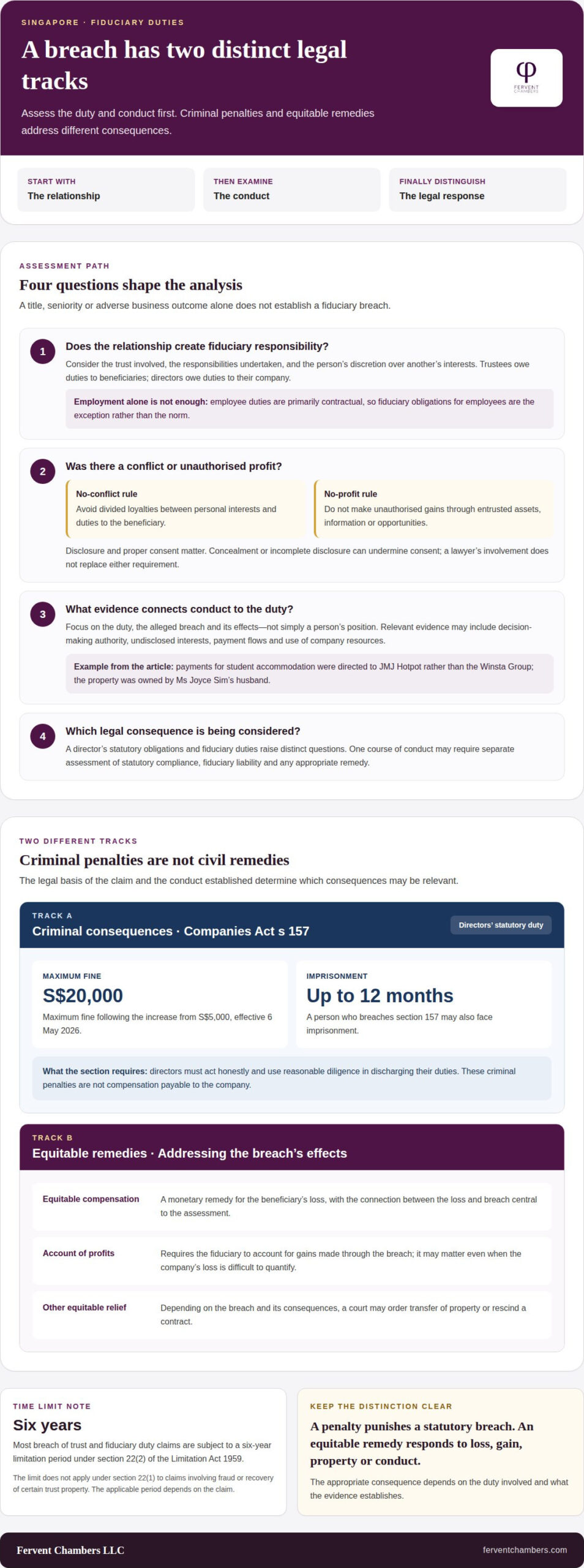
A senior title or an adverse business outcome alone does not establish a breach of fiduciary duty. In Singapore, the penalties depend on the duty and conduct involved: for a breach of section 157 of the Companies Act, a director may face a maximum fine of S$20,000 and imprisonment for up to 12 months. Those criminal consequences are distinct from equitable remedies, which may address the loss or profit arising from a breach.
It is understandable to want a clear answer about who counts as a fiduciary. The relationship, responsibilities and degree of trust matter. Because employee-employer duties are primarily contractual, fiduciary obligations for employees are the exception rather than the norm. This article explains what fiduciary duties involve, how a breach is assessed, and the difference between criminal penalties and equitable remedies in Singapore. It also explains the rules on conflicts and unauthorised profits, and the evidence relevant to liability.
Key Takeaways
- Assess whether the relationship gives one party responsibility and discretion over another’s interests; an employment relationship alone does not automatically establish fiduciary duties.
- Identify potential conflicts and unauthorised profits, then consider whether the relevant conduct involved a director’s statutory duties.
- Understand how equitable remedies may address losses, profits, property or ongoing conduct, depending on the breach and its effects.
- Build the case around evidence of the duty, its breach and resulting harm, rather than relying on a person’s title or position alone.
What is a breach of fiduciary duty in Singapore?
A fiduciary undertakes to act for another in circumstances involving trust and confidence. A breach occurs when that person violates duties attached to the relationship, including the rules against conflicts of interest and unauthorised profits.
Conflicts of Interest and Duty
A conflict arises when a fiduciary’s personal interest competes with the beneficiary’s interests or the fiduciary’s duty. This matters because a decision may favour the fiduciary even if no immediate financial loss occurs. A director considering a transaction with a company they control should disclose the interest and obtain proper consent before proceeding. The relationship, decision-making authority and effect on the beneficiary’s interests all inform the assessment. A lawyer’s involvement does not remove a conflict or replace the need for disclosure and consent.
No-Profit and No-Conflict Rules
The no-conflict rule requires fiduciaries to avoid divided loyalties, while the no-profit rule prohibits unauthorised gains made through their position. The Singapore Court of Appeal identified both as core fiduciary duties, alongside the duty to act in good faith. A director cannot take a company business opportunity for personal gain without the principal’s consent. Consent may authorise a profit, but concealment or incomplete disclosure can undermine it. These rules apply to gains obtained through assets, information or opportunities entrusted to the fiduciary.
Fiduciary status depends on the relationship, not simply a job title. Trustees owe duties to beneficiaries, and directors owe them to their company. High-ranking employees may also owe duties to their employer. However, employment duties are primarily contractual, so fiduciary obligations for employees are the exception. In How Weng Fan v Sengkang Town Council, members and senior employees were found to owe duties of care and skill, rather than fiduciary duties.
The Sims breached the no-profit rule by directing payments for Mongolian students’ accommodation to JMJ Hotpot instead of the Winsta Group. The accommodation was at a property owned by Ms Joyce Sim’s husband. The example shows why payment flows, undisclosed interests and the use of company resources matter when assessing conflicts of interest.
Most breach of trust and fiduciary duty claims are subject to a six-year limitation period under section 22(2) of Singapore’s Limitation Act 1959. Under section 22(1), that limit does not apply to claims involving fraud or recovery of certain trust property. The applicable period therefore depends on the claim’s character and the property or conduct involved.
Criminal penalties for breach of directors’ duties
Penalties for a breach of fiduciary duty in Singapore depend on the legal duty involved and the conduct established. For directors, statutory consequences under the Companies Act are distinct from civil claims based on fiduciary obligations. Under Section 157 of Singapore’s Companies Act, every director must act honestly and use reasonable diligence in discharging their duties, according to the Attorney-General’s Chambers of Singapore. A dispute may therefore require separate assessment of statutory compliance and equitable liability.
From 6 May 2026, the maximum fine for breaching section 157 increased from S$5,000 to S$20,000. A person who breaches the section may also face imprisonment for up to 12 months. These are criminal penalties, not compensation payable to the company. They differ from civil remedies, such as an account of profits, which may address gains obtained through a breach. The applicable consequence turns on the legal basis of the claim and the conduct established.
Singapore penalties for breach of fiduciary duty must be distinguished from directors’ statutory obligations. The Companies Act imposes statutory duties on directors, who also owe fiduciary duties to the company. One course of conduct may therefore raise separate questions: whether statutory requirements were met, whether fiduciary duties were breached, and what remedy may follow. A civil claim and a statutory offence involve distinct legal tests.
Singapore’s legal framework also draws on common law and equity. Under s 3 of the Application of English Law Act, English law, including common law and equity, applies in Singapore. Precedent decisions of superior courts bind lower courts, and Singapore courts may follow Commonwealth decisions, particularly from the United Kingdom, where appropriate. These principles inform how courts assess directors’ duties in a particular dispute.
Where director conduct may engage criminal and civil consequences, dispute resolution assistance can help frame the issues and the appropriate response.
Equitable remedies, including accounts of profits and compensation
In Singapore, penalties for breach of fiduciary duty are distinct from equitable remedies, which address loss, gains, property or ongoing conduct. The appropriate response depends on the breach and its consequences.
Equitable Compensation and Damages
Equitable compensation is a monetary remedy awarded against a fiduciary for a beneficiary’s loss. It addresses harm linked to the breach, rather than focusing only on the fiduciary’s gain. Singapore courts may award compensation to the beneficiary, with the loss and its connection to the breach central to the assessment. In Sumifru Singapore Pte Ltd v Felix Santos Ishizuka, the court found that an employee had breached fiduciary duties.
Accounts of Profits and Civil Remedies
An account of profits requires a fiduciary to account for gains made through a breach. It may be relevant when a director uses their position to take a business opportunity, even if the company’s loss is difficult to quantify. Other remedies address different consequences: a court may order the transfer of property, rescind a contract, or grant an injunction or specific performance. These civil and equitable remedies are separate from criminal penalties for breach of fiduciary duty in Singapore.
Personal Liability for Losses
A director can be personally liable for losses caused by breaching fiduciary duties owed to the company. The company, as beneficiary of those duties, may seek equitable compensation from the director. Liability depends on whether the duty existed, whether it was breached, and whether the breach caused the loss. A director’s position does not, by itself, shield them from personal responsibility for their conduct.
Calculating Damages and Compensation
Compensation is assessed by examining the beneficiary’s loss and its connection to the fiduciary breach. The calculation depends on evidence of what happened, the loss claimed and whether the breach caused it. Under s 103(2) of Singapore’s Evidence Act, the fiduciary bears the legal burden of proving that the principal’s loss would have occurred even without the breach. The claim for compensation follows this civil assessment, rather than the criminal penalties associated with a breach of fiduciary duty in Singapore.
Proving a breach of fiduciary duty
A claim requires proof of an existing fiduciary duty, its breach and resulting harm. The key question is not simply whether conduct appears unfair, but whether the relationship and evidence establish each element.
First, establish the relationship and the scope of the duty. A trustee owes duties to beneficiaries, while an employee’s position alone does not automatically create fiduciary obligations. Courts assess the contractual and operational relationship. Not being on a company’s board does not, by itself, rule out an employee’s fiduciary duties. Evidence should show the responsibilities undertaken, the authority exercised and the interests entrusted to the person. A contract may help explain the circumstances, but the full relationship matters.
Next, identify the specific conduct said to breach the duty. In Sumifru Singapore Pte Ltd v Felix Santos Ishizuka, [2022] SGHC 14, the High Court found that an employee was the plaintiff’s fiduciary and had breached those duties. In the Winsta Group matter, the Sim sisters used company personnel and resources for JMJ Hotpot without disclosure, board approval or payment. Such facts can help show how entrusted resources or decision-making were applied for another interest.
Next, connect the breach to the harm or gain. Financial records, transaction documents and communications may help show what the company lost or what benefit was obtained. A claim for equitable compensation depends on establishing loss linked to the breach; a gain may instead support an account of profits. Consent is relevant if the fiduciary says the principal authorised the conduct, so evidence of what was disclosed and approved matters.
A separate claim may arise where a third party dishonestly assists a breach. It requires an underlying fiduciary duty, breach, assistance and dishonesty in that assistance. In the Singapore High Court case involving the employee, two assisting companies were held jointly and severally liable; the controlling individual’s knowledge was attributed to them. For a focused assessment of the evidence and potential claims, discuss your fiduciary duty dispute.
Fervent Chambers LLC
Fervent Chambers LLC can assess a fiduciary duty dispute and identify an appropriate course of action, whether the issue involves establishing liability, pursuing equitable remedies or responding to a claim. Its Dispute Resolution service addresses commercial disputes, while Arbitration may provide a suitable forum where arbitration is appropriate. If fiduciary issues intersect with company governance or financial distress, Corporate and Commercial or Restructuring and Insolvency work may also be relevant.
Consider seeking legal assistance when the evidence involves complex transactions, competing interests, company assets or potential claims against directors and other fiduciaries. A focused assessment can clarify the relationship, alleged breach, available remedies and procedural options. Contact Fervent Chambers LLC to discuss your circumstances.
Take the Next Step with Clarity
When questions arise about a fiduciary’s conduct, consider how to protect the organisation’s position while maintaining a clear record of events. Relevant correspondence, transaction documents and approval records can help establish what was disclosed, authorised and done. Before acting, consider how a response may affect business relationships, governance responsibilities and potential claims.
Assessing penalties for breach of fiduciary duty in Singapore requires attention to the conduct, the applicable duties and the evidence supporting each allegation. A focused legal assessment can help identify the issues and inform a proportionate way forward. It can also guide decisions about whether to pursue a claim, respond to an allegation or seek resolution.
For advice tailored to your circumstances, contact Fervent Chambers to discuss your legal position. A considered next step can help you address the dispute with greater confidence and protect the interests at stake.
Frequently Asked Questions
What is a fiduciary?
A fiduciary is someone entrusted to exercise judgment in another person’s interests in a particular matter. The relationship may arise from a formal role, such as trustee and beneficiary, or from responsibilities assumed in a company setting. For example, a senior employee given discretion over a company opportunity may require closer assessment than an employee performing routine contractual duties. The person’s actual responsibilities matter.
Can compensation also be claimed?
Yes. A beneficiary may seek compensation for loss attributed to a fiduciary’s breach, while an account of profits focuses on gains made through that breach. These remedies address different consequences and may require different evidence. Records showing diverted revenue may help establish financial loss, while documents tracing a benefit obtained through entrusted authority may support a claim focused on the fiduciary’s gain.
How does a fiduciary duty dispute usually proceed?
A dispute generally centres on the relationship, the conduct challenged and the remedy sought. The parties may examine contracts, board records, communications, transaction documents and financial records to establish the responsibilities involved and what occurred. The claim may proceed through negotiation, court proceedings or arbitration if an applicable arbitration agreement provides for that route. The evidence and remedy sought shape the issues in dispute.
How is a fiduciary claim different from contract or negligence?
A fiduciary claim concerns obligations arising from a relationship of loyalty, while a contract claim concerns promises made between parties. Negligence focuses on a duty of care and whether conduct fell below the required standard. The distinction can matter: in How Weng Fan v Sengkang Town Council, the relevant members and senior employees were found to owe duties of care and skill, not fiduciary duties.
What duties do company directors owe?
Company directors owe duties to the company, including duties to act honestly and in good faith and to avoid unauthorised conflicts or profits. Section 157 of the Companies Act also requires every director to use reasonable diligence when discharging duties. In practical terms, a director considering a transaction involving a personal interest should ensure the interest and decision-making process are properly addressed.
What constitutes breach of fiduciary duty under Singapore law?
A breach occurs when a person subject to fiduciary obligations acts contrary to them, for example by concealing a personal interest or obtaining an unauthorised benefit. The relationship and the specific conduct must be assessed together. Consent can affect whether a profit is authorised, but its significance depends on what was disclosed and agreed. A title alone does not establish fiduciary status or prove a breach.