



A company’s entry into an insolvency process changes who controls recovery, but it does not automatically erase the debt. In Singapore, the process may involve receivership, judicial management or winding up, and the applicable procedure determines what steps a creditor can take when recovering debt from a company in administration. A secured creditor may appoint a receiver to enforce its charge, while the Court may appoint a judicial manager to take control of the company’s business.
It is natural to ask whether the company can pay and whether ordinary collection action can continue. The answer depends on the process in place, your security rights and the company’s position. Identify these factors before deciding how to pursue recovery.
This article explains what “administration” means in context, how payment priorities affect the prospect of recovery, and which actions may be restricted or redirected. It also outlines how Singapore’s restructuring and insolvency framework shapes creditors’ claims against a distressed company.
Key Takeaways
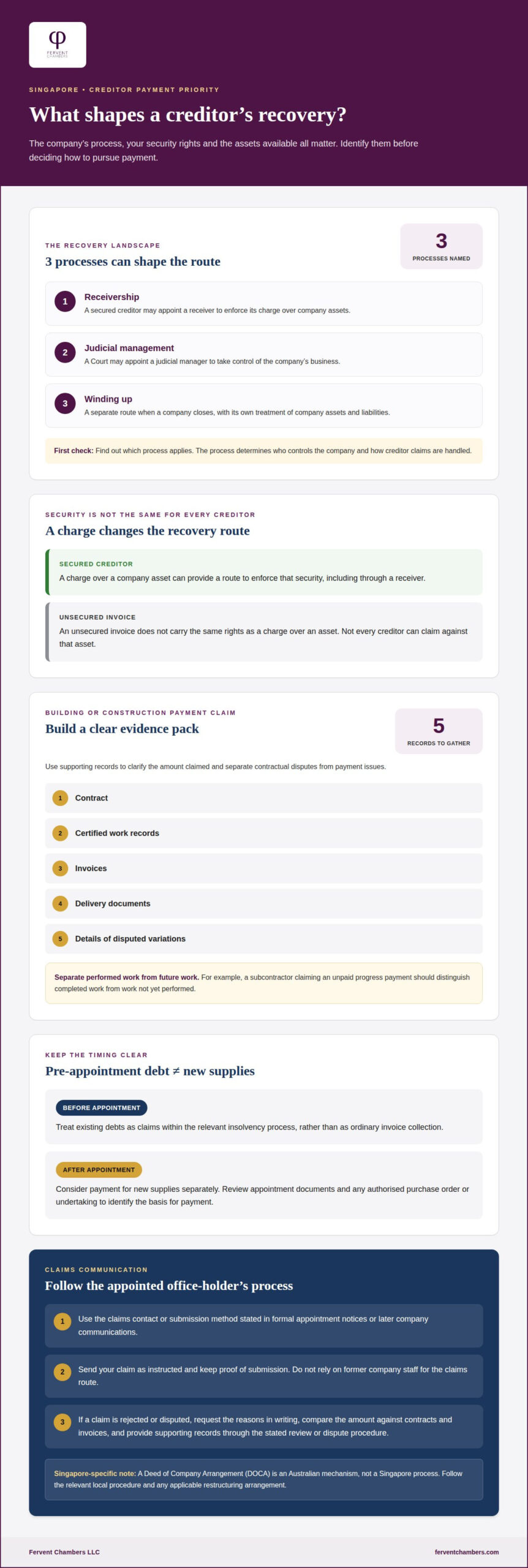
- Identify whether the company is in receivership, judicial management or winding up, because the process affects who controls the business and its assets.
- Security over company assets can shape recovery: a creditor with a charge may appoint a receiver to enforce it.
- Judicial management may involve a Court-appointed manager taking control of the company, while winding up is another route when a company closes.
- When insolvency procedures affect your recovery position, Fervent Chambers LLC can assist through its Restructuring and Insolvency and Dispute Resolution offerings.
Creditor payment priority
In Singapore, creditor priority depends on the company’s actual process, security rights and available assets. A charge over a company asset gives the secured creditor a route to enforce that security, including through a receiver. It does not mean every creditor can claim against that asset, or that an unsecured invoice carries the same rights.
For a building or construction payment claim, gather the contract, certified work records, invoices, delivery documents and details of disputed variations. For example, a subcontractor claiming an unpaid progress payment should distinguish completed work from work not yet performed. This evidence clarifies the amount claimed and helps separate contractual disputes from payment issues.
The appointed office-holder’s contact details and claims process are usually set out in formal appointment notices and subsequent company communications. Send your claim to the stated office as instructed, and keep proof of submission. Use the claims contact or method named in the notice rather than relying on former company staff.
Payment for supplies delivered after an appointment should be considered separately from pre-appointment debts. In Singapore, review the appointment documents and any authorised purchase order or undertaking to identify the basis for payment for new supplies. Do not assume that rules for an English administration apply to a Singapore process.
A Deed of Company Arrangement, or DOCA, is an Australian mechanism, and its terms determine how debts and claims are handled there. It is not a Singapore process. For a Singapore company, follow the relevant local procedure and any applicable restructuring arrangement, rather than assuming DOCA terms apply.
If you owe regular loan instalments to a company that enters an insolvency process, its financial distress alone does not cancel your payment obligation. Follow formal payment instructions and keep transaction records. Treat your debt to the company separately from any claim for money it owes you, as each may be handled through a different process.
Companies Act and Insolvency, Restructuring and Dissolution Act
Creditors in Singapore should distinguish insolvency from the specific process controlling the company. The applicable legislation and appointment determine how the company’s affairs and creditor claims are handled.
Relevant Insolvency Legislation
The Companies Act and the Insolvency, Restructuring and Dissolution Act are key Singapore references for receivership and judicial management. Their relevance depends on the process affecting the company, so identify whether a receiver or judicial manager has been appointed before assessing your position. These procedures differ from winding up, which is another route when a company closes.
For a viable business, Singapore’s Simplified Debt Restructuring Programme may provide a restructuring route when annual revenue is below S$10 million. The programme is directed at restructuring debts while the business remains viable. Creditors should therefore distinguish a restructuring proposal from a winding-up process, since the company’s intended path affects how claims are considered.
Administration of an Insolvent Company
When a company is in financial difficulty, administration may be one process used to address its situation. In Singapore, creditors may encounter receivership or judicial management; a Court may appoint a judicial manager to take control of a company’s business. The appointed office-holder’s role and the process determine how creditors communicate and how the company’s affairs proceed.
A claim against an insolvent company must be considered within the relevant process, rather than treated as an ordinary invoice collection. If the office-holder rejects or disputes your claim, request the reasons in writing, compare the stated amount with your contracts and invoices, and provide supporting records. Then follow the claim review or dispute procedure communicated for that process.
A lender’s insolvency does not, by itself, cancel a borrower’s scheduled loan repayments. Follow payment instructions in formal communications and retain transaction records, particularly if the lender’s assets or loans are transferred. A transfer may change the entity receiving payment, while the borrower’s repayment obligation may remain unchanged under the agreement.
Directors and creditors considering restructuring should assess whether the business can remain viable and meet its obligations under a proposed arrangement. If it cannot, winding up may be the relevant path. The distinction matters: restructuring seeks to address debts while the business continues, whereas winding up concerns closure and the treatment of company assets and liabilities.
Effects of an administrator’s appointment on creditor actions
In Singapore, the effect on creditor action depends on the process affecting the company and the rights attached to each claim. Receivership, judicial management and winding up involve different control arrangements. Identify the applicable process before deciding how to pursue payment.
Creditor Participation and Voting
Creditor participation means submitting a claim and taking part in decisions available under the relevant Singapore process. In judicial management, a Court-appointed judicial manager takes control of the company’s business, making the manager’s communications central to understanding the process. Review notices for meeting details, proposals and opportunities to provide information. For example, a supplier can use a meeting or submission process identified in a notice to explain disputed invoices or the effect of a proposed arrangement.
Legal Action During Administration
Legal action means pursuing a claim through court proceedings rather than relying only on the company’s insolvency process. The materials provided do not establish a general Singapore rule that automatically suspends every creditor action when a company enters administration. The relevant procedure and any Court directions therefore matter. Before commencing or continuing proceedings, assess how the company’s receivership, judicial management or winding up affects the claim and the assets available to satisfy it.
Comparing Recovery Routes
Recovery through a company process differs from a lawsuit: the process addresses the company’s affairs, while litigation determines a particular dispute. In Singapore, a creditor with a charge may appoint a receiver to enforce it. The receiver may sell an asset or temporarily run the business while recovering what is owed. This route is tied to the secured asset and charge.
Winding up is a route when a company closes, while judicial management places its business under a Court-appointed manager. A lawsuit may address a disputed contract or unpaid invoice, but does not establish by itself which company assets are available. Compare your claim, security rights and the company’s process before choosing a recovery route.
Debt recovery during external administration
External administration changes who manages company affairs and how creditors pursue payment. In Singapore, identify the specific process and appointed office-holder before taking recovery steps.
Submitting a Proof of Debt
A proof of debt records the amount a creditor claims and the basis for payment. In Singapore proceedings, follow the claim instructions and deadline in communications from the appointed office-holder. Submit your claim promptly, as late or incomplete material may affect its consideration. If the notice does not state a deadline, ask the office-holder for the applicable submission date.
Keep copies of your submitted claim, supporting records and any acknowledgement. If you are owed money under several invoices, provide an itemised total rather than one unexplained figure.
Evidence for Proving a Debt
Evidence links the amount claimed to an agreement, supply or transaction with the company. Assemble the contract or purchase order, invoices, delivery or completion records, account statements and payment history. Emails acknowledging the balance, credit notes and part-payment records can help explain adjustments or disputed entries.
For example, a supplier claiming for delivered materials can match each invoice to delivery records and the relevant purchase order. A clear reconciliation helps the office-holder distinguish the amount owed from sums already paid or disputed.
Recovery Costs, Risks and Rates
Recovery costs depend on the route pursued and the work needed to establish or enforce the claim. Possible expenses include preparing evidence and taking legal action; there is no single standard recovery cost for every Singapore claim. Assess the company’s assets, secured creditors’ rights and the expenses of realising those assets.
An individual unsecured creditor’s recovery depends on what remains available after applicable claims and process expenses. If assets are insufficient, an accepted claim may still receive only partial payment. A restructuring arrangement may produce a different outcome from winding up, so review its proposed terms and payment basis.
Discuss your creditor claim and recovery options where the process, disputed debt or asset position requires legal analysis.
Fervent Chambers
Fervent Chambers LLC advises creditors assessing recovery options when an insolvency process, disputed claim or asset position complicates payment. Its work in Restructuring and Insolvency, Dispute Resolution, Arbitration, and Corporate and Commercial matters can help align a claim strategy with the governing process, supporting documents and commercial interests at stake.
Consider legal assistance if an office-holder disputes the debt, a proposed arrangement affects your rights, or you need to assess whether proceedings remain appropriate when recovering debt from a company in administration. The analysis can address the basis of your claim, available recovery routes, and the legal or commercial consequences of pursuing them. Court action is not the only option.
Contact Fervent Chambers LLC to discuss your creditor position and the issues affecting recovery.
Make your next recovery decision with clarity
Align your recovery strategy with the commercial purpose behind the claim. You may need to preserve a working relationship, challenge a disputed liability or decide whether formal proceedings remain proportionate. The right course depends on the evidence, the company’s process and the likely consequences of each available route.
When recovering debt from a company in administration raises questions about competing claims, disputed obligations or restructuring options, legal analysis can clarify your position before you act. Fervent Chambers’ work in Dispute Resolution, Arbitration, and Restructuring and Insolvency addresses these connected issues, supporting a considered approach to creditor rights and commercial priorities.
Discuss debt recovery with Fervent Chambers and determine a practical next step for your circumstances. A clear assessment can help you proceed with greater confidence.
Frequently Asked Questions
What is administration?
In Singapore, “administration” is often used broadly for an external insolvency process, but the formal procedure matters. Receivership involves a receiver enforcing a charge, while judicial management places the company’s business under a Court-appointed judicial manager. Winding up is a separate process associated with closing the company. The procedure named in the company’s notice helps you identify who controls the business and where creditor communications should go.
An insolvent company owes me money. What do I do?
First, identify the office-holder handling the company’s process and send your claim through the stated channel. Gather the agreement, invoices, delivery or completion records, payment history and correspondence confirming the balance. If the company disputes part of the amount, separate the agreed sum from disputed items and explain each calculation. Keep copies of your submission and later communications so you can respond consistently to requests for clarification.
How do I know what kind of creditor I am?
Your creditor status depends mainly on the legal basis of your claim and whether you hold security over company assets. A lender with an enforceable charge may be secured for that obligation; a supplier with an unpaid invoice and no security is generally unsecured. Review the relevant loan, security or supply documents, including any guarantee. One creditor may have different classifications for separate debts, so assess each claim and its supporting rights individually.
I have a debt with a company that has gone into administration. What should I do?
If you owe the company money, do not assume its insolvency automatically cancels your repayment obligation. Review your agreement and formal notices, then follow payment instructions from the authorised office-holder. If the named payment recipient changes, retain the notice and proof of each transaction. If the company also owes you money, record that claim separately and submit it through the relevant process rather than deducting it informally.
Can you provide me with an estimate of the timeframe for reviewing my claim and paying a dividend?
The timeframe depends on when the claim can be verified and when assets can be realised and distributed. A straightforward invoice supported by a signed delivery record may be assessed differently from a claim involving incomplete records or a disputed contract. Payment also depends on the company’s assets, claims with priority and the progress of the process. Claim review and distribution are separate stages, and approval does not mean payment is immediate.
I am owed money. What notification will I receive?
Monitor formal communications from the office-holder for claim instructions, requests for supporting evidence, decisions on claims and information about distributions. Their content and timing depend on the procedure and developments in the company’s affairs. Keep your correspondence address and email current, and retain each notice with your claim records. Follow any stated deadline or response method carefully to avoid missing a step in the process.