




A statutory demand is not simply a stronger letter of demand; it is a formal insolvency step. Serving a statutory demand for unpaid invoices in Singapore against a firm generally requires a debt that is due, liquidated and at least S$15,000. If the company does not pay, the creditor may consider insolvency proceedings, but a genuinely disputed debt can make a statutory demand vulnerable to challenge.
A letter of demand and a statutory demand serve different purposes, so choosing the right route matters when an invoice remains unpaid. This guide explains the difference, what to consider before serving a demand on a company, and how Singapore’s limitation period may affect debt recovery. It also outlines what may follow if a statutory demand goes unanswered, helping you assess the procedural risks before taking the next step.
Key Takeaways
- Separate an ordinary payment request from a formal insolvency demand, and choose the route that fits the nature and status of the invoice debt.
- Calculate the applicable limitation period before taking recovery action: contract claims are generally subject to six years, while Small Claims Tribunals claims must be filed within two years.
- Record the service date and act promptly; the response period can affect whether bankruptcy or winding-up proceedings may follow.
- For a company debt, assess whether the claim is genuinely disputed and whether the statutory insolvency process is suitable before proceeding.
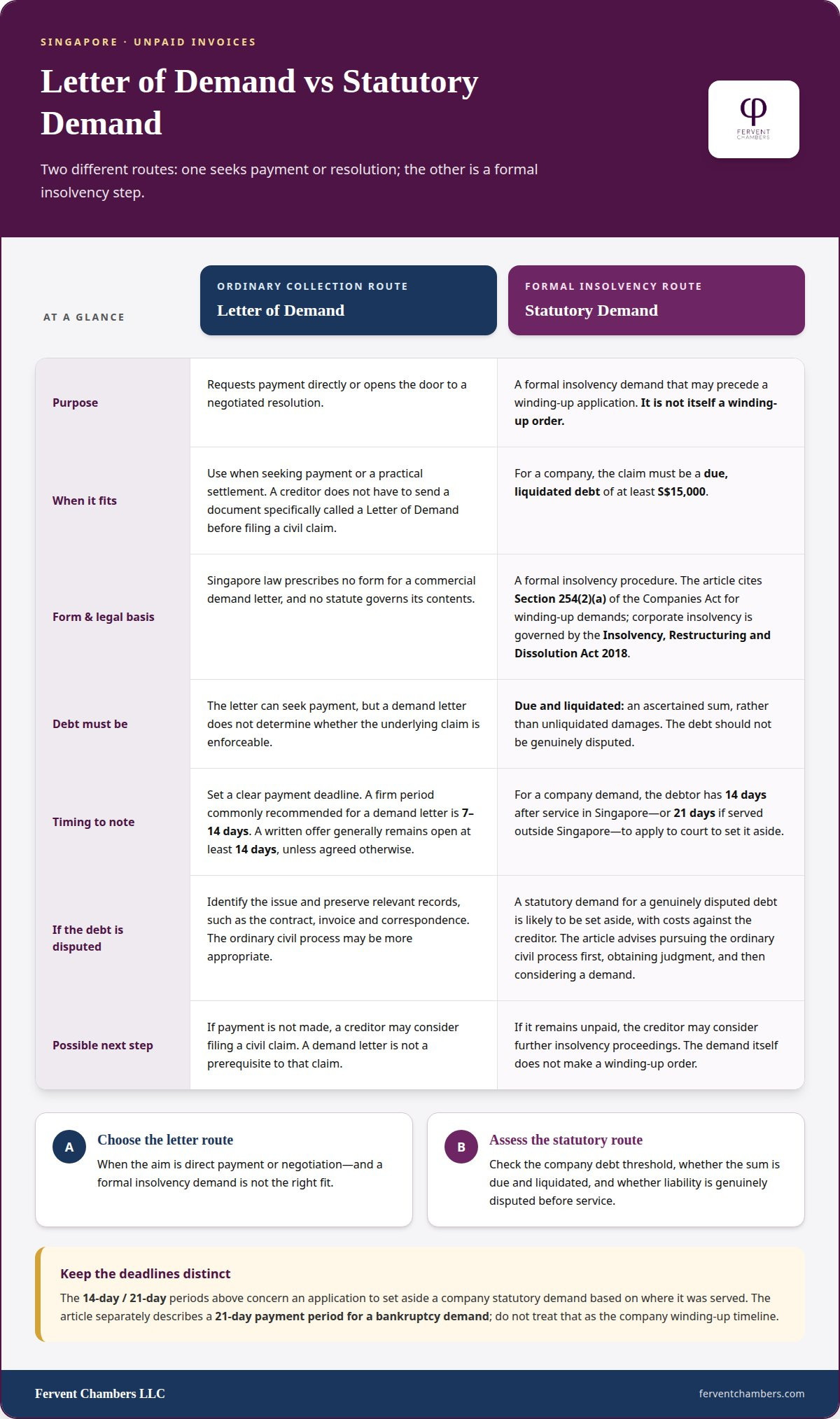
Difference between a letter of demand and a statutory demand
- Identify the procedure before sending anything. In Singapore, a statutory demand for unpaid invoices is a formal insolvency demand for a due, liquidated debt, rather than an ordinary collection letter. For a company, the stated minimum debt threshold is S$15,000. Section 254(2)(a) of the Companies Act is cited for winding-up demands, while corporate insolvency is governed by the Insolvency, Restructuring and Dissolution Act 2018. The demand may precede a winding-up application; it is not itself a winding-up order.
- Use a solicitor’s letter of demand when you seek direct payment or negotiated resolution. Singapore law prescribes no form for a commercial demand letter, and no statute governs its contents. A creditor also need not send a document specifically called a Letter of Demand before filing a civil claim. Set a clear payment deadline; a firm period commonly recommended for a demand letter is 7-14 days. Under the Rules of Court 2021, parties must consider amicable resolution, and a written offer generally remains open at least 14 days unless agreed otherwise.
- Assess whether the invoice supports the insolvency route before serving a statutory demand. The debt must be due and liquidated, meaning it is an ascertained sum rather than unliquidated damages. If the debtor genuinely disputes liability or the amount, pursue the ordinary civil process first, obtain judgment, and then consider a statutory demand. If the demand remains unpaid, the creditor may consider further insolvency proceedings.
- If the company challenges the demand, distinguish an application to set it aside from a response seeking payment or settlement. A debtor has 14 days after service in Singapore to apply to court to set aside the demand, or 21 days when it was served outside Singapore. A statutory demand for a genuinely disputed debt is likely to be set aside, with costs against the creditor, so assess the evidence before using insolvency proceedings as collection pressure.
What is the statute of limitations for debt recovery in Singapore?
- For a Singapore company, serve a statutory demand only for a due, liquidated debt of at least S$15,000. This answers when a creditor may use the demand; the limitation period remains a separate question. Record the invoice, amount claimed, payment due date and creditor’s legal name so the debtor can identify the claim and respond.
- Calculate the ordinary contract claim period before choosing recovery proceedings. Contract claims in Singapore are generally subject to a six-year limitation period. A partial payment or signed written acknowledgment can start the period afresh under Section 26(2). Keep the payment record or acknowledgment with the invoice and account statements; a later judgment has a separate 12-year validity period.
- Check the appropriate forum and filing deadline for smaller claims. According to the Small Claims Tribunals, eligible claims must be filed within two years. Do not assume that sending a demand letter or discussing restructuring pauses a limitation period. If an invoice is disputed, identify the specific issue, such as a contested quantity or incomplete work, and preserve the contract and related correspondence. A statutory demand for a genuinely disputed debt risks being set aside.
- For cross-border commercial claims, identify the contracting parties, governing terms and location of the debtor’s assets before selecting a route. Those factors affect where proceedings may be brought and whether a judgment can be enforced. If service occurs outside Singapore, the debtor has 21 days to apply to set aside a statutory demand, rather than 14 days for service in Singapore.
- Before instructing a debt collector, establish whether the proposed collection activity falls within Singapore’s licensing regime. The licensing requirement under the Debt Collection Act 2022 took effect after the transition period ended on 1 March 2024. Keep the invoice, contract, payment history and creditor details together; precise records help distinguish an enforceable claim from an unresolved dispute.
The 21-day statutory demand response period
Record the service date immediately, because the applicable response period can determine whether a creditor may take the next insolvency step. The 21-day payment period must not be confused with the distinct procedures for corporate winding-up.
-
Track the Statutory Demand Response Period
Note the date the demand was served and preserve the document and proof of delivery. For a bankruptcy demand, the debtor has 21 days after service to pay before the creditor may proceed with a bankruptcy application. Treat this three-week period as a formal deadline, not an estimate, and obtain advice promptly if the debt, service or calculation is disputed.
-
Make Payment Within the Demand Period
If the debt is accepted, arrange payment within the 21-day period and retain evidence showing the amount and date paid. Compare the demand against the underlying invoices and payment records, so any shortfall or disputed component is identified before the deadline. A partial payment may not resolve the full claim, so communicate clearly about the remaining balance.
- If the debtor disputes liability, respond in writing before the deadline and state the specific grounds, such as a payment credit or an invoice for work not accepted. Attach relevant records, including the invoice or payment confirmation. A genuine dispute requires substantive grounds. Silence does not resolve the issue and may leave the creditor free to take the next step.
- Distinguish personal bankruptcy from company insolvency before deciding what follows. The 21-day bankruptcy response period concerns a creditor’s potential bankruptcy application against a debtor. A company demand instead engages the corporate procedure under the Insolvency, Restructuring and Dissolution Act, and should not be treated as an identical bankruptcy process.
- If payment or a documented resolution is not possible, assess the appropriate formal response before the relevant period expires. Litigation, a court application and restructuring discussions each involve different procedural considerations. Preserve every letter, payment record and service document. These materials help establish what was demanded and how the debtor responded.
Corporate insolvency and compulsory winding-up
For an unpaid company invoice, distinguish corporate winding-up from personal bankruptcy before choosing an insolvency remedy. The applicable process depends on the debtor’s legal status and the evidence of its inability to pay.
- Confirm that the debtor is a company and assess the debt against the statutory threshold. A corporate statutory demand requires a debt of at least S$15,000. The Insolvency, Restructuring and Dissolution Act 2018 governs this corporate insolvency process; personal bankruptcy follows a separate procedure. Check the current threshold and the company’s registered details before preparing documents, since a demand addressed to the wrong legal entity can undermine enforcement.
- Establish the company’s inability to pay, rather than treating non-payment alone as proof of insolvency. Section 125(2) of the Insolvency, Restructuring and Dissolution Act 2018 sets out three ways a company may be deemed unable to pay its debts. Section 312 also addresses other ways to show inability to pay. Review the contract, invoices, payment history and any written dispute before relying on the demand route.
- Serve the demand in a way that brings it to the company’s attention, and preserve proof of delivery. Make a reasonable attempt to deliver a hard copy personally and serve it at the company’s registered office. Keep the demand, delivery records and related correspondence together. These records may support a later filing and help address any challenge to service or the amount claimed.
- If the demand remains unpaid, consider whether an application to wind up the company is appropriate under Section 124 of the Insolvency, Restructuring and Dissolution Act. Filing initiates court proceedings; it does not itself secure payment or establish that winding-up is the best commercial outcome. Review the company’s circumstances, any restructuring discussions and the creditor’s objectives before proceeding. A genuinely disputed demand may be set aside, with costs against the creditor.
For a company debt involving insolvency risk or restructuring discussions, seek advice on corporate insolvency options before filing a winding-up application.
Fervent Chambers LLC
Fervent Chambers LLC helps creditors and companies assess the legal and commercial issues raised by unpaid invoices before choosing a recovery or response strategy. This can include reviewing the contract and payment records, considering whether the debt is disputed, and weighing the risks of insolvency proceedings against other ways to resolve the matter.
If a statutory demand has been served or is being considered, timely legal advice can clarify the procedural options, the consequences of non-compliance and the implications of restructuring discussions. Fervent Chambers LLC handles commercial matters through its Dispute Resolution, Restructuring and Insolvency, and Corporate and Commercial practices, as appropriate to the circumstances.
Plan the next step with care
Recovery decisions can affect more than the unpaid invoice. They may influence commercial relationships, negotiations and a company’s options. Before pursuing a statutory demand for unpaid invoices in Singapore, consider how the evidence and the debtor’s position align with your commercial objectives. A considered strategy can help keep enforcement action proportionate to the dispute and its wider consequences.
Fervent Chambers LLC assists with disputes requiring a structured legal response through its Dispute Resolution, Arbitration, and Restructuring and Insolvency practices. This support may be relevant when a creditor is weighing recovery proceedings or a company needs to respond to an insolvency-related demand. The appropriate course depends on the circumstances and the objectives at stake.
Contact Fervent Chambers for advice about your circumstances and the available next steps. A clear assessment can help you proceed with greater confidence.
Frequently Asked Questions
What if I am serving the statutory demand on a firm?
Confirm that the demand names the company that owes the invoice, not a director, employee or related entity. Use the company’s registered details and clearly identify the contract, invoices, payments received and outstanding balance. Keep proof of delivery and records supporting the amount claimed. If the company disputes liability or the invoice calculation, consider whether ordinary court proceedings are more appropriate than insolvency action.
Can legal fees and interest be recovered from the debtor in Singapore?
Interest may be claimed where the contract provides for it or the court allows it; Singapore court guidelines ordinarily state statutory interest at 5.33% per annum for debt claims. Legal fees are not automatically recoverable in full simply because a solicitor was instructed. Recovery may depend on the contract and court decisions on costs, while Small Claims Tribunals generally do not award legal costs.
How long after a statutory demand can I apply to wind up a company?
A creditor may consider a winding-up application after the company fails to comply with the applicable corporate statutory demand procedure. Do not assume that the 21-day bankruptcy response period automatically sets the timing for a company winding-up application, because personal bankruptcy and corporate insolvency are separate procedures. Before filing, assess service, the debt evidence, any challenge, and the procedural requirements applying to the company.
How long can you legally be chased for a debt in Singapore?
For contract debts, a claim is generally subject to a six-year limitation period in Singapore. A partial payment or signed written acknowledgment can restart that period under Section 26(2). A court judgment has a separate 12-year validity period. These periods concern legal recovery routes; the relevant dates and documents matter, so retain invoices, payment records, acknowledgments, and any judgment.
How long do I have to chase an unpaid invoice?
For a claim based on a contract, the general limitation period is six years. According to the Small Claims Tribunals, eligible claims must be filed within two years. Preserve the contract, invoice, delivery or completion records and payment history, then identify the appropriate forum and deadline rather than relying on continued correspondence to recover the balance.
What are the risks of issuing a statutory demand?
A demand for a genuinely disputed debt may be set aside, and the creditor may face an adverse costs order. Incorrect debtor details, defective service or an unsupported amount can also undermine the intended insolvency step. A winding-up application can have serious commercial consequences for the company, so distinguish a genuine insolvency concern from an ordinary invoice dispute before proceeding.