




Incorporation separates company debts from personal debts, but it does not shield directors and shareholders in every circumstance. The rules on personal liability for company debts in Singapore start with the company’s separate legal identity under section 19(5) of the Companies Act 1967. For a company limited by shares, a shareholder’s liability on winding up is limited to any amount unpaid on their shares, while a director may face personal liability for a guarantee or certain forms of wrongful or fraudulent trading.
It is understandable to view limited liability as a safeguard, especially when a business faces financial pressure. The key distinction is whether liability arises from a person’s own commitment or conduct, rather than simply from their role as a director or shareholder.
This article explains when directors may be responsible for company debts, how shareholders’ liability differs, and what a personal guarantee means in practice. It also covers practical steps to reduce risk and when advice on restructuring, insolvency, or a commercial dispute may help clarify what to do next.
Key Takeaways
- Separate the company’s debts from your personal commitments: a guarantee can create direct repayment exposure.
- Assess the conduct behind a company’s financial distress, since wrongful or fraudulent trading can expose officers to personal consequences.
- Preserve clear boundaries between company and personal assets, and keep decisions and records properly documented to reduce veil-piercing risks.
- For a company limited by shares, identify any unpaid amount on your shares to understand the usual limit of shareholder liability on winding up.
Can Directors be Liable for Company Debts in Singapore?
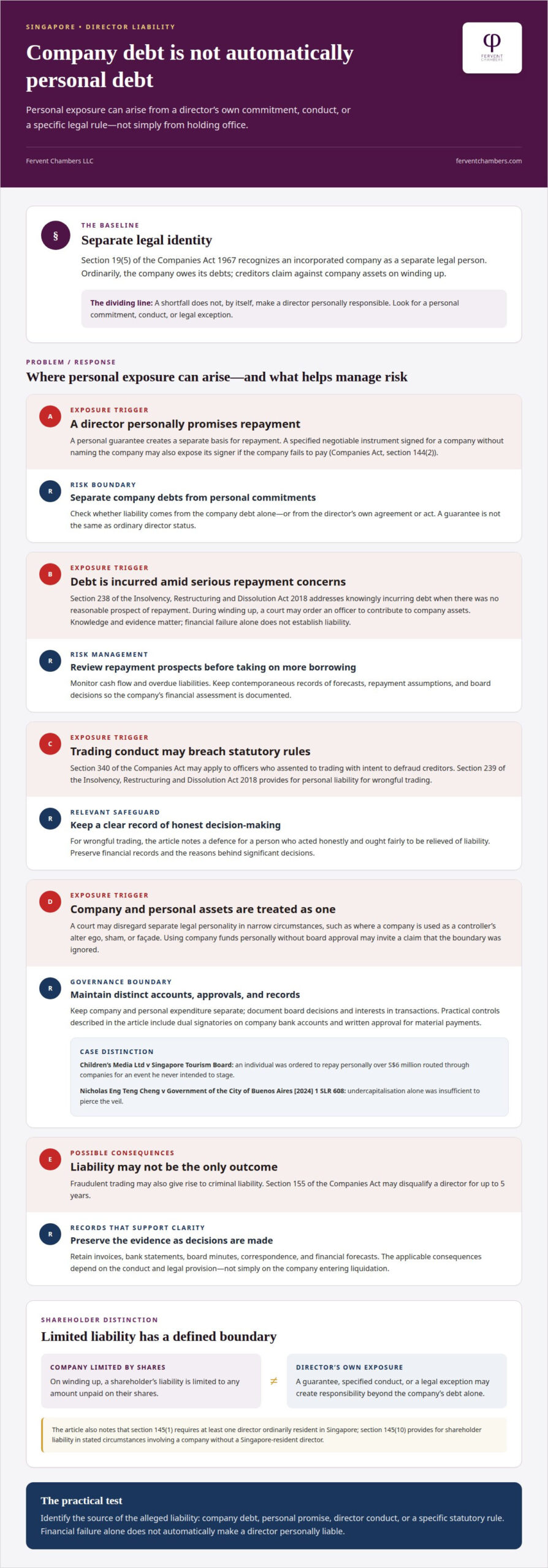
Ordinarily, a Singapore company owes its debts, not its directors, because incorporation creates a separate legal person. When the company is wound up, creditors claim against its assets. Any shortfall remains unpaid unless a guarantee or legal exception makes another person liable.
Separate Legal Personality and the Baseline Rule
Section 19(5) of Singapore’s Companies Act 1967 recognizes an incorporated company as separate from the people who run it. This distinction generally keeps a director’s personal assets separate from company debts, even when the business cannot pay creditors.
That rule does not protect a director from their own commitments or conduct. For example, signing a personal guarantee creates a separate basis for repayment. The question is whether liability arises from the company’s debt alone or from the director’s own act, agreement, or statutory responsibility.
Circumstances for Personal Liability
A director may become personally liable where legislation or their own conduct creates responsibility for a company debt. Section 340 of the Companies Act may apply to officers who assented to trading with intent to defraud creditors.
Section 238 of the Insolvency, Restructuring and Dissolution Act 2018 addresses knowingly incurring debt when there was no reasonable prospect of repayment. During winding up, the court may order an officer to contribute to company assets. The circumstances and evidence of the officer’s knowledge matter; financial failure alone does not establish personal liability.
A specified negotiable instrument signed for a company without naming it can also expose its signer if the company fails to pay, under section 144(2) of the Companies Act.
Insolvency Prevention and Director Risk Management
Managing risk means monitoring the company’s ability to pay its debts and keeping records of significant financial decisions. Before committing the company to more borrowing, directors should review cash flow, overdue liabilities, and realistic repayment prospects.
According to Attorney-General’s Chambers, Singapore, section 239 of Singapore’s Insolvency, Restructuring and Dissolution Act 2018 provides for personal liability for wrongful trading, subject to a defence for a person who acted honestly and ought fairly to be relieved of liability. A contemporaneous record of forecasts and board decisions can help explain the director’s assessment.
Section 145(1) requires at least one director ordinarily resident in Singapore. Section 145(10) provides for shareholder liability in stated circumstances involving a company without a Singapore-resident director.
Disqualification and Criminal Exposure
Personal liability is not the only possible consequence of a director’s conduct. Fraudulent trading may also give rise to criminal liability, while section 155 of the Companies Act may disqualify a director for up to 5 years.
The consequences depend on the conduct and the applicable legal provision, not simply on the company entering liquidation. If insolvency is approaching, preserve financial records and seek advice before taking steps that could affect creditors. An early assessment can help distinguish legitimate restructuring decisions from conduct that may carry personal or criminal exposure.
How should directors protect themselves from personal liabilities?
Directors can reduce exposure through disciplined governance, a clear separation between company and personal property, and decisions supported by reliable records. These practices also help demonstrate that the company operated as a genuine, separate entity.
Piercing the Corporate Veil
Piercing the corporate veil means a court disregards a company’s separate legal personality in narrow circumstances, such as when it is a controller’s alter ego, sham, or façade. The issue may arise when a director uses the company structure to defeat creditors rather than to conduct legitimate business.
For example, a director who withdraws company funds for personal use without board approval may invite a claim that company and personal assets were treated as one. In Children’s Media Ltd v Singapore Tourism Board, an individual was ordered to repay personally over S$6 million routed through companies for an event he never intended to stage.
By contrast, Nicholas Eng Teng Cheng v Government of the City of Buenos Aires [2024] 1 SLR 608 held that undercapitalisation alone was insufficient to pierce the veil. The distinction is material: poor funding by itself differs from dishonest use of corporate structure or assets.
Governance Practices for Reducing Liability Risk
Governance practices create a documented boundary between company decisions and a director’s personal interests. Under section 157 of the Companies Act, directors owe duties to the company; disclose interests in transactions, record board decisions, and avoid using company assets as personal property.
Practical controls include requiring dual signatories on company bank accounts, obtaining written approval for material payments, and keeping company and personal expenditure separate. Before taking on new debt, record the company’s financial position, repayment assumptions, and reasons for proceeding. These records can help explain the decision-making process if creditors later challenge conduct during winding up.
Accounting discipline matters too. Failures involving proper accounting records or laying accounts can attract personal fines under sections 199 and 201 of the Companies Act. A director should preserve invoices, bank statements, board minutes, and correspondence, rather than reconstructing the record after a dispute begins. Where a transaction raises conflicts or corporate-structure concerns, corporate and commercial advice can help assess the proposed actions and their creditor implications.
What is a personal guarantee?
A personal guarantee is a signed commitment to repay a company debt if the company fails to pay. In Singapore, directors and shareholders who sign as guarantors may become personally liable. Creditors can pursue recovery under the guarantee and applicable debt-recovery processes.
Personal Guarantees and Company Debt
A guarantee gives a creditor recourse against the guarantor as well as a claim against the company. The Civil Law Act requires a personal guarantee to be in writing and signed by the guarantor.
Before signing, review what the document covers: it may relate to a loan, lease, or credit facility, and its terms determine which obligations are guaranteed. A director who signs personally for a company loan may be sued for repayment, even though the company is the borrower. The guarantee is separate from the director’s role, and restructuring the company does not by itself remove that personal commitment.
Guarantees and Co-Borrowing
A guarantor promises to answer for another party’s debt. A co-borrower, by contrast, signs as a borrower and takes on the debt directly. The distinction matters if the company stops trading, defaults, or seeks restructuring.
Where a company and a personal guarantor sign a company loan agreement, they are jointly and severally liable for the debt. Subject to the agreement’s terms, the creditor may pursue the guarantor under the agreement, rather than treating the guarantee as a mere expression of intent. Before signing, check whether the individual is named as guarantor, co-borrower, or both, and understand the obligations attached to each role.
Creditor Recovery from Directors or Shareholders
Recovery begins with the creditor relying on the signed guarantee or other personal obligation, rather than the person’s title as director or shareholder alone. If the debt exceeds S$15,000, a creditor may serve a statutory demand under Singapore’s Insolvency, Restructuring and Dissolution Act before pursuing a bankruptcy application.
A creditor may bring a claim, obtain judgment, and enforce it against the liable individual if the judgment remains unpaid. Enforcement may include seizure and sale of personal belongings. The relevant documents, alleged breach, payment history, and guarantee terms shape the dispute. A director or shareholder facing a claim should respond promptly and preserve relevant loan and payment records.
Limited liability of shareholders in a Singapore company limited by shares
Business structure affects whether debts remain with the business or may reach an owner’s personal assets. A sole proprietorship has no separate legal identity, while a Singapore company limited by shares generally limits shareholders’ liability on winding up to any unpaid amount on their shares.
In a sole proprietorship, the owner is personally responsible for business debts and losses. General partnership partners face unlimited personal liability, including for debts caused by other partners. A private limited company is different: under section 250(1)(d) of the Companies Act, a shareholder’s liability on winding up is limited to amounts unpaid on their shares.
This limit applies to shareholders in their capacity as shareholders; it does not erase separate commitments. A shareholder who signs a personal guarantee may be pursued under that guarantee. A private company may have no more than 50 shareholders, but this limit does not change the liability rule. Check the share records to establish whether any amount remains unpaid.
A company’s insolvency does not, by itself, make its shareholders personally liable for its debts. The distinction is between ownership and a person’s own actions: a guarantee or wrongful conduct may create separate exposure. Fraudulent trading and wrongful trading can also have personal consequences under applicable rules, particularly for officers involved in the company’s business.
Courts assess the relevant legal basis and evidence, rather than treating every shareholder as responsible for a corporate debt. Before investing or responding to a creditor claim, identify the business structure, share-payment status, and any signed guarantees. If a company is distressed, seek restructuring and insolvency advice to assess creditor claims and the company’s available options.
Fervent Chambers: Dispute Resolution
Fervent Chambers LLC advises companies, directors, and shareholders facing creditor claims, disputed guarantees, or financial distress through dispute resolution and related corporate advice. When a company’s ability to pay is in question, its restructuring and insolvency work can help clarify obligations, assess available options, and address creditor interests.
In a dispute over a guarantee or alleged personal liability for company debts Singapore, the relevant documents, company records, and conduct leading to the debt help define the issues. Fervent Chambers LLC handles dispute resolution and arbitration, while corporate and commercial advice can address the underlying agreements and governance concerns. Early legal assessment is especially relevant if a creditor has made a demand, proceedings have begun, or the company is considering restructuring.
Contact Fervent Chambers LLC to discuss the circumstances and determine a considered path forward.
Choose a considered path forward
A creditor demand or internal concern can create pressure to respond quickly. Start by clarifying the decision at hand: identify the immediate objective, preserve relevant correspondence, and list the questions to resolve before committing to a position or payment proposal.
Assessing personal liability for company debts in Singapore requires more than looking at job titles or company structure. A focused legal discussion can help organise relevant documents, separate established facts from disputed allegations, and identify the practical consequences of the available options. This preparation supports more deliberate decisions, whether the issue is an existing claim or a company under financial strain.
When you are ready to consider your position, contact Fervent Chambers for advice. A clear next step can make a difficult situation more manageable.
Frequently Asked Questions
Can I sue a director because the company owes me money?
Generally, no: a creditor cannot sue a director solely because the company has not paid an invoice. The practical test for personal liability for company debts in Singapore is whether there is a separate legal basis, such as a signed guarantee, statutory liability, or actionable conduct. Check the contract’s named parties, any guarantee, and who signed related payment documents. These records help identify the proper defendant and basis for a claim.
What is wrongful trading?
Wrongful trading concerns knowingly incurring company debts when there was no reasonable prospect of repayment. Under section 239 of Singapore’s Insolvency, Restructuring and Dissolution Act 2018, a person may face personal liability, with a defence available where they acted honestly and ought fairly to be relieved. According to Attorney-General’s Chambers, Singapore, this provision addresses civil liability; a criminal conviction is not a prerequisite to pursuing wrongful trading.
When do directors need to start thinking about creditors?
Directors should assess the impact on creditors as soon as cash-flow information suggests the company may struggle to meet upcoming obligations. Repeated missed supplier payments or reliance on new borrowing to pay existing debts, for example, should prompt a review before the company takes on further commitments. Record its financial position, repayment assumptions, and reasons for any decision to continue trading. If liabilities are mounting, assess whether restructuring options should be considered.
Are shareholders personally liable for company debts in Singapore?
Shareholders are not ordinarily liable merely because they own shares in a company. Their exposure can arise from a separate commitment, such as signing a personal guarantee, or from a specific legal circumstance. On winding up, section 250(1)(d) of the Companies Act limits a shareholder’s liability to amounts unpaid on their shares. A shareholder reviewing exposure should examine share records and any documents signed personally.
When can directors be personally liable for a Singapore company’s debts?
Directors may face personal liability for company debts in Singapore through a guarantee, certain wrongful or fraudulent trading, or liability attached to their own actions. Section 144(2) of the Companies Act also covers a director or shareholder who signs a specified negotiable instrument for the company without naming it, if the company fails to pay. Section 62 of the Income Tax Act provides for personal recovery from directors in defined cases involving company tax defaults.
What does limited liability mean for a Singapore private limited company?
Limited liability means company debts are generally the company’s obligations, not automatic personal debts of its shareholders. The company’s assets may be used to meet creditor claims, while a shareholder’s liability on winding up is limited to any unpaid amount on their shares. This does not cancel a separate guarantee or liability arising from the shareholder’s own conduct. Limited liability protects personal assets, not the value of the shareholder’s investment.