




A cash shortage doesn’t automatically mean a business must close, but delay can narrow the options available to revive it. In Singapore, business rescue and turnaround legal advice can help directors assess restructuring options, creditor pressure and immediate cash needs, including whether creditor action may be paused while a rescue plan is prepared. As a company approaches insolvency, directors’ primary legal obligation shifts from serving shareholders to protecting creditors.
When cash is tight, making payroll, meeting supplier commitments and keeping essential operations running may feel most urgent. But decisions about new borrowing, creditor payments and asset transfers can also have legal consequences. A sound turnaround plan must address cash flow alongside directors’ duties.
This article explains Singapore’s corporate rescue options, how measures such as refinancing and debt rescheduling may address a cash shortage, and why creditor rights and wrongful trading risks matter. It also covers when legal advice can help structure negotiations and assess whether a proposed recovery is commercially and legally viable.
Key Takeaways
- Assess rescue options by considering creditor pressure, business viability and the need for clear communication with stakeholders.
- Weigh asset sales, refinancing and debt rescheduling against their effect on the company’s finances and creditor position.
- Strengthen cash management by identifying immediate shortfalls and prioritising the operations that support recovery.
- Consider how new debts, payments and asset transfers may affect directors’ duties and create legal risk during a turnaround.
What is a Corporate Rescue?
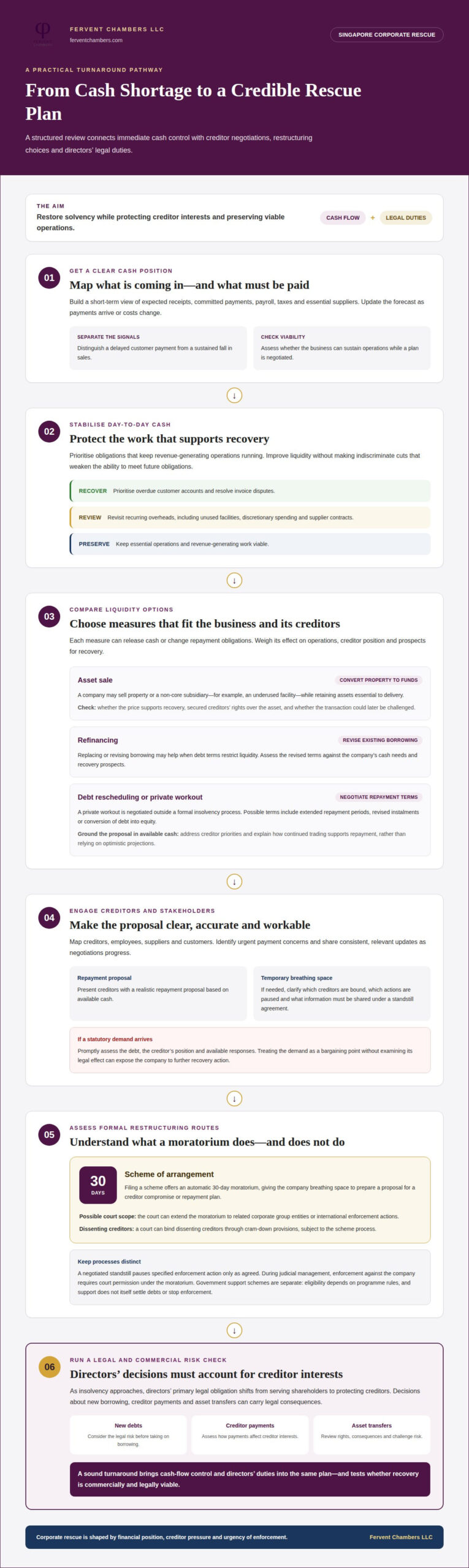
Corporate rescue is a structured effort to restore solvency through operational changes, creditor negotiations or formal restructuring. In Singapore, the right route depends on the company’s financial position, creditor pressure and the urgency of enforcement.
Stakeholder communication and creditor negotiations
Stakeholder communication means giving creditors, employees, suppliers and customers consistent, relevant updates as negotiations progress. Uncertainty can prompt creditors to enforce their rights or suppliers to restrict essential terms. Map the stakeholders, identify urgent payment concerns and present creditors with a realistic repayment proposal or request for temporary breathing space. Clear, accurate updates help preserve trust while the company assesses its options.
Advice for restructuring participants
Restructuring advice addresses the distinct decisions facing directors, practitioners and creditors. Directors must consider creditors’ interests as insolvency approaches, rather than treating shareholder interests as the only priority. Practitioners need to understand their responsibilities in any formal process, while creditors need to assess available enforcement and negotiation choices. Singapore law firms with restructuring and insolvency practices advise these participants; the advice should reflect each party’s legal position and the company’s financial distress.
Government support schemes are separate from creditor restructuring. Eligibility depends on each programme’s rules, and support does not itself settle debts or stop enforcement. The duration and risks of a turnaround depend on creditor action, the process chosen and whether the company can sustain operations while negotiating a plan.
Schemes and creditor moratoriums
A scheme of arrangement is a formal restructuring route through which a company seeks agreement with creditors on a compromise or repayment plan. In Singapore, filing a scheme of arrangement offers an automatic 30-day moratorium, giving the company breathing space to prepare its proposal. The court can extend the moratorium to related corporate group entities or international enforcement actions. A court can also bind dissenting creditors through cram-down provisions, subject to the scheme process.
Enforcement and standstill agreements
Creditor enforcement covers steps to recover debts or realise security. A standstill agreement is a negotiated pause in specified enforcement action. Either can determine whether a company has time to negotiate a restructuring plan. Before relying on a standstill, clarify which creditors are bound, which actions are paused and what information must be shared. During judicial management, enforcement against the company requires court permission under the moratorium, so the applicable process matters.
Asset sales, refinancing, and debt rescheduling
For a Singapore company under financial pressure, restructuring can release cash or change repayment obligations. Assess each measure for its impact on operations, creditors and the prospects of recovery.
Asset sales and refinancing
An asset sale converts company property or a non-core subsidiary into funds; refinancing replaces or revises existing borrowing. These options may help when cash is tied up in assets or debt terms restrict liquidity. For example, a company might sell an underused facility while retaining assets essential to delivery. Before proceeding, assess whether the price supports recovery, whether secured creditors have rights over the asset and whether the transaction could later be challenged.
Debt rescheduling and private workouts
Debt rescheduling changes repayment terms. A private workout is a negotiated arrangement with creditors outside a formal insolvency process. Either may provide breathing space if creditors accept terms grounded in available cash. Negotiations could cover extended repayment periods, revised instalments or conversion of debt into equity. A proposal should address creditor priorities and explain how continued trading supports repayment, rather than rely on optimistic projections.
A statutory demand requires prompt assessment of the debt, the creditor’s position and the available responses. Treating it as a bargaining point without examining its legal effect can expose the company to further recovery action. The company’s discussions with the demanding creditor should therefore form part of its wider restructuring strategy.
To improve liquidity, prioritise overdue customer accounts, resolve invoice disputes and negotiate payment arrangements. Management can also review recurring overheads, such as unused facilities, discretionary spending and supplier contracts. Preserve the operations that generate revenue: indiscriminate cuts may weaken the company’s ability to meet future obligations.
Where asset transfers or creditor negotiations carry legal uncertainty, restructuring and insolvency advice can help assess the proposed action and its consequences.
How do you handle a cash flow shortage?
Cash management means matching incoming funds with essential payments and viable operations. A disciplined review can show whether the pressure is temporary or points towards insolvency.
Cash management and operational control
Start with a short-term cash position: expected receipts, committed payments, payroll, taxes and essential suppliers. Update the forecast as payments arrive or costs change, then prioritise obligations that keep revenue-generating work operating. For example, distinguish a delayed customer payment from a sustained fall in sales. This gives directors a clearer basis for decisions that protect creditor interests.
Stabilising operations and cash flow
Stabilisation aligns day-to-day activity with the cash the business can access. Management can focus staff and inventory on viable products or contracts, pause discretionary spending and address bottlenecks that delay invoicing or delivery. Assess each measure for its effect on customers, suppliers and future income. Cutting a critical input may ease immediate pressure but undermine recovery.
Connect cash needs to realistic operating assumptions. Identify overdue customer receipts, contracts requiring near-term spending and expenses that can be deferred without disrupting delivery. Compare expected inflows with obligations, then revise the plan as collections or trading conditions change. This can distinguish a timing gap from a deeper operational problem, such as persistent revenue decline or rising debt repayments.
When cash cannot support every activity, prioritise according to the company’s commercial position and obligations, not convenience. Consider whether a core service can continue profitably, whether suppliers will maintain essential terms and whether customers are likely to remain engaged. These factors help show whether the business remains viable as a going concern or needs a different restructuring response.
Continuing to trade under pressure can deepen losses if recovery assumptions are unrealistic. If the company cannot meet its obligations and has no workable stabilisation plan, directors may need to consider formal insolvency options, including liquidation. Early assessment frames that decision around current cash, operating viability and creditor interests.
Director duties and wrongful trading risks
Financial distress changes how directors assess commitments, creditor interests and recovery prospects. In Singapore, directors should identify the legal issues before making commitments, avoid taking on new debts without a reasonable prospect of repayment, and consider creditors’ interests as insolvency approaches.
Directors’ duties and potential liability
Directors facing financial distress must give careful attention to creditor interests and the consequences of company decisions. Taking on new debt without a reasonable prospect of repayment may constitute wrongful trading. Payments, asset transfers, redundancies and procurement decisions may also face later scrutiny. Keep a record of how each material decision relates to available cash and a credible recovery plan.
Personal risk for directors
Personal risk may arise when directors’ conduct leads to claims for wrongful trading, fraudulent trading, breach of duty or similar conduct. Exposure is not limited to a single decision: inaccurate statements to staff, lenders or the market may have further legal consequences. For example, a lender’s assessment may be affected if forecasts omit known cash shortfalls. Stakeholder communications should reflect the company’s actual position.
Steps near insolvency
When a Singapore company is insolvent or nearing insolvency, directors should promptly assess cash, debts, creditor action and realistic recovery prospects. Identify the legal issues before making commitments, scrutinise proposed payments and asset transfers, and obtain qualified professional advice for the relevant jurisdictions. These steps help assess whether continued trading supports a viable recovery or risks deepening losses.
Directors should keep accurate records of forecasts, board discussions and the reasons for material decisions. If a cross-border stakeholder is involved, the relevant jurisdictions may affect the legal analysis. Clear records support a consistent account of how the company addressed its obligations and assessed recovery options.
Discuss director duties and restructuring risks before committing the company to further obligations.
Fervent Chambers LLC
Fervent Chambers LLC advises on restructuring and insolvency, corporate and commercial matters, dispute resolution and arbitration. This work can help directors and creditors assess restructuring choices when cash pressure, enforcement concerns or potential liability make a turnaround legally complex. Legal input is particularly relevant before directors incur further debt, agree creditor terms, transfer assets or enter a formal process, as each decision may affect the company and its stakeholders.
Contact Fervent Chambers LLC to discuss the legal issues affecting your company’s turnaround.
Move from financial pressure to a considered decision
Turn the company’s current position into a decision framework: identify immediate legal exposure, determine which actions preserve viable options and assign responsibility for each commitment. Business rescue and turnaround legal advice can help directors assess these choices before creditor discussions or operational decisions create further consequences. The aim is not to preserve every activity at any cost, but to make deliberate decisions based on the company’s circumstances and the interests affected.
Fervent Chambers LLC advises on Restructuring and Insolvency, as well as Dispute Resolution and Arbitration. These services are relevant when a turnaround involves creditor disagreements or formal restructuring. A discussion can clarify the issues requiring attention and the legal pathways available.
Contact Fervent Chambers LLC for advice about your company’s situation, and take the next step with a clearer understanding of its options.
Frequently Asked Questions
How do I revive a dying business?
First assess whether the business’s core activity can generate enough income to sustain operations. Distinguish, for example, a temporary cash delay caused by slow customer payments from a deeper problem, such as contracts that lose money after delivery costs. Then align operational decisions with available cash, assess creditor pressure and identify commitments that may be renegotiated. The goal is a credible recovery path, not simply more borrowing.
How does business rescue work?
Business rescue assesses whether a company can recover through operational change, creditor agreement or formal restructuring. The route depends on its finances, creditor profile and immediate threats. Options may include an informal workout, a proposed scheme of arrangement or judicial management, in which an independent Judicial Manager appointed by the court manages the company. Each route affects control, stakeholder negotiations and how the company’s obligations are addressed.
Preventing a company from being dissolved, what can be done?
Act promptly to understand the company’s financial position and address threats to its continued existence. Depending on the circumstances, directors may explore creditor negotiations, a restructuring proposal, asset sales or an insolvency process intended to preserve value. A moratorium may pause certain creditor action while a plan is prepared, but it cannot replace a viable plan or engagement with affected creditors.
What is a turnaround strategy in business?
A turnaround strategy coordinates actions to restore financial and operational viability. It should link cash needs to value-generating activities, set out realistic creditor proposals and assign responsibility for decisions. For example, a company could prioritise profitable contracts while renegotiating a loss-making supply arrangement. The strategy should account for customers, employees and suppliers, not just short-term savings.
Why does corporate restructuring matter?
Corporate restructuring matters when a company’s debt obligations, operating model and stakeholder commitments no longer fit its financial position. A considered restructuring can provide a framework for changing repayment terms, reorganising operations or reaching a compromise with creditors. It also helps decision-makers assess how proposed changes affect contracts, guarantees, leases and supply arrangements, so the plan addresses the relationships on which continued trading depends.
What does business rescue and turnaround legal advice cover in Singapore?
In Singapore, business rescue and turnaround legal advice can address restructuring routes, creditor negotiations, enforcement pressure and the legal consequences of directors’ decisions. It can also examine how contracts, guarantees and asset transactions affect a proposed recovery, and whether a formal process or negotiated approach better fits the company’s circumstances. This analysis helps directors and creditors understand their positions before taking on commitments, making payments or starting restructuring steps.