




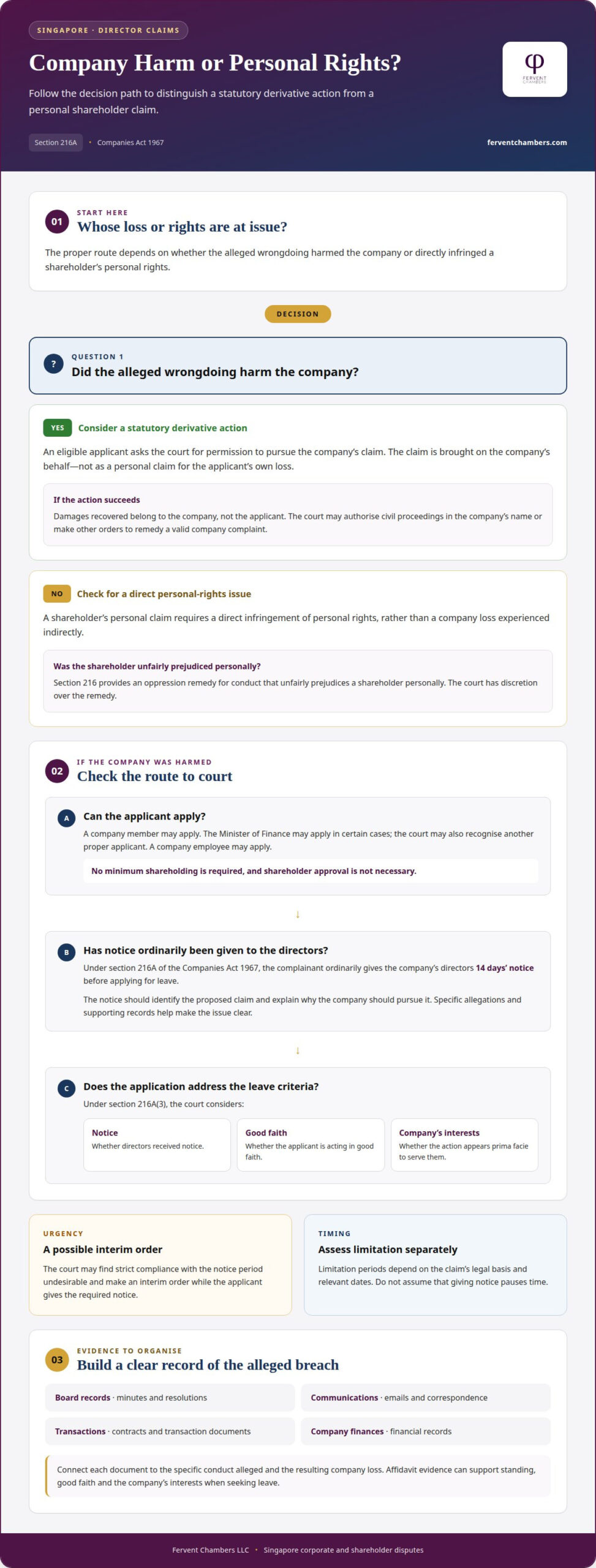
Legal action against a company director in Singapore may take the form of a statutory derivative action when the alleged wrongdoing is against the company: an eligible applicant seeks the court’s permission under section 216A of the Companies Act 1967 to bring proceedings on the company’s behalf. According to the Attorney-General’s Chambers, Singapore, the complainant ordinarily gives the directors 14 days’ notice before applying for leave.
The distinction is decisive: a shareholder’s personal grievance is not automatically a claim belonging to the company. Separately, an act approved through a defective board process may raise questions about compliance with the company’s constitution. The proper route depends on whose rights were infringed and what remedy is sought.
This guide explains what a derivative action does, when directors must be notified, how personal liability may arise, and how an invalid corporate act can affect the relief available. It also distinguishes company losses from shareholder losses, outlining key procedural considerations before advancing a claim.
Key Takeaways
- Identify whether the alleged wrongdoing harmed the company or infringed your personal shareholder rights, since that distinction shapes the appropriate legal route.
- A derivative action seeks to pursue a company’s claim, and the applicant must obtain the court’s permission before proceeding.
- Plan for the ordinary 14-day notice to directors before applying for leave, while considering whether the circumstances call for an interim order.
- Assess the company’s constitution, board approvals and circumstances in which debts were incurred to understand whether corporate acts were valid and whether personal liability may arise.
What is a Derivative Action?
- Identify whose loss the claim addresses. A statutory derivative action lets an eligible applicant seek court permission to pursue a claim for a Singapore-incorporated company. A company member may apply; the Minister of Finance may apply in certain cases, and the court may recognise another proper applicant. Any damages recovered belong to the company, not the applicant.
- Separate corporate wrongdoing from personal oppression. According to Attorney-General’s Chambers, Singapore, section 216 of Singapore’s Companies Act provides an oppression remedy for conduct that unfairly prejudices a shareholder personally. This route may be relevant where, for example, a shareholder faces unfair treatment in company affairs, rather than merely a loss suffered by the company. The court has discretion over the remedy.
- Connect the director’s conduct to a legal claim. Potential claims include breach of fiduciary duties owed to the company, or breach of statutory duties under section 157. Directors must act bona fide in what they consider the company’s best interests. A shareholder’s personal claim requires a direct infringement of personal rights, rather than a corporate wrong better pursued by the company or derivatively.
- Build evidence around specific acts. Relevant material may include board minutes, emails, contracts, financial records, transaction documents and company resolutions. Records showing that a director approved a transaction despite a conflict, for example, may help establish what happened and its effect. A clear chronology should connect each document to the alleged breach and the company’s loss.
- Match the remedy to the complaint. A derivative action seeks relief for the company, while section 216 addresses unfair prejudice to a shareholder personally. For a valid company complaint, a court may authorise civil proceedings in the company’s name or make other orders to remedy it. Identify whether the desired outcome concerns company assets, governance, or personal shareholder rights.
- Consider proportionate alternatives. Mediation may help resolve a shareholder dispute without a trial, but it does not establish director liability. A complaint to ACRA may be relevant to suspected filing or corporate-record issues, but it is not a substitute for a private claim seeking compensation. Litigation also requires evidence, court permission for a statutory derivative action, and careful consideration of the company’s interests.
Notice to directors before applying to court
- Confirm standing before preparing the application. A company member may apply for permission to bring a statutory derivative action. The Minister of Finance may apply in certain cases, and the court may accept another person it considers proper. A company employee may also apply. No minimum shareholding is required, and shareholder approval is not necessary.
- Give notice before seeking leave. According to Attorney-General’s Chambers, Singapore, under section 216A of the Companies Act 1967, a complainant ordinarily must give the company’s directors 14 days’ notice before applying for leave. The notice should identify the proposed claim and explain why the company should pursue it, allowing directors to consider the complaint.
- Make the notice specific and evidence-based. Describe the director’s alleged conduct, the resulting harm to the company, and the documents supporting those claims. Board minutes, transaction records and relevant correspondence can help define the issue. A general accusation may obscure the company’s position and make it harder to show that notice was meaningful.
- Address the statutory leave criteria. Under section 216A(3), the court considers notice to directors, the applicant’s good faith, and whether the action appears prima facie to serve the company’s interests. Explain why the proposed claim belongs to the company, what evidence supports it, and why the applicant is acting for that purpose.
- Account for urgency and limitation periods. A court may find strict compliance with the notice period undesirable and make an interim order while the applicant gives the required notice. Limitation periods depend on the claim’s legal basis and relevant dates. Assess them separately from the notice requirement, and do not assume that giving notice pauses time.
- Prepare for a focused court application. If directors do not pursue the company’s claim, the applicant can seek leave with affidavit evidence supporting standing, good faith, and the company’s interests. Where disputed conduct involves company records or technology transactions, an early legal assessment of the derivative claim can help organise the evidence and procedural position.
Personal liability for company debts contracted without a reasonable expectation of payment
Assess the decision to incur debt separately from the company’s losses: director conduct, creditor exposure and shareholder interests raise distinct issues.
-
Assess Personal Liability for Company Debts
Examine the documents and financial information available when the company incurred each debt. For example, compare supplier contracts, payment schedules, cash-flow forecasts and board records with the company’s ability to meet its obligations at the time. Later insolvency or an unpaid invoice alone does not establish what the director knew when approving the commitment.
Directors owe fiduciary duties to their companies at common law, subject to section 157 of the Companies Act. They must act bona fide in what they consider to be the company’s best interests. Assess whether the director considered the company’s position, the commercial purpose of the debt and the interests affected. Avoid treating a failed business decision as proof of personal liability without identifying the legal basis and evidence connecting the director to the alleged wrongdoing.
-
Distinguish Corporate and Shareholder Losses
Trace who suffered the immediate loss before choosing a claim. If a director’s decision left the company unable to pay a supplier, the company’s loss may differ from a shareholder’s personal loss in share value. Identify the right infringed, who suffered harm and the remedy sought, rather than treating every corporate loss as personal damage.
For example, a reduction in the value of shares following company losses does not, by itself, show that the director infringed a shareholder’s separate rights. Section 216 provides an oppression remedy for conduct unfairly prejudicing a shareholder personally, according to Attorney-General’s Chambers, Singapore. Distinguish that personal complaint from a corporate wrong, and record how the challenged conduct affected the shareholder directly.
- Organise the evidence by decision and consequence. Create a chronology linking each debt, approval and payment default to the relevant records. Separate evidence of the company’s financial position from evidence of the director’s conduct, then explain how each supports the proposed remedy. This helps clarify the distinction between corporate and personal shareholder interests.
Invalid corporate actions that breach a company constitution
- Compare the challenged decision with the constitution. In Nanyang Commercial Management Pte Ltd v Matex International Ltd, [2025] SGHC 190, the Singapore High Court considered whether share issuances had been validly approved. The constitution governed how Matex’s board could approve subscription agreements. Identify the relevant provision, required voting process, quorum and approval record before deciding whether an act breached the company’s governing rules.
- Trace each approval through the records. Matex’s annual general meeting on 28 April 2025 granted a general mandate for share issuances. Only three of six directors signed the written resolution purportedly approving subscription agreements on 11 July 2025. The constitution required written resolutions to pass by a majority of directors, so the resolution was invalid.
- Test whether a later meeting cured the defect. Matex’s board met on 12 July 2025 to ratify the agreements, but the High Court found that meeting lacked a quorum. Any approval obtained there would therefore have been invalid. Review meeting notices, attendance, minutes and voting records; a later resolution does not cure an earlier breach unless it follows the constitution.
- Match the proposed proceedings to the affected rights. Section 39 of the Companies Act 1967 treats a company constitution as a contract between the company and its members, and among the members. A member whose personal rights are directly affected may seek appropriate relief; a corporate wrong may instead support a statutory derivative action brought on the company’s behalf. A derivative action or application cannot be discontinued, settled or dismissed without court approval.
- Preserve evidence and seek a remedy before completion. In Matex, the High Court said it would have granted an injunction preventing completion unless a constitution-compliant board resolution or shareholder approval authorised the agreements. The proposed issuances would have reduced Nanyang Commercial Management Pte Ltd’s stake from 29.86% to 21.22%; the Court also noted the issue was structured below the 15% Catalist Rules threshold requiring shareholder approval. Seek advice on challenging an invalid corporate act before the transaction is completed.
Fervent Chambers
Fervent Chambers LLC can assess the appropriate course when alleged director misconduct raises questions about company rights, shareholder interests or an invalid corporate decision. By examining relevant records, constitutional provisions and proposed remedies, the firm can clarify the legal issues and procedural considerations before action is taken.
The firm’s work in Dispute Resolution, Arbitration, Restructuring and Insolvency, and Corporate and Commercial matters provides a framework for addressing disputes alongside their wider business consequences. This may be relevant when a claim affects governance, ongoing operations, creditor interests or the company’s financial position.
Contact Fervent Chambers LLC to discuss your circumstances and the legal options available.
Make the Next Decision with Clarity
Before taking legal action against a company director in Singapore, define the outcome you need to protect: the company’s commercial position, your own rights, or the integrity of a decision affecting both. That objective can guide which evidence to prioritise, what remedy to pursue and how the dispute may affect ongoing business relationships. A measured assessment also helps distinguish a genuine legal claim from a disagreement over commercial judgment.
Where a dispute has wider implications for governance, operations or creditor interests, consider how each proposed step may affect the company beyond the immediate proceedings. Fervent Chambers LLC’s work in Dispute Resolution, Arbitration, and Restructuring and Insolvency can support a considered approach to complex commercial disputes, with strategy tailored to the circumstances and intended outcome.
Contact Fervent Chambers LLC for guidance on the options available in your circumstances. A clear starting point can help you proceed with greater purpose and confidence.
Frequently Asked Questions
Should I Engage a Lawyer and Why?
Engaging a lawyer can help you assess the claim, evidence and procedural route before acting. A lawyer can distinguish a corporate claim from a shareholder’s personal complaint, identify records needed to support the allegation, and organise the notice and court materials. This is particularly useful when board decisions, company accounts and commercial consequences need to be considered together.
When is a Singapore company director personally liable for company debts or losses?
A director’s personal exposure depends on the legal basis of the claim and the evidence about the conduct in question. For debts, examine whether they were incurred without a reasonable expectation of payment, alongside the financial information and decisions available at the time. The company’s later inability to pay does not, by itself, establish what the director knew when the debt was incurred.
What are directors’ duties under the Singapore Companies Act and common law?
Directors owe fiduciary duties to the company at common law, subject to section 157 of the Companies Act. They must act bona fide in what they consider to be the company’s best interests. In assessing a transaction, relevant records may include declarations of interest, board papers and minutes. These materials can help show how the director approached the decision and whether the company’s interests were considered.
How can shareholders sue a director for breach of fiduciary duty in Singapore?
A shareholder should first establish whether the alleged breach harmed the company or directly infringed personal shareholder rights. For a corporate claim, an eligible applicant can seek court permission to pursue a statutory derivative action, supported by evidence of good faith and the company’s interests. If the complaint concerns unfair personal prejudice, section 216 may offer a distinct route, with remedies directed to the shareholder’s circumstances.
How can a creditor take legal action against a company director in Singapore?
A creditor should identify the legal basis for pursuing a director personally rather than treating the company’s unpaid debt as sufficient on its own. Relevant materials may include the credit agreement, invoices, payment history, financial information available when the debt was incurred, and communications about repayment. The claim should connect the director’s conduct to a recognised legal basis and distinguish it from the company’s contractual obligation.
What is the process, timeline, and cost of suing a company director in Singapore?
The process depends on the claim: a statutory derivative action requires a leave application, while a personal claim follows its own procedural route. A derivative-action leave application may take 2 to 4 months; a substantive claim may take 12 to 24 months to reach trial, or less if settled. Costs depend on evidence volume, legal issues, applications and trial requirements, so they are assessed by reference to the case’s scope.