
Who you notify depends on the breach’s scale and likely harm, but first contain it and assess the risk promptly. Under Singapore’s PDPA, a breach is notifiable if it causes, or is likely to cause, significant harm to an affected individual, or is, or is likely to be, of significant scale. Once your assessment confirms it is notifiable, you must notify the PDPC within three calendar days. Affected individuals must also be notified when significant harm is likely, subject to the Act’s exceptions.
It is understandable to focus first on protecting people whose information may have been exposed, while determining which organisation is responsible for reporting. This guide explains how to handle a data breach in Singapore, from immediate containment and evidence preservation to assessing notification duties and communicating with the right parties.
You’ll also learn how responsibilities differ between an organisation and its data intermediary, what to document during the response, and how a structured review can address the breach’s causes and reduce the risk of recurrence.
Key Takeaways
- Contain the incident promptly, preserve relevant evidence, and record the timing and actions taken so the response can be reconstructed.
- Clarify whether your organisation or a data intermediary holds the reporting responsibility, and establish a clear route for immediate escalation.
- Assess the likely harm and scale of the breach; a breach affecting 500 or more individuals meets the significant-scale notification trigger.
- If the assessment finds the breach notifiable, notify the PDPC within three calendar days, then communicate with affected individuals when required by the PDPA.
- Investigate the root cause and use the findings to strengthen safeguards, response procedures, and future incident readiness.
Containing a breach and recording response details
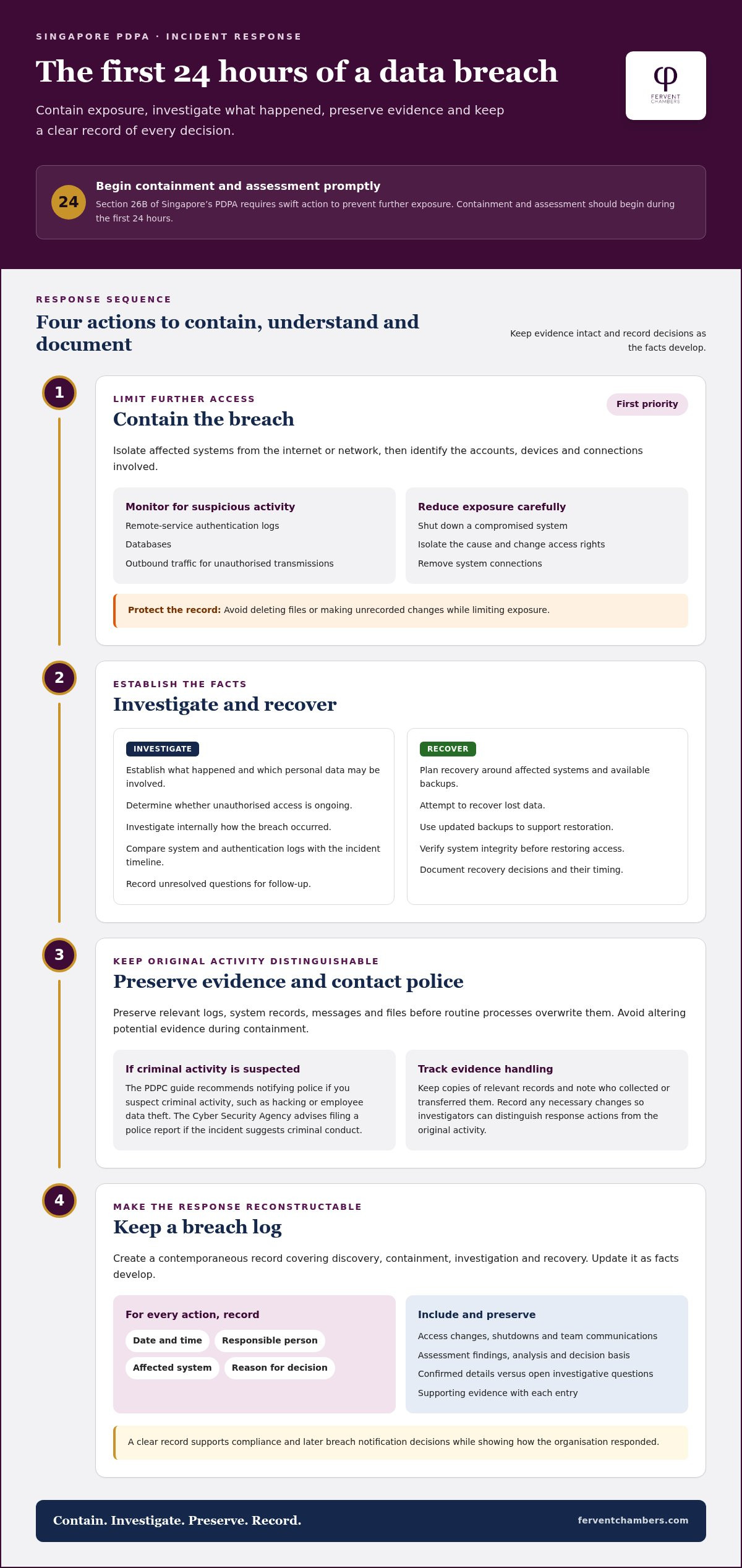
Act immediately when an incident may involve personal data; containment and assessment should begin during the first 24 hours. Section 26B of Singapore’s PDPA requires swift action to prevent further exposure.
-
Contain the breach
Isolate affected systems from the internet or network to limit further access. Singapore’s Cyber Security Agency recommends this step, along with monitoring remote-service authentication logs, databases for suspicious activity, and outbound traffic for unauthorised transmissions.
Next, identify the affected accounts, devices, and connections. The PDPC guide recommends shutting down a compromised system, isolating the cause, changing access rights, and removing system connections. Avoid deleting files or making unrecorded changes while limiting exposure.
-
Investigate and recover
Establish what happened, which personal data may be involved, and whether unauthorised access is ongoing. Singapore’s Cyber Security Agency recommends investigating internally how the breach occurred. Compare system and authentication logs with the incident timeline, and record unresolved questions for follow-up.
Plan recovery around the affected systems and available backups. The PDPC guide recommends attempting to recover lost data, while the Cyber Security Agency recommends maintaining updated backups to support restoration. Verify system integrity before restoring access, and document recovery decisions and their timing.
-
Preserve evidence and contact police
Preserve relevant logs, system records, messages, and files before routine processes overwrite them. The PDPC guide recommends preserving evidence and notifying police if you suspect criminal activity, such as hacking or employee data theft.
If the incident suggests criminal conduct, file a police report, as the Cyber Security Agency advises. Keep copies of relevant records and note who collected or transferred them. Avoid altering potential evidence during containment. Record any necessary changes so investigators can distinguish response actions from the original activity.
-
Keep a breach log
Create a contemporaneous log covering discovery, containment, investigation, and recovery. For every action, record its date and time, the responsible person, the system affected, and the reason for the decision. Include access changes, shutdowns, and communications with relevant teams.
Preserve the assessment findings, analysis, and basis for decisions about the incident. A clear record supports compliance and later breach notification decisions, while showing how the organisation responded. Update the log as facts develop, distinguish confirmed details from open investigative questions, and retain supporting evidence with each entry.
Data controller and data intermediary responsibilities
Assign responsibility early, because the organisation and its data intermediary have distinct roles. A defined incident structure supports assessment, security measures, and decisions under Singapore’s Personal Data Protection Act.
- Identify who controls the affected personal data. Map the information involved to the organisation that determines its purposes and handling, then identify any intermediary processing it on the organisation’s behalf. Record the relevant agreement, systems, and operational contacts. This creates a practical route for sharing facts and coordinating decisions. For organisations deciding how to handle a data breach in Singapore, clarity about these roles helps prevent confusion during response planning.
- Establish immediate escalation from the intermediary. In Singapore, a data intermediary must notify the data controller or public agency immediately after discovering a data breach. Set a direct escalation route and request known details, including the affected service, discovery circumstances, data categories, and actions already taken. The controller can then consolidate information and coordinate the organisation’s assessment without delaying internal decisions.
- Use CARE as an internal response framework. If your organisation uses a CARE framework, apply it as a practical coordination aid, not as a substitute for the Data Protection Act or PDPC guidance. Assign owners for containment, assessment, communication, and recovery, and track how each task relates to the incident. A practical model for how to handle a data breach in Singapore should clarify accountability without obscuring statutory duties.
- Assemble a cross-functional response team. Appoint a coordinator to maintain the incident record and bring together privacy, information security, operations, communications, and senior decision-makers. Include the intermediary’s technical contact when its systems or processing are involved. Give each participant a defined responsibility: security establishes system facts, privacy assesses personal data obligations, and communications prepares consistent updates for relevant internal teams.
- Keep decisions aligned as facts develop. Establish a controlled process for updating the team when new evidence changes the assessment, and record who approved each material decision. The PDPC’s guidance is intended to help organisations identify, prepare for, and manage data breaches, but it is not legally binding. Where responsibility or notification analysis is contested, data protection and privacy advice can help clarify the legal issues and inform the response.
Notifying affected individuals
Singapore’s PDPA distinguishes notification to the PDPC from communication with affected individuals. Apply the harm test to individual notices and assess scale separately for notification to the Commission.
- Identify who may face significant harm. Map the types of personal data involved to the individuals affected, then assess how exposure could affect them. Credit card details may meet the significant-harm trigger. Consider the context of exposure, the sensitivity of the information, and practical risks individuals may face, such as account misuse.
Under section 26D of Singapore’s Personal Data Protection Act 2012, organisations must notify affected individuals about a notifiable breach involving significant harm, subject to the Act’s exceptions. The duty concerns likely harm to people, not merely the number of records or the size of the incident.
- Separate the individual harm test from breach scale. A breach affecting 500 or more individuals meets the significant-scale notification trigger to the PDPC. That threshold does not, by itself, establish that every affected person must receive an individual notice. Assess likely significant harm separately, while maintaining an accurate count of individuals and data categories involved.
For example, an incident involving a large dataset may require notification to the PDPC because of its scale, while individual notices depend on the likely-harm assessment and applicable exceptions. Record the reasoning behind both decisions to keep the distinction clear during the response.
- Time notices in the required sequence. When individual notification is required, notify affected individuals as soon as practicable. Under Singapore’s PDPA, the organisation must notify them at the same time as, or as soon as practicable after, notifying the PDPC. The PDPC generally expects the overall period from discovery to notification to be 30 days.
Section 26D(6) prohibits notifying affected individuals if a law enforcement agency or the PDPC so directs. Section 26D(5) allows an organisation to omit formal individual notification when the breach is unlikely to cause significant harm. Apply these provisions to the established facts and record the basis for any exception.
- Make each notice specific and usable. Explain how and when the breach occurred, which types of personal data were involved, and what the organisation has done to address resulting risks. The PDPC guide recommends including these details. State clearly what affected individuals should do next, such as securing an account if exposure could enable unauthorised access.
Choose a channel based on urgency and the number of individuals affected. The PDPC guide identifies email, telephone calls, letters, and social media as possible methods. For sensitive personal data, the guide recommends notifying individuals immediately. Keep a record of the method, timing, and content.
Singapore PDPA data breach notification criteria
Use the statutory tests to determine whether the incident requires notification, then track each deadline separately. Singapore’s rules distinguish assessment, notification to the PDPC, and communication with affected individuals.
-
Assess notifiable breach thresholds
Determine whether personal data was accessed, collected, used, disclosed, copied, modified, or disposed of without authorisation. Under section 26B of Singapore’s Personal Data Protection Act 2012, a breach is notifiable if it causes, or is likely to cause, significant harm, or is, or is likely to be, of significant scale.
Section 26C provides for determining whether an incident qualifies as a notifiable breach. A breach affecting 500 or more individuals meets the significant-scale trigger. Assess likely harm separately by examining the types of personal data involved and the circumstances of exposure.
Singapore’s framework is not interchangeable with GDPR requirements. Apply Singapore’s own assessment period and notification clock rather than importing another jurisdiction’s process.
-
Check notification deadlines
Complete the assessment of whether the breach is notifiable within 30 calendar days. This is the assessment deadline, not the PDPC notification period. The assessment duty applies to breaches occurring on or after 1 February 2021.
Once the assessment is complete and finds the breach notifiable, notify the PDPC within three calendar days. The three-day clock begins after completing that assessment, not simply when the incident is discovered. The PDPC generally expects the overall period from discovery to notification to be 30 days.
Keep both timelines visible in the breach response record. If facts remain under investigation, document the information considered, the assessment actions taken, and the basis for the decision. This helps distinguish the assessment deadline from the subsequent notification deadline.
-
Notify the PDPC and other stakeholders
Prepare a report explaining how and when the breach occurred, the types of personal data involved, and the measures taken to address resulting risks. The PDPC guide recommends including these details. Set out the known scale, effects, and response actions so the Commission can understand the incident and the organisation’s data protection measures.
Notify affected individuals when the breach is likely to cause significant harm, subject to the PDPA’s exceptions. Keep the individual harm assessment distinct from the significant-scale test. A breach affecting 500 or more individuals meets the scale trigger, but that number alone does not establish the individual notification duty.
A failure to notify can affect future findings by the PDPC. Section 48J empowers the PDPC to impose a financial penalty of up to S$1 million or up to 10% of annual turnover. Individuals can reduce exposure risks through good cyber hygiene, including securing affected accounts and changing compromised credentials.
Reviewing root causes and preventing recurrence
After containment and notification, use the investigation to identify control failures and assign corrective actions. Singapore’s PDPC guide recommends reviewing the cause of the breach and testing whether existing safeguards can prevent a recurrence.
-
Evaluate the post-breach response
Conduct an internal investigation, as Singapore’s Cyber Security Agency recommends, to establish how the incident occurred. Trace the compromised account, system, or process, and distinguish the initial weakness from later control failures. For example, an exposed account may point to access-management gaps, while unauthorised data transfer may call for a review of outbound traffic controls.
Compare the response with the organisation’s incident plan. Singapore organisations should document assessment findings, analysis, and the basis for decisions. Record which actions contained the breach, where escalation slowed, and whether teams had timely access to reliable information.
Review the cause against existing protection measures, as the PDPC guide recommends. Identify whether a safeguard was absent, misconfigured, or not followed, and assign an owner to each corrective action. Avoid ending the investigation with a general conclusion such as “human error” without identifying the process or control that failed.
Test the response framework through a tabletop exercise at least annually. The Cyber Security Agency recommends these exercises. Use a realistic scenario, such as a compromised account or exposed database, to test escalation, decision-making, and recovery coordination.
-
Remediate and prevent recurrence
Implement corrective measures tied to the findings, then record who owns each measure and how completion will be assessed. The Cyber Security Agency recommends regularly updating systems, software, and applications to patch known vulnerabilities. Prioritise systems connected to the breach’s root cause rather than applying unrelated changes.
Reduce unnecessary personal data collection and storage, following Cyber Security Agency guidance. Where collection is necessary, encrypt personal data before storing it in a database. Review retention and destruction practices so information no longer needed is removed through an established process.
Strengthen access security by requiring strong passwords and multi-factor authentication for customer accounts. Review user accounts periodically, remove accounts no longer needed, and restrict privileged access to authorised personnel, particularly for sensitive systems. These measures address common pathways identified during investigations.
Maintain updated backups and a data security plan suited to the organisation’s context. The Cyber Security Agency recommends a plan covering sensitive-data use and destruction. For a technology-related incident with complex commercial or legal implications, seek support for technology-related matters as corrective actions are assessed.
Fervent Chambers: Dispute Resolution
Fervent Chambers LLC can assist when a data breach develops into a commercial dispute involving a business partner, supplier, or other organisation. After immediate containment and notification decisions, disagreements may arise over contractual responsibilities, loss, or the steps needed to resolve the matter.
Fervent Chambers LLC and its Dispute Resolution offering addresses commercial disputes, while Arbitration may be relevant when parties need to resolve a dispute through that process. Corporate and Commercial matters may also be relevant when a breach affects business arrangements or contractual obligations. The appropriate path depends on the dispute and the parties’ agreements, not on the technical incident alone.
If a breach has led to a commercial dispute, contact Fervent Chambers LLC to discuss the matter.
Turn response decisions into lasting resilience
A data breach can affect commercial relationships long after systems are restored. The next step is to turn incident findings into clear governance, accountable ownership, and durable safeguards, so future decisions reflect what the organisation has learned.
Understanding how to handle a data breach in Singapore also means recognising when the incident has become a wider legal or business dispute. Fervent Chambers’ Dispute Resolution and Arbitration offerings may be relevant when disagreements arise between organisations or contractual parties. If the breach contributes to financial distress or threatens business continuity, its Restructuring and Insolvency offering may address related challenges.
Consider obtaining legal advice when contractual responsibilities, business relationships, or organisational viability are affected. Contact Fervent Chambers for advice on the issues arising from your organisation’s circumstances. A deliberate next step can help place the response on a clearer footing and support informed decisions ahead.
Frequently Asked Questions
Who to Notify?
Notify the PDPC when your assessment finds a notifiable breach, and notify affected individuals when significant harm is likely, subject to statutory exceptions. If a data intermediary discovers an incident, it should promptly inform the organisation or public agency involved. If hacking, employee data theft, or other suspected criminal activity is involved, preserve relevant evidence and contact the police. Match each recipient to the reason for notification, and record who in your organisation is responsible for communicating with them.
When Does the Three-Day Clock Start?
The three-calendar-day period begins when the organisation completes its assessment and determines that the breach is notifiable. It does not start automatically on discovery. For example, if an investigation initially leaves the affected data or likely harm unclear, the assessment establishes whether notification is required. Keep a dated record of when the assessment was completed and the decision reached, so you can calculate the applicable reporting period from that point.
Who must be notified after a data breach in Singapore, and when must affected individuals be informed?
The organisation must notify the PDPC when the breach meets a notifiable threshold, and affected individuals when significant harm is likely, subject to the PDPA’s exceptions. Notify individuals at the same time as, or as soon as practicable after, notifying the PDPC. Do not send individual notices if a law enforcement agency or the PDPC directs otherwise. A data intermediary that discovers a breach must immediately alert its data controller or public agency.
How do organisations report a data breach to the PDPC in Singapore?
Organisations should notify the PDPC after determining that an incident is notifiable, providing information that explains the event and response. Prepare a coherent account of how and when it occurred, the personal data involved, the people affected, and the actions taken to address risks. Ensure the assessment and supporting facts are internally consistent, then retain a record of the submitted notification and the organisation’s decisions.
What immediate steps should a Singapore organisation take after discovering a data breach?
First restrict further access to affected systems, then preserve relevant records and establish what may have been exposed. Assign an incident lead to coordinate technical, privacy, and operational teams, including any data intermediary involved. Record decisions as they are made rather than relying on later recollection. If the incident suggests hacking or employee data theft, preserve evidence and contact the police. Keep recovery measures aligned with the known risks to affected individuals.
What information should a Singapore data breach notification include?
Explain how and when the breach occurred, identify the types of personal data involved, and describe the organisation’s response to resulting risks. Give affected individuals clear, relevant information about the exposure and steps they can take, such as securing an account if account details were involved. Tailor the level and channel of communication to urgency and the number of recipients. Keep the notification factual, distinguish established findings from ongoing response actions, and avoid unnecessary personal data.