




A Singapore address does not place a business beyond the GDPR. GDPR compliance for a Singapore business may be required if it offers goods or services to people in the EU or monitors their behaviour there, even without an EU establishment. The key issue is the organisation’s activities involving people in the EU, not simply its location.
It is understandable to assume that complying with Singapore’s PDPA provides sufficient protection. The two regimes share important aims, but differ in scope and requirements. Meeting one does not automatically satisfy the other.
This article explains when the GDPR may apply to a Singapore business, how its rules differ from the PDPA, and what consent, policies and records may involve. It also looks at the documentation that supports accountable data handling, so you can identify where obligations begin and which practical questions to address.
Key Takeaways
- Separate consent from other lawful grounds for processing, and ensure people can withdraw consent through a clear process.
- Compare the GDPR and Singapore’s PDPA requirement by requirement; compliance with one regime does not automatically meet the other.
- Understand how breach reporting duties and certification questions differ, and what records help demonstrate a sound response.
- Use policies, processing records and risk assessments to make data handling practices clearer and more accountable.
Consent and withdrawal of consent
Consent is not the only basis for processing personal data under Singapore’s PDPA. Certain deemed-consent scenarios apply, including where consent may be implied through reasonable expectations. An organisation should identify the applicable basis before collecting data, rather than treating silence as approval. Individuals should be able to withdraw consent to the organisation’s use of their personal data.
The GDPR recognises six legal bases for processing personal data: consent, contractual necessity, legal obligations, vital interests, public interests and legitimate interests. Consent is one basis, not a universal requirement. An organisation should identify and document the basis for each processing activity. Unlike Singapore’s deemed-consent provisions, the GDPR does not provide for deemed consent. When an organisation relies on consent, it must be explicit, freely given, informed and specific, with clear records kept.
Consent must match the stated purpose. When collecting personal data, explain why it is needed and obtain consent if that is the chosen basis. For example, an online retailer collecting an email address for order updates should distinguish that use from sending promotional messages. Clear notices and purpose-specific records help show what individuals agreed to.
Withdrawal should be practical, not merely mentioned in policy language. Under the GDPR, individuals may withdraw consent at any time, and organisations should provide simple ways to do so without penalising them. A person might use an account setting or a clear request channel. The organisation can record the original notice, legal basis, consent and withdrawal request. Staff should promptly route requests to relevant systems. These records show how processes changed after withdrawal and support personal data protection.
Differences between the Singapore PDPA and EU GDPR
Singapore’s Personal Data Protection Act was enacted in 2012, and the Personal Data Protection Commission (PDPC) enforces it. The PDPA generally applies to organisations operating in Singapore. Companies acting on behalf of Singapore public agencies are exempt from Parts III to VI. By contrast, GDPR Article 3 covers organisations established in the EU and certain organisations without an EU presence.
A Singapore business may fall within the GDPR’s scope if it offers goods or services to people in the EU or monitors their behaviour there. The key issue is the activity, not simply whether the business processes an EU citizen’s data. For example, using an EU country’s language, local currency and shipping options may indicate that a Singapore company is targeting that market. PDPA compliance alone does not establish GDPR compliance.
For processors and vendors, map which parties handle personal data, their roles, and any transfers beyond the EU. Article 44 sets the general principle for transfers to third countries; Standard Contractual Clauses are one safeguard for restricted transfers. Singapore’s PDPA separately requires overseas recipients to provide protection comparable to the Act. A vendor register can help employees implement proper controls and track digital data flows.
There is no single compliance cost for every small or medium-sized Singapore business. The work depends on factors such as data volume, processing complexity, vendor arrangements and the measures needed to meet each regulation.
Enforcement exposure also differs. For major GDPR infractions, fines may reach 4% of the organisation’s total worldwide annual turnover for the preceding financial year. For organisations with annual turnover exceeding SGD 10 million, the PDPA maximum is 10% of annual turnover in Singapore or SGD 1 million, whichever is higher. The applicable framework depends on the organisation’s activities and the relevant breach or violation.
When cross-border processing or vendor arrangements create uncertainty, cross-border data protection analysis can help clarify the relevant obligations and support a considered compliance approach.
Is obtaining GDPR certification compulsory?
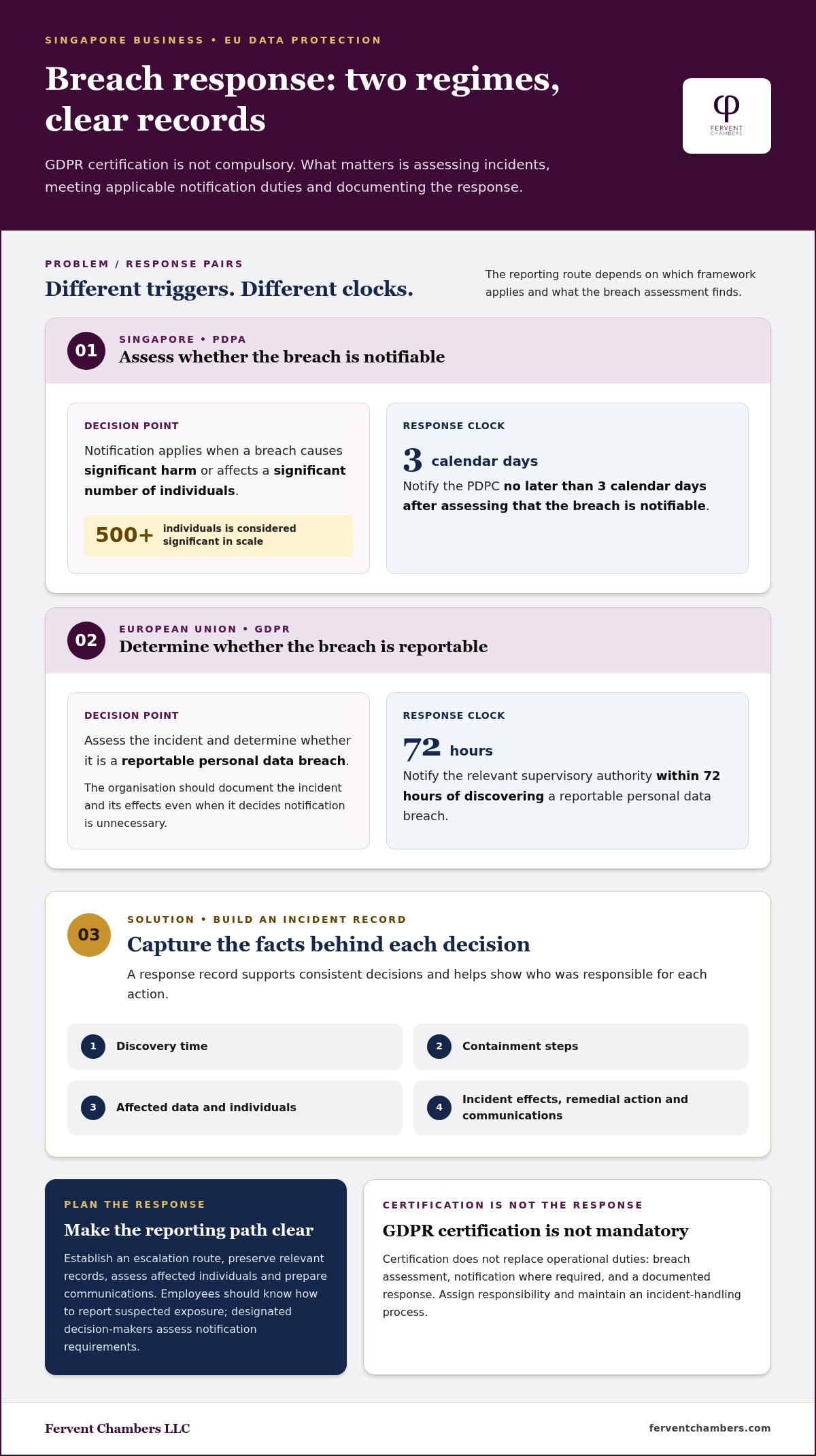
GDPR certification is not mandatory for businesses handling EU residents’ data. Certification does not replace operational duties, including breach assessment, notification and documented response. A Singapore organisation should assign responsibility and maintain a process for handling data protection incidents.
Under Singapore’s PDPA, notify the PDPC no later than three calendar days after assessing that a breach is notifiable. Notification applies when a breach causes significant harm or affects a significant number of individuals. A breach involving personal data of 500 or more individuals is considered significant in scale. For example, an exposed customer spreadsheet may require assessment of the information involved, affected people, and likely harm.
The GDPR requires notification to the relevant supervisory authority within 72 hours of discovering a reportable personal data breach. The organisation should document the incident, its effects, and remedial action, even where it determines notification is unnecessary. A response record can capture discovery time, containment steps, affected data, and communications. These details support consistent decision-making and show who was responsible for each action.
For transfers of personal data from the EU to Singapore, the GDPR restricts transfers to countries outside the EU. Cross-border data transfers may require appropriate safeguards. Standard Contractual Clauses may provide one safeguard; organisations can also conduct a data transfer impact assessment. Singapore’s PDPA separately requires comparable protection when personal data leaves Singapore.
Response planning should connect notification duties with practical steps. A Singapore business could establish an escalation route, preserve relevant records, assess affected individuals and prepare communications. Employees should know how to report suspected exposure, while designated decision-makers assess notification requirements. These steps help determine whether an event is a notifiable breach under each data protection act. The assessment should consider the data involved, potential harm, affected individuals and applicable jurisdiction. An incident log records decisions and supports later review of policies and controls.
Data protection policies and documentation
For a Singapore organisation subject to the GDPR, documentation turns written commitments into evidence of actual data protection practices. Article 5(2) makes a controller responsible for, and able to demonstrate, compliance with the data protection principles. A policy alone is not enough; records should reflect how employees and each provider handle personal data in practice.
A processing register can show what information the organisation collects, why it processes it, who can access it and where it goes. Record the business function, data categories, purpose, recipient, retention approach and relevant safeguards. For example, customer support may involve account details, a support provider and access by regional teams. Comparing the register with operational systems can reveal changes that policies need to address.
Assess the existing privacy framework against both Singapore’s PDPA and GDPR requirements. A comparison can reveal, for example, where a policy addresses access requests but omits a GDPR right, or where a vendor process fails to document international transfers. Data protection policies should assign responsibility, explain internal escalation and give employees practical handling procedures. Keep approval dates and revision histories so the organisation can trace how its controls have developed.
Risk assessment adds further detail. A Data Protection Impact Assessment can help identify risks when processing sensitive personal data, and records should explain the assessment and resulting safeguards. Appointing a GDPR DPO is required in specified circumstances, including public bodies, regular monitoring of people or large-scale handling of sensitive data. The role’s remit should reflect actual processing and reporting lines.
For a Singapore business, coherent documentation brings legal obligations and daily operations into alignment. Seek legal guidance on data protection policies when reviewing cross-border processing, internal accountability, or gaps between Singaporean and European requirements.
Fervent Chambers: Dispute Resolution
Fervent Chambers LLC assists businesses with commercial disputes involving cross-border data handling, vendor relationships or compliance commitments. If a disagreement over contractual responsibilities escalates, its Dispute Resolution practice can help address it. Arbitration may be relevant when the parties’ agreement provides for that process.
These issues can intersect with broader commercial arrangements, including service agreements and regional operations. Fervent Chambers LLC also handles Corporate and Commercial matters, helping businesses address related contractual questions alongside a dispute. The right focus depends on the dispute’s subject, the governing agreement and the resolution mechanism the parties adopted.
If a cross-border commercial dispute requires legal attention, contact Fervent Chambers LLC or visit ferventchambers.com.
Put cross-border obligations into a clear business framework
A sound approach to GDPR compliance for a Singapore business should go beyond internal policies. Align data responsibilities with commercial agreements, vendor relationships and the organisation’s wider risk position. Clear accountability helps decision-makers address emerging issues before they disrupt operations or develop into formal disputes.
When disagreements arise over contractual responsibilities or commercial exposure, Fervent Chambers offers Dispute Resolution and Arbitration. Its Restructuring and Insolvency practice may also be relevant when financial distress complicates an organisation’s obligations or operations. The appropriate legal focus depends on the dispute and its commercial context.
A considered next step is to examine how data commitments interact with the agreements and business structures supporting regional activity. This review can clarify where responsibilities lie and how unresolved issues may be addressed, rather than treating compliance as a standalone exercise.
Discuss your next steps with Fervent Chambers, and move forward with greater clarity in your cross-border business decisions.
Frequently Asked Questions
Is the GDPR applicable in Singapore?
Yes. A Singapore business may fall within the GDPR’s scope through its activities involving people in the EU, even if it has no EU office. For example, a business directing an online service to EU users may need to assess its GDPR obligations. To determine GDPR compliance, a Singapore business should compare its customers, digital services and monitoring activities with the Regulation’s territorial scope.
Who Must Comply with the GDPR?
Organisations established in the EU must comply when processing personal data within the Regulation’s scope. Certain organisations outside the EU must also comply if they offer goods or services to people in the EU or monitor behaviour there. For example, a Singapore software company analysing EU users’ online activity should assess its role and processing operations, rather than relying solely on its place of incorporation.
Who is the GDPR Enforced By?
Data protection supervisory authorities enforce the GDPR, while Singapore’s Personal Data Protection Commission enforces the PDPA. A company operating across EU markets should identify which authority may oversee its processing and where relevant decisions or complaints could arise. This helps direct internal escalation and regulatory communications to the appropriate body, rather than treating the PDPC as the enforcement authority for EU GDPR matters.
How Should Companies Improve their Compliance for the Future?
Companies can strengthen compliance by making privacy reviews part of business changes, rather than treating them as periodic paperwork. Before launching a product feature, record the personal data it uses, its purpose, and any new vendors or international transfers. Then update employee guidance and operational records to reflect the change. Regularly reviewing systems, contracts and incident procedures helps keep controls aligned with actual practices.
What is PDPA?
Singapore’s Personal Data Protection Act, or PDPA, is the country’s principal legislation governing personal data protection for organisations. Enacted in 2012, it is enforced by the Personal Data Protection Commission. For example, a Singapore retailer managing customer accounts must consider the Act when handling personal information. The PDPA also requires organisations to designate one or more individuals responsible for ensuring compliance.
What is the General Data Protection Regulation (GDPR)?
The General Data Protection Regulation is the EU’s data protection and privacy regulation. It entered into force on 25 May 2018, replacing the earlier European Data Protection Directive as the main EU framework. It regulates the processing of personal data and provides rights for individuals, including access, rectification, erasure, and portability, subject to applicable conditions. Its scope can extend to organisations operating outside the European Union.