


A construction dispute need not begin with a courtroom strategy. In Singapore, parties may pursue private negotiation, mediation, adjudication under the Security of Payment Act, arbitration or litigation. The right route depends on the contract, the claim and the project’s circumstances. A construction dispute lawyer in Singapore can assess these factors and advise on a proportionate approach.
Cost, delay and uncertainty are understandable concerns when a disagreement threatens project progress or payment. Early legal advice can clarify contractual rights, help preserve relevant records and assess whether a process outside court may be appropriate.
This article explains how construction dispute lawyers advise on project disputes, support adjudication and assist with negotiation, mediation and other forms of dispute resolution. It also outlines what to prepare before seeking advice and how to assess the legal support a construction matter needs.
Key Takeaways
- Compare negotiation, mediation, adjudication, arbitration and litigation against the contract, the claim and the project’s priorities before choosing a route.
- Clarify how the dispute arose, what contractual obligations are involved and what outcome would protect the project’s commercial position.
- Assess a lawyer’s construction-law experience, procedural knowledge and ability to connect legal strategy with project realities.
- Organise the contract, project correspondence, payment records and evidence of defects or delays to make an initial legal assessment more focused.
Adjudication, mediation and interparty negotiation
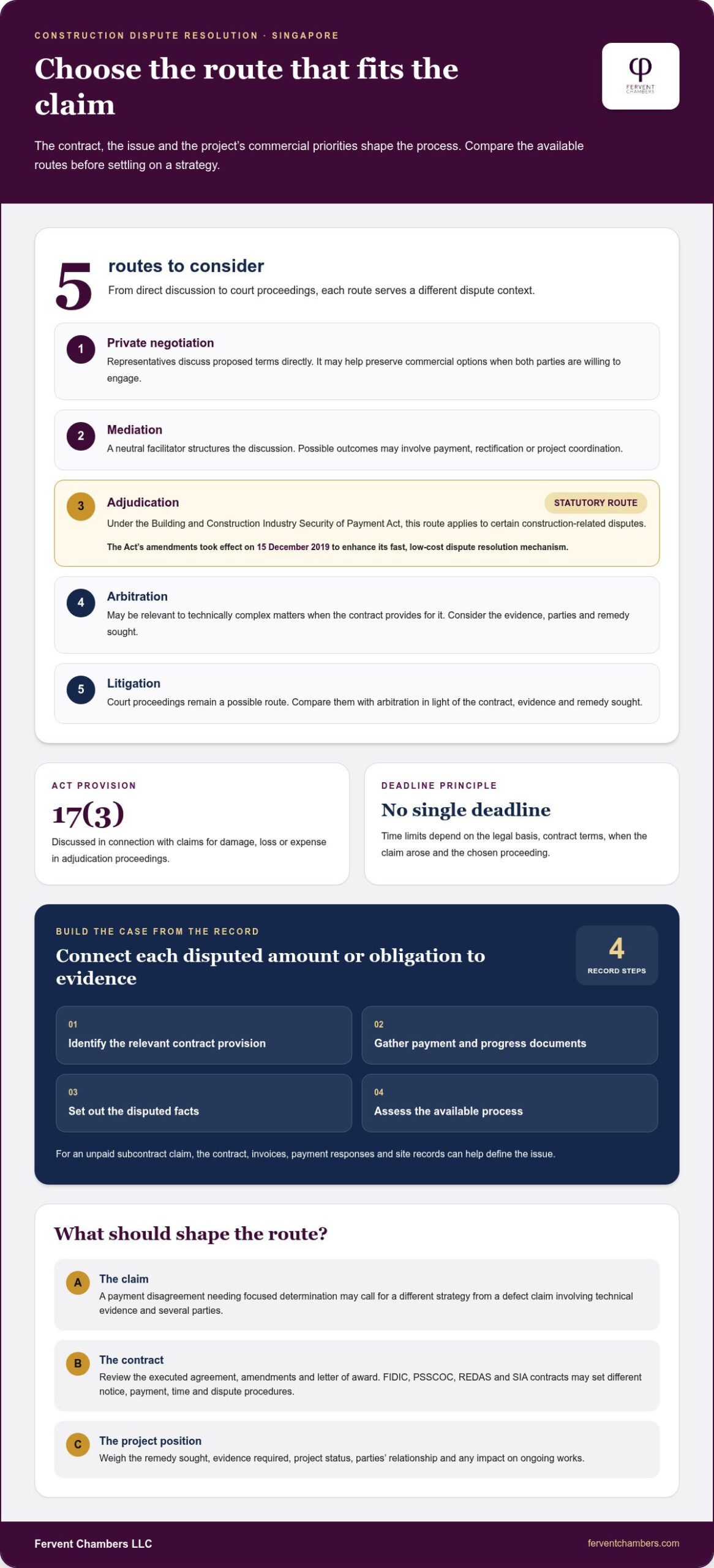
Singapore construction disputes may proceed through private negotiation, mediation, adjudication, arbitration or litigation. The suitable route depends on the contract, the issue and the project’s commercial priorities. A payment disagreement requiring a focused determination, for example, may call for a different strategy from a defect claim involving technical evidence and several parties.
Adjudication under the Building and Construction Industry Security of Payment Act provides a statutory route for certain construction-related disputes. Amendments to the Act took effect on 15 December 2019 to enhance its fast and low-cost dispute resolution mechanism. Section 17(3) is discussed in connection with claims for damage, loss or expense in adjudication proceedings. A construction dispute lawyer in Singapore can assess the claim, relevant records and procedural steps before advising on this route.
Link each disputed amount or obligation to supporting records. Identify the relevant contract provision, gather payment and progress documents, set out the disputed facts, then assess the available process. For a subcontractor’s unpaid claim, the contract, invoices, payment responses and site records can help define the issue. Clear documentation also supports negotiation, mediation or adjudication.
Negotiation and mediation can preserve commercial options when the parties are willing to engage. In negotiation, representatives discuss proposed terms directly; mediation adds a neutral facilitator to structure the discussion. Developers and contractors may explore outcomes involving payment, rectification or project coordination, while retaining arbitration or litigation as possible routes if they do not reach agreement.
Time limits depend on the legal basis, contract terms, when the claim arose and the chosen proceeding. No single deadline applies to every construction claim or court proceeding in Singapore. Identify relevant dates and procedural requirements promptly.
International arbitration may be relevant to technically complex matters when the contract provides for it. Compare this route with court proceedings, taking account of the evidence, parties and remedy sought. Early advice can help align the process with the project’s practical needs.
Construction dispute resolution
Construction claims commonly arise when challenging site conditions lead to unforeseen changes or a party fails to meet contractual obligations. A delay claim, for example, should identify the affected work, the relevant contract requirement and the event said to have caused the delay. Match each allegation to dated project records and the applicable contract clause.
Contract form matters in Singapore. FIDIC, PSSCOC, REDAS and SIA contracts may set out different notice, payment, time and dispute procedures. Review the executed agreement, amendments and letter of award together, then map each claim to the relevant clauses. This helps prevent the strategy from overlooking a contractual step or treating distinct obligations as interchangeable.
A dispute strategy should account for the remedy sought, evidence required, project status and parties’ relationship. A security of payment issue may call for a different approach from a defect claim requiring technical assessment. For each claim, record the outcome sought, supporting documents, contractual response deadlines and any impact on ongoing works. This gives negotiation, adjudication, arbitration or litigation a clear commercial purpose.
Singapore’s Covid-19 (Temporary Measures) Act 2020 included Parts 8A and 8B, which provided statutory extensions of time and cost-sharing for construction contracts. Their relevance depends on the facts and applicable legal framework. Limitation analysis also requires attention: the Singapore construction-contract case Management Corporation Strata Title Plan No 4099 v KTP Consultants Pte Ltd was reported at [2024] 1 SLR 1226.
For technically complex disputes, the Singapore International Commercial Court established a technology, infrastructure and construction list to manage such cases. Where parties or project obligations cross a border, assess the contract’s dispute clause, governing law and selected forum before choosing arbitration or court proceedings. A structured construction dispute resolution assessment can help align the process with the claims, evidence and project priorities.
How do I choose a construction dispute lawyer in Singapore?
Match legal experience to the dispute, rather than relying on broad commercial credentials alone. A delay claim under a FIDIC contract may need different analysis from defects under an SIA contract. A construction dispute lawyer in Singapore should explain how the contract terms, project records and desired remedy shape the proposed strategy.
The Singapore Academy of Law’s Specialist Accreditation Scheme includes Building and Construction Law. Specialist accreditation can be one useful indicator, alongside relevant case experience and familiarity with construction procedures. Consider whether a construction dispute lawyer in Singapore can address adjudication, arbitration and litigation, and explain why one route may better suit the project.
- Contract knowledge: Look for experience with forms such as FIDIC, PSSCOC, REDAS or SIA contracts.
- Dispute fit: Consider experience relevant to your issue, such as payment, delay, defects or contractual non-performance.
- Practical strategy: Assess whether the proposed approach connects the evidence, remedy and project impact.
Ask how the legal analysis would address a specific issue. For a delay assessment, the analysis should distinguish the contractual obligation, the event affecting progress and the records supporting causation. For a defect claim, the lawyer should identify the disputed work, relevant contractual requirements and evidence needed to explain the alleged deficiency.
Assess communication and commercial judgment alongside technical knowledge. A developer managing ongoing works may need a strategy that addresses the claim while considering project relationships and operational decisions. The lawyer should explain the process in clear stages, identify key decisions and show how documentation supports the chosen position.
Compare the proposed legal work with the dispute’s complexity, parties and forum. An international arbitration clause, for example, changes the procedural context from a court claim. A considered assessment should identify the governing contract terms, available evidence and outcome sought, then set out a coherent path to resolve the matter.
How do I choose a lawyer for a construction dispute?
Match legal experience to the dispute, rather than relying on broad commercial credentials alone. A delay claim under a FIDIC contract may need different analysis from defects under an SIA contract. A construction dispute lawyer in Singapore should explain how the contract terms, project records and desired remedy shape the proposed strategy.
The Singapore Academy of Law’s Specialist Accreditation Scheme includes Building and Construction Law. Specialist accreditation can be one useful indicator, alongside relevant case experience and familiarity with construction procedures. Consider whether a construction dispute lawyer in Singapore can address adjudication, arbitration and litigation, and explain why one route may better suit the project.
- Contract knowledge: Look for experience with forms such as FIDIC, PSSCOC, REDAS or SIA contracts.
- Dispute fit: Consider experience relevant to your issue, such as payment, delay, defects or contractual non-performance.
- Practical strategy: Assess whether the proposed approach connects the evidence, remedy and project impact.
Ask how the legal analysis would address a specific issue. For a delay assessment, the analysis should distinguish the contractual obligation, the event affecting progress and the records supporting causation. For a defect claim, the lawyer should identify the disputed work, relevant contractual requirements and evidence needed to explain the alleged deficiency.
Assess communication and commercial judgment alongside technical knowledge. A developer managing ongoing works may need a strategy that addresses the claim while considering project relationships and operational decisions. The lawyer should explain the process in clear stages, identify key decisions and show how documentation supports the chosen position.
Compare the proposed legal work with the dispute’s complexity, parties and forum. An international arbitration clause, for example, changes the procedural context from a court claim. A considered assessment should identify the governing contract terms, available evidence and outcome sought, then set out a coherent path to resolve the matter.
Fervent Chambers: Dispute Resolution
Fervent Chambers can assist when a construction delay, defect or payment disagreement requires a structured legal assessment. Its dispute resolution work can help parties evaluate contractual positions, organise claims and consider suitable routes, including negotiation, adjudication, litigation or arbitration where relevant.
Early advice may help when project records present competing accounts, a contractual notice needs attention or ongoing works make the dispute commercially sensitive. Where a contract provides for arbitration, Fervent Chambers advises on that process. Corporate and commercial matters may also intersect with a project dispute. If financial distress affects a project party, restructuring and insolvency issues may be relevant to the wider assessment.
To discuss a construction dispute, contact Fervent Chambers or visit ferventchambers.com.
Set a Clear Course for the Project Ahead
A live construction dispute can affect more than the immediate claim. It may shape project decisions, commercial relationships and the organisation’s ability to complete ongoing work. Before taking the next step, identify who has authority to make decisions, which operational choices cannot wait and how proposed legal action may affect them. This helps align the dispute strategy with the project’s wider obligations.
Engaging a construction dispute lawyer in Singapore can help clarify the legal position while keeping commercial considerations in view. Fervent Chambers offers Dispute Resolution and Arbitration. Its Restructuring and Insolvency practice may be relevant where financial distress complicates a project dispute.
For a considered discussion of your matter and its practical implications, contact Fervent Chambers. A clear next step can help you approach the project’s challenges with greater direction and confidence.
Frequently Asked Questions
What does a lawyer handling construction disputes in Singapore do?
A construction dispute lawyer in Singapore assesses contractual rights, claims and evidence, then advises on a suitable resolution strategy. A contractor disputing responsibility for rectification, for example, may need to connect contract terms with inspection records and correspondence. Depending on the dispute and process, a lawyer can also prepare submissions, represent a party in adjudication, arbitration or litigation, and assist with settlement discussions.
Which Singapore law firms specialise in construction disputes?
Fervent Chambers LLC handles complex commercial disputes and offers Construction, Dispute Resolution and Arbitration. A construction dispute lawyer in Singapore should explain how relevant experience applies to the issue, whether it concerns payment, delay, defects or another contractual matter. Consider whether the proposed advice addresses both the legal questions and the project’s commercial context, not just procedural steps.
What construction disputes can be resolved through Singapore’s adjudication process under the SOP Act?
The Building and Construction Industry Security of Payment Act provides for adjudication of construction-related matters within its scope, particularly payment disputes. For example, a disagreement over a payment claim may turn on the contract, claim documents and response. Section 17(3) is discussed in connection with claims for damage, loss or expense in adjudication proceedings, making the basis and supporting material for each claimed amount important.
What are the deadlines and steps for adjudication under Singapore’s SOP Act?
The Act’s adjudication process has a statutory timetable, making the dates on payment claims and responses important. Start by reviewing the contract and relevant payment documents. Establish the applicable procedural dates, prepare the adjudication application, and organise supporting evidence and submissions. As the deadline depends on the procedural stage, a construction dispute lawyer in Singapore can assess the recorded dates against the applicable process.
How are construction disputes handled through arbitration or litigation in Singapore?
Arbitration follows the parties’ contract and applicable arbitration procedure, while litigation puts the dispute before a court. The forum affects how the claim is presented and determined. Parties typically organise their pleaded positions, project documents and witness evidence around the issues in dispute. A delay claim, for example, may require a chronology showing how particular events relate to contractual obligations and the alleged impact on the works.
What risks and costs should I consider before starting a construction dispute in Singapore?
Consider cost, delay and uncertainty, as well as the effect of the dispute on ongoing works, project relationships and commercial priorities. Compare negotiation, mediation, adjudication, arbitration and litigation. Adjudication under the Security of Payment Act is described as a fast, low-cost route for certain disputes.