



Who bears the loss is not, by itself, the answer to who may sue. In a Singapore carriage of goods dispute, a lawful holder of a bill of lading receives rights of suit under section 2(1) of Singapore’s Bills of Lading Act as if they had been a party to the bill. The contract and the way the bill’s rights have passed therefore matter when identifying the proper claimant.
That distinction can shape a cargo claim from the outset, especially when goods are damaged, lost or misdelivered and several parties have an interest in the shipment. Reviewing the bill of lading is a practical first step, but it is only part of the analysis.
This article explains who may bring a claim, how bill-of-lading rights work, and how carrier liability limits and jurisdiction or arbitration clauses can affect the path to resolution. It also outlines Singapore’s sea-carriage framework and how the governing rules relate to the claimant, the contract and the dispute forum.
Key Takeaways
- Identify the governing carriage regime and bill terms before assessing recoverable cargo losses, because liability limits and exclusions can affect the claim.
- Read the jurisdiction and arbitration clauses closely; their wording can determine where the dispute proceeds and whether court action may be stayed.
- Trace who holds the bill of lading and how rights passed, as this can establish which party is entitled to bring the cargo claim.
- Fervent Chambers LLC offers Dispute Resolution and Arbitration for parties assessing a cargo claim, responding to a claim or determining the appropriate forum.
Carrier liability limits and consequential losses
In Singapore, the governing carriage terms shape liability, available defences and recoverable loss. The Hague-Visby Rules address carrier limits and exclusions under Article IV, rule 2.
Shipowners’ Limitation of Liability
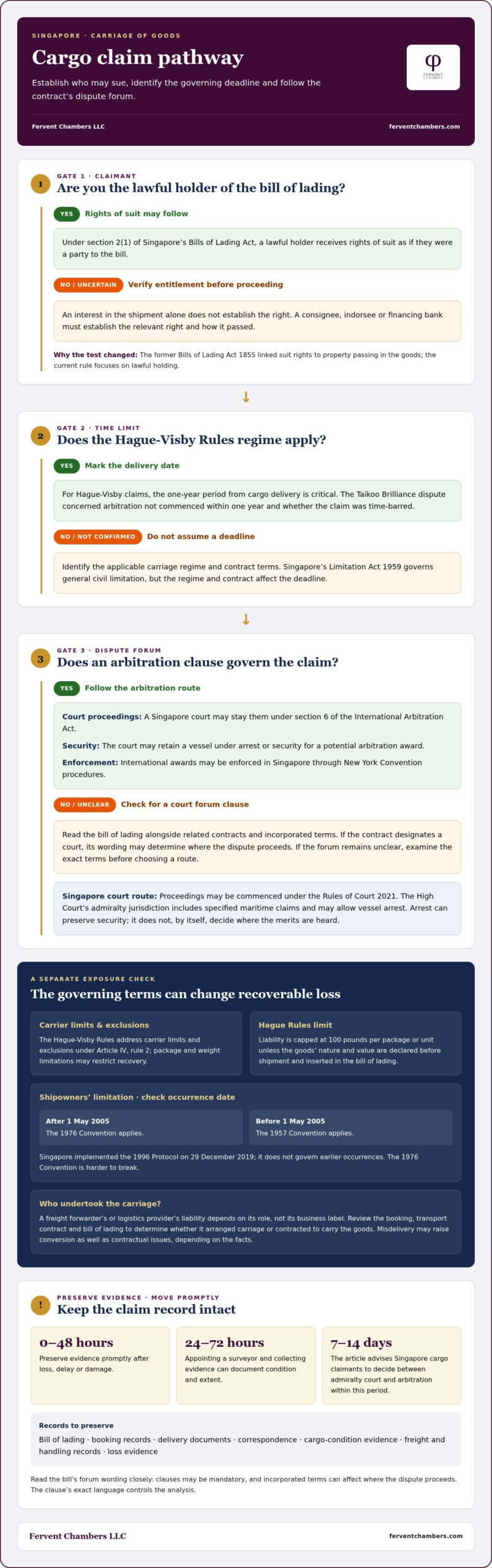
Shipowners’ limitation of liability caps certain maritime claims under the applicable limitation regime. Singapore’s Merchant Shipping Act addresses this subject in Part VIII. For occurrences after 1 May 2005, the 1976 Convention applies; occurrences before that date remain governed by the 1957 Convention. The 1976 Convention is harder to break, making the occurrence date material to a cargo claim. Singapore implemented the 1996 Protocol on 29 December 2019, but it does not govern earlier occurrences.
Carrier Liability Limits
Carrier liability limits restrict recovery for cargo loss or damage, subject to the governing rules and contract. Under the Hague-Visby Rules, carriers have package and weight limitation protections, while Article IV, rule 2 lists exclusions. The Hague Rules provide a different limit: liability is capped at 100 pounds per package or unit unless the goods’ nature and value are declared before shipment and inserted in the bill of lading. These distinctions affect how a claimant values and documents a loss.
Freight Forwarder and Logistics Provider Liability
A freight forwarder’s or logistics provider’s liability depends on the role it undertook in the shipment, not its business label. In Singapore, review the booking, transport contract and bill of lading to determine whether the provider arranged carriage or contracted to carry the goods. Potential responsibility depends on that undertaking and the alleged failure. For example, misdelivery may raise a claim in conversion as well as contractual issues, depending on the facts.
Carrier Defenses and Liability Limits
Carrier defences include applicable exclusions and limitation protections under the governing carriage regime. Under the Hague-Visby Rules, Article IV, rule 2 exclusions may answer particular allegations, while package and weight limits may restrict recovery. For consequential losses, identify the claimed loss, its connection to the cargo incident and the contract terms governing recovery. A claimant should preserve the bill of lading, cargo records and loss evidence, since those materials help assess the carrier’s defence and the claim’s proper scope.
Jurisdiction and arbitration clauses in contracts of carriage
A carriage contract may direct cargo claims to a named court or arbitration, shaping where proceedings take effect. Read the bill of lading alongside related contracts, because incorporated terms can affect the forum. In one Singapore dispute, the bill stated Singapore law applied and disputes belonged solely in Singapore courts, unless the carrier agreed otherwise in writing. In The Epar, the Singapore judge treated the clause as imposing a mandatory obligation, following the approach indicated in The Hollandia [1985] 2 M.L.J. 3.
For a cargo claim in Singapore, court proceedings may be commenced under the Rules of Court 2021. The High Court’s admiralty jurisdiction includes specified maritime claims, and it may arrest a vessel for claims within that jurisdiction. Arrest can preserve security while the dispute proceeds, but the contract’s forum clause remains central to deciding where the merits are heard.
Where an arbitration clause governs, a Singapore court may stay proceedings under section 6 of the International Arbitration Act. The court may retain a vessel under arrest or security to satisfy a potential arbitration award. That distinction matters: a court application concerning security does not necessarily displace the agreed arbitral forum. Singapore cargo claimants are advised to decide between admiralty court and arbitration within 7-14 days.
International arbitration can also offer an enforcement route: awards may be enforced in Singapore through New York Convention procedures. Before commencing, compare the clause’s seat, scope, governing law and any conditions for starting arbitration against the claim and available security. A clause may cover disputes broadly or prescribe a specific process, so its exact language controls the analysis. Parties considering an arbitration strategy can review arbitration support as they assess the appropriate forum and next procedural step.
Who may bring a cargo claim and bill-of-lading holder rights
Under section 2(1) of Singapore’s Bills of Lading Act, a lawful holder receives rights of suit as if they were a party to the bill. A consignee, indorsee or financing bank must establish the relevant right, not merely an interest in the shipment. The former Bills of Lading Act 1855 linked suit rights to property passing in the goods; the current rule focuses on lawful holding. A 2025 Singapore Court of Appeal judgment, 2025_SGCA_42, concerned cargo misdelivery without original bills and a financing bank’s claim to transferred rights.
For Hague-Visby claims, the one-year period from cargo delivery is critical: the Taikoo Brilliance dispute concerned arbitration not commenced within one year and whether the claim was time-barred. Singapore’s Limitation Act 1959 governs general civil limitation, but the applicable carriage regime and contract affect the deadline. Identify the delivery date and claim basis promptly.
After loss, delay or damage, preserve the bill of lading, booking records, delivery documents, correspondence and cargo-condition evidence. Singapore claimants are advised to preserve evidence and act within 0-48 hours; appointing a surveyor and collecting evidence within 24-72 hours can document condition and extent. Record freight and handling records as well, since they may clarify the shipment’s route and contractual parties.
For maritime claims, sections 3(1) and 4 of Singapore’s High Court (Admiralty Jurisdiction) Act define relevant jurisdiction and specified situations for an action in rem. A ship arrest may involve security and procedural expenses, so assess those against the claim’s value and available recovery. Where a ship mortgage or competing maritime claim exists, the vessel’s ownership and existing interests can affect the practical value of security; the claimant must assess priority rather than assume arrest guarantees payment.
Carriage of goods and passengers by sea
Sea cargo claims in Singapore depend on the bill of lading, the loading point and the applicable rules. According to Attorney-General’s Chambers of Singapore, section 3 of Singapore’s Carriage of Goods by Sea Act 1972 provides that the Hague-Visby Rules apply to outward bills from Singapore. The Act applies to cargo loaded in Singapore, not cargo merely discharged here. Article X sets connecting conditions for Hague-Visby application, so the bill and voyage details matter.
That distinction has practical consequences. For example, cargo loaded in Singapore for export falls within section 3’s stated scope, while discharge in Singapore alone does not establish that connection. Article X envisages wider application than section 3’s outward-bill rule. A careful assessment therefore identifies the shipment’s origin, the bill’s terms and any incorporated rules before considering the nature of the alleged loss.
Singapore-specific rules differ by transport mode. Sea carriage has the statutory and bill-of-lading framework described above; road claims require analysis of the relevant transport contract and applicable law. For air carriage, identify the governing contract and applicable framework rather than assuming sea rules apply. The Convention for the Unification of Certain Rules for International Carriage by Air was signed in Montreal on 28 May 1999, but that fact alone does not resolve which rules govern a particular shipment.
Passenger carriage should also be distinguished from cargo carriage: the parties, documents and claimed loss may differ, even where both arise from sea transport. In a shipment involving multiple legs, map each leg, identify its carrier and documents, and establish where goods were loaded and delivered. That sequence helps prevent a sea bill’s terms from being applied indiscriminately to road or air transport. For assistance assessing the relevant cargo framework and dispute options, seek dispute resolution support.
Fervent Chambers LLC: Dispute Resolution
Fervent Chambers LLC assists parties assessing or responding to cargo claims through its Dispute Resolution and Arbitration services. This support may be relevant when bill-of-lading rights, carrier liability, security or forum clauses raise important questions about how to proceed.
If a shipping dispute also involves a company’s financial distress or wider commercial obligations, Restructuring and Insolvency or Corporate and Commercial services may be relevant. The appropriate course depends on the documents, parties and issues, including whether court proceedings or arbitration fit the contract.
For help assessing a carriage dispute and its resolution options, contact Fervent Chambers LLC or visit ferventchambers.com.
Move from uncertainty to a considered next step
A carriage of goods dispute in Singapore is also a commercial decision: how the claim is handled can affect business relationships, operational continuity and the resources devoted to recovery. Start by identifying who will coordinate the response, preserve relevant records and maintain consistent communications with counterparties.
This preparation helps decision-makers consider the dispute in its wider commercial context rather than treating the cargo issue in isolation. Fervent Chambers LLC assists with disputes requiring careful assessment of the parties’ positions and resolution options, including arbitration and related corporate concerns. A focused discussion can clarify the issues and information relevant to the matter.
Contact Fervent Chambers LLC about your dispute to discuss a considered path forward.
Frequently Asked Questions
Who may sue?
A party with a right to sue under the applicable contract or statute may bring a cargo claim. For example, a bank financing a shipment may have a potential claim if bill-of-lading rights were transferred to it. A buyer named as consignee should not assume that this status alone establishes standing. Trace the relevant documents and transfers to identify which party holds enforceable rights.
What laws govern carriage of goods disputes in Singapore?
The governing law depends on the transport mode, shipment route and contract terms. Sea cargo may engage Singapore’s Carriage of Goods by Sea Act 1972 and the Hague-Visby Rules, while bill-of-lading rights are addressed by the Bills of Lading Act. Admiralty claims may involve the High Court (Admiralty Jurisdiction) Act, and arbitration clauses may engage the International Arbitration Act. The contract also helps determine which rules apply.
Which court or tribunal handles carriage of goods disputes in Singapore?
The Singapore High Court may hear maritime cargo claims within its admiralty jurisdiction, but an action against a vessel is available only in specified situations. If the carriage contract contains an applicable arbitration clause, the dispute may instead go to an arbitral tribunal, with court proceedings stayed under the International Arbitration Act. A claimant may need to distinguish a court application to preserve security from a decision on the merits of the cargo claim.
Who is liable for goods lost or damaged during carriage in Singapore?
Liability depends on the party’s contractual undertaking, the event that caused the loss and the terms governing that leg of transport. A carrier responsible for the relevant carriage may face a cargo-damage claim. A freight forwarder’s position depends on whether it undertook to carry the goods or performed another role. For a multimodal shipment, identify each contract and where the loss occurred before attributing responsibility.
What evidence and documents are needed for a Singapore carriage of goods claim?
Preserve records showing the shipment, the claimant’s rights, the cargo’s condition and the alleged loss. Relevant materials may include the bill of lading, booking confirmation, invoices, packing lists, delivery receipts, photographs, survey findings and communications with shipment parties. An intact delivery receipt followed by later damage reports, for example, may help establish when the damage was identified. Keep the original records together with a dated chronology.
How do Singapore courts interpret bills of lading and carriage contracts?
Singapore courts consider the wording of the bill and contract as a whole, including clauses selecting governing law, identifying a forum or incorporating other terms. For example, a booking confirmation may appear to name one forum while the issued bill contains a more specific dispute clause. Compare the documents, parties and scope of each clause. Their wording and contractual context determine how they interact.