
Liquidation is not the only option when a Singapore small business faces financial pressure. Alternatives to liquidation for a small business include seeking early legal advice, negotiating payment terms with suppliers and, if the business remains viable, considering formal debt restructuring. Potential routes include the Simplified Debt Restructuring Programme, judicial management and a scheme of arrangement. Informal agreements may leave a company without the protections of a formal process, and creditors may not agree to them.
When creditor demands are urgent, the first questions are whether the business is viable, what cash it has available and how much it owes. The right response depends on those facts. This article explains how early advice and supplier negotiations may create room to act, and how formal restructuring can provide a framework for addressing debt while preserving a viable business. It also distinguishes these routes from winding up, which is designed for a different situation, so you can compare their purposes and implications.
Key Takeaways
- Assess cash flow, creditor pressure and the company’s prospects before choosing a route; a viable business may have different options from one that is dormant or no longer viable.
- Administration and debt restructuring serve different purposes, so weigh whether the business can continue trading and whether a formal process could support a better path forward.
- In Singapore, the Simplified Winding Up Programme is intended for dormant or non-viable businesses, while the Simplified Debt Restructuring Programme is for viable businesses.
- Before members’ or partners’ voluntary winding up, directors must believe the company can pay all its debts within 12 months of starting the process, according to Attorney-General’s Chambers Singapore.
Early advice and supplier payment renegotiation
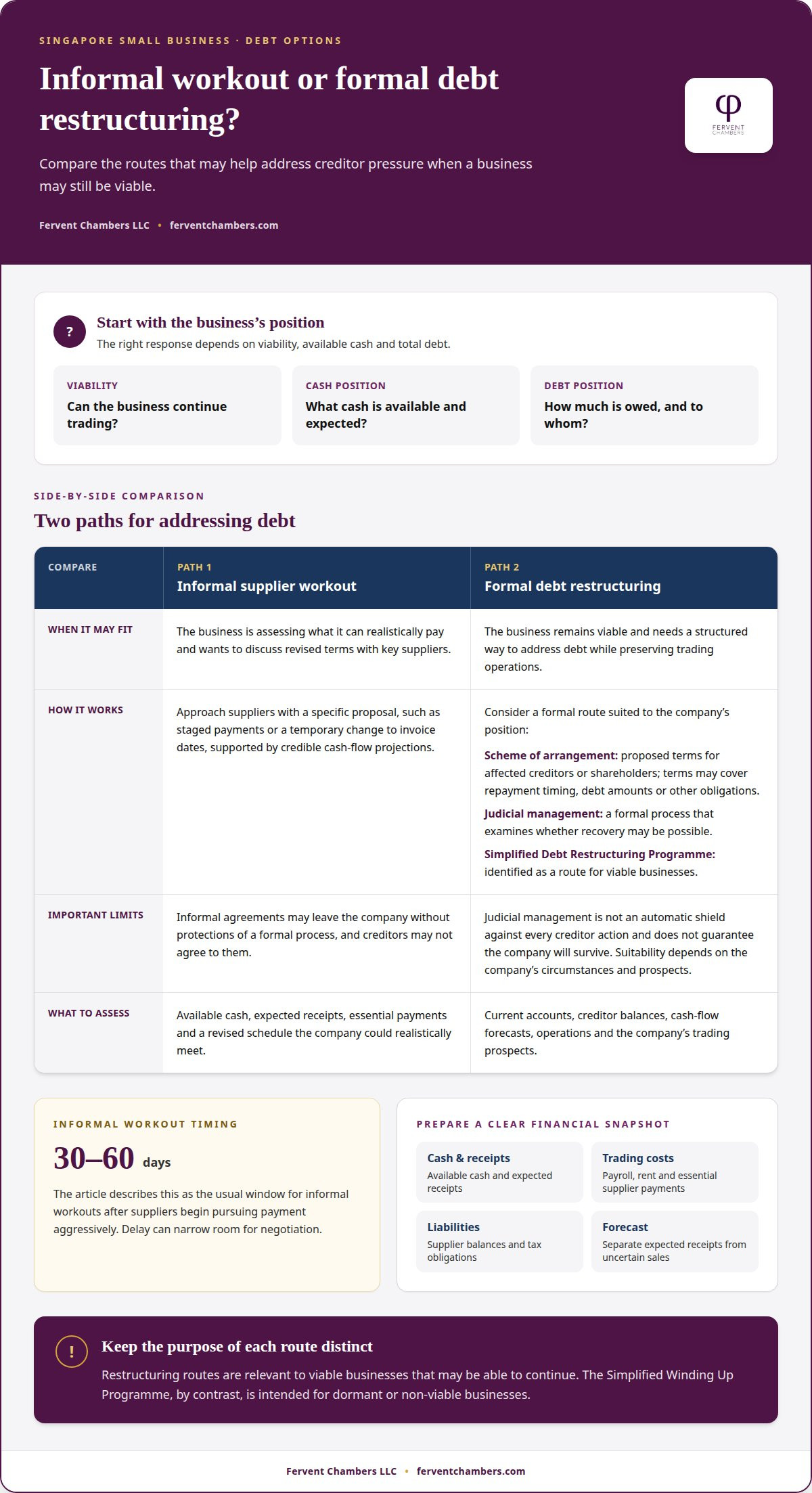
Early legal advice can help a Singapore business assess its cash position before overdue invoices turn into wider creditor disputes. Prepare a concise financial snapshot showing available cash, expected receipts, payroll, rent, supplier balances and tax obligations. Identify which payments are essential to continued trading, then work out what revised payment schedule the company could realistically meet.
Approach key suppliers with a specific proposal, such as staged payments or a temporary change to invoice dates, supported by credible cash-flow projections. Discussing a revised payment schedule with suppliers may help clarify what the business can realistically pay. The usual window for informal workouts is 30-60 days after suppliers begin pursuing payment aggressively, so delay can narrow the available room for negotiation.
The article’s UK debt-advice organisations, StepChange, Business Debtline and Citizens Advice, provide guidance on budgeting and debt discussions. For a Singapore company, local legal advice is needed to assess formal restructuring and winding-up options. Their guidance is not a substitute for advice on the company’s Singapore legal position.
When a Singapore business restructures rather than liquidates, employees may remain at work, while leases and supplier contracts continue to affect cash flow and may need renegotiation. The consequences depend on the restructuring route and the terms of each employment, lease and supply agreement.
Government grants do not replace creditor payments or an agreed repayment plan. A business in distress should first assess its cash position, discuss matters with creditors and consider whether formal restructuring is suitable. Grant eligibility depends on the scheme’s purpose and conditions.
Directors considering members’ or partners’ voluntary winding up must believe the company can pay all its debts within 12 months of starting the process, according to Attorney-General’s Chambers Singapore. If compulsory winding up is pursued, an applicant pays a S$10,400 deposit to the Official Receiver, according to the Official Receiver, Ministry of Law Singapore. Section 203 of Singapore’s Insolvency, Restructuring and Dissolution Act sets the priority order for distributing assets in a winding up, according to Attorney-General’s Chambers Singapore.
Administration as an insolvency option
A viable Singapore company facing insolvency may consider judicial management as a formal alternative to liquidation. The process examines whether the business can recover, rather than moving directly to closure and dissolution. Compulsory winding up, by contrast, puts the company into liquidation.
Judicial management is a formal process for a financially distressed Singapore company where recovery may be possible. The company’s finances, cash-flow forecasts, operations and creditor claims all inform whether it is suitable. Directors should assess whether the business can keep operating and meet essential obligations while a restructuring plan is considered.
For example, a company with continuing customer demand but overdue supplier invoices may have better prospects for recovery than one without viable operations. A useful forecast separates expected receipts from uncertain sales and identifies payroll, rent and essential supplier payments. This helps show whether continued trading could support a workable restructuring.
Judicial management is not an automatic shield against every creditor action, nor does it guarantee the company will survive. Its suitability depends on the company’s circumstances and prospects for resolving its financial difficulties. Directors should also consider the effects on employees, contracts and ongoing claims.
“Administration” is a broad term used in some jurisdictions. For Singapore businesses, judicial management is the relevant formal rescue route for a viable company. It differs from the Simplified Winding Up Programme, which is intended for dormant or non-viable businesses. The key question is whether the company has a credible path to recovery.
Before selecting a route, assemble current accounts, creditor balances, cash-flow projections and a concise explanation of the company’s trading position. These materials support a focused assessment of restructuring options and the implications for directors and creditors. Fervent Chambers LLC restructuring and insolvency guidance can help clarify the available legal pathways for a Singapore business exploring alternatives to liquidation for small business.
Debt restructuring for viable small businesses
For a Singapore company that remains viable, restructuring can address liabilities while preserving trading operations. Options to assess include a scheme of arrangement, judicial management and the Simplified Debt Restructuring Programme.
Scheme of Arrangement Eligibility and Steps
A scheme of arrangement is a proposed agreement to reorganise a company’s obligations with affected creditors or shareholders. It may suit a business that can put forward a credible proposal and continue operating on revised terms. Start by mapping the company’s assets, liabilities, creditor claims and forecast cash flow. Then develop proposed terms, identify affected parties and assess the effects on the company’s capital and trading position.
How a Company Scheme of Arrangement Works
The company presents its proposed restructuring terms to the relevant creditors or shareholders for consideration. Depending on its position and proposal, the terms may cover repayment timing, debt amounts or other obligations. A structured proposal can help the business address liabilities together, rather than negotiating each one in isolation. For a viable company, it can link creditor recovery with continued operations, but the practical outcome depends on the agreed terms and their implementation.
Risks for Directors and Shareholders
Restructuring can change a company’s liabilities, capital structure and future control. Directors and shareholders should examine the proposed consequences before proceeding. Creditors may reject a proposal, and revised obligations may still exceed what the company can afford. Directors should keep reliable financial records and make decisions in light of the company’s actual position. Shareholders may also see changes to their interests or influence under the restructuring terms.
There is no single typical cost for restructuring, judicial management or liquidation in Singapore. Costs depend on the process, the company’s finances and assets, the creditors affected, and the work needed to develop and implement a proposal.
Compare forecast trading income with the proposed payments and essential operating costs. An insolvency practitioner can assess financial information and help evaluate restructuring options; whether one is appointed and which process applies depend on the route selected. Before deciding, compare the prospects of recovery with the consequences of winding up.
Alternatives to liquidation for viable businesses
For a viable Singapore business, restructuring may provide a way to address debt while continuing to trade. The decision depends on whether the company’s affairs and financial position support a credible recovery plan.
Comparing Restructuring with Liquidation
Restructuring aims to address creditor claims while the business continues to operate; liquidation winds up the company and distributes its assets. Restructuring requires a workable plan, while liquidation focuses on winding up the company’s affairs. Creditors may consider revised repayment terms, and employees may retain their roles if trading continues. The key comparison is whether ongoing operations offer a credible way to meet obligations.
Choosing Restructuring Over Liquidation
A Singapore small business should consider restructuring if it remains viable and its trading prospects can support a credible plan. Current accounts, forecast receipts, essential costs and creditor claims help show whether operations can continue. If the figures reveal no realistic way to meet obligations, continued trading may deepen financial difficulties rather than preserve value.
Singapore’s Simplified Debt Restructuring Programme is intended for viable businesses, while the Simplified Winding Up Programme is intended for dormant or non-viable businesses. A company may also consider judicial management or a scheme of arrangement. Since these routes serve different purposes, assess the company’s viability and whether a proposed plan can address its debts.
For example, a business with ongoing customer demand and predictable receipts can assess whether revised repayment terms would cover suppliers, wages and other operating costs. A business without viable trading prospects should not use restructuring simply to defer a necessary decision. Shareholders, members, employees and creditors may be affected differently, so assess the company’s circumstances carefully.
Compare the projected recovery under restructuring with the consequences of winding up, including the company’s assets, creditor claims and ability to continue trading. Discuss restructuring options for a viable business when you need to assess which formal route fits the company’s situation.
Fervent Chambers
Fervent Chambers advises businesses on restructuring and insolvency issues in light of the commercial realities affecting their operations. If creditor pressure is increasing or a proposed repayment plan needs legal assessment, the firm can clarify available options and their implications for the company, its directors and creditors.
Fervent Chambers’ work in Corporate and Commercial, Dispute Resolution and Arbitration may also be relevant when contractual obligations or creditor disagreements complicate recovery. The appropriate course depends on the company’s finances, prospects for continued trading and the claims that need to be resolved. Early legal advice can help decision-makers understand how these factors interact before choosing a formal process.
Contact Fervent Chambers to discuss your company’s circumstances and potential next steps.
Make the next decision with clarity
The next step is to make a decision based on the company’s actual prospects. Before choosing a course, consider what continued trading requires, how creditors may respond and whether the proposed approach is sustainable for the business and its stakeholders. The alternatives to liquidation for a small business depend on that commercial reality, not simply on a preference to keep operating.
Where creditor disputes affect a recovery plan, Fervent Chambers offers Dispute Resolution and Arbitration alongside Restructuring and Insolvency advice. This combination can help address the company’s financial position and disputes that may complicate its options, without assuming that one route suits every business.
Contact Fervent Chambers for advice about your company’s circumstances and the legal considerations shaping its next steps. A clear assessment can help decision-makers proceed with greater purpose and confidence.
Frequently Asked Questions
Can the Business Keep Trading During SBR?
A Singapore business may continue trading during restructuring if its operations remain viable and can support ongoing obligations. The Simplified Debt Restructuring Programme is intended to help viable businesses restructure, but cash flow and the company’s circumstances affect how trading proceeds. Forecast wages, rent and essential supplies to ensure proposed repayment terms do not undermine day-to-day operations.
Does Restructuring Show Up on Business Credit Reports?
There is no single answer about credit reporting that applies to every Singapore restructuring route. An informal workout involves direct negotiations with creditors, while formal processes follow their own procedures and records. Before choosing a route, establish what filings, notices or records it involves and how they may affect the company’s commercial dealings. Do not assume an informal agreement and a formal proceeding have the same visibility.
How Long Does an Informal Workout Negotiation Usually Take?
Informal workout negotiations usually take 3-8 weeks from first creditor contact to signed agreements. The timetable can be affected by how many creditors must participate, whether the company presents a coherent proposal and how quickly parties respond. A business with several suppliers may need to align different payment schedules, while a single major creditor may require focused negotiations over that creditor’s claim.
What Happens to Personal Guarantees During Restructuring?
Personal guarantees generally remain in place during restructuring unless the creditor releases them in writing. A company repayment plan does not itself release a director or shareholder from a separate guarantee. Review the guarantee alongside the proposed restructuring terms, and obtain any agreed release in writing from the relevant creditor before relying on it.
What alternatives to liquidation are available to small businesses in Singapore?
For a small business in Singapore, alternatives to liquidation include negotiating with suppliers, the Simplified Debt Restructuring Programme, judicial management and a scheme of arrangement. The right route depends on the business’s viability, its creditors and whether a workable repayment or recovery plan is possible. The Simplified Winding Up Programme is for dormant or non-viable businesses, so it is not a rescue route for a viable company.
Can a Singapore small business restructure debts through informal negotiations or a voluntary workout?
Yes. A small business considering alternatives to liquidation can propose revised payment terms to creditors, such as instalments or adjusted due dates, and document any agreement reached. An informal workout offers no legal protection, however, and creditors do not have to accept the proposal. Support the offer with realistic cash-flow projections, and distinguish creditor consent from a formal restructuring process.