




A business partner’s role does not shield them from civil or criminal accountability if they misuse company money or property. The consequences depend on the evidence and circumstances. Knowing how to sue a business partner for stealing in Singapore starts with distinguishing a civil claim to recover losses from a report of suspected criminal conduct.
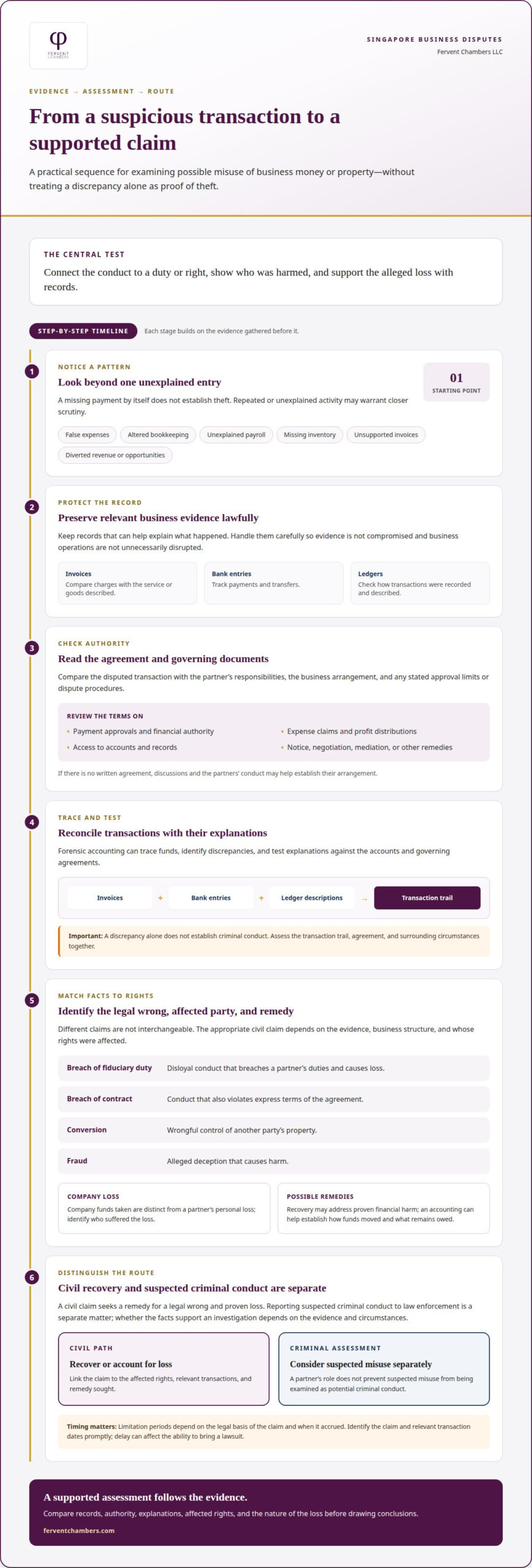
Unexplained payments, false expenses, or missing assets may be more than an accounting problem, particularly if the partner you suspect controls access to records. Support allegations with evidence. The appropriate claim depends on the business structure, governing documents, and nature of the loss.
This article explains when a partner’s conduct may support civil claims or a criminal investigation in Singapore, what records and other evidence can help establish what happened, and how inspection rights may apply. It also explains why preserving records carefully and reviewing the partnership agreement before taking formal action can help protect your position and the business’s interests.
Key Takeaways
- Assess whether the conduct breached a partner’s duties and caused a demonstrable loss before determining which civil claim may apply.
- Review the partnership agreement and governing documents for dispute procedures, access rights, and available remedies.
- Look for patterns such as unexplained expenses, diverted revenue, or inconsistent bookkeeping, rather than treating an isolated discrepancy as proof of theft.
- Preserve relevant business records lawfully and avoid actions that could compromise evidence or disrupt the company’s operations.
Can I Sue My Business Partner for Breach of Fiduciary Duty?
Yes. A partner’s misuse of business money may support civil claims when the evidence shows a duty, a breach, and resulting loss. In Singapore, the proper claimant and remedy depend on the business structure and whose rights were affected.
Partners’ Fiduciary Duties
A fiduciary duty requires a partner to act loyally and in the partnership’s interests when handling shared business affairs. For example, a partner who secretly transfers partnership revenue to a personal account may breach that duty, even if they have authority to manage payments.
Disclosure, loyalty, and care are relevant when assessing a partner’s conduct. A partner who conceals a conflict while directing a contract to another business, for example, may have put personal interests ahead of the partnership’s. Compare the transaction, the partner’s role, and their explanation with the partnership agreement and established business arrangements.
Civil Claims for Partner Misconduct
A civil claim identifies the legal wrong, who was harmed, and the remedy sought. A breach of fiduciary duty may apply when a partner’s disloyal conduct causes loss; a breach of contract may apply when the conduct also violates the agreement’s express terms.
Conversion concerns wrongful control of another party’s property, while fraud involves alleged deception that causes harm. A transfer recorded as a business expense, for example, may support different claims depending on the evidence and the partner’s explanation. These claims are not interchangeable. Link each allegation to specific records, transactions, and affected rights.
Damages and Where to Bring a Claim
Damages aim to address proven financial harm, such as partnership funds diverted for a partner’s personal use. A claimant may seek recovery for the loss, while an accounting can help establish how funds moved and what remains owed. The partnership agreement may also set out remedies for a breach.
In Singapore, the proper claimant depends on who suffered the loss and the business’s legal form. If company funds were taken, the company’s loss is distinct from a partner’s personal loss. A partner may sue personally for separate harm to their own rights. Limitation periods depend on the legal basis of each claim and when it accrued. Identify the claim and relevant transaction dates promptly, as delay can affect the ability to bring a lawsuit.
Can a Business Partner Be Charged With Embezzlement in Texas?
In Singapore, a business partner’s role does not prevent suspected misuse of company funds from being examined as potential criminal conduct. Whether the facts support a criminal investigation is a separate question from whether the business can pursue civil remedies.
Filing fees and legal costs for a business dispute depend on the claim, procedure, and work required; there is no single typical total for every case. Legal fees depend on the dispute’s complexity and the steps involved, and are provided after a quote request.
Partnership Agreement Terms and Responsibilities
A partnership agreement records responsibilities, financial authority, and agreed ways to resolve disputes. Review its provisions on payment approvals, expense claims, profit distributions, access to accounts, and remedies for misconduct.
For example, a partner may have authority to approve ordinary supplier payments but not to transfer business funds for personal use. The agreement can help distinguish these actions and identify any required notice, negotiation, mediation, or other dispute process before a lawsuit. The documents governing a business may set out owners’ management rights and ways to resolve disputes.
Even without a written agreement, discussions and the partners’ conduct may help establish their arrangement. Compare those records with the disputed transaction before drawing conclusions about authority or intent.
Forensic Accounting and Governing Agreements
Forensic accounting examines transactions and supporting records to trace funds, identify discrepancies, and test explanations against the accounts. Reviewing the findings alongside governing agreements can show whether a payment exceeded an approval limit or departed from an agreed responsibility.
For instance, an accountant may reconcile invoices, bank entries, and ledger descriptions to identify a transfer with no apparent business support. That discrepancy alone does not establish criminal conduct. Assess the transaction trail, agreement, and surrounding circumstances together to distinguish a bookkeeping error from suspected misappropriation.
When records indicate possible criminal conduct, reporting it to law enforcement is distinct from bringing a civil claim to recover losses. The appropriate assessment depends on the transactions, supporting documents, business structure, and governing agreements.
For help evaluating the records and possible business claims, discuss your dispute.
What are the Common Grounds for Suing a Business Partner?
A missing payment alone does not establish theft, but repeated unexplained transactions can warrant closer scrutiny. In Singapore, the claim depends on the conduct, the business rights affected, and evidence connecting the partner to a loss.
Warning Signs and Forms of Partner Theft
Warning signs are transaction patterns that may indicate a partner used business assets without proper authority. Examples include false expense claims, altered bookkeeping entries, unexplained payroll payments, missing inventory, or invoices for services never supplied.
A partner may also divert customers, revenue, employees, or a business opportunity to another enterprise. Records showing partnership work billed through a competing business, for instance, may warrant investigation. Treat each indicator as a lead, then compare invoices, bank entries, and business records before making a formal allegation.
Civil Claims and Police Reports
A civil claim seeks a remedy for harm to the business or an owner’s rights, while a police report raises suspected criminal conduct for investigation. The routes address different issues: litigation may seek to recover losses, while reporting does not itself return funds or resolve the business relationship.
A lawyer can assess whether the evidence supports a civil claim, a report to law enforcement, or both. Preserve transaction records and identify the specific property or funds involved before describing the allegation. A report should distinguish documented events from assumptions about a partner’s intent.
Theft and Breach of Trust in Singapore
In Singapore, suspected theft or breach of trust by a business partner concerns the unauthorised taking or use of business property, including money entrusted for business purposes. A partner’s access to company funds does not, by itself, establish authority to use them personally.
For example, a transfer marked as a supplier payment but routed to a partner’s personal account may raise questions about authority, purpose, and supporting records. The transaction history, agreement, and surrounding conduct help explain the allegation. An accounting discrepancy alone does not establish criminal conduct.
A Singapore civil lawsuit typically begins by identifying the claimant, the alleged wrong, and the remedy sought, followed by formal court filings and the exchange of evidence. Its duration depends on the issues, evidence, court directions, and whether the parties resolve the dispute before trial. A lawyer can assess the appropriate claim and procedural route using the records and governing documents.
Preserving evidence and inspecting business records
A bank transfer, invoice, or missing asset becomes useful evidence when linked to records showing its purpose and authority. In Singapore, preserve those records before confronting a partner or changing business access.
Gathering and Securing Evidence
Preserving evidence means retaining relevant records in their original form and keeping copies secure. Save emails, text messages, invoices, bank statements, accounting entries, and witness details connected to each disputed transaction.
Take screenshots and make digital or print copies, noting when and where each item came from. Keep an orderly chronology and restrict access to a secure business location. Do not secretly search a partner’s phone or laptop; a lawyer can advise on lawful ways to obtain material. The Intellectual Property Office of Singapore notes that clear transaction records can help document dealings involving confidential information.
Business Records and Discovery
Inspecting business records can help establish who approved a payment, where funds went, and whether the books accurately reflect the transaction. Inspection rights depend on the entity type, governing documents, and applicable law. Identify the agreement and records relevant to your role.
For example, compare ledger entries with invoices, bank statements, payroll records, and contracts. A partner’s refusal to provide records may warrant attention, but does not by itself prove theft. In a lawsuit, a lawyer may use discovery to seek relevant material, including emails, text messages, phone or bank records, hard drives, and accounting files.
Proving Theft and Securing Accounts
To substantiate suspected theft, connect a specific asset or payment to records showing its ownership, movement, and lack of business purpose. A bank statement showing a transfer, paired with an invoice and approval history, may help explain the transaction and establish losses.
Before taking legal action, preserve account logs and coordinate access changes through authorised business controls. Avoid deleting files or locking out a partner without considering existing rights and agreements. An unsupported accusation can turn an accounting error into a deeper dispute, damage the working relationship, and weaken later claims. Verify discrepancies before making formal allegations.
For guidance on preserving evidence and assessing potential business litigation claims, discuss your dispute.
Fervent Chambers LLC
Fervent Chambers LLC can help assess suspected partner misconduct through Dispute Resolution and Corporate and Commercial advice. When financial records, governing agreements, and competing explanations create uncertainty, a structured review can clarify the claims, potential remedies, and appropriate route forward.
If an agreement provides for arbitration, that process may shape how the dispute proceeds. If business continuity is also at risk, Restructuring and Insolvency considerations may become relevant. The right approach depends on the business structure, evidence, and impact on the company and its owners. Early legal advice can help frame the issues, preserve the business’s position, and assess whether negotiation, arbitration, or court proceedings are appropriate.
Contact Fervent Chambers LLC to discuss your business partner dispute.
Choose a Deliberate Path Forward
The decision is not simply whether to proceed, but how to protect the business while addressing suspected misconduct. Align the evidence, remedy sought, and company’s operational needs before taking formal action. This assessment can help determine whether negotiation, litigation, or another dispute process best serves the business and its owners.
Understanding how to sue a business partner for stealing requires a strategy that considers both recovery and the commercial consequences of escalation. A sound plan also accounts for the company’s governing arrangements and the evidence supporting each allegation. Fervent Chambers LLC provides Dispute Resolution and Arbitration, and can advise on Restructuring and Insolvency where a dispute puts business continuity under strain.
Contact Fervent Chambers LLC to discuss your business dispute and consider a considered way forward. An evidence-led approach can help you make the next decision with confidence.
Frequently Asked Questions
Can I Sue My Business Partner for Using the Business’s Intellectual Property?
Yes, a civil claim may be available if a partner uses business intellectual property without authority and causes loss. For example, a partner might use a jointly developed design, customer database, or confidential commercial material to generate revenue independently. The business’s ownership records, partnership arrangements, and evidence of use matter. Keep dated copies of relevant files and communications to clarify who created or controlled the material.
Can I Sue a Business Partner for Criminal Activity?
Yes, you may pursue a civil claim for losses while reporting suspected criminal conduct separately to law enforcement. For example, a company may seek compensation for funds allegedly diverted while authorities assess whether an offence occurred. These processes have different purposes: a criminal case addresses alleged offending, while a civil claim seeks a remedy for harm. A criminal case and a civil claim serve different purposes, so recovering money may require separate steps.
Can I sue my business partner for stealing money?
Yes, a civil lawsuit may be possible if the evidence supports a recognised claim and identifies who suffered the loss. A transfer from a business account to a partner’s personal account, without a business purpose or proper authority, may warrant investigation. If the funds belonged to the company, the company may be the claimant rather than an individual owner. The entity’s structure and governing documents help determine the proper claimant and available remedies.
Should I report a business partner for theft to the Singapore Police or the Commercial Affairs Department?
Report suspected theft through the Singapore Police Force. Information concerning commercial conduct may be directed to the Commercial Affairs Department as appropriate. Clearly set out the transactions, dates, amounts, account details, and supporting documents, and distinguish what the records show from what you suspect. A police report does not replace a civil claim for recovery, so keep a separate record of the business loss and the remedy sought.
What civil claims can a Singapore business bring against a partner who misappropriated funds?
Depending on the facts, a business may consider claims involving breach of fiduciary duty, fraud, conversion, breach of contract, or recovery through an accounting. A false invoice, for example, may support different legal arguments from an undisclosed transfer that breached agreed spending controls. Identify the conduct, the business right affected, and the loss or remedy sought. The company’s legal form and governing documents can shape the available route.
Can I seek an injunction, asset freeze, or accounting of company funds in Singapore?
Depending on the claim and evidence, a business may seek court orders to restrain conduct, preserve assets, or require an accounting. An injunction or asset-freezing order is not automatic; an application must be supported by relevant facts and meet applicable legal requirements. Records suggesting imminent asset transfers, for instance, may be relevant. An accounting can clarify disputed transactions, but does not itself establish wrongdoing.