




A nominee director cannot treat the nominating party’s interests as a substitute for the responsibilities of office. Under section 157 of Singapore’s Companies Act, directors must act honestly and use reasonable diligence, according to Singapore Statutes Online. Director duties during insolvency in Singapore may also require consideration of creditors’ interests before formal insolvency, depending on the company’s financial condition and the decisions being made.
It is understandable to ask whether a nominee director is responsible for company compliance when someone else appointed them. This article explains when directors must consider creditors’ interests, which statutory and fiduciary duties apply, and when personal liability or court relief may arise. Understanding director duties during insolvency in Singapore also means distinguishing a breach of duty from insolvency itself, so directors can assess the legal significance of their decisions.
Key Takeaways
- Assess the company’s financial position when major transactions are considered, because the weight given to creditors’ interests depends on the degree of financial distress.
- Understand how wrongful trading rules may apply when a company incurs debts it cannot reasonably expect to repay.
- Distinguish company insolvency from personal liability, which generally requires a separate legal basis such as misfeasance or breach of trust.
- Consider how a court may grant relief from liability, and what a director must establish to qualify.
Directors’ obligations to consider creditors’ interests in Singapore – When is the duty engaged?
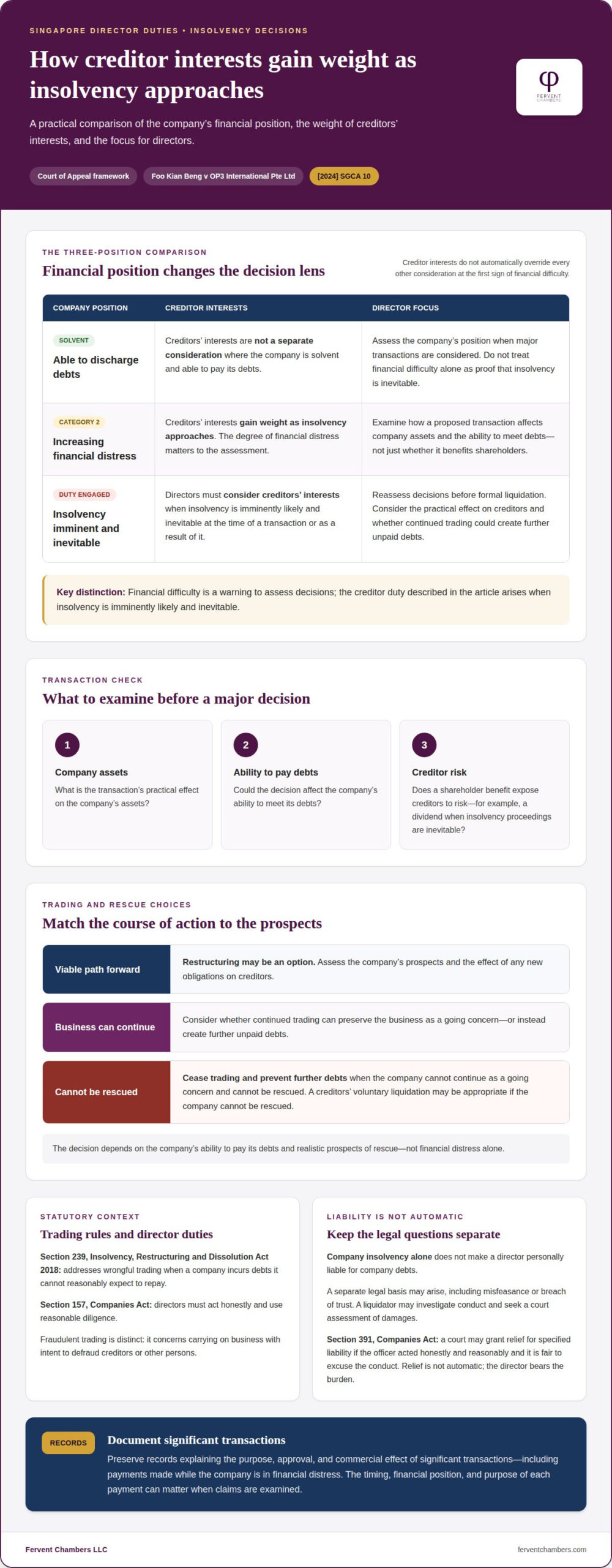
Creditor duties may arise before a Singapore company enters liquidation, while it remains solvent but financially distressed. The Court of Appeal considered these obligations in Foo Kian Beng v OP3 International Pte Ltd (in liquidation). Its decision, [2024] SGCA 10, sets out a three-stage framework for assessing the company’s financial position.
When the Creditor Duty Is Engaged
The creditor duty requires directors to consider creditors’ interests when insolvency is imminent and inevitable. This matters because directors may need to reassess transactions before formal liquidation begins. The Court’s framework distinguishes a solvent company able to discharge its debts from companies experiencing increasing financial distress. In the intermediate position, described as “Category 2”, creditors’ interests gain weight as insolvency approaches.
The duty arises when the company is imminently likely to be unable to pay its debts, and insolvency is inevitable at the time of a transaction or as a result of it. Financial difficulty is less severe than being on the verge of insolvency, but it signals that directors must assess how decisions may affect creditors.
Creditor Interests as Insolvency Approaches
As a company’s position worsens, creditors’ interests carry greater weight because the company is using creditors’ money to continue trading. Directors should examine the transaction’s practical effect on the company’s assets and its ability to meet debts, rather than considering shareholder benefit alone. The Court of Appeal identified relevant assessment factors at paragraph [106] of its judgment.
For example, a dividend that benefits shareholders while exposing creditors to risk is especially concerning when insolvency proceedings are inevitable. This does not mean creditors’ interests override every other consideration as soon as a company faces financial distress. The company’s financial position matters: where it is solvent and able to pay its debts, creditors’ interests are not a separate consideration.
Restructuring, Trading and Winding Up
Restructuring may be an option if the company has a viable path forward; creditors’ voluntary liquidation may be appropriate if it cannot be rescued. Directors should assess whether continued trading can preserve the business as a going concern or instead create further unpaid debts. If the company cannot continue as a going concern and cannot be rescued, directors should cease trading and prevent further debts.
When must directors stop trading or consider winding up an insolvent Singapore company? Directors should cease trading and prevent further debts when the company cannot continue as a going concern and cannot be rescued. The decision depends on the company’s ability to pay its debts and the realistic prospects of rescue, not financial distress alone.
Wrongful trading in Singapore is addressed under section 239 of the Insolvency, Restructuring and Dissolution Act 2018, according to Singapore Statutes Online. Directors considering continued trading or a proposed restructuring should therefore assess the company’s prospects and the effect of new obligations on creditors.
Relief from liability under the Companies Act
Section 391 of Singapore’s Companies Act allows a court to relieve a company officer from liability for negligence, default, breach of duty or breach of trust if the statutory conditions are met, according to Singapore Statutes Online. Relief is not automatic. The director must show that they acted honestly and reasonably, and that it is fair to excuse the conduct. The burden rests on the director seeking relief.
A liquidator may investigate an officer’s conduct, review company records and examine decisions involving company assets. If the evidence indicates misfeasance or breach of trust, the liquidator may apply to court for an assessment of damages against the officer. Directors should preserve records that explain the purpose, approval and commercial effect of significant transactions, including payments made while the company is in financial distress.
Recovery can include restoring assets or funds improperly applied, allowing them to be realised and distributed for creditors. In Foo Kian Beng v OP3 International Pte Ltd, the liquidator pursued disputed dividends and loan repayments made to the director. The example demonstrates why the timing, financial position and purpose of each payment matter when claims are examined.
What are the wrongful trading and fraudulent trading rules for Singapore company directors? Wrongful trading is addressed under section 239 of the Insolvency, Restructuring and Dissolution Act 2018. Fraudulent trading concerns carrying on business with intent to defraud creditors or other persons. These are distinct from relief under section 391, which concerns whether an officer should be excused from specified liability.
Where can directors find Singapore-specific guidance on insolvency duties, including Companies Act provisions and ACRA requirements? Singapore Statutes Online provides the Companies Act provisions, including section 391. ACRA publishes guidance on company administration and filing obligations; directors should consider these alongside the conduct under review and any liquidator’s claims.
Where an insolvency dispute raises questions about transactions, officer conduct or asset recovery, insolvency dispute advice can help clarify the legal issues and available responses.
Personal liability for misfeasance or breach of trust
Liquidation does not, by itself, make a director personally liable for the company’s debts. A liquidator may apply to court for an assessment of an officer’s damages for misfeasance or breach of trust. The inquiry focuses on the director’s conduct, the company’s assets, and whether a transaction caused loss or improperly benefited another party.
In Chip Thye Enterprises Pte Ltd (in liquidation) v Phay Gi Mo and Others, directors who authorised interim dividends despite insufficient profits were held personally liable for S$321,900. The case illustrates how taking company funds without adequate profits can expose directors to claims. In Lim Teck Cheng v Wyno Marine Pte Ltd (in liquidation), a director who knew the company was insolvent was made liable for expenses it incurred.
How is insolvency determined under Singapore law, including cash-flow and balance-sheet tests? The Court of Appeal clarified in 2021 that the cash-flow test is the sole test: a company is insolvent if it cannot pay debts as they fall due, excluding debts not yet due. A balance-sheet assessment may inform the evidence, but it is not a separate insolvency test.
Can directors be personally liable for company debts during insolvency in Singapore? Yes, where a distinct legal basis supports liability, including misfeasance, breach of trust, or wrongful or fraudulent trading. In Foo Kian Beng v OP3 International Pte Ltd, the court assessed contingent liability in related proceedings at between S$441,000 and S$514,500, showing why unresolved claims can matter when directors authorise payments.
A non-executive or nominee title does not, by itself, answer whether a director is responsible; the relevant issue is their own decisions and conduct. Under section 339(3) of the Companies Act, directors may be prosecuted for causing a company to incur debts without reasonable or probable grounds to expect repayment. Fraudulent trading may also lead to personal liability, and conviction can carry imprisonment. Restructuring decisions therefore require careful scrutiny of liabilities and the company’s actual position.
Directors’ statutory and fiduciary duties
Under section 157 of Singapore’s Companies Act, directors must act honestly and use reasonable diligence in carrying out their duties, according to Singapore Statutes Online. This statutory standard applies alongside fiduciary obligations. Directors should act in good faith for the company’s interests, rather than treating their appointment as a formality.
Directors’ core duties include acting in good faith, exercising skill and care, avoiding conflicts of interest, and not misusing their position. They must disclose interests in transactions, maintain proper records and comply with applicable laws. These duties apply to nominee and executive directors alike. Being appointed by a shareholder or investor does not make that party’s interests the sole measure of a director’s conduct.
The company’s interests remain central, but the factors directors must consider can shift as insolvency approaches. In Foo Kian Beng v OP3 International Pte Ltd (in liquidation), the Court of Appeal identified relevant considerations at paragraph [106]. Its framework makes the decision’s context important: directors should determine the company’s financial position and consider how a proposed transaction affects the company and its creditors.
For a significant payment or asset transfer, directors should record its commercial purpose, the information considered, and any conflicts disclosed. Board minutes and financial records can help show how directors reached their decision. In contrast, approving a transaction that benefits a director personally, without considering the company’s position, may support a claim for profits made or losses caused by a section 157 breach.
The creditor duty is owed to the company, not directly to individual creditors. That distinction matters when assessing who may pursue a breach claim and whose interests directors must consider. Directors facing a disputed transaction or difficult insolvency decision can seek advice on directors’ duties and the company’s restructuring position.
Fervent Chambers: Dispute Resolution
Fervent Chambers LLC advises on dispute resolution and restructuring and insolvency matters arising from directors’ decisions during financial distress. If a liquidator challenges payments, creditors dispute a transaction, or directors face questions about their conduct, legal analysis can clarify the issues, potential claims and available responses.
The appropriate approach depends on the facts of the dispute, the company’s financial position and the relief sought. Fervent Chambers LLC handles dispute resolution, arbitration, and related corporate and commercial matters, including disputes connected with insolvency proceedings. Early legal advice can help directors and companies understand their position and address contested decisions within the applicable legal framework.
Contact Fervent Chambers LLC to discuss a director-liability or insolvency dispute.
Prepare a considered response to insolvency risk
A considered approach to director duties during insolvency in Singapore begins with a clear record of decisions, the information available at the time, and the commercial reasons for acting. As circumstances change, directors can preserve relevant board materials and financial records, identify transactions that may be challenged, and establish who approved them. This preparation supports informed discussions about the company’s position and helps distinguish a difficult commercial decision from conduct that may attract legal scrutiny.
Where a dispute has emerged or a restructuring decision carries personal or corporate consequences, focused legal advice can clarify the issues and help shape a proportionate response. Fervent Chambers LLC handles dispute resolution, arbitration, and restructuring and insolvency matters, which may be relevant when directors or companies need to address contested decisions.
Contact Fervent Chambers LLC for advice about your circumstances and the available next steps. A timely, well-documented response can help directors approach difficult decisions with greater clarity.
Frequently Asked Questions
Are nominee directors responsible for company compliance?
Yes. A nominee director remains responsible for the duties attached to the office, even if someone else nominated or appointed them. They should oversee company records, consider board materials and raise concerns about proposed decisions rather than simply follow instructions. For example, if a nominee learns that accounts are incomplete, they should address the issue through the company’s governance processes and keep a record of their response.
Can Directors Be Sued When the Company Liquidates?
Yes. Liquidation does not itself establish a director’s liability, but a liquidator may investigate transactions and apply to court over alleged misfeasance or breach of trust. A claim may also arise on a separate statutory or fiduciary basis. Evidence matters: payment records, board minutes and communications can help show who authorised a transaction and the circumstances in which it occurred.
Can a non-executive director still be liable?
Yes. Non-executive status does not automatically remove a director’s responsibility for their own decisions or omissions. Relevant questions include what information the director received, whether they participated in or approved the decision, and how they responded to warning signs. For instance, a director who receives financial reports showing mounting unpaid debts should consider the issue and document any steps taken through the board.
What About Unfair Preferences?
An unfair preference may arise where a company places a creditor, surety, or guarantor in a better position than they would have occupied in insolvent liquidation, subject to statutory requirements. For example, repayment to a connected creditor shortly before insolvency may draw scrutiny. Section 225 of the Insolvency, Restructuring and Dissolution Act 2018 provides a statutory unfair-preference regime for certain claims when a company enters judicial management or winding up.
What effects does liquidation have on the company and creditors?
Liquidation places the company’s affairs into a process for realising assets and addressing creditor claims. After a winding-up order, proceedings against the company cannot be commenced or continued without the Court’s leave. A disposition of company assets after court winding up commences is void unless the Court sanctions or approves it. Creditor claims are handled according to statutory priorities, so payment depends on the applicable order and the assets available.
What is liquidation or winding-up?
Liquidation, also called winding up, brings a company’s affairs to an end by collecting and realising its assets and handling claims. A liquidator administers the process and may investigate the company’s dealings. In a compulsory winding up, proceedings commence on the date the winding-up application is presented, which can affect how later transactions are treated.