



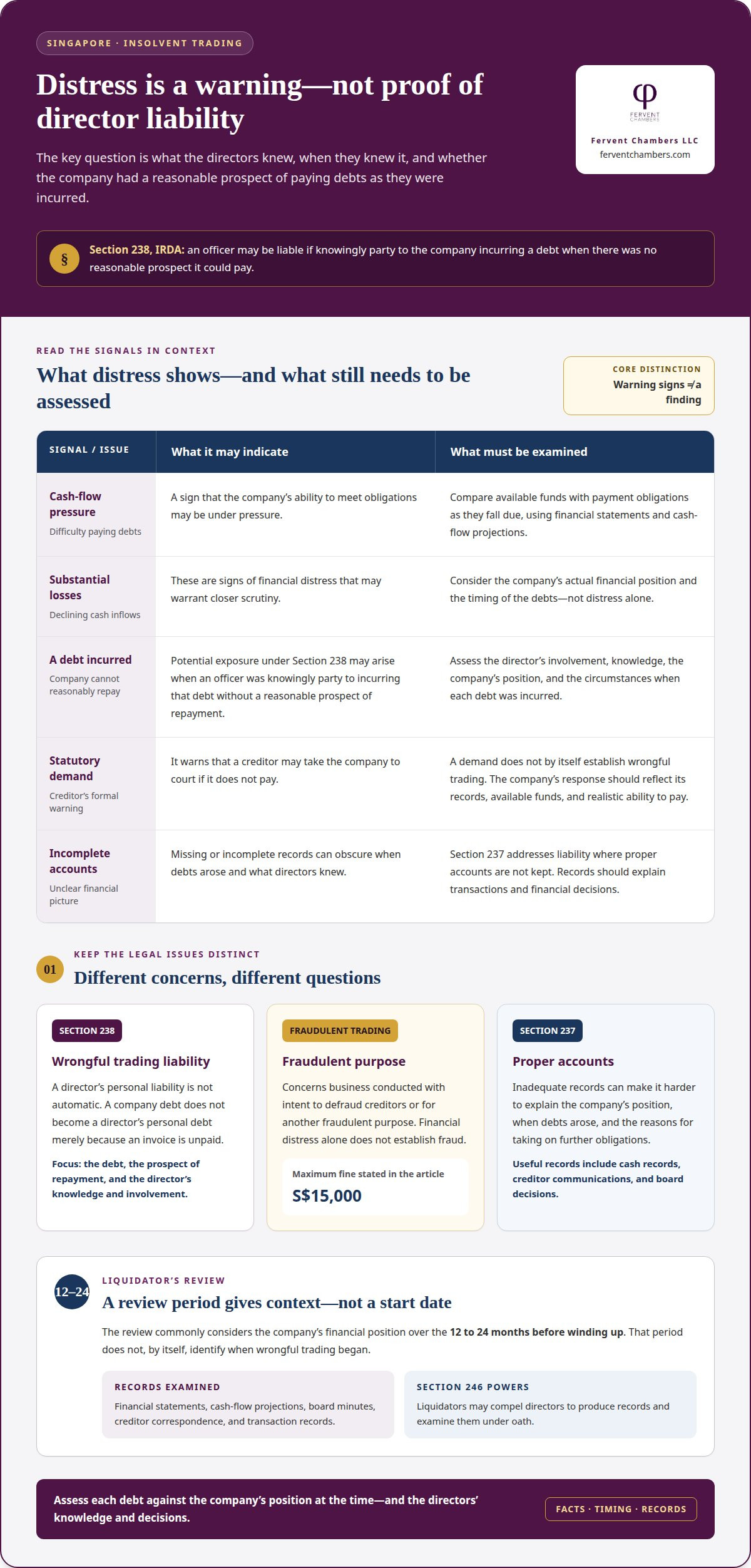
A company’s financial distress is a warning, not by itself a finding of director liability. In Singapore, signs of insolvent trading include substantial losses, difficulty paying debts and declining cash inflows; under Section 238 of the Insolvency, Restructuring and Dissolution Act, an officer may be liable if knowingly party to the company incurring a debt when there was no reasonable prospect it could pay. The critical issue is therefore not only whether the business was struggling, but what directors knew and when.
Concerns about the signs of insolvent trading in Singapore can be difficult to assess while a company is still operating, particularly when cash-flow pressure, creditor demands and incomplete records overlap. This article explains what insolvent trading means, how directors’ potential liability is assessed, and how creditors and liquidators may respond. It also considers how a liquidator’s review of the company’s financial position can help identify when debts were incurred and which decisions may warrant closer scrutiny.
Key Takeaways
- Assess financial distress through cash flow, payment difficulties and accumulating losses, then consider what the company can realistically pay as obligations fall due.
- Understand how directors’ knowledge and decisions may affect personal exposure when a company incurs debts it cannot reasonably repay.
- Recognise that a statutory demand can precede court action, making a prompt, considered response important for companies and creditors.
- See how liquidators examine company records and financial decisions to identify when insolvency concerns arose and which transactions may warrant scrutiny.
Can a director face personal liability for company debts under Section 239 IRDA?
Section 239 of Singapore’s Insolvency, Restructuring and Dissolution Act 2018 sets out when a director might be liable for wrongful trading, according to Attorney-General’s Chambers of Singapore (Singapore Statutes Online). The signs of insolvent trading in Singapore matter because they may prompt closer examination of what directors knew and when.
Personal Liability for Company Debts
Personal liability means a director may have to contribute personally towards company debts when statutory conditions are met. Under Section 238, an officer may be liable if knowingly party to the company incurring a debt without a reasonable prospect of repayment. The signs of insolvent trading in Singapore should therefore be assessed alongside the director’s role and the company’s position when it incurred each debt.
Company debts do not automatically become a director’s personal debts. An unpaid invoice alone does not establish wrongful trading; the circumstances in which the debt was incurred and the director’s involvement must be considered.
Contribution Orders Against Directors
A contribution order may require a director to contribute to company assets after a finding of relevant wrongful trading. This can affect personal finances, even though the company incurred the original debt. The connection between the debt, the company’s ability to pay and the director’s decisions is central to assessing potential exposure.
Cash records, creditor communications and board decisions can help establish that connection. Directors should preserve records that explain commitments as the company’s financial position changes.
Director Liability and Fraudulent Trading
Fraudulent trading concerns business conducted with intent to defraud creditors or for another fraudulent purpose. Financial distress alone does not establish fraud. The maximum fine stated for fraudulent trading in Singapore is S$15,000, according to Attorney-General’s Chambers of Singapore (Singapore Statutes Online).
Review transactions, statements to creditors and the reasons for incurring debts. An inability to pay and a fraudulent purpose are separate issues.
Liability for Not Keeping Proper Accounts
Section 237 addresses liability where proper accounts are not kept. Incomplete records can obscure the company’s financial position and make it harder to explain when debts arose or what directors knew. They may also hinder an assessment of decisions to accept further obligations.
Keep accounting records that explain transactions and financial decisions. When concerns arise, compare those records with payment obligations and commitments made.
Creditor confidence, statutory demands and court action
In Singapore, a statutory demand formally warns that a creditor may take a company to court if it does not pay. It can heighten concern among suppliers and lenders, particularly when missed payments have already affected trading terms. Directors should treat a demand as a clear signal to assess the company’s position and respond promptly.
If the company may be insolvent, directors should review financial statements and cash-flow projections, compare obligations with available funds, and avoid taking on debts the company cannot pay. They should act to reduce creditor losses and seek advice before assuming high-interest debt. These steps help ensure decisions reflect the company’s actual position, rather than unsupported expectations of future cash.
Creditors can review public corporate records and published notices for information about a company’s liquidation or judicial management. They should identify any liquidator or judicial manager named and follow the contact or claims process in the relevant notice. This helps creditors understand the company’s formal status before deciding what to do next.
Sound financial controls support informed decisions. Directors can compare cash-flow projections with payment due dates, review overdue accounts and record why new commitments are expected to be payable. For example, if the company cannot pay an existing supplier invoice, approving further credit without a credible repayment plan may deepen losses and erode creditor confidence.
A statutory demand does not, by itself, establish wrongful trading. However, failing to address it may leave creditors considering court action or winding up. The company’s response should be grounded in its records, available funds and realistic ability to pay. Creditors can preserve demands, statements and payment correspondence to document the debt and the company’s response.
Where directors face competing creditor claims or uncertainty over the next restructuring step, insolvency legal advice can help assess options and creditor interests. Prompt analysis can inform decisions while the company’s financial position and obligations are documented.
Liquidator investigations and identifying the insolvent-trading period
A liquidator examines financial records to establish when the company’s position deteriorated and debts continued accumulating. In Singapore, the review commonly considers the company’s financial position over the 12 to 24 months before winding up. That review period provides context; it does not, by itself, identify when wrongful trading began.
Section 246 of Singapore’s Insolvency, Restructuring and Dissolution Act gives liquidators powers to compel directors to produce records and examine them under oath. Relevant material may include financial statements, cash-flow projections, board minutes, creditor correspondence and transaction records. Comparing those documents can show when directors received information about missed payments or falling cash inflows.
The investigation may take 3 – 12 months. During that time, a liquidator can compare the company’s obligations with its available funds at different points. The central task is to trace when the company incurred each debt and what its financial position showed then. A later collapse alone does not establish the earlier date.
For example, a company may continue ordering stock after failing to pay a supplier invoice. A liquidator can compare the order date with bank statements, payment records and directors’ minutes. Records showing cash shortages and repeated overdue liabilities may help establish whether the company had a reasonable prospect of paying new debts.
Section 238 wrongful-trading applications require the company to have been wound up. Restructuring discussions, later repayment efforts or corporate forecasts may still form part of the chronology, but each must be assessed against contemporaneous records. The evidence must distinguish financial difficulty from conduct that may attract liability. Fraudulent trading raises a separate issue: whether the evidence indicates a fraudulent purpose, rather than distress alone.
For directors, complete records help explain decisions as circumstances change. For creditors, a liquidator’s chronology can clarify which transactions and debts warrant scrutiny. The key is to connect each commitment to the company’s financial evidence at the time, rather than treating the entire period before winding up as one undifferentiated episode.
What are the consequences for directors of insolvent trading in Singapore?
In Singapore, consequences depend on the conduct established and applicable provision. Under Section 238, an officer may be liable for knowingly participating in debts without a reasonable prospect of repayment. The consequences can extend beyond the company’s unpaid obligations.
A court may order a director to contribute to company assets. The amount depends on the liability established and the circumstances of the case. This can expose personal finances, even though the company incurred the debts. Creditors may benefit if a contribution increases the assets available for distribution.
Disqualification can also affect a director’s ability to hold office. A director may be disqualified for up to 5 years after a contribution order. Section 155 of Singapore’s Companies Act concerns disqualification of directors of insolvent companies. For a director, that consequence can interrupt current responsibilities and future corporate appointments.
Section 391 of Singapore’s Companies Act gives the court discretion to relieve directors from liability if they acted honestly and reasonably. The court’s assessment focuses on the director’s conduct and circumstances, rather than the company’s failure alone. Board minutes, financial statements and creditor correspondence can help explain decisions made as the company’s position changed.
Fraudulent trading carries more serious exposure than ordinary commercial failure. Fraudulent trading can carry serious consequences. The distinction turns on evidence of fraudulent conduct or purpose, not simply a creditor’s unpaid invoice. Directors should preserve records that explain transactions and communications with creditors.
For a director facing a claim, identify the legal basis, debts in question and supporting records. Then assess whether the evidence addresses knowledge, conduct and the company’s financial position when debts arose. Seek legal advice on director liability to evaluate the claim, available evidence and appropriate response.
Fervent Chambers: Dispute Resolution
Fervent Chambers LLC assists directors and creditors with disputes involving suspected insolvent trading, creditor claims and company restructuring. Its Restructuring and Insolvency and Dispute Resolution services are relevant when parties need to assess potential liability, review evidence or consider how a claim may proceed. Where contractual obligations or complex commercial relationships are involved, Corporate and Commercial advice can help clarify the issues and support a considered response.
Early legal analysis can help directors organise relevant company records and help creditors assess their rights and possible routes to pursue a claim. The appropriate approach depends on the dispute, the evidence and the parties’ objectives. Contact Fervent Chambers LLC to discuss your circumstances.
Take the Next Step with a Clear Strategy
Recognising the signs of insolvent trading in Singapore can help directors and creditors assess the decisions before them. Rather than reacting to each dispute in isolation, consider how the company’s records, obligations and commercial priorities fit together. This broader view can support a more considered approach to what comes next.
Fervent Chambers LLC assists with insolvency-related disputes through Dispute Resolution, Arbitration and Restructuring and Insolvency. A focused assessment of the signs of insolvent trading in Singapore can help clarify the issues, identify relevant evidence and shape a response suited to the circumstances.
Contact Fervent Chambers LLC for advice about your situation and potential next steps. A clear strategy can provide a constructive basis for moving forward.
Frequently Asked Questions
What Is Insolvent Trading?
Insolvent trading generally describes a company incurring debts when it cannot pay them as they fall due. A temporary cash-flow timing problem is different from repeatedly taking on obligations without a realistic repayment plan. For example, a delayed customer payment may explain one late invoice, while continuing to order goods despite recurring unpaid bills may raise broader concerns about the company’s decisions.
Are non-executive directors also liable?
A director’s non-executive status alone does not determine potential liability. Relevant questions include what the director knew, how they participated in decisions and whether they acted on the financial information available. A director who receives repeated reports of unpaid obligations should consider how their responses and recorded decisions may be assessed alongside the company’s conduct.
What does insolvent trading mean under Singapore law?
Under Singapore’s Section 238 framework, an officer may be liable if knowingly party to the company incurring a debt when there was no reasonable prospect it could pay that debt or liability. The focus is on the circumstances surrounding the debt, rather than insolvency alone. Wrongful trading and fraudulent trading are distinct issues, and evidence of financial difficulty does not by itself establish fraud.
What are the signs a Singapore company is unable to pay its debts?
Warning signs include substantial losses, difficulty paying debts and declining cash inflows. Consider how these conditions affect actual commitments: can the company meet payroll, rent or supplier invoices while servicing existing obligations? A single missed payment needs context, but repeated delays combined with shrinking receipts may indicate that available funds cannot cover ordinary payments.
What is the cash-flow test for insolvency in Singapore?
A cash-flow assessment considers whether a company can meet obligations as they fall due using available funds and expected receipts. Directors can compare payment dates with cash-flow projections, then test whether projected income is reliable enough to meet those commitments. A forecast based on uncertain sales or delayed collections presents a different picture from cash already available to pay creditors.
What is the balance-sheet test for insolvency in Singapore?
A balance-sheet assessment compares a company’s assets with its liabilities to evaluate its overall financial position. The comparison should consider what assets can realistically contribute toward meeting obligations, rather than relying only on figures in an accounting statement. For example, an asset that cannot be converted into funds promptly may not resolve an immediate inability to pay creditors.