




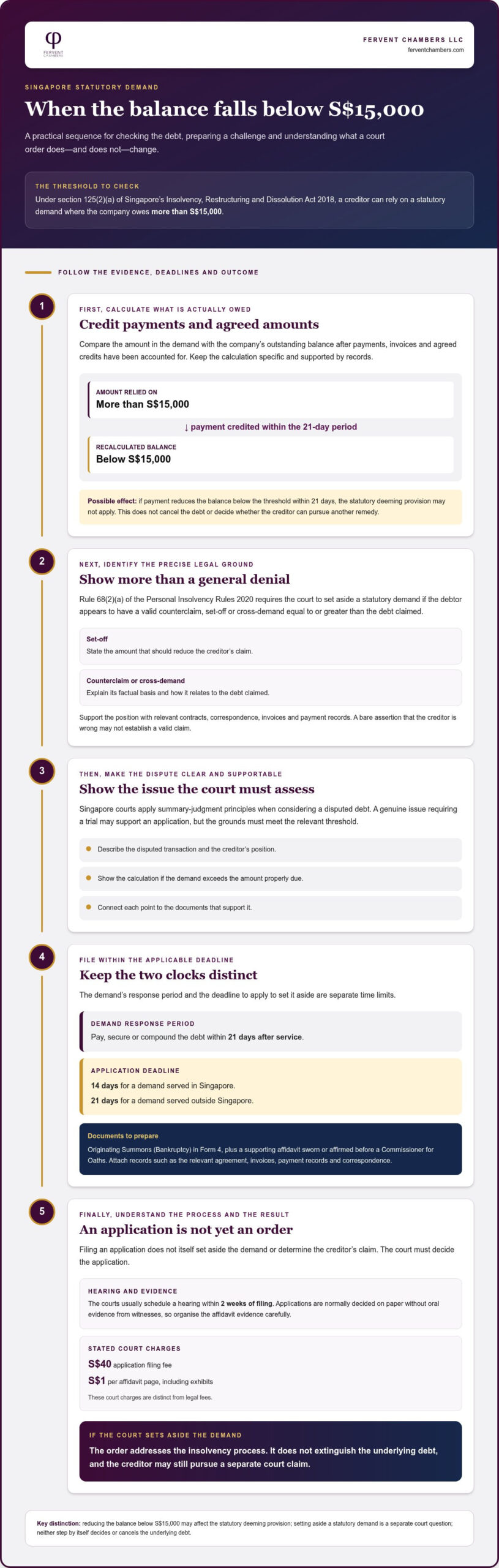
A debt below S$15,000 can change the effect of a statutory demand against a Singapore company. Under section 125(2)(a) of the Insolvency, Restructuring and Dissolution Act 2018, a creditor can rely on a demand where the company owes more than S$15,000; if partial payment reduces the balance below that threshold within the 21-day period, the statutory deeming provision may not apply. Setting aside a statutory demand is a separate question, and an order setting it aside does not extinguish the underlying debt.
It’s understandable to view a demand as an immediate threat, especially when you dispute the amount or it is close to the applicable threshold. This guide explains how Singapore rules apply, when a below-threshold balance may affect a demand, the steps and deadlines for applying to set it aside, and what happens to the debt afterwards. It also separates the demand’s insolvency consequences from the creditor’s ability to pursue the debt separately.
Key Takeaways
- Assess the outstanding balance, not only the original claim: for a Singapore company, reducing the debt below S$15,000 within the 21-day period may affect whether statutory insolvency is deemed.
- Prepare clear evidence of any genuine dispute, counterclaim, set-off or cross-demand, since the court considers whether the grounds for challenging the demand appear substantial.
- Act promptly after service: the application deadline is 14 days for a demand served in Singapore and 21 days for one served outside Singapore.
- A court order setting aside the demand addresses the insolvency process, not the debt itself; the creditor may still pursue a separate court claim.
What if the debt is below the statutory threshold?
- First, calculate the company’s outstanding balance after crediting payments. Under section 125(2)(a) of Singapore’s Insolvency, Restructuring and Dissolution Act 2018, a creditor can rely on a statutory demand when the company owes more than S$15,000. If payment reduces the balance below S$15,000 within the 21-day period, the statutory deeming provision may not apply. That does not itself cancel the debt or decide whether the creditor can pursue another remedy.
Use invoices, payment records and agreed credits to establish the correct figure. Compare the amount claimed in the demand with the balance remaining after each payment. If the sum demanded exceeds what is owed, identify the calculation and supporting evidence rather than relying on a general denial.
- Next, identify the precise basis for disputing the debt. Rule 68(2)(a) of Singapore’s Personal Insolvency Rules 2020 requires the court to set aside a statutory demand if the debtor appears to have a valid counterclaim, set-off or cross-demand equal to or greater than the debt claimed. State the amount and explain how it relates to the creditor’s demand.
For a set-off, show the amount said to reduce the creditor’s claim. For a counterclaim or cross-demand, explain its factual basis and provide supporting records. A bare assertion that the creditor is wrong may not establish a valid claim. Organise contracts, correspondence, invoices and payment records so the court can assess the competing amounts.
- Distinguish a genuine triable issue from a disagreement without evidential support. Singapore courts apply summary-judgment principles when deciding whether a disputed debt justifies setting aside a demand. A genuine issue requiring a trial may support an application, but the grounds must meet the relevant threshold.
Set out the disputed transaction, the creditor’s position and the evidence supporting your response. If the claim exceeds the amount properly due, show the calculation and the documents behind it. A clear record helps the court assess whether the dispute is substantial, whether the demand should be set aside, or whether another issue requires separate proceedings. This is central to setting aside a statutory demand.
Effect of a court order on the underlying debt
- Prepare the application documents and evidence before filing. The required documents include an Originating Summons (Bankruptcy) in Form 4 and a supporting affidavit sworn or affirmed before a Commissioner for Oaths. Attach records that substantiate the debtor’s grounds, such as the relevant agreement, invoices, payment records, and correspondence with the creditor. Organise the exhibits so the court can connect each document to a specific disputed amount or event.
- Do not treat a pending application as an order setting aside the demand. Filing an application does not determine the creditor’s claim or establish that the demand has been set aside. The court must still decide the application. If the court sets aside the demand, the order does not prevent the creditor from bringing a separate court claim for the debt. Preserve records relevant to both the insolvency application and any underlying claim.
- Identify the grounds that the court must assess. Under Rule 68(2) of Singapore’s Insolvency, Restructuring and Dissolution (Personal Insolvency) Rules, grounds include a substantial dispute about the debt and a qualifying counterclaim, set-off or cross-demand. The court applies summary-judgment principles when considering whether a disputed debt should support the application. Prepare to explain the evidence and legal basis, rather than relying on a bare denial. Bankruptcy consequences make precise legal advice especially important.
The courts usually schedule a hearing within 2 weeks of filing, and applications are normally decided on paper without oral evidence from witnesses. Prepare affidavit evidence carefully, since the written record may carry the central arguments.
- Separate court charges from legal fees when planning the application. The stated application filing fee is S$40, while filing an affidavit costs S$1 per page, including exhibits. These court charges are distinct from legal fees for advice and preparation. Keep the affidavit focused, because exhibit volume affects its page count and filing charge.
For a structured review of the evidence and procedural position, consider a case-specific assessment.
Meaning and consequences of a statutory demand
A Singapore statutory demand begins a formal insolvency process, but does not itself determine whether the debt is owed.
-
Understand the Demand and Its Consequences
Check what the creditor requires and the date of service. A debtor must pay, secure or compound the debt within 21 days after service. This gives the creditor a route to invoke insolvency consequences if the demand remains unanswered. The demand is not a court judgment, and its service alone does not establish that the claimed sum is legally owed. It also does not appear on a person’s credit report.
-
Consider the Consequences of Failing to Set It Aside
Act before the 21-day period expires, because inaction may support further proceedings. Under section 312 of Singapore’s Insolvency, Restructuring and Dissolution Act 2018, a court may rely on a presumption of insolvency in bankruptcy proceedings. For a company, section 125(1)(e) may provide prima facie grounds for a winding-up petition after the three-week statutory demand period expires without a proper response. These consequences are serious, but do not turn the demand into a final ruling on the debt.
- Identify which process applies before deciding what to do next. The demand may relate to an individual bankruptcy matter or a company winding-up dispute, and the legal consequences differ. Review the creditor’s claim, the service date and any response already made. If you dispute the debt, identify your grounds and supporting records rather than assuming silence will preserve your position. Failing to respond risks allowing the creditor to rely on the statutory process. Filing an application, however, does not decide the underlying liability.
Keep the demand and proof of service with payment records and correspondence. These documents help establish when the response period began and what the creditor claimed.
Singapore rules for setting aside a statutory demand
First identify who the demand addresses and when it was served. Singapore’s deadlines and insolvency procedures depend on these details.
-
Distinguish Rules for Companies and Individuals
Identify whether the debtor is an individual or a company before preparing a challenge. Personal bankruptcy applications use the Insolvency, Restructuring and Dissolution (Personal Insolvency) Rules, including Rule 68 (2) for grounds to set aside a demand. A company’s demand instead sits within the corporate winding-up framework, including section 125(2)(a) of the Insolvency, Restructuring and Dissolution Act 2018, which concerns debts exceeding S$15,000.
The underlying debt and potential insolvency consequences differ by debtor type. An individual’s application uses an Originating Summons (Bankruptcy), while a company may face a winding-up petition. The individual bankruptcy procedure is not interchangeable with a company’s winding-up process.
-
Assess Whether the Deadline Can Be Extended
Calculate the filing deadline from service, then prepare the application without delay. An individual must apply within 14 days after service in Singapore, or 21 days after service outside Singapore. The service date matters, not the day the demand is opened or read.
An extension was granted to Dinesh Pandey until 31 December 2021, to file his application concerning EFA’s statutory demand. That case-specific extension does not establish an automatic extension for every debtor. Do not assume extra time will be granted; act within the applicable period and address any extension request through the court process.
- Prepare the required documents and service steps. Rule 67(5) addresses application documents, including an Originating Summons (Bankruptcy) in Form 4 and supporting affidavit. The applicant must swear or affirm the affidavit before a Commissioner for Oaths, then serve the application documents on the creditor within 3 days after filing.
Part XX of the Supreme Court Practice Directions is also relevant. Match each ground to evidence, such as payment records or correspondence, so the court can assess the challenge on a coherent record. For procedural guidance on a demand, seek advice on your application.
Fervent Chambers: Dispute Resolution
Fervent Chambers LLC assists individuals and companies facing statutory demands through its Dispute Resolution and Restructuring and Insolvency practices. When a demand is contested, careful analysis of the claim, evidence, procedural requirements and insolvency implications can clarify the available legal steps. This includes distinguishing an application concerning the demand from a separate dispute over the underlying debt.
Consider Fervent Chambers LLC when you need to assess potential grounds for challenge, prepare for proceedings or understand how a debt dispute affects wider commercial interests. Contact Fervent Chambers LLC to discuss your circumstances.
Take the Next Step With a Clear Strategy
A statutory demand can put immediate pressure on decisions about a debt, but your response should reflect the wider dispute and the available evidence. Before taking the next procedural step, organise the documents, identify the outcome you need and consider how insolvency proceedings could affect it. A considered approach to setting aside a statutory demand can align the court application with the underlying dispute, rather than treating each issue in isolation.
Fervent Chambers LLC offers Dispute Resolution, Arbitration, and Restructuring and Insolvency for clients addressing contested claims and related insolvency issues. Its Dispute Resolution practice can help assess questions about liability, supporting evidence and the broader route to resolving the dispute.
For guidance on the next step in your circumstances, contact Fervent Chambers LLC. A structured assessment can help you move forward with greater clarity and purpose.
Frequently Asked Questions
What is a statutory demand and what does it mean for me?
A statutory demand is a formal written request for payment that may support insolvency proceedings if it remains unanswered. Identify whether it concerns personal bankruptcy or a company winding-up process, then preserve the demand and service details. An individual and a company may face different proceedings even when the same creditor alleges an unpaid debt.
What is rule 10.4 of the Insolvency Rules 2016?
Rule 10.4 of the Insolvency Rules 2016 concerns applying to court to challenge a statutory demand on valid grounds, but it is not the Singapore rule identified for this process. Singapore’s personal insolvency framework refers to Rule 68(2) of the Insolvency, Restructuring and Dissolution (Personal Insolvency) Rules. Avoid relying on a rule from another jurisdiction when preparing a Singapore application.
Will I have to attend a hearing?
You may receive a hearing date, although applications are normally decided on paper without oral evidence from witnesses. In Singapore, a hearing is usually scheduled within 2 weeks from filing. Prepare the affidavit and exhibits as though the court will determine the application from those documents, and review any hearing notice for directions about attendance or further submissions.
What is the deadline to apply to set aside a statutory demand in Singapore?
File within 14 days after service if the demand was served in Singapore, or within 21 days after service if served outside Singapore. Calculate the period from service, not from the day the demand was opened or read. Record the service date and method immediately, then use that date to organise filing and service.
What grounds can a debtor rely on to set aside a statutory demand in Singapore?
A debtor can seek setting aside a statutory demand where the debt is disputed on grounds that appear substantial to the court. Rule 68(2)(a) also requires the court to set aside a demand if a valid counterclaim, set-off or cross-demand appears equal to or greater than the debt claimed. Support each ground with relevant records, such as contracts, account statements, invoices or correspondence.
How do you apply to set aside a statutory demand in the Singapore court?
To apply for setting aside a statutory demand, prepare an Originating Summons (Bankruptcy) in Form 4 and an affidavit explaining the grounds with supporting evidence. Swear or affirm the affidavit before a Commissioner for Oaths, file within the applicable deadline, then serve the documents on the creditor within 3 days. Organise exhibits so each document is linked to the issue it supports.