


A construction dispute is not resolved simply by showing that a project has gone wrong. A construction contract claim in Singapore may be justified when a party fails to perform an obligation under the agreement and that breach causes loss; the contract terms and available evidence shape what can be claimed. For payment disputes, Singapore’s Building and Construction Industry Security of Payment Act 2004 provides access to statutory adjudication.
Delay, defective work, or unpaid progress claims can put a construction project under significant commercial pressure. The right response depends on the breach and its consequences. This article explains when a construction contract claim in Singapore may support legal action, what remedies may be available, and which records can help establish the claim. It also covers how Singapore contract interpretation considers the agreement’s wording and surrounding context, helping parties assess their position before deciding how to pursue or resolve a dispute.
Key Takeaways
- Assess whether the other party failed to meet a contractual obligation and whether that failure caused identifiable loss before deciding what remedy to pursue.
- For payment disputes, distinguish contractual payment rights from statutory adjudication and suspension procedures; following the required steps can be critical.
- Build the claim around the contract, notices, payment records and contemporaneous project documents, with clear evidence connecting the breach to the loss claimed.
- Interpret the agreement in context: its wording, project circumstances and relevant surrounding evidence may affect how each party’s obligations are understood.
Breach of Contract: When Can You Sue and What Can You Claim?
A party may sue when a contractual breach causes loss, subject to the agreement and applicable law. Singapore’s Building and Construction Industry Security of Payment Act 2004 (SOPA) also provides a statutory route for certain payment disputes.
Security of Payment Adjudication
Statutory adjudication under SOPA is a process for resolving qualifying construction payment disputes. It gives contractors and suppliers access to a determination without removing their other dispute resolution options. A payment claim must comply with the contract’s requirements, and adjudication applications and responses must meet statutory deadlines. Adjudication determines payment entitlement, not every issue that may arise between an employer and contractor.
Notice and Time Limits
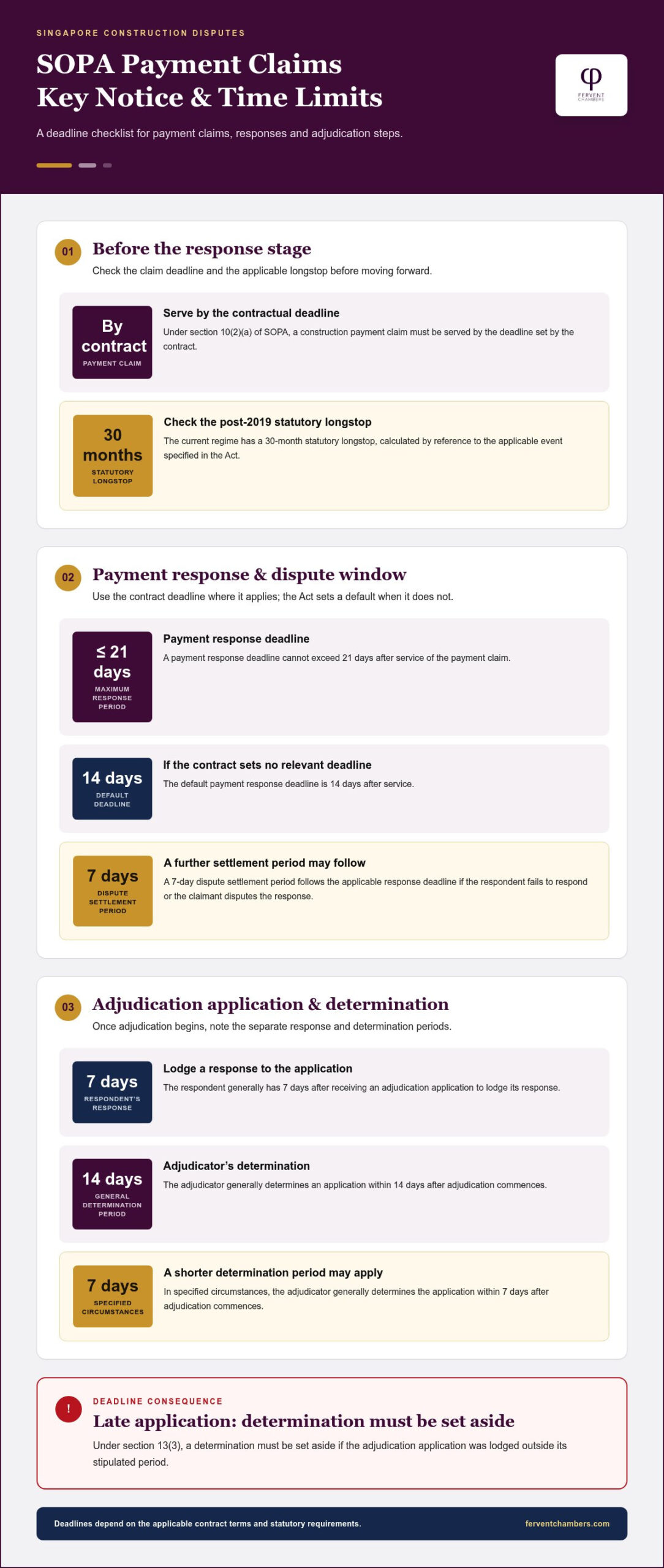
Notice and time limits are contractual and statutory deadlines governing payment claims and adjudication steps. Under section 10(2)(a) of SOPA, a construction payment claim must be served by the contractual deadline. The current post-2019 regime has a 30-month statutory longstop, calculated by reference to the applicable event specified in the Act. A payment response deadline cannot exceed 21 days after service; where the contract sets no relevant deadline, the default is 14 days. A 7-day dispute settlement period follows the applicable response deadline if the respondent fails to respond or the claimant disputes the response. The respondent generally has 7 days after receiving an adjudication application to lodge its response. An adjudicator generally determines an application within 14 days after adjudication commences, or 7 days in specified circumstances. Under section 13(3), a determination must be set aside if the application was lodged outside its stipulated period.
Claim Costs, Risks, and Consequences
The costs, risks, and consequences of a claim include its financial and procedural effects. Adjudication can address payment disputes, while arbitration and litigation can resolve broader contractual issues through different procedures. Arbitration follows the parties’ agreed framework; litigation proceeds through the courts. A claimant may seek damages for additional costs, delay, or lost profit. A serious breach may support termination and compensation, while specific performance may be considered if financial compensation is insufficient. Before choosing a route, weigh the evidence, contract terms, potential recovery, and consequences of an adverse outcome. A contractor who suspends work without contractual or statutory entitlement risks committing a repudiatory breach.
Contractual payment protections and late-payment remedies
Singapore’s payment protections combine contractual terms with statutory rights under SOPA. The distinction matters for progress claims and whether work may lawfully stop.
Contractual Payment Protections
Contractual payment protections are agreed terms governing payment timing, valuation, and consequences of default. On a Singapore project, review payment milestones, supporting documents, certification steps, and notice requirements before submitting an invoice. Section 9 of the Building and Construction Industry Security of Payment Act 2004 makes pay-when-paid structures unenforceable for contracts governed by SOPA. Section 36 voids terms that modify, restrict, or prejudice the Act’s operation, or deter a person from taking action under it. These safeguards preserve statutory rights alongside actual contractual obligations.
Statutory Progress-Payment Claims
A statutory progress-payment claim under SOPA can cover construction work or related goods and services. The Act provides contractors and suppliers with access to statutory adjudication to resolve payment disputes. For example, a contractor may claim for completed work while the employer disputes its valuation; the adjudicator determines the payment issue under the Act. If the contract does not specify how to value variations, SOPA may use contract rates, agreed adjustments, or prevailing industry rates. This fallback helps assess variation entitlements without changing unrelated contract terms.
Suspension for Non-Payment
Suspension rights are contractual or statutory entitlements to pause work after qualifying non-payment. Singapore common law provides no general right to suspend construction work solely because payment is late. A contractor relying on SOPA’s statutory suspension right must serve the required notice and wait seven days before suspending work or supplying goods or services. Suspension without contractual or statutory authority risks repudiatory breach, particularly if it prevents project obligations from being delivered. Before stopping work, match the unpaid claim, notice, and response history to the applicable mechanism. For a serious payment dispute under SOPA, consider construction dispute resolution before taking steps that may affect project delivery.
Evidence needed to prove a breach
To support a breach claim, establish a valid contract, the relevant terms, the breach, and the resulting loss. Organise the supporting documents by obligation, event, and consequence.
Delay and Disruption Records
Records of delay and disruption show how an event affected project timing and productivity. For a claim involving employer prevention, contractors in Singapore must demonstrate actual productivity loss, a clear causal link, and supporting contemporaneous records.
Compare the approved programme with updated schedules, site diaries, progress reports, and instructions. Records showing that a work area remained inaccessible, for example, can help link the employer’s act to a delay. Pair them with labour allocation, equipment logs, and subcontractor correspondence to show which activities were affected and when.
Distinguish project-wide delay from the specific disruption claimed. A timeline should record the event, affected work, response, and resulting cost or delay. If termination is alleged, retain notices and communications showing the contractual basis and sequence of events. These records help distinguish a substantial breach from an isolated shortfall.
Payment Claim Evidence
Evidence for a payment claim should connect the amount sought to completed work and the contract’s valuation terms. Gather the agreement, relevant payment provisions, claim documents, and records of the work or materials supplied.
For a progress claim, link each item to a measured quantity, agreed rate, milestone, or approved variation. Include delivery records, inspection reports, certifications, invoices, and correspondence about disputed work. If the employer challenges a variation, keep the instruction, submission, response, and records of the work performed.
Reconcile the claimed amount against prior payments and credits in a clear schedule. Identify each unpaid item, its contractual basis, and its supporting document. If the dispute concerns defective work, include inspection findings and rectification records. A consistent file helps establish entitlement and the amount outstanding without confusing separate payment periods or obligations.
Singapore construction contract interpretation
Contract interpretation determines the meaning and effect of the parties’ written agreement. Singapore construction claims are governed by the contract terms and applicable statutes, including the Building and Construction Industry Security of Payment Act 2004 for statutory payment rights. The Evidence Act, section 94(f), permits extrinsic evidence in contextual contract interpretation.
Start with the exact clause relevant to the alleged failure. Identify the work, payment, notice, or completion obligation, then read it alongside related clauses. For instance, a progress-payment clause may depend on a separate certification process. Reading the provisions together can clarify when payment is due and which documents must support the claim.
Context can inform meaning, but it does not replace the agreement. Under section 94(f) of the Evidence Act, extrinsic evidence may be admitted in contextual interpretation. Project correspondence, instructions, and records of performance may help explain disputed language. A variation instruction, for instance, may illuminate how parties applied a clause, while the signed terms remain central to the analysis.
Statutory frameworks can affect contractual rights and dispute resolution. SOPA provides statutory progress-payment rights and adjudication for covered construction and supply contracts. Its section 36 voids provisions that modify, restrict, or prejudice the Act’s operation, or deter a person from taking action under it. The contract may also specify arbitration. Domestic arbitration is governed by the Arbitration Act 2001; international arbitration is governed by the International Arbitration Act 1994.
For a practical interpretation, map each disputed clause to the relevant project event, notice, and claimed consequence. Separate the parties’ express obligations from contextual evidence, then assess how each affects liability, financial recovery, or resolution. This method helps distinguish a genuine breach from disagreement over progress, valuation, or procedure. Discuss your contract interpretation concerns before committing to a dispute strategy.
Fervent Chambers LLC: Dispute Resolution
Fervent Chambers LLC advises on construction disputes involving contract interpretation, payment obligations, or alleged breaches. Its Dispute Resolution and Arbitration services help parties assess the dispute, contractual framework, evidence, and available routes to resolution.
Consider legal advice if a claim could affect project delivery, expose a party to substantial losses, or trigger contractual termination rights. If financial distress or wider commercial obligations complicate the dispute, Restructuring and Insolvency or Corporate and Commercial advice may also be relevant. The right approach depends on the contract, facts, and objectives.
Contact Fervent Chambers LLC to discuss your construction dispute and the options for addressing it.
Take the Next Step with a Clear Strategy
A construction contract claim in Singapore should serve a defined commercial objective, rather than become a dispute pursued without regard to project consequences. Before taking the next step, identify the decision you need to make: preserve an ongoing relationship, reach a resolution, or prepare for formal proceedings. Align that objective with the project’s operational and financial priorities.
Fervent Chambers LLC provides Dispute Resolution and Arbitration services for parties considering how to address construction disputes, alongside Restructuring and Insolvency support when financial distress affects the commercial position. A focused review can clarify the issues, assess available routes, and shape a response that reflects your wider business interests.
Contact Fervent Chambers LLC for advice about your circumstances and possible next steps. With a considered strategy, you can approach the dispute with greater direction and confidence.
Frequently Asked Questions
Security of Payment Act Singapore: How Does SOPA Work?
Singapore’s Building and Construction Industry Security of Payment Act 2004 (SOPA) provides a statutory process for progress-payment disputes involving construction work and related goods or services. A claimant serves a payment claim, and the respondent may provide a payment response. If disagreement remains, the claimant may apply for adjudication under the Act. SOPA rights cannot be excluded by contract, so a contractual dispute clause does not by itself remove this statutory route.
What Can You Claim Under Construction Law?
Depending on the breach and its consequences, a party may claim damages for proven losses, including additional costs, delay-related loss, or lost profit. If financial compensation is inadequate, specific performance may be available to require contractual performance. A serious breach may also support termination and compensation for resulting loss. For example, a party facing incomplete work should link the remedy sought to the contractual obligation and the practical harm caused.
Where Does Mediation Fit Into a Construction Dispute?
Mediation is a dispute resolution process in which a neutral mediator helps the parties explore settlement. Unlike adjudication or arbitration, the mediator does not decide the dispute; the parties decide whether to agree on terms. Mediation may suit an employer and contractor seeking to preserve project cooperation or resolve issues beyond payment, such as revised work arrangements. Record any proposed settlement clearly and ensure it aligns with the contract.
What is a construction contract claim in Singapore?
A construction contract claim in Singapore seeks a legal or contractual remedy for an alleged failure to perform an agreement. The claimant must connect the obligation, the other party’s conduct, and the remedy sought. For example, a contractor alleging delayed access should identify the access obligation and explain how the restriction affected its work. The claim’s strength depends on the contract wording and supporting evidence.
What types of construction claims can contractors make in Singapore?
Contractors may claim for unpaid work, delayed payment, variations, project delay, disruption, non-compliant work, or abandonment. A variation claim, for example, may concern additional work directed during construction and how the contract values it. Delay or disruption claims require a link between the relevant event and the alleged impact. The claim category alone does not establish entitlement; the contract terms and facts determine whether the remedy is supported.
What documents and evidence are needed to support a construction claim?
Useful records include the signed contract and amendments, payment applications, instructions, correspondence, progress schedules, site records, invoices, and inspection documents. Organise them by disputed obligation and event, then connect each item to the remedy sought. For example, a variation file can pair the instruction with work records and the valuation. Keep dated records in sequence so the decision-maker can follow what happened and how the claim amount was calculated.