


A small headcount does not place a private organisation outside Singapore’s PDPA. Singapore’s Personal Data Protection Act 2012, identified by Singapore Statutes Online, governs how organisations collect, use and disclose personal data; organisations are responsible for compliance and must appoint a Data Protection Officer. A PDPA compliance lawyer in Singapore can help businesses assess how these requirements apply to their operations.
Businesses may know personal data needs protection, but obligations can become less clear when consent, employee records, internal policies and individual requests overlap. This article explains who the PDPA applies to and how consent, staff training, privacy policies, and access and correction requests shape compliance. It also sets out practical steps to make data-protection practices clearer and more consistent.
Key Takeaways
- Understand whether your organisation’s handling of personal data brings it within Singapore’s PDPA, including in employment contexts.
- Align consent and notification practices with the purposes for which personal data is collected and used.
- Make privacy policies operational through clear internal procedures and ongoing staff education.
- Prepare a process to verify requesters’ identities and respond to access or correction requests within 30 days, unless valid reasons justify an extension.
- Review how responsibility for data protection is assigned and how compliance is maintained across business operations.
What Is the Personal Data Protection Act (PDPA)?
Singapore’s data protection framework governs how organisations handle personal data, from collection through retention and disposal. Its requirements affect corporate policies, staff practices, cybersecurity controls and responses to data breaches.
Personal Data Protection Legislation
Singapore’s Personal Data Protection Act is the Personal Data Protection Act 2012, according to Singapore Statutes Online. The framework also includes regulations and guidelines issued by the Personal Data Protection Commission of Singapore. Businesses should consider these materials together when reviewing data-handling procedures, rather than treating the Act as a standalone policy checklist.
The PDPA generally applies to private organisations that handle personal data, regardless of size, including employee information and paper records. Public agencies are generally outside the PDPA’s application to their collection, use or disclosure of personal data. Start by mapping where information enters the business, who can access it and which internal documents govern each use.
When choosing a PDPA compliance lawyer in Singapore, look for counsel who can relate the law to your organisation’s actual data flows and review its policies, contracts and incident procedures. That practical review can identify gaps between written rules and day-to-day operations.
Data Accuracy, Security and Retention
Personal data protection requires more than a privacy notice. Organisations should take reasonable steps to keep personal data accurate and complete when it may affect a decision or be disclosed to another organisation. For example, a business using customer records to make service decisions should have a process for correcting outdated contact or account details.
Security controls should reflect the information held and the risks of unauthorised access, use or disclosure. Review access permissions, storage locations, staff handling procedures and vendor arrangements as part of cybersecurity compliance. Retention rules should specify when personal data is no longer needed for legal or business purposes and provide for its secure disposal or anonymisation.
Internal documents turn these duties into workable procedures. A data inventory, retention schedule, access-control procedure and incident response plan can assign responsibility and guide staff. Review them when systems, services or data uses change, so controls continue to reflect actual processing.
Penalties for PDPA Breaches
The Personal Data Protection Commission of Singapore can impose financial penalties for non-compliance, and serious breaches may attract penalties of up to SGD 1,000,000. The consequences depend on the breach and its circumstances, so organisations should assess their controls before an incident occurs, not only after receiving a complaint or investigation notice.
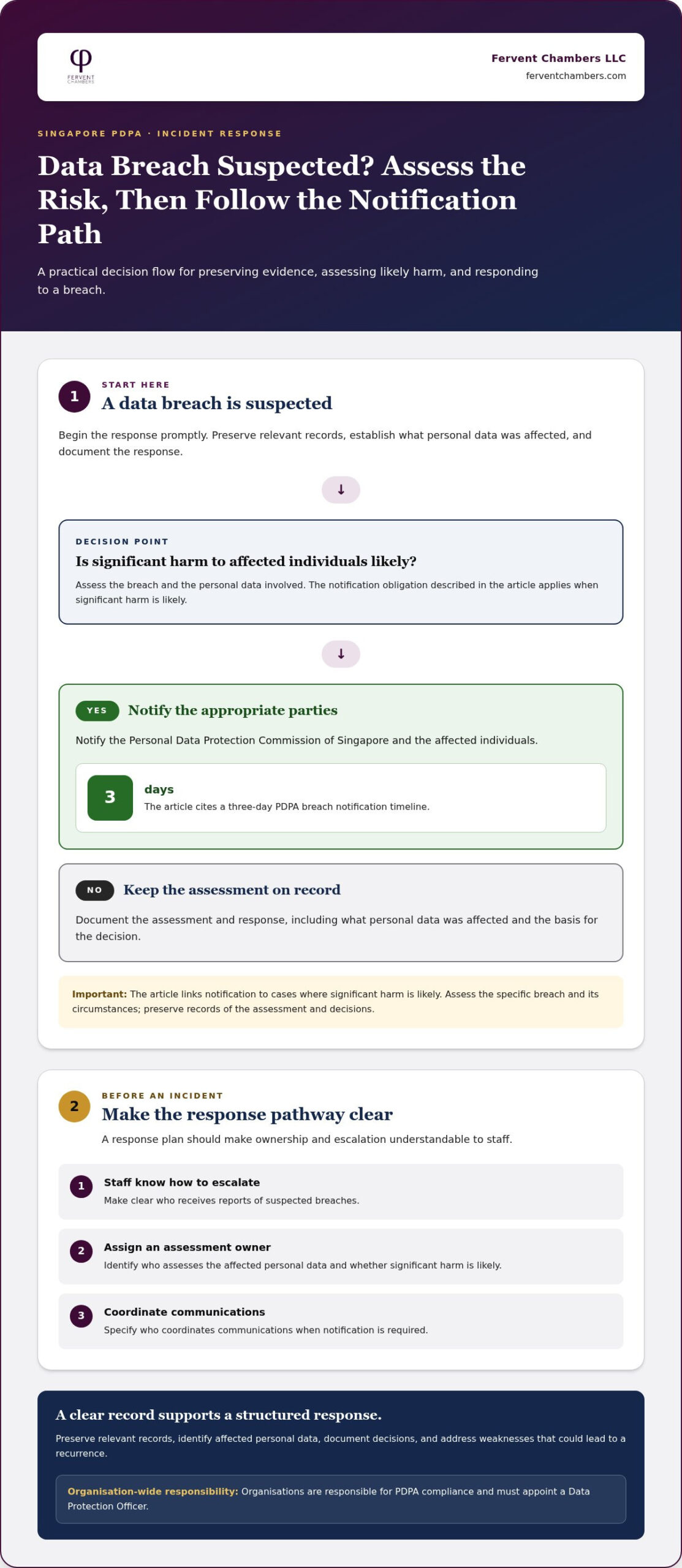
When a data breach occurs, preserve relevant records, establish what personal data was affected and document the response. Organisations must assess breaches and notify the Commission and affected individuals when significant harm is likely. A clear incident procedure helps decision-makers gather facts, manage notification obligations and address weaknesses that could lead to a recurrence. For practical guidance on how to handle a data breach in Singapore and who to notify, review the steps for containment, assessment and notification.
Legal review can help assess exposure, interpret obligations and refine internal documents after a suspected breach. It should connect the law with the organisation’s data, security measures and incident record, giving leadership a structured basis for decisions.
Consent, notification and purpose limitation
Consent, notification and purpose limitation govern why an organisation collects personal data and how it may use it. Effective governance connects those requirements to the systems and staff handling individuals’ information.
Consent and Purpose Limitation
Before collecting personal data, identify the intended purpose and notify individuals clearly. Under Singapore’s data protection act, consent is a key basis for collection, use and disclosure. A notice should describe the actual activity, such as processing an applicant’s details for recruitment, rather than use broad wording that obscures the purpose.
Keep a record of the notice presented and the consent obtained, then compare later uses with the stated purpose. If a business plans to use customer details for a new campaign, assess whether that purpose was communicated and whether consent supports the proposed use. This makes purpose limitation part of everyday operations.
Legal review has limits if it examines documents without tracing the underlying data flow. A well-written notice cannot fix a system that collects unnecessary fields, gives unauthorised teams access or reuses information for an undisclosed purpose. Review should connect contracts and notices with forms, databases, access permissions and staff procedures.
For example, compare a website sign-up form with its privacy notice, then check whether the marketing team uses only information collected for the stated purpose. Assign an owner to record changes when a product, vendor or processing activity changes. This helps keep legal documents aligned with actual practice rather than leaving them as static templates.
Notification Requirements
Organisations must assess data breaches and notify the Personal Data Protection Commission of Singapore and affected individuals when significant harm is likely. According to the Personal Data Protection Commission of Singapore, Singapore’s PDPA breach notification timeline is three days. Preserve incident records and document the assessment and notification decisions.
Notification obligations make preparation essential. A response plan should identify who receives incident reports, who assesses affected personal data and who coordinates communications. Staff should know how to escalate a suspected breach, such as sending customer information to an unintended recipient, rather than attempting an undocumented fix.
Use a defined incident workflow: contain the exposure, establish what information was involved, assess likely harm, and record the resulting decision. Assigning these steps before an incident clarifies how personnel respond under pressure. Organisations reviewing consent language, breach procedures or privacy governance can consider data protection and privacy legal support as part of that work.
Internal privacy policies and staff training
Written policies translate Singapore’s PDPA obligations into procedures employees and partners can follow. Their value depends on whether actual practices match the rules.
Policies and website terms
Start with a data-handling policy that assigns responsibility for collection, access, use, retention and disposal. For each activity, identify the personal data involved, its business purpose, authorised users and applicable safeguards. A recruitment process, for example, may involve applicant records handled by human resources and an external recruitment platform.
Website privacy notices and terms of use serve different purposes. A privacy notice explains how personal data is handled; terms of use govern access to the website and its services. Compare each with website forms, analytics tools and marketing practices. If a form collects information for service enquiries, its notice should explain that purpose clearly.
Keep internal procedures aligned with external statements. When a new partner handles customer information, review the relevant contract, access arrangements and privacy notice. Document who approved the change and who maintains the records. This creates a clear governance trail if questions arise about a disclosure or breach.
Training, responsibilities and audits
Staff training should address the decisions employees make in their roles, not merely repeat policy language. The Personal Data Protection Commission of Singapore strongly recommends that Data Protection Officers receive training, certification and practical knowledge of the PDPA. Ongoing employee education can also help prevent common compliance mistakes.
Use practical scenarios to test understanding. Customer-service staff should know how to handle a personal data request, while marketing staff should understand approved contact lists and permitted purposes. Anyone who spots a misdirected email should know the internal escalation route, preserve relevant details and avoid informal deletion that could obscure the incident.
The DPO can coordinate policy ownership, staff guidance and review cycles, while business leads remain responsible for applying procedures in their teams. Make the DPO’s business contact information publicly available, for example on the organisation’s website. The PDPA does not prescribe specific statutory qualifications for this role, so assess practical knowledge and the authority to oversee implementation.
Audits should compare written controls with real systems and work practices. Review user access, retention settings, partner contracts, staff guidance and website notices. Record findings, assign corrective actions and revisit them after material operational changes. A corporate lawyer can review contracts, advise on internal policies and guide employee training, connecting legal advice with both documentation and implementation.
Access and correction requests
Access and correction requests require a defined process, not an improvised response. Under Singapore’s PDPA, organisations must respond within 30 days unless valid reasons justify an extension. A consistent workflow helps staff identify the request, protect personal data and communicate the outcome effectively.
Start by recording when the request arrives, what it covers and which team holds the relevant records. A request may concern details in a customer account, recruitment file or employee record. Assign an owner to coordinate searches across the systems and departments likely to hold that information.
Before disclosing information, verify the requester’s identity and provide only that person’s personal data. This safeguard matters when records contain information about several people. For example, a shared correspondence file may include details about a colleague or another customer that should not be disclosed in the response.
- Log the request and its receipt date, then assign responsibility for coordinating the response.
- Confirm the requester’s identity and identify the relevant systems, teams and records.
- Review the material for other individuals’ information before communicating the response.
For a correction request, identify the precise information challenged and compare it with reliable records used by the organisation. An employee asking to correct an outdated contact detail, for example, should be directed to a process that updates the relevant record and informs teams relying on it. Keep a record of the request and action taken.
Clear communication is central to effective handling. A response should address the request’s scope, explain the action taken and identify anything that cannot be completed, with the reason. If an extension is justified, record why and explain the handling approach rather than leaving the request unanswered.
Requests may reveal gaps in record management. If a search cannot locate information because departments use inconsistent names or storage practices, document the systems searched and improve the internal index. Recurring correction requests may also indicate that a form or customer-service workflow captures inaccurate information at its source.
Review request records periodically to identify repeated delays, unclear ownership or recurring data-quality issues. The responsible officer can use these findings to refine staff instructions and escalation routes. Treating each request as both an individual obligation and an operational test can strengthen records, protect other people’s information and support a coherent response process.
PDPA compliance for Singapore businesses
Compliance depends on how a business collects, uses, stores and shares personal data. A structured review can connect legal obligations with operational practice and support confident decision-making.
Choosing a PDPA Lawyer
Before engaging a lawyer, define the work required: reviewing privacy notices, assessing vendor contracts, advising on a breach or examining cross-border data flows. Ask how the review will address your actual systems, business processes and internal responsibilities, rather than documents in isolation. Confirm that the advice will distinguish legal requirements from operational recommendations.
Singapore’s PDPA and the GDPR are separate regimes, and the GDPR generally imposes more stringent requirements. According to the European Union, a Singapore business may also need to comply with the GDPR if it offers goods or services to individuals in the European Union, regardless of where it is based. Seek an assessment of both regimes when those activities arise.
Useful preparation includes a map of personal data collection, current notices, partner agreements, internal policies and known process gaps. Consider whether the organisation has assigned DPO responsibility and made the DPO’s business contact information publicly available. These materials help focus legal advice and identify operational changes that need attention.
When to Hire a Compliance Lawyer
Seek legal advice when launching a service that changes personal data collection, entering a new data-sharing arrangement or responding to a suspected breach. Early review can clarify the purpose for collecting information, the notice required and the responsibilities to record in partner contracts before implementation.
A lawyer can also assist when internal teams disagree about permitted data use, customer requests reveal inconsistent records or leadership needs to assess a proposed cross-border activity. For example, a business expanding its online services to individuals in the European Union should examine whether GDPR obligations apply alongside Singapore’s PDPA.
For ongoing governance, consider legal review when a system, vendor or business process changes materially. The review can test whether privacy notices, staff procedures and contracts still reflect actual processing. It can also help leadership prioritise corrective actions, assign owners and document decisions, without treating a policy update as a complete compliance programme.
Prepare a concise scope before seeking assistance: identify the business activity, data involved, affected individuals, partners and decisions required. This enables a focused assessment of regulatory exposure and practical next steps. Discuss PDPA compliance concerns when your organisation needs legal analysis of its data-handling practices.
Fervent Chambers LLC: Dispute Resolution
Fervent Chambers LLC can assist when a data-protection issue develops into a commercial dispute requiring structured resolution. Where parties disagree about contractual responsibilities, disclosures or the consequences of an incident, its Dispute Resolution practice can address the dispute through appropriate legal processes.
For parties whose agreements provide for arbitration, Fervent Chambers LLC also offers Arbitration. Its Corporate and Commercial work is relevant when a dispute intersects with contractual arrangements or business operations. The appropriate route depends on the dispute, the governing agreements and the parties’ objectives.
If a PDPA-related disagreement has become a broader commercial conflict, discuss the dispute and relevant agreements with Fervent Chambers LLC. Contact the firm or visit ferventchambers.com.
Put your compliance decisions on a clear footing
Strong data governance depends on more than written policies. Decisions must remain coherent as business relationships, systems and commercial priorities change. A focused legal assessment can help leadership identify decisions that need clarification, responsibilities to record and the potential effect of emerging issues on wider operations.
A PDPA compliance lawyer in Singapore can help when privacy concerns intersect with contractual duties or risk developing into commercial conflict. Fervent Chambers LLC offers Dispute Resolution and Arbitration for disputes, as well as Restructuring and Insolvency where corporate distress forms part of the circumstances. The legal response should reflect the underlying issue and the organisation’s commercial position.
Taking a deliberate next step can help your organisation address concerns with greater clarity and prepare for informed decision-making. Contact Fervent Chambers LLC about PDPA compliance to discuss your organisation’s legal needs.
Frequently Asked Questions
What Is PDPA and Who Does It Apply To?
Singapore’s Personal Data Protection Act 2012 governs how private organisations handle personal data, regardless of their size. It can apply to organisations without a physical presence in Singapore when they handle personal data in scope. Employee and job applicant records are included. Public agencies are generally excluded from the Act’s application to their collection, use or disclosure of personal data.
How Can Companies Avoid Common PDPA Mistakes?
Businesses can reduce avoidable errors by assigning a clear owner to each data-handling process and checking actual practice against written procedures. Before giving a new department access to a customer database, for example, record its business need and limit access accordingly. Review partner permissions when a project ends, and ensure staff know how to escalate unusual disclosures instead of making undocumented fixes.
How Does the Company Act in Singapore Affect PDPA Compliance?
Company-law responsibilities and data-protection governance can intersect through corporate recordkeeping and reporting. Directors and officers should ensure relevant records are maintained and information reported accurately. If a data incident affects business records or corporate disclosures, leadership should coordinate the response, preserve decision records and assess what must be reported. Clear responsibility helps management oversee these issues rather than leaving them solely to technical teams.
What Are the Core PDPA Obligations?
Core obligations include governing the collection, use and disclosure of personal data; protecting it; retaining it only as necessary; and addressing access or correction requests. Organisations must also appoint a Data Protection Officer and make the officer’s business contact information publicly available. Connect each obligation to an accountable role, such as assigning a business lead to approve access to sensitive customer records.
What Steps Should Businesses Take to Maintain Compliance?
Maintain compliance by reviewing how data moves through the business, assigning owners and revisiting controls when operations change. Map the information collected by each service, document its purpose and identify the systems and partners involved. Then test whether staff instructions and access permissions reflect that map. Before introducing a new platform, assess its data flows and update relevant internal procedures.
Why PDPA Compliance Is Important for Businesses?
Compliance supports accountable handling of information entrusted to an organisation by customers, employees and business partners. It also gives leadership a defined basis for decisions about data access, retention and incident response. With documented responsibilities, an organisation can identify who should assess a suspected disclosure and preserve relevant records. This structure supports informed governance and confidence in business relationships.
What Does Singapore’s PDPA Require Businesses to Do?
Businesses must handle personal data in accordance with the Act’s applicable obligations, appoint a Data Protection Officer and make the officer’s business contact information publicly available. They should establish procedures for protecting data, managing retention and responding to individual requests. The DPO function may be assigned to an existing role or treated as a dedicated responsibility, depending on how the organisation can effectively oversee its data practices.
What PDPA Compliance Services Do Singapore Law Firms Offer?
Legal support may include interpreting PDPA obligations, reviewing privacy arrangements, advising on data-protection governance and assisting with disputes arising from data matters. Fervent Chambers LLC’s Data Protection and Privacy practice covers Singapore’s PDPA and the EU GDPR. Its advice can help a company analyse its privacy practices or address a commercial disagreement connected with personal data handling.