
A dispute in Singapore can quickly become a regional business issue when contracts, counterparties and operations span multiple markets. MNC legal advisory in Singapore helps multinational businesses assess disputes, commercial arrangements and cross-border legal risks from a Singapore perspective, while keeping regional implications in view. The practical starting point is to understand the immediate issue, identify the jurisdictions and business interests involved, and plan a considered response.
For multinational companies, local legal clarity matters, but regional operations can add connected commercial and dispute-resolution considerations. This article explains what Singapore-based MNC legal advisory can cover, how domestic and international disputes are approached, and which factors shape the choice of counsel. It also considers how Singapore advice can support businesses operating across Southeast Asia without treating the region as a single legal system.
Key Takeaways
- Map the dispute’s contracts, parties, assets and governing law early to identify the jurisdictions and resolution routes that may shape your response.
- Use Singapore’s legal support resources to strengthen internal processes, while distinguishing professional ethics guidance from advice on a company’s specific dispute.
- For Southeast Asian operations, assess each market’s legal framework separately and coordinate regional decisions with the Singapore-based commercial strategy.
- When selecting counsel for corporate matters, compare the team’s relevant experience, dispute capabilities and ability to align legal advice with business priorities.
- Understand how local and international firms differ in structure and regional reach, then choose counsel suited to the matter’s jurisdictions and complexity.
Domestic and international dispute resolution
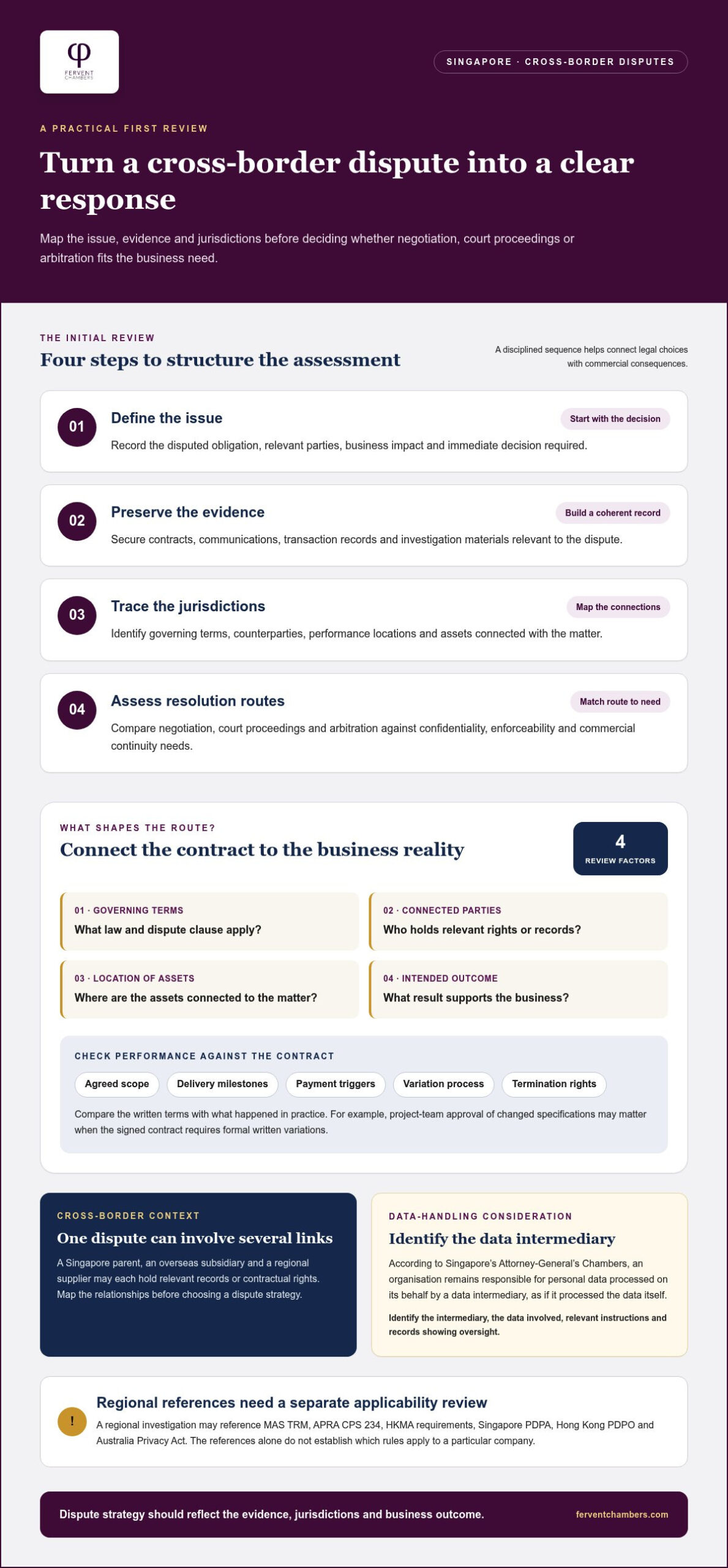
Multinational companies in Singapore face risks when contract language, performance evidence and commercial expectations diverge. Regulatory investigations can also reveal gaps between internal controls and the conduct under review. A sound assessment begins with the relevant contracts, parties, governing terms and business records. These details shape the available response and the commercial consequences of delay.
Cross-border disputes raise questions about where claims should proceed and how decisions may affect regional operations. A Singapore parent company, an overseas subsidiary and a regional supplier may each hold relevant records or contractual rights. Map those relationships before choosing a dispute strategy. The governing law, dispute clause, location of assets and intended business outcome help determine whether negotiation, court proceedings or arbitration merits consideration.
Contract review should focus on operational terms, not only liability language. Compare the agreed scope, delivery milestones, payment triggers, variation process and termination rights against how the parties performed. For example, a project team’s approval of changed specifications may matter when the signed contract requires formal written variations. Preserve the contract, amendments, invoices, project correspondence and decision records in a coherent chronology.
Singapore’s cross-border data risks can also intersect with commercial disputes and investigations. According to Attorney-General’s Chambers, Singapore, an organisation remains responsible for personal data processed on its behalf by a data intermediary, as if it processed the data itself. Therefore, identify the intermediary, the data involved, relevant instructions and the records showing oversight. This step can clarify where a data-handling concern overlaps with contractual responsibilities.
For a disciplined initial review, assign responsibility for these steps:
- Define the issue: Record the disputed obligation, relevant parties, business impact and immediate decision required.
- Preserve evidence: Secure contracts, communications, transaction records and investigation materials relevant to the dispute.
- Trace jurisdictions: Identify governing terms, counterparties, performance locations and assets connected with the matter.
- Assess resolution routes: Compare negotiation, court proceedings and arbitration against confidentiality, enforceability and commercial continuity needs.
Regulatory references may require a separate, coordinated review. The AIG Singapore legal role refers to MAS TRM, APRA CPS 234 and HKMA requirements as references relevant to cyber-resilience frameworks. It also calls for advice on the Singapore PDPA, Hong Kong PDPO and Australia Privacy Act. These references illustrate how a regional investigation may engage several frameworks; they do not, by themselves, establish which rules apply to a particular company.
For MNC legal advisory in Singapore, the practical value lies in connecting dispute strategy with governance and operational realities. Before responding to a claim or inquiry, establish who can authorise decisions, which records support the company’s position, and how a proposed resolution affects contracts and regional relationships. A clear sequence helps leadership assess the dispute as a business matter, not merely a procedural event.
Legal help and support services
An MNC can select Singapore counsel by matching the adviser’s experience to its legal issue, sector and regional structure. To begin the engagement, define the work, identify decision-makers and organise the key documents and business context.
Selecting a Legal Adviser
Start with the substance of the matter: a transaction, regulatory concern or commercial disagreement may call for different experience. Compare lawyers on relevant practice work, familiarity with the company’s sector, communication with internal teams and ability to coordinate advice across jurisdictions. For example, a regional technology business may prioritise counsel who can assess commercial terms alongside privacy and operational concerns. Set clear selection criteria before comparing proposed approaches.
Engaging a Legal Adviser
Prepare a concise instruction identifying the decision required, relevant entities, key dates, counterparties and existing advice. Provide the governing documents, transaction records and internal approvals in an organised file, and flag urgent deadlines or business constraints. Then agree on the scope, reporting channel, responsible internal contact and update format. Clear instructions help counsel distinguish immediate priorities from questions that can be addressed later.
The Law Society of Singapore provides practice resources on anti-money-laundering obligations, risk management, practice directions and guidance notes. These materials offer context on the professional environment in which Singapore lawyers operate. For an internal review, assign a legal or compliance contact to identify the relevant resource, record the issue it addresses and direct company-specific questions to the appropriate adviser. This keeps general guidance separate from advice on a particular transaction or dispute.
For ethical questions concerning legal practice, the Law Society of Singapore provides an Ethics Assist Helpline for confidential ethical guidance. This is distinct from an MNC’s external legal advice on contract terms, transactions or regulatory exposure. A practical first step is to classify the issue: determine whether it concerns professional ethics, a business decision or a specific legal risk. That classification helps direct the question to the right channel.
A structured engagement can then proceed through a small number of defined steps:
- Set the objective: State the decision or deliverable the business needs.
- Identify the stakeholders: Name the relevant Singapore and regional entities, executives and internal teams.
- Organise the record: Provide contracts, correspondence, transaction documents and prior analysis in a usable sequence.
- Establish governance: Confirm who may give instructions, approve decisions and receive reports.
Where a matter involves commercial exposure or a contested position, a focused discussion with Singapore legal counsel can help frame the issues and the next steps.
Singapore and Southeast Asia legal advisory
Regional counsel should connect Singapore decisions with each market’s distinct rules, contracts and operating structure. For an MNC, compare advisers’ capabilities, then map the legal questions arising from local operations.
Firm Comparisons and Options
Singapore law firms can provide local legal analysis and dispute support, while international firms may coordinate advice across multiple jurisdictions. The right structure depends on where the entities operate, which laws govern the matter and whether regional coordination is central. Compare lawyers by relevant sector experience, corporate transaction capability, reporting approach and familiarity with the markets involved.
No single firm suits every multinational. For example, a Singapore transaction involving regional subsidiaries may require local contract analysis and coordinated input from counsel in other countries. Ask prospective advisers to explain how they would divide responsibilities, manage instructions and present jurisdiction-specific advice. Legal fees depend on the matter’s scope and complexity, the work required and staffing. Request a quote based on the proposed scope.
Local Laws and Regulations
MNCs operating in Singapore should identify the rules relevant to their activities, entity structure, workforce, customer information and sector. The Singapore PDPA is a key consideration where a business handles personal data. A practical review maps each activity to the responsible entity, applicable contracts and internal approval process, rather than applying one regional policy without local analysis.
For employment and workplace compliance, review employment terms, hiring processes, work authorisation, workplace policies and safety procedures against Singapore requirements. Assign an internal owner to maintain records, address employee concerns and escalate changes affecting staff or operations. For instance, a new regional hire may require a coordinated review of the employment arrangement and permission to work in Singapore.
For data protection and cybersecurity, document what personal data the Singapore operation collects, who can access it and which service providers process it. Include the Singapore PDPA in the local privacy review. When information moves across borders, map the sender, recipient, purpose, safeguards and contractual controls, then assess how the data is managed in each relevant jurisdiction.
Setting up a foreign company or subsidiary involves choosing an appropriate structure, preparing incorporation information, establishing governance and arranging operational requirements. The steps depend on the intended activities, ownership and management arrangements. Setup costs vary with the structure, professional work and ongoing compliance needs. Define the scope before seeking a quote, and distinguish formation expenses from continuing legal and administrative costs.
Which Singapore law firms advise multinational corporations on corporate and commercial matters?
Singapore-based law practices and international firms with Singapore operations advise multinational corporations on corporate and commercial matters. No single firm is suitable for every transaction; the right choice depends on the work, jurisdictions, sector and internal decision structure. For example, a regional acquisition may require Singapore contract advice and coordinated input on overseas subsidiaries. Start by defining the transaction and the jurisdictions involved.
Compare firms based on the substance of their work, not broad labels alone. Review experience relevant to the proposed transaction, such as a joint venture, supply agreement, restructuring or regional expansion. Ask how the proposed legal team would handle drafting, negotiation, due diligence and closing coordination. A clear division of responsibility helps executives understand who advises on each issue and how decisions will be escalated.
For a Singapore law practice, assess its ability to explain local legal issues in commercially useful terms. For an international firm, examine how Singapore advice connects with its regional coordination model. An MNC with subsidiaries across Southeast Asia, for instance, may need distinct advice for each entity rather than a single regional template. Compare the proposed team’s reporting method, local knowledge and ability to align advice with the company’s governance.
- Define the work: Identify the transaction, commercial objective, entities involved and jurisdictions requiring advice.
- Assess relevant experience: Look for comparable work involving the same transaction type or commercial sector.
- Clarify team roles: Establish who leads drafting, negotiations, due diligence and regional coordination.
- Review communication: Agree on reporting, decision escalation and document management before work begins.
The Law Society of Singapore publishes practice directions and guidance notes for legal practitioners. These resources provide professional context, but do not replace an assessment of a firm’s transaction experience. When comparing proposals, ask each team to identify the principal commercial risks, explain its proposed work sequence and distinguish essential issues from negotiable terms. This shows how clearly the advisers connect legal analysis with the business decision.
For corporate and commercial advice, the engagement should also specify the expected deliverables. A share purchase may involve transaction documents, due diligence findings and negotiation support; a commercial agreement may instead focus on drafting, risk allocation and implementation. Confirm the entities covered, assumptions, reporting contacts and approval process. These steps let an MNC compare Singapore firms and international firms on relevant work, not reputation alone.
Team capacity can also matter when advice spans business units. These listings describe individual roles, not the quality or fees of any particular firm, so treat them only as limited context when discussing resourcing and team structure.
The Law Society of Singapore’s webinar on corporate structures and transactions in the evolving tax landscape is scheduled for Wednesday, 14 October 2026. It may offer context for questions about how corporate structure and tax considerations intersect, while the selected legal team should address the specific transaction, entities and jurisdictions in its engagement.
What are the leading international law firms with offices in Singapore?
No single international law firm leads every Singapore mandate. For a multinational, the right choice depends on the transaction, dispute, industry and jurisdictions requiring coordinated advice. A firm’s Singapore presence matters most when local legal work must connect with counsel elsewhere. Compare the proposed team and its role, rather than relying on a general ranking.
International firms may suit mandates requiring coordination across several countries, while Singapore firms can provide locally focused advice and context. An MNC expanding from Singapore into Southeast Asia, for example, should identify which legal questions arise locally and which need separate country-level input. The engagement should explain how those workstreams will be managed and who is accountable for each deliverable.
Assess each firm against the work at hand. For a regional acquisition, examine its proposed approach to transaction documents, due diligence, negotiation and coordination among the entities involved. For a Singapore commercial agreement, focus on drafting, allocation of contractual risk and implementation. Ask the proposed lawyers to identify the work they will perform directly and the issues requiring additional jurisdiction-specific advice.
The Law Society of Singapore publishes practice directions and guidance notes for legal practitioners. These materials provide professional context, but do not rank firms or determine which team best fits an MNC’s mandate. A sound comparison should instead examine relevant experience, proposed staffing, communication arrangements, conflicts procedures and the ability to explain legal issues in commercially useful terms.
Before appointing an international firm with a Singapore office, establish the engagement’s structure:
- Define the mandate: Identify the business objective, entities, jurisdictions and required legal work.
- Allocate responsibility: Confirm who leads Singapore advice and how other jurisdictions are coordinated.
- Set reporting lines: Name the internal decision-maker, escalation route and expected reporting format.
- Clarify deliverables: Specify the documents, analysis and negotiation support required.
For example, a multinational negotiating a regional supply contract should confirm whether the Singapore team will review only the local agreement or coordinate related regional documents. This distinction affects the scope of work and the company’s internal approvals. Written responsibilities also help executives compare proposals on substance, rather than office count or branding.
Use a focused mandate to assess the team’s fit for Singapore and regional legal work. For help framing a commercial or dispute-related matter, discuss your Singapore legal requirements with Fervent Chambers LLC.
These strategies should also be checked against the cross-border risk profile. The page names the U.S. Foreign Corrupt Practices Act and UK Anti-Bribery Act as laws that apply to US/UK and non-US/UK companies doing business internationally. For a mandate touching these issues, ask the proposed team to identify which advice falls within its scope and what further jurisdiction-specific input is needed. A photovoltaic project portfolio spanning Germany and with a total capacity of approximately 80 MWp was financed for acquisition; this illustrates why a firm’s relevant transaction experience and coordination plan should be tested against the actual assets and jurisdictions involved.
The Law Society of Singapore offers international-relations resources through its Law Society Hub. The Singapore office’s telephone number is +65 6311 0030, and its fax number is +65 6311 0058. Confirming contact routes and escalation arrangements at appointment can help make responsibilities clear.
Fervent Chambers LLC: Dispute Resolution
Fervent Chambers LLC assists multinational businesses with commercial disputes affecting contractual relationships, operations or restructuring decisions. Its work includes dispute resolution and international arbitration, as well as corporate and commercial advice when a disagreement intersects with a transaction or business arrangement. For companies facing financial distress, restructuring and insolvency advice can help assess the situation alongside existing commercial obligations.
Consider seeking legal advice when a claim, arbitration, threatened proceedings or insolvency concern could affect business decisions. Organising the relevant contracts, correspondence and key events can help frame the issues and clarify which decisions need attention.
To discuss a matter with Fervent Chambers LLC, visit ferventchambers.com.
Set a Clear Course for Your Next Decision
Regional growth depends not only on identifying legal exposure, but also on deciding who owns each decision when commercial pressure rises. For MNC legal advisory in Singapore, establish an internal escalation path connecting business leaders, legal teams and relevant regional stakeholders. A clear mandate helps counsel focus on the decision ahead and keep legal analysis connected to operational priorities.
Fervent Chambers LLC can assist when a commercial disagreement requires dispute resolution or arbitration, or when financial pressure calls for restructuring and insolvency advice. To take the next step, define the issue, identify the business outcome sought and organise the key documents for an initial discussion. This preparation gives the conversation a focused starting point without predetermining the strategy.
Contact Fervent Chambers LLC to discuss your needs and consider a measured path forward for your business.
Frequently Asked Questions
What legal advisory services do multinational corporations need in Singapore?
Multinational corporations commonly need support with commercial agreements, disputes, arbitration, data protection, and restructuring or insolvency concerns. The right mix depends on the company’s activities and immediate decisions. For example, a business entering a joint venture may need its commercial terms reviewed, while a company facing a contested supplier claim may need dispute advice. A Singapore adviser can assess the issue within the company’s wider operational context.
What are Singapore’s data protection, cybersecurity, and cross-border data transfer rules?
An organisation remains responsible for personal data processed on its behalf by a data intermediary, as if it processed the data itself. The Singapore PDPA is relevant to the local review. For cross-border data flows, identify the parties, purpose, safeguards and contractual controls involved.